
Military Transport Planes
Douglas C-124 Globemaster II
ICAO: C124
The USAF's only production turboprop strategic airlifter, built to carry ICBMs
Updated: by Tim de Vries
The latest aviation news and stories sent to your inbox.
The Douglas C-133 Cargomaster was a large four-engine turboprop cargo aircraft built between 1956 and 1961 for the United States Air Force. It was the only production turboprop strategic airlifter the USAF ever flew, and it carried Atlas, Titan and Minuteman missiles around the world until the C-5 Galaxy replaced it in 1971.
Live Fleet Activity (C133)
Fetching live data…




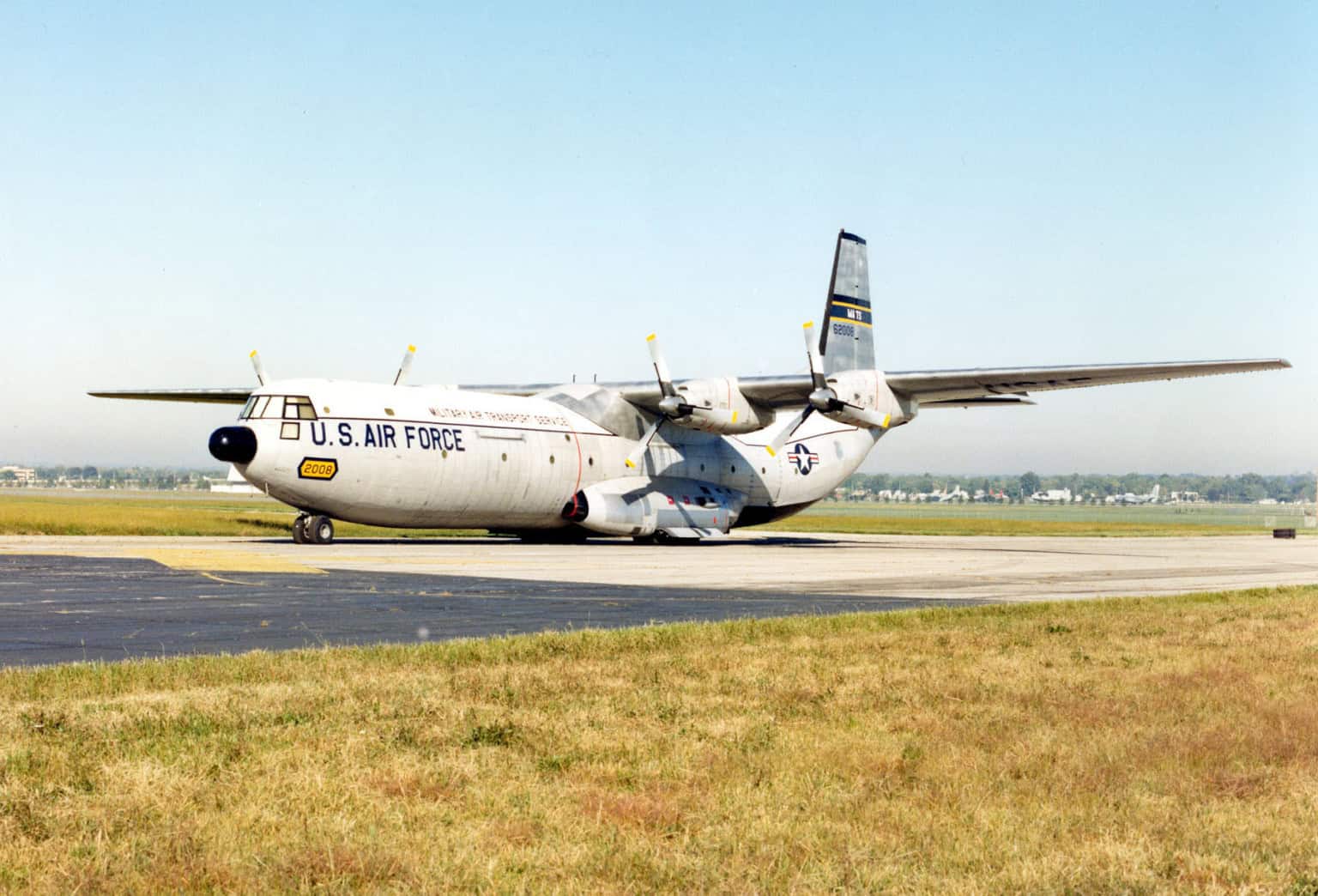
The Douglas C-133 Cargomaster was a large four-engine turboprop cargo aircraft built between 1956 and 1961 for the United States Air Force. It was the USAF’s only production turboprop strategic airlifter, and it spent 13 years hauling cargo that nothing else in the fleet could fit.
That cargo was often a ballistic missile. The C-133 carried Atlas, Titan and Minuteman rockets to their bases, then flew spacecraft and boosters for NASA’s early programs.
The C-133 was designed to meet the USAF’s Logistic Carrier Support System SS402L requirement for a new strategic transport. It was a very different aircraft from the C-74 Globemaster and C-124 Globemaster II before it.
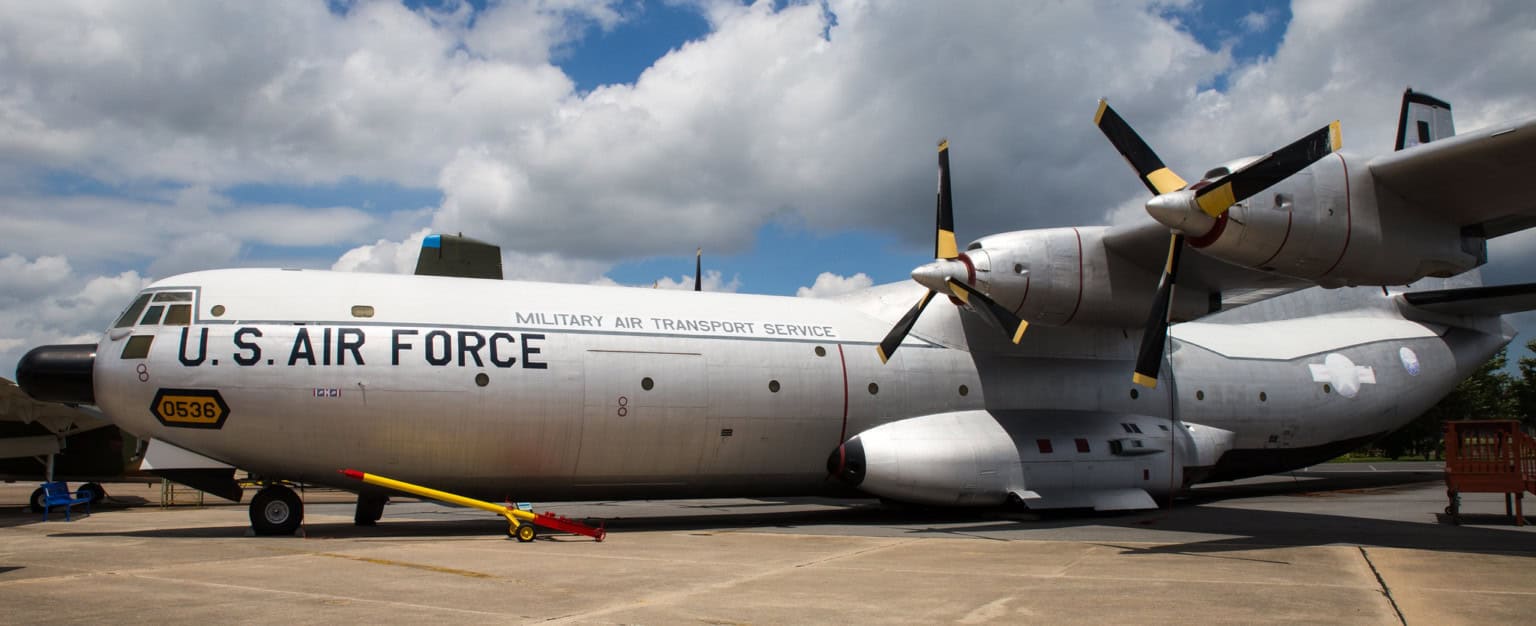
It had a high-mounted wing, blister fairings on each side to hold the landing gear, and doors at the rear and on the side. That layout kept the structure out of the way, so the cargo compartment could be wide, tall and easy to load. The hold was pressurized, heated and ventilated.
The C-124 had a cargo deck about 13 feet (4 m) off the ground and less engine power, which left a lot of cargo it simply could not carry. The C-133 was for many years the only USAF aircraft able to haul very large or very heavy loads.
Douglas built no prototype. The first aircraft was a production C-133A, and it flew on April 23, 1956.
The first C-133As reached the Military Air Transport Service (MATS) in August 1957 and began flying its routes around the world. Two of them set transatlantic speed records for transport aircraft on their first flights to Europe.
Production ended in 1961 with 50 aircraft delivered: 35 C-133As and 15 C-133Bs. Douglas also kept one extra example of each version at Long Beach as a test article. Those two never received construction numbers or USAF serials.
The C-133 is best remembered for moving intercontinental ballistic missiles. It carried Atlas and Titan missiles, and later Minuteman, and several hundred missiles flew to and from their operational bases in C-133s.
Moving them by air was cheaper, safer and faster than trucking them over highways. The C-133 also delivered Atlas, Saturn and Titan rockets to Cape Canaveral for the Mercury, Gemini and Apollo programs. After Apollo capsules splashed down, C-133s flew them from Norfolk, Virginia, or Hickam AFB, Hawaii, onward to Texas or California.
The common story is that the C-133 was designed around the missiles. The record suggests the reverse. The airframe design was frozen by 1955 so the first aircraft could fly in April 1956, but the Atlas and Titan designs were not firm until after their contracts were signed that same year.
The C-133B did get a change for the job. Its rear cargo doors were modified to open to the side as petal doors, which made loading missiles much easier.
On December 16, 1958, C-133A 56-2008 lifted a payload of 117,900 pounds (53,480 kg) to 10,000 feet (3,048 m) over Dover Air Force Base. It was a world record for propeller-driven aircraft, and it is the only record the FAI officially sanctioned for the type.
That aircraft is now at the National Museum of the U.S. Air Force. It flew there on March 17, 1971.
Other flights set unofficial records for military transports. One nonstop flight from Tachikawa Airfield, Japan, to Travis Air Force Base, California, took 17 hours 20 minutes on May 22, 1959.
Early in its life the C-133 earned a reputation for crashing, and some crews called it the “widowmaker.” Of the 50 aircraft built, nine were lost in crashes and one was destroyed in a ground fire.
The investigations found several problems. The propeller auto-pitch controller needed a time delay to relieve stress on the nose casing. The stall also came with little warning, and the left wing stalled before the right. The fix for that was a small metal strip on the right wing, so both wings stalled together.
The last C-133B crash came on February 6, 1970. A hidden skin crack under the paint grew to about 17 feet (5 m) long, and the aircraft came apart at 23,000 feet (7,000 m) over Nebraska. Not every loss had one cause. A November 1964 takeoff crash at Goose Bay, Labrador, was blamed on a power stall, with icing or aerodynamic instability as possible factors.
By 1971 the Cargomaster was both obsolete and worn out. Its airframe had a 10,000-hour life that was extended to 19,000 hours.
Severe vibration caused stress corrosion in the airframes, and the aircraft had reached the point where they were beyond economical operation. The Air Force kept as many in service as it could until the Lockheed C-5 Galaxy entered squadron service.
The USAF then withdrew the fleet. Most airframes were cut up within months of arriving at Davis-Monthan Air Force Base near Tucson, Arizona.
The full specification table for the aircraft is on this page. A few of those numbers need context.
The range figure is tied to a specific load. The published range is quoted with a 52,000 pound payload , so it is not a maximum-payload range.
Power also varies by source. Wikipedia lists the T34 turboprops at 7,500 horsepower each with water injection. The National Museum of the U.S. Air Force fact sheet prints a lower rating for the same engines.
The same is true of height. Wikipedia and the page’s spec table show the tail at 14.7 m, while the museum’s fact sheet prints 48 feet 8 inches. Treat small differences in published figures for a 1950s transport as normal.
Several Cargomasters survive.

Two more C-133As have been in storage at Mojave Air and Space Port in California since the 1970s.

The C-130 Hercules is a tactical airlifter, while the C-133 was a strategic one that entered service shortly after it. The C-133 was meant for long intercontinental hauls of very large and heavy loads.
The C-5 Galaxy, not the C-130, is the aircraft that replaced it.

By 1971 the C-133 was obsolete and worn out. Severe vibration had caused stress corrosion in the airframes, and the aircraft were beyond economical operation. The Air Force kept as many as possible flying until the C-5 Galaxy entered service, then withdrew them.
Douglas built 50 for the USAF: 35 C-133As and 15 C-133Bs. Two more test articles, one of each version, were kept at Long Beach and never received serial numbers.
It carried very large and heavy loads, including Atlas, Titan and Minuteman missiles, plus rockets and spacecraft for NASA. Several hundred Minuteman and other ICBMs were airlifted by C-133s.
Early in its service it developed a reputation for crashing, and some crews would not fly it. Investigators found propeller-control and stall-characteristic problems. Nine of the 50 aircraft were lost in crashes.
No flying example is known. N199AB flew cargo in Alaska until 2004 and made its last flight in August 2008, and it is now a museum aircraft.
Sources and references used for research and fact-checking.