Military Propellor Planes
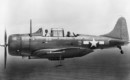
Douglas SBD Dauntless
ICAO: SBD
The piston attack aircraft that outlived the jets meant to replace it
Updated: by Tim de Vries
The latest aviation news and stories sent to your inbox.
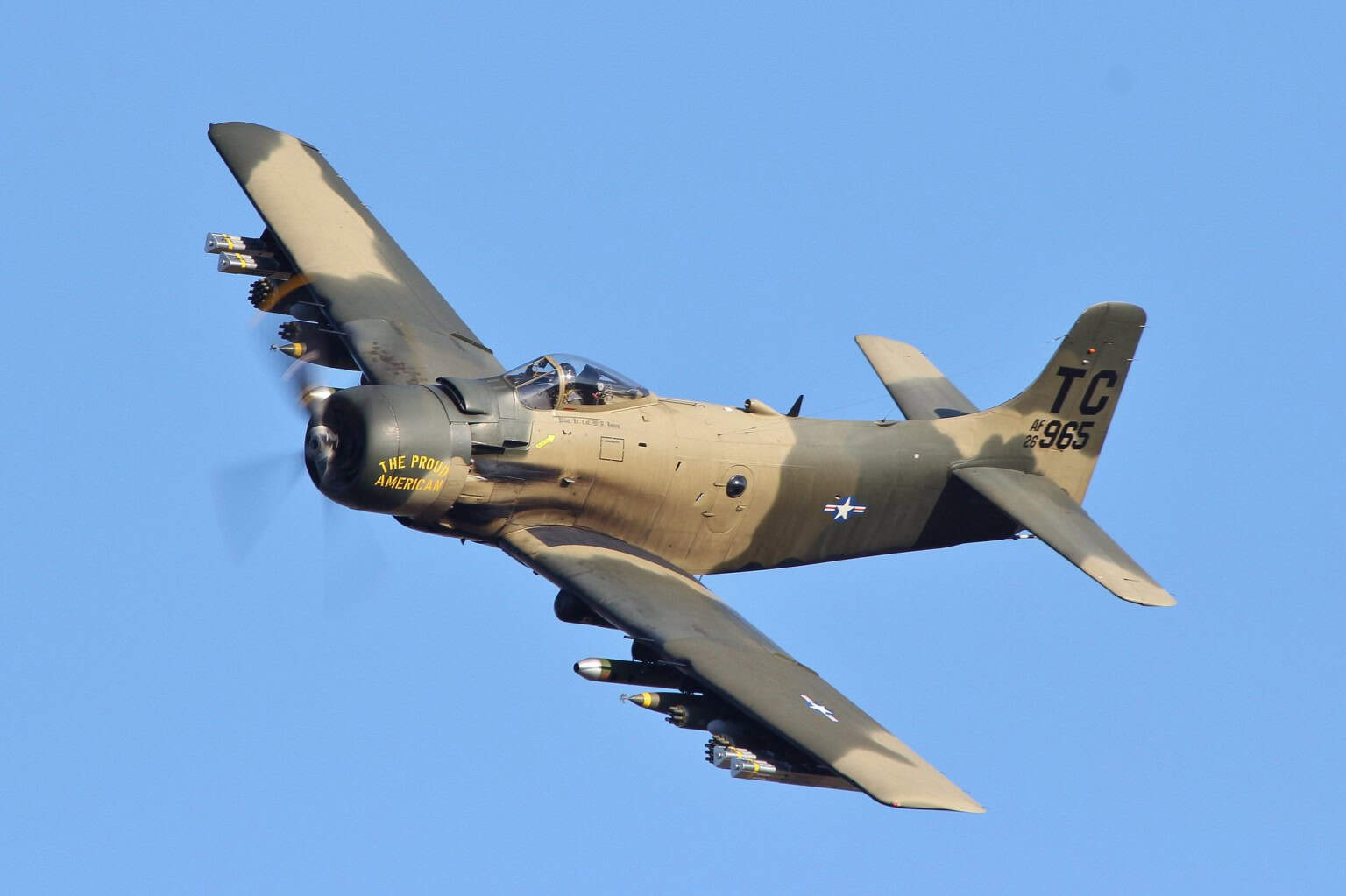
The Douglas A-1 Skyraider is a single-seat, piston-engined attack aircraft that Douglas developed for the U.S. Navy at the end of World War II and that stayed in frontline service deep into the jet age. Designed by a team under Ed Heinemann, it first flew on 18 March 1945 and entered service in 1946 as the AD-1, becoming the A-1 when U.S. designations were unified in 1962. Powered by a 2,700 hp Wright R-3350 radial and carrying up to 10,500 lb of ordnance on 15 hardpoints, it flew close air support in Korea and became famous in Vietnam as the Sandy rescue escort. A total of 3,180 were built between 1945 and 1957, and the type served with the U.S. Navy, Marine Corps and Air Force, the British Royal Navy, France, South Vietnam and Gabon, where it was retired in 1985.
Live Fleet Activity (A1)
Fetching live data…




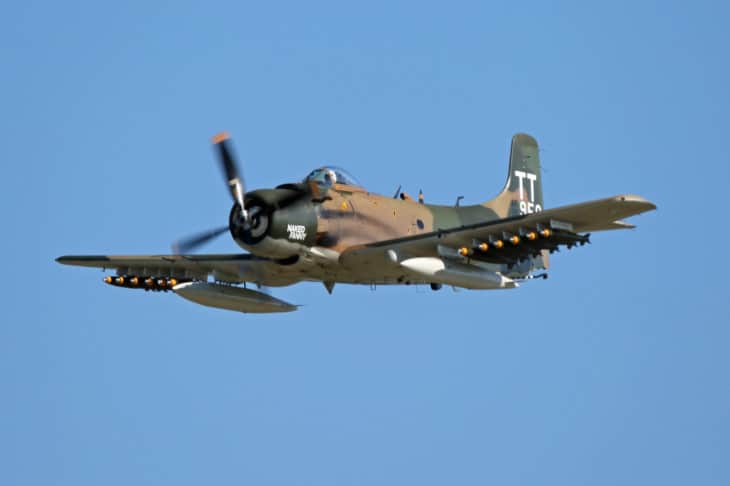
The Skyraider began with a 1943 decision by the U.S. Navy’s Bureau of Aeronautics to stop buying separate multi-seat dive bombers and torpedo bombers, and to combine both jobs in one single-seat aircraft. The requirement asked for a carrier-based machine with long range and high performance to replace types like the Douglas SBD Dauntless.
Douglas answered with a design team led by Ed Heinemann. The company received an order for prototypes under the designation XBT2D-1 on 6 July 1944.
The first XBT2D-1 flew on 18 March 1945, almost four months ahead of schedule, and went to the Naval Air Test Center that April. The Navy ordered it into production on 5 May 1945 as the AD-1, and the Skyraider name was attached around the same time.
Japan’s surrender curtailed production but did not cancel it. The first production aircraft reached fleet squadron VA-19A in December 1946, and the type was redesignated A-1 in 1962 when the Navy and Air Force unified their designation systems.
Production ran from 1945 to 1957 and totaled 3,180 aircraft. The Skyraider stayed in frontline service so far into the jet age that it became known as a flying anachronism, and it remained in U.S. service until 1973 and in Gabonese service until 1985.
The A-1H is powered by a single Wright R-3350-26WA Duplex-Cyclone, an 18-cylinder, twin-row, air-cooled radial rated at 2,700 hp. It drives a four-bladed Aeroproducts constant-speed propeller.
That engine is the reason the Skyraider kept working long after jets replaced almost every other piston combat aircraft. A big radial turning a large propeller produces enormous thrust at low speed, which is exactly what a ground-attack aircraft needs and what early jets were worst at.
The practical result was endurance. Where jets had to leave a target area to refuel, the Skyraider could stay overhead for hours, and the National Museum of the U.S. Air Force credits it with providing nearly continuous suppressing fire until rescue helicopters could extract a downed airman.
Being slow was also tactically useful. A pilot searching for a survivor under a jungle canopy, or putting ordnance close to friendly troops, needs time to look and a stable platform to aim from.
The full specification table for the aircraft is on this page. A few of its figures get quoted against each other, so they are worth separating.
Three different weights circulate for the A-1H, and they measure three different things. Empty weight is 11,968 lb (5,429 kg), normal gross weight is 18,106 lb (8,213 kg), and maximum takeoff weight is 25,000 lb (11,300 kg), which is the number the specification panel carries.
Range and combat radius are also distinct. The published range of 1,144 nautical miles (1,320 miles, 2,120 km) describes a ferry-style cruise, while the Air Force museum quotes a combat radius of 300 miles (480 km) for a loaded aircraft that has to fight and come home.
Ordnance capacity depends on which document you read. The NAVWEPS flight manual figure is 10,500 lb (4,763 kg) across the aircraft’s external stations, the Air Force museum states up to 10,000 lb (4,536 kg), and loads nearer 8,000 lb (3,629 kg) are commonly quoted for routine missions. The panel uses the manual figure.
Top speed of 280 knots is measured at 18,000 feet, which is about 322 mph (519 km/h). Normal cruise is 172 knots, roughly 198 mph (319 km/h).
Built-in armament is four 20 mm AN/M3 cannon, two in each wing, with 200 rounds per gun. That alone made the Skyraider a serious strafing aircraft.
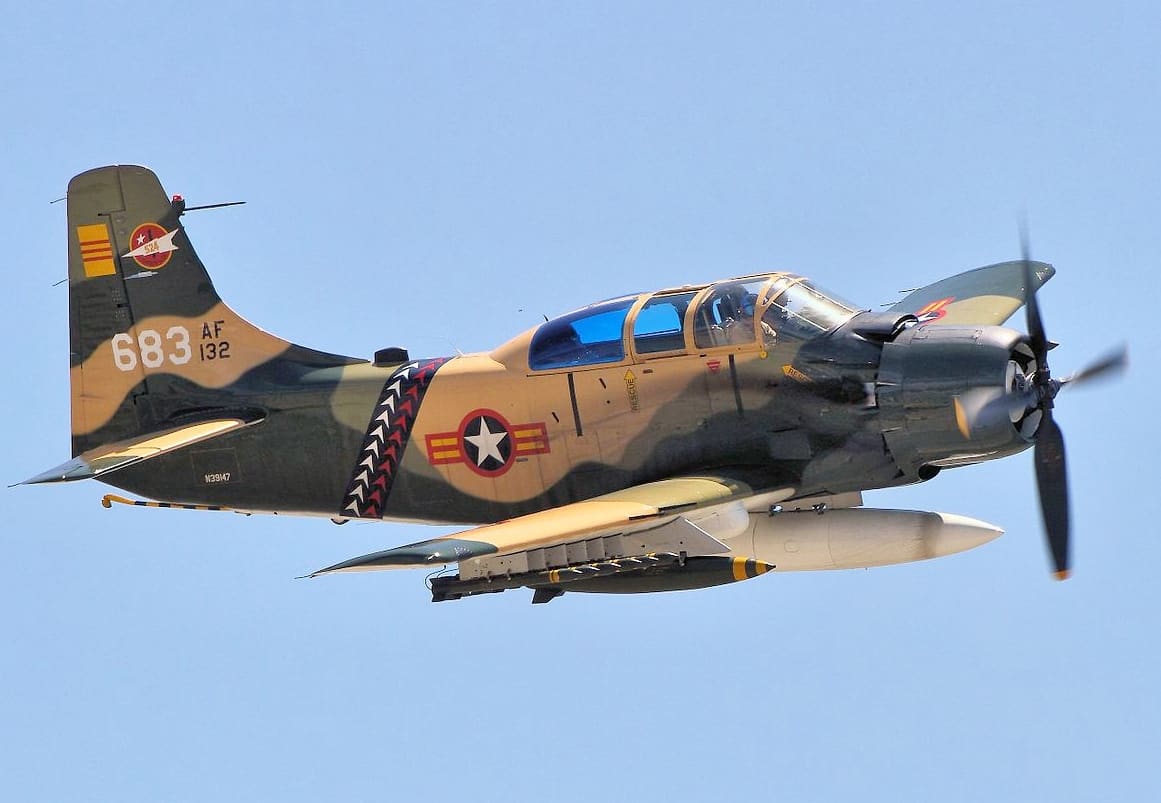
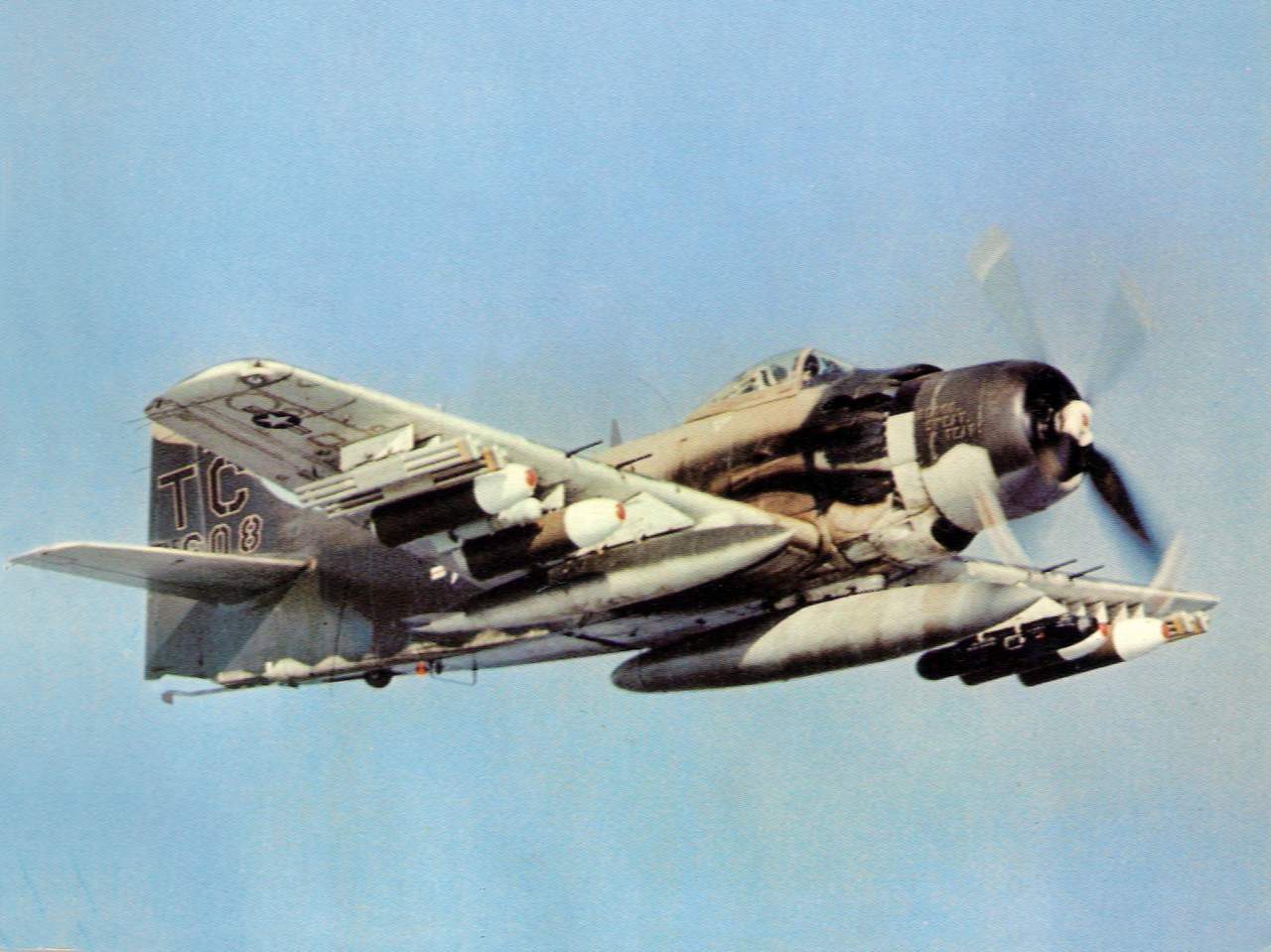
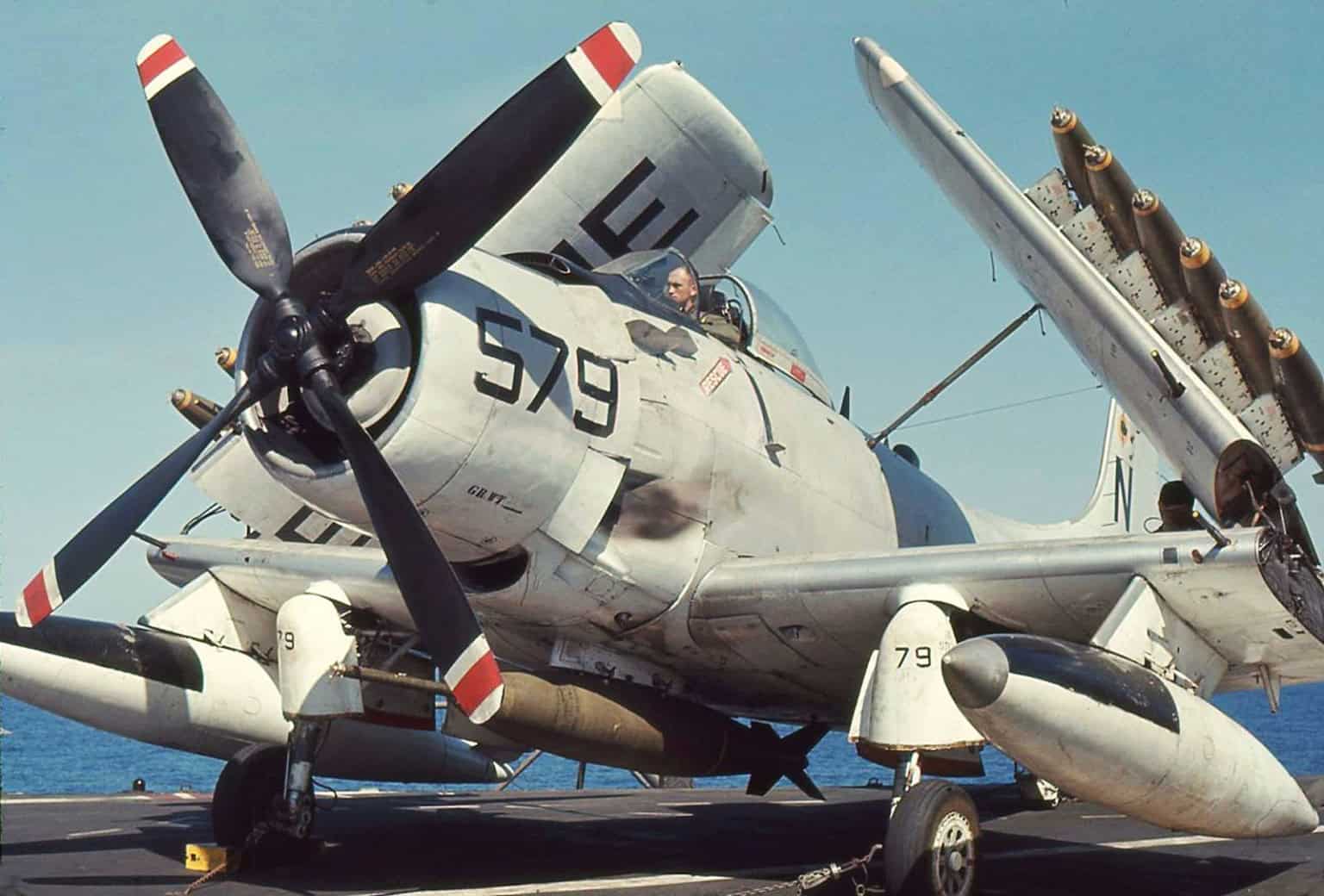
The external load is what set it apart. Fifteen hardpoints under the wings and fuselage carried bombs, torpedoes, mine dispensers, unguided rockets, gun pods and external fuel tanks.
The most famous item ever hung on one of those stations was not a weapon. In October 1965, to mark the dropping of the six millionth pound of ordnance, Commander Clarence J. Stoddard of VA-25 flew an A-1H with a toilet attached alongside his regular munitions.
The Skyraider arrived too late for World War II but became the backbone of Navy and Marine Corps strike work in Korea. The first ADs went into action from USS Valley Forge with VA-55 on 3 July 1950.
Its weapons load and roughly 10-hour flying time far exceeded what the jets of the Korean War could offer, and the type flew constant interdiction and close air support sorties against North Korean supply lines.
On 2 May 1951, Skyraiders carried out the only aerial torpedo attack of the war, striking the Hwacheon Dam. On 16 June 1953 a Marine AD-4 from VMC-1 shot down a Polikarpov Po-2 biplane, the only documented Skyraider air-to-air victory of that conflict.
Korean-era Skyraiders wore dark navy blue, which is why enemy troops reportedly called the type the Blue Plane.
By the time American involvement in Vietnam escalated, the Skyraider was still the medium attack aircraft in many carrier air wings, though the Navy already planned to replace it with the Grumman A-6 Intruder. Skyraiders from USS Constellation and USS Ticonderoga flew in the first U.S. Navy strikes against North Vietnam on 5 August 1964 during Operation Pierce Arrow.
The Air Force took surplus A-1s from the Navy, and the air commandos began flying them in 1964. Those aircraft went to special operations and combat rescue work rather than to conventional strike squadrons.
Twice, Navy Skyraiders used their cannon to shoot down MiG-17 jet fighters. The first was on 20 June 1965, when four Skyraiders operating from USS Midway engaged the MiGs and downed one without loss.
Rescue escort, or RESCORT, was the mission the Skyraider is best remembered for in Southeast Asia. Crews flew it under the call sign Sandy, while the same squadrons used the call sign Firefly for attack missions against the Ho Chi Minh Trail.
A rescue normally required four A-1s. Two aircraft, Sandy Low, went in toward the downed aircrew, while Sandy High rendezvoused with the helicopters and orbited above, conserving fuel.
The ranking Sandy Low pilot took command of the whole rescue effort. His element located the survivor, confirmed his identity by radio, and suppressed ground fire until the area was safe enough for the Sandy High aircraft to bring the HH-3 Jolly Green Giant or HH-53 Super Jolly Green Giant helicopters in.
The first USAF A-1s assigned to that duty came from the 602nd Air Fighter Squadron (Commando) in August 1965, rotating between Bien Hoa in South Vietnam and Udorn in Thailand. A typical squadron mixed single-seat A-1H and A-1J aircraft with the side-by-side A-1E and A-1G models that crews called fat face.
On 10 March 1966, Major Bernard Fisher was diverted to a Special Forces camp in the A Shau Valley that was under attack by 2,000 North Vietnamese troops. He led five other A-1Es down through a hole in the overcast to support the defenders, and one of them was hit and crash landed on the camp’s airstrip.
With enemy troops across the field and capture near certain before a helicopter could arrive, Fisher landed his own Skyraider on that airstrip under fire and flew the downed pilot out. He received the Medal of Honor, and the aircraft he flew, serial 52-132649, is displayed at the National Museum of the U.S. Air Force.
On 1 September 1968, Lieutenant Colonel William A. Jones III led a four-ship searching for a downed F-4 Phantom II crewman near the Ban Karai Pass. On his 98th combat mission, Jones located the survivor and spotted an enemy gun position firing from directly above him.
His Skyraider was hit and set on fire, and a 14.5 mm round ignited the rocket of his Yankee parachute extraction system behind his headrest. The canopy blew away, but the extraction itself never fired.
The fire disabled all of his transmitters and left him able to receive on only one channel, so he could not pass the survivor’s location by radio. Jones flew the burning aircraft back to Nakhon Phanom with severe burns and refused medical attention until he had reported where the survivor and the guns were.
President Nixon approved the Medal of Honor in November 1969, but Jones was killed in an aircraft crash before it could be presented. His family received it at a White House ceremony in August 1970.
The Skyraider’s strengths were also its exposure. Weaving slowly through a search area at low altitude made it an easy target for gunners, and the losses reflect that.
Chris Hobson’s accounting of fixed-wing losses in Southeast Asia records 65 Navy Skyraiders lost, 48 of them in combat, and 191 Air Force Skyraiders, 150 of them in combat, for a combined 256 aircraft. Of those, five fell to surface-to-air missiles and three to air-to-air combat, and anti-aircraft artillery accounted for the rest.
The last Navy A-1 lost in the war went down on 14 February 1968, when Lieutenant junior grade Joseph P. Dunn was intercepted by Chinese MiG-17s near Hainan. The last Air Force A-1 lost in combat, on 28 September 1972, was A-1H 52-139738, the same airframe on which Jones had earned his Medal of Honor four years earlier.
Skyraider designations look confusing because the type was rebuilt repeatedly for new roles, and because everything was renamed in 1962. Before that year the aircraft were ADs, and the dash number identified the production block.
The suffix letters are the key to the rest of the family. Q marked electronic countermeasures aircraft, W marked airborne early warning aircraft carrying search radar, and N marked night attack versions.
The type collected nicknames throughout its career. The most durable were Spad, after the French World War I fighter, and Able Dog, the phonetic rendering of its original AD designation.
Beyond the U.S. Navy, Marine Corps and Air Force, Skyraiders served with the British Royal Navy, the French Air Force, the Republic of Vietnam Air Force, and the air arms of Cambodia, Chad, Gabon and Sweden.
The British and Swedish aircraft were early warning versions rather than attack aircraft. Fifty AD-4Ws went to the Royal Navy as the Skyraider AEW Mk 1, and several later passed to Sweden for use as target tugs. The wider family of U.S. Navy aircraft types puts the Skyraider’s carrier role in context.
When all remaining U.S. aircraft were handed to the South Vietnamese by 1973, the type’s American combat career ended. Most of those aircraft were destroyed after the surrender in April 1975, but four were flown out to Thailand and later recovered by Military Aircraft Restoration Corporation, restored to flying condition in Long Beach, California.
One of them, BuNo 135332, went to the Smithsonian National Air and Space Museum in 1982. Wikipedia’s survivor list counts roughly 18 airworthy Skyraiders and about 29 more on static display worldwide, though warbird registries and museum lists disagree with each other and airframes move between categories, so treat those totals as approximate rather than exact.
That survival rate keeps the Skyraider among the more visible piston warbirds on the airshow circuit, and it remains one of the notable long-serving military aircraft designs.
Searches for the Skyraider now return a second, unrelated aircraft. In 2025 Air Force Special Operations Command named its new light attack aircraft the OA-1K Skyraider II, explicitly as a tribute to the Douglas original.
The OA-1K is not a Douglas design and shares no parts with the A-1. It is a modified AT-802U Sky Warden, a single-engine turboprop built for short takeoffs and landings at austere airfields, bought under the Armed Overwatch program for armed reconnaissance, close air support and precision strike.
AFSOC accepted its first missionized OA-1K on 3 April 2025. As of May 2026 the command had 18 aircraft and expected a few more by that October, with 53 funded in the fiscal 2027 budget request against a program record of 75.
Crew training was still underway at that point, and AFSOC said the aircraft’s first combat missions were expected in the coming years rather than immediately. What the two aircraft genuinely share is a mission idea: a slow, long-loitering, heavily armed airplane supporting troops and special operations forces on the ground.
Chris Hobson’s study of fixed-wing losses in Southeast Asia records 256 Skyraiders lost in total: 191 Air Force aircraft, 150 of those in combat, and 65 Navy aircraft, 48 of those in combat.
Five were brought down by surface-to-air missiles and three in air-to-air combat, with anti-aircraft artillery responsible for the majority. Some published tallies run slightly higher, so the figure varies a little by source.
By the measures that mattered for its mission, yes. It carried an exceptional weapons load on 15 hardpoints, loitered for hours where jets could not, was accurate at low speed, and absorbed damage that would have destroyed lighter aircraft.
The trade was vulnerability. Flying low and slow over defended ground made it easy to hit, which is why 256 were lost in Southeast Asia, most of them to anti-aircraft fire.
In the Navy, the Skyraider’s medium attack role passed to jets, with the A-6 Intruder named as the planned replacement.
In the Air Force, A-1 operations in Southeast Asia wound down through 1972. The last Air Force Skyraider was lost in combat that September, and the remaining aircraft were transferred to the South Vietnamese Air Force after November 1972.
There is no agreed answer, and it depends entirely on who is being asked. Ground troops, downed aircrew, and opposing forces each had different reasons to fear or welcome a particular aircraft.
What can be said about the Skyraider specifically is that its reputation rested on presence rather than speed. For an airman on the ground waiting for rescue, a flight of Sandys overhead meant sustained covering fire until the helicopters arrived.
The A-1H used one Wright R-3350-26WA Duplex-Cyclone, an 18-cylinder twin-row air-cooled radial producing 2,700 hp, turning a four-bladed Aeroproducts constant-speed propeller. Earlier AD variants used progressively lower-rated versions of the same R-3350 family.
Maximum speed was 280 knots, about 322 mph (519 km/h), measured at 18,000 feet. Normal cruise was 172 knots, roughly 198 mph (319 km/h), and the service ceiling was 28,500 feet.
Occasionally. Around 18 airworthy examples are in private and museum hands, and they change ownership rarely, at prices typical of large restored warbirds. Operating one means maintaining a 2,700 hp radial engine and finding parts for a type that left production in 1957, so ownership is a specialist undertaking rather than a straightforward purchase.
Sandy was the radio call sign used by Air Force Skyraider crews flying rescue escort missions, and it stuck to the aircraft itself. The same squadrons used the call sign Firefly when flying interdiction and attack missions, so the name identified the mission rather than the airplane.
Sources and references used for research and fact-checking.