

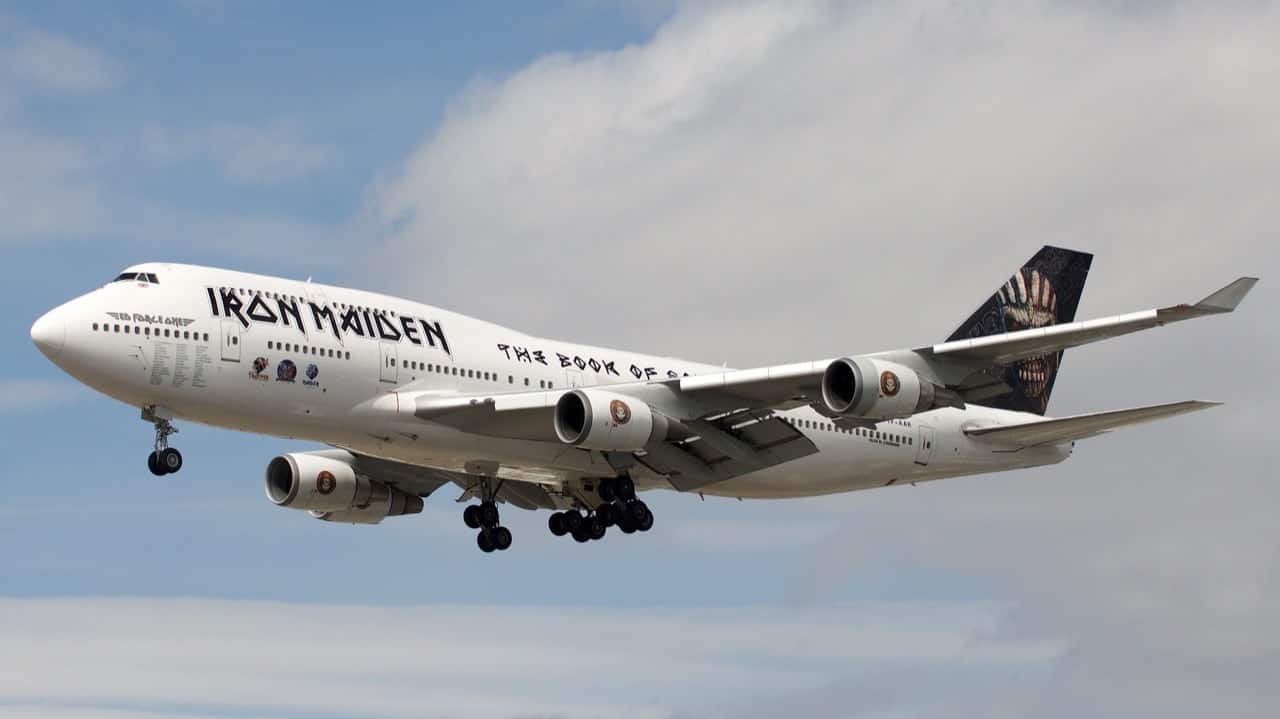
Most celebrities with a private jet are content to sit in the back and let someone else handle the controls. Bruce Dickinson is not most celebrities. The lead vocalist of Iron Maiden is also a qualified airline captain with an Airline Transport Pilot License, type ratings on the Boeing 737, 757, and 747, and enough actual hours in the flight deck to have evacuated 200 UK citizens from a war zone. When Iron Maiden needed a pilot for their converted Boeing 747-400 tour jet, they didn’t hire one from a staffing agency. They asked their singer.
Dickinson’s relationship with aircraft doesn’t begin and end with Iron Maiden’s famous Ed Force One tour planes. His personal collection runs to vintage warbirds and a WWI replica triplane he flies in formation at UK airshows 50 feet above the ground. He co-founded Cardiff Aviation, a commercial maintenance, repair, and overhaul facility in Wales employing over 100 people. He chairs Aeris Aviation, a UK distributor for the Eclipse very light jet. He is, in short, one of the most seriously credentialed aviation figures in rock and roll history, and the only major rock frontman to have personally captained a Boeing 747 loaded with 12 tons of concert equipment across six continents.
This is the full story of Bruce Dickinson’s aviation fleet: the two Ed Force One jets he captained, the warbirds he owns and displays, the businesses he built around his pilot credentials, and the humanitarian flights that rarely share column inches with the heavy metal records.
Quick facts about Bruce Dickinson’s aviation career
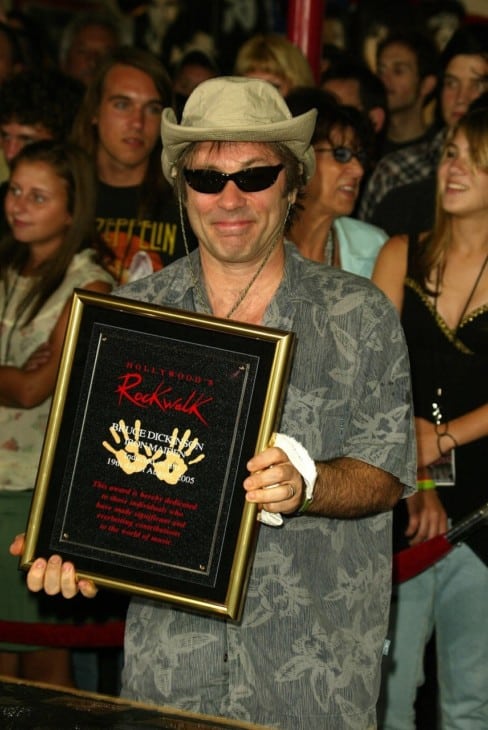
Bruce Dickinson’s Aviation Fleet
Bruce Dickinson’s aviation portfolio is unlike any other celebrity’s. Rather than a single flashy business jet parked at a fixed base operator, his fleet spans two eras and two purposes: the leased Boeing tour jets he captained for Iron Maiden’s world tours, and the personal warbirds he owns, maintains, and displays at UK airshows. The aircraft cards below cover the major aircraft in his story, from the 747 jumbo to the WWI triplane replica he bought during his cancer recovery.
The Wider Personal Hangar
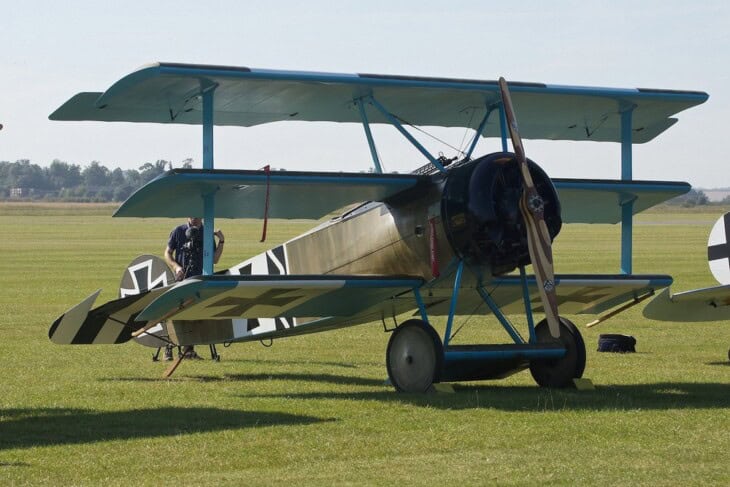
Dickinson’s confirmed personal aircraft also include a co-owned SA Bulldog and a WWII-era Bücker Jungmann biplane trainer. Aviation publications have additionally reported ownership of a Grumman Goose amphibious seaplane, a Boeing E-75 Stearman biplane, and a Cessna 208 Caravan. He also holds a type rating on the Eclipse very light jet through his role at Aeris Aviation.
The Origin Story: From Worksop to the Flight Deck of a 747
Bruce Dickinson’s path from a small coal-mining town in Nottinghamshire to the captain’s seat of a Boeing 747 took three decades and ran in parallel with one of rock music’s most enduring careers. It started not with Iron Maiden but with a family holiday, a bored drummer, and a Cessna 152 in Florida.
1958
Born in Worksop, Nottinghamshire. Paul Bruce Dickinson is born on August 7. His uncle serves in the Royal Air Force. At age five he attends his first airshow, beginning a lifelong fascination with aircraft that will eventually reshape his career.
1981
Joins Iron Maiden. Dickinson replaces Paul Di’Anno as lead vocalist and begins one of rock’s most enduring careers. Aviation remains a side passion for the next decade.
1990
First flying lesson in Florida. On a family holiday, Dickinson tries a lesson in a Cessna 152. “My life changed,” he later tells Business Jet Traveler. “My heroes were U-boat captains, test pilots, astronauts, and fighter pilots. I got to fly a Cessna 152, and I thought: wow, this is incredible.”
1991
Earns private pilot’s license. Within a year of his first lesson, Dickinson has his license. The qualification starts him down a path toward one of the most unusual dual careers in aviation history.
Late 1990s
Earns Airline Transport Pilot License (ATPL). Dickinson obtains the highest level of pilot certification available in commercial aviation. He joins British World Airlines before becoming a Boeing 757 captain at Astraeus, a British charter airline based in Crawley.
2006
Lebanon evacuation. During the Israel-Hezbollah conflict, Dickinson pilots a repatriation flight evacuating 200 UK citizens from Lebanon, one of several humanitarian flights he completes through his work with Astraeus.
2008
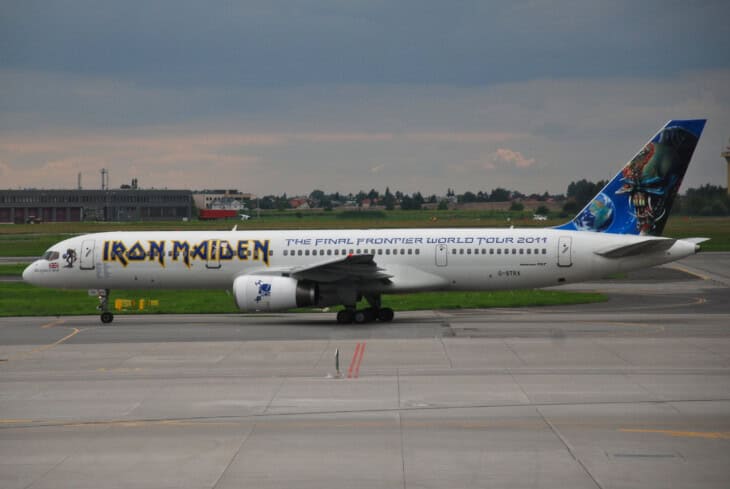
First Ed Force One tour. Dickinson captains Iron Maiden’s chartered Boeing 757 G-STRX, dubbed Ed Force One, for the Somewhere Back In Time World Tour. The journey spans 21 countries and becomes the subject of the 2009 documentary Iron Maiden: Flight 666.
2011
Final Frontier World Tour. Dickinson again pilots the 757 Ed Force One, this time enabling the band to perform in 13 countries across 45 days, including stops in Colombia, India, Japan, and Australia.
2012
Launches Cardiff Aviation. After Astraeus collapses in November 2011, Dickinson co-founds Cardiff Aviation Ltd. with former Astraeus CEO Mario Fulgoni at a former military airfield in St. Athan, Wales. The MRO facility employs over 100 people and holds approvals for all Boeing narrowbody aircraft types.
2013
Joins Aeris Aviation as chairman. Dickinson becomes non-executive chairman of Aeris Aviation, the UK distributor for the Eclipse very light jet. He earns a type rating on the Eclipse, bringing his total to four aircraft types.
2014
Cancer diagnosis and triplane purchase. Dickinson is diagnosed with tongue cancer and undergoes radiation and chemotherapy. During recovery, he purchases a Fokker Dr.1 403/17 triplane replica (G-CDXR) and joins the Great War Display Team, performing WWI dogfight reenactments at UK airshows.
2016
Boeing 747 type rating and Book of Souls World Tour. Dickinson completes type conversion on the Boeing 747-400 and captains the upgraded Ed Force One, a former Air France jumbo leased from Air Atlanta, across six continents for Iron Maiden’s Book of Souls World Tour. The aircraft carries 12 tons of concert equipment in its hold.
Ed Force One: Inside the Boeing 747-400 That Iron Maiden Took Around the World
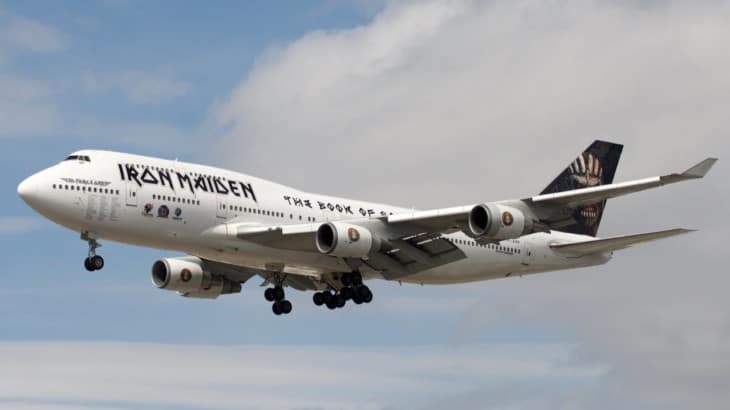
The Boeing 747-400 that became Iron Maiden’s second Ed Force One was not a celebrity vanity project. It was a sound operational decision, arrived at after the band exhausted what a Boeing 757 could practically do for a touring act of their scale. The 747’s colossal freight capacity meant that Iron Maiden’s full stage production could travel in the hold without the structural modifications the 757 required. That saved time, money, and logistical complexity. The range of 7,285 nautical miles meant fewer fuel stops on intercontinental legs. And because Bruce Dickinson had been flying Boeing jets commercially for two decades, the question of who would captain the aircraft had a convenient answer.
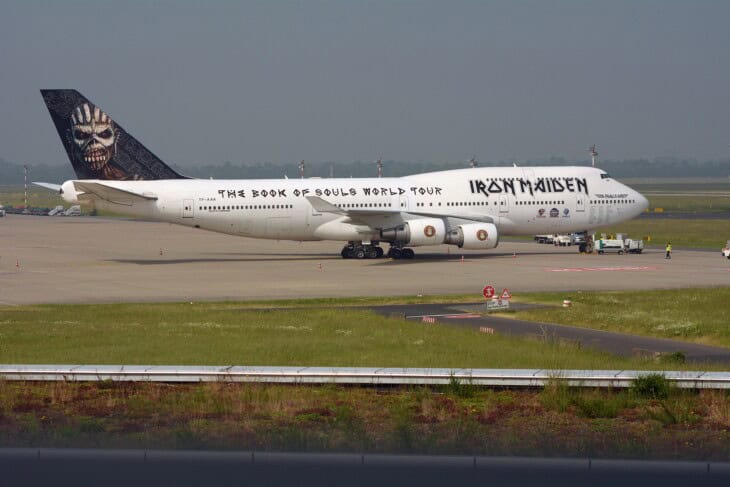
The aircraft was originally manufactured for Air France before passing to Air Atlanta Icelandic, a specialist charter and ACMI operator. For the Book of Souls World Tour, it was covered in Iron Maiden’s signature Eddie artwork and loaded with band, crew, and freight for what became one of the most ambitious touring operations in rock history. Dickinson was one of three captains on the rotation, sitting in the left seat for a substantial portion of the route legs. He had completed his Boeing 747 type rating during the training period leading up to the tour, earning the qualification on top of his existing 737 and 757 ratings.
Performance
Airframe
Power
The aircraft’s range advantage over the 757 was decisive in route planning. Dickinson described the operational logic directly to Business Jet Traveler: “The range of around 7,000 nautical miles is much greater, which means we will not have to make the refueling stops we needed to with the 757.” For a tour covering Australia, South America, Africa, and Asia, that translated into fewer ground delays, less logistical friction, and a tighter show schedule.
12 Tons in the Hold
The 747-400’s freight capacity allowed Iron Maiden to carry all of their stage production in the cargo hold with no structural modifications. On the 757, extensive modifications had been required to fit the same load. The switch to the 747 saved the band significant complexity and cost per tour leg.
The First Ed Force One: Boeing 757-28A G-STRX
Before the 747 came the 757. Iron Maiden first converted a chartered Boeing 757 into Ed Force One for the 2008-09 Somewhere Back In Time World Tour, with Dickinson in the captain’s seat for the entire journey. The aircraft, registered G-STRX and leased from Astraeus Airlines where Dickinson was already a serving captain, was specially configured to carry the band’s staging and equipment alongside passengers. The name Ed Force One was a play on Air Force One and a nod to Eddie the Head, Iron Maiden’s skeletal mascot who has graced the band’s album covers since 1980.
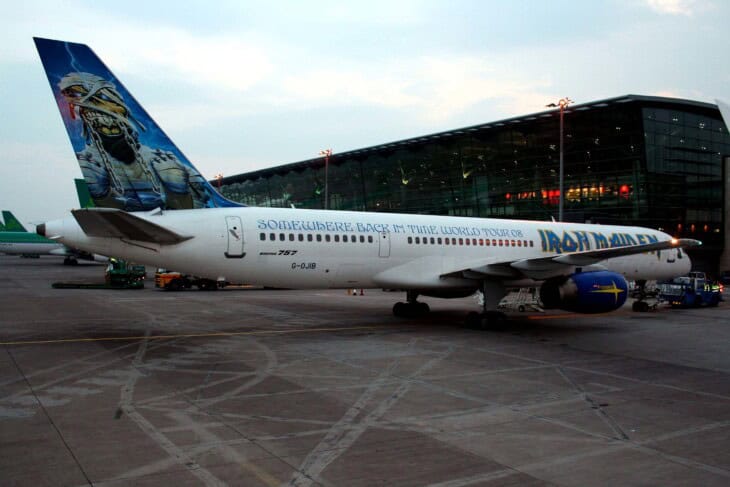
The tour covered 21 countries across multiple continents, logging a volume of intercontinental flying that would have been logistically chaotic on commercial flights with separate cargo shipments. Instead, the band, their crew, and their equipment traveled on the same aircraft, under the control of their own frontman. The model was so successful that Dickinson captained the 757 again for the 2011 Final Frontier World Tour, which covered 13 countries in 45 days, including legs to Colombia, India, Japan, and Australia. Astraeus’s collapse later that year ended the 757 chapter, but it laid the operational groundwork for the 747 upgrade five years later.
Iron Maiden: Flight 666
The 2008-09 Ed Force One tour became the subject of the documentary Iron Maiden: Flight 666, directed by Sam Dunn and Scot McFadyen and released in 2009. The film follows the band and crew across the Somewhere Back In Time World Tour, with Dickinson prominently featured both on stage and in the cockpit. It remains one of the few rock documentaries in which the lead singer is also visibly doing the flying.
The Warbird Collection: G-CDXR and Beyond
While Dickinson’s tour jets attract most of the headlines, his personal aircraft tell a different story. He is not a Gulf Stream buyer. He is a warbird collector and display pilot, and his personal hangar reflects the same enthusiasm for aviation history that runs through much of Iron Maiden’s music.
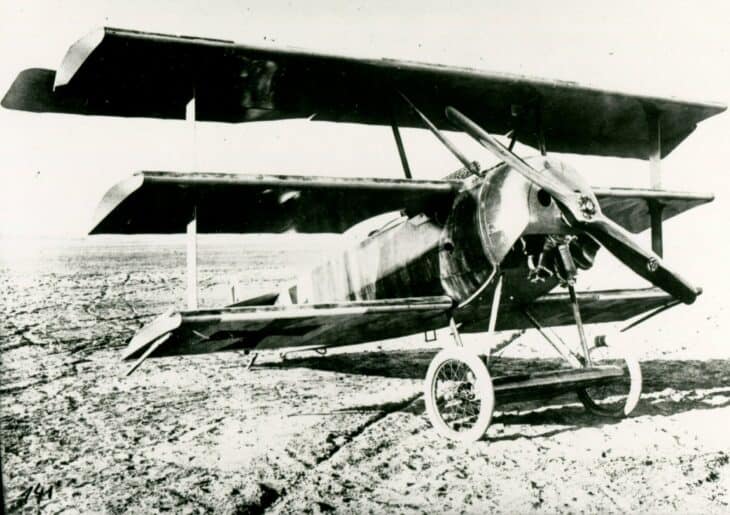
The centerpiece is a Fokker Dr.1 403/17 triplane replica, registered G-CDXR, which Dickinson purchased in 2014. The Fokker Dr.1 is the aircraft most associated with Manfred von Richthofen, the Red Baron, and it is among the most demanding aircraft to display safely. Dickinson flies it with the Great War Display Team at airshows across the UK, performing close-formation reenactments of WWI dogfights at 50 to 100 feet above the crowd. Speaking to Business Jet Traveler, he described the experience without irony: “I’ve almost been inadvertently knocked upside down, 50 feet above the deck in a World War I full-size replica. Trust me, it gets your attention.”
The triplane is not incidentally connected to Dickinson’s music. The Book of Souls album, the same record that launched the 747 Ed Force One tour, includes a track called “Death or Glory,” which is specifically about WWI dogfighting in tri-planes. Dickinson was flying the replica during the album’s writing. His personal aircraft and his art are, in this case, genuinely the same subject.
His co-owned aircraft include an SA Bulldog, the two-seat British military trainer used by the RAF’s Red Arrows pre-formation display team, and a WWII-era Bücker Jungmann biplane trainer, originally a Luftwaffe primary trainer of the 1930s and 1940s. Aviation publications have also reported a Grumman Goose amphibious seaplane and a Boeing E-75 Stearman biplane among his personal fleet, the latter being a US Army Air Corps primary trainer from the Second World War era.
The Aviation Businesses: Cardiff and Aeris
Dickinson doesn’t just fly aircraft. He runs businesses built around them, and his commercial aviation ventures give him a professional stake in the industry that goes well beyond rockstar hobbyism.
Cardiff Aviation Ltd., co-founded with former Astraeus CEO Mario Fulgoni in May 2012, operates from a former RAF base at St. Athan in the Vale of Glamorgan, Wales. The site has a 6,000-foot runway, long enough to handle narrowbody commercial jets, and the facility employs over 100 people in maintenance, repair, and overhaul work. Cardiff Aviation holds regulatory approvals to service all Boeing narrowbody types, including the 737 and 757. One of its early commercial contracts was with Air Djibouti, the national carrier of the East African country: Dickinson personally piloted the airline’s inaugural commercial flight on a Boeing 737 from Cardiff to Djibouti. The company has since rebranded as Caerdav.
Aeris Aviation, where Dickinson serves as non-executive chairman, distributes the Eclipse very light jet in the UK. He is type-rated on the Eclipse, which means he can fly the aircraft he helps sell. His investment in the Airlander project, a hybrid airship being developed as a lower-emission long-range transport platform, adds another dimension to his aviation portfolio. Dickinson has consistently engaged with the industry at an operational level rather than as a passive investor.
The Airlander Investment
Dickinson is among the backers of the Airlander project, which aims to develop the world’s largest hybrid airship as a more fuel-efficient alternative to conventional air freight. The project, developed by Hybrid Air Vehicles in Bedford, UK, would use a helium-supported hull combined with aerodynamic lift and diesel engines. It is an unusual aviation bet for a rock star, and a commercially serious one.
Carbon Footprint and the Environment
In the era of celebrity jet tracking and emissions controversy, Bruce Dickinson sits in an unusual position. The aircraft most associated with his name, the two Ed Force One jets, were chartered and leased rather than personally owned. Iron Maiden did not operate private jets for personal convenience. The 747 and 757 were tour logistics platforms, carrying crew and equipment to markets that commercial routing could not efficiently service.
That distinction matters in the wider conversation about celebrity aviation. Taylor Swift, Travis Scott, and other artists have faced sustained public scrutiny over private jet use, particularly for short-hop flights where commercial or ground alternatives exist. Dickinson’s case is structurally different: the aircraft were chartered for operational purposes, the flights were intercontinental tour legs rather than personal convenience trips, and the aircraft were shared across a large crew rather than used by a single passenger.
Dickinson’s investment in the Airlander project also signals an awareness of aviation’s environmental footprint that is unusual among celebrity pilots. As a working aviation professional with businesses dependent on the industry’s long-term viability, his interest in hybrid airship technology is commercially grounded rather than purely symbolic.
Leased, Not Owned
Neither the Boeing 757 G-STRX nor the Boeing 747-400 Ed Force One was owned by Bruce Dickinson or Iron Maiden. Both were chartered aircraft: the 757 from Astraeus Airlines and the 747 from Air Atlanta. This distinguishes Dickinson’s aviation footprint from the personal jet ownership patterns that have drawn public criticism for other celebrities.
Bruce Dickinson’s Most Famous Flights
Evacuating 200 UK Citizens from Lebanon (2006)
During the 2006 Israel-Hezbollah conflict, with Beirut under bombardment and commercial flights grounded, Dickinson piloted an Astraeus charter that evacuated 200 UK citizens from Lebanon. It was a routine Astraeus mission on paper; the fact that the man in the flight deck had also sold tens of millions of rock albums was incidental to the outcome. The flight is rarely mentioned in the same breath as Iron Maiden’s discography but represents the clearest demonstration that Dickinson’s pilot credentials are professional, not merely honorary.
Bringing Home Stranded Holidaymakers After XL Airways Collapse (2008)
When UK budget carrier XL Airways collapsed in September 2008, stranding thousands of passengers across Europe and North Africa, Astraeus was among the charter operators mobilized for repatriation. Dickinson piloted one of the flights, carrying 180 stranded holidaymakers home from Egypt. The same year, he also flew a charter bringing British Royal Air Force personnel home from Afghanistan.
Somewhere Back In Time World Tour (2008-09)
The inaugural Ed Force One tour, captained by Dickinson on the Boeing 757 G-STRX, covered 21 countries across six months and became the subject of Iron Maiden: Flight 666, the 2009 documentary that showed global audiences something they had never seen: a rock frontman walking from the stage straight to the flight deck. The film became one of the highest-grossing concert documentaries of its year. The logistical model it pioneered was the template for everything that followed.
Final Frontier World Tour: 13 Countries in 45 Days (2011)
The second Ed Force One tour, again on the 757, pushed the model further. Thirteen countries in 45 days, with legs spanning South America, South Asia, East Asia, and Australasia. The pace and geographic scope would have been unworkable on commercial routing with separate freight logistics. On a dedicated aircraft captained by their own singer, it was merely ambitious.
Book of Souls World Tour: Six Continents on the 747 (2016)
The 2016 Book of Souls World Tour, the first to use the Boeing 747-400, was Iron Maiden’s most ambitious touring operation. More than 100 shows across six continents, with 12 tons of stage equipment hauled in the cargo hold of a former Air France jumbo painted in Eddie artwork. Dickinson had completed his 747 type rating specifically for the tour and served in rotation with two other captains. He was 57 years old and recovering from cancer treatment the previous year. He flew a Boeing 747 around the world anyway.
How Bruce Dickinson Compares to Other Celebrities in the Sky
Celebrity private jet coverage in recent years has settled into a familiar shape: tracking services publish flight data, journalists calculate emissions, and the public reacts. Taylor Swift’s Private Jet logged some of the most widely criticized short-hop flights in 2022 and 2023. Travis Scott’s aircraft drew attention for similar patterns. Drake’s Boeing 767 has become a recurring reference point in discussions about hip-hop and aviation consumption.
Bruce Dickinson doesn’t fit any of those narratives. His most prominent aircraft were leased, not owned. The flights were operational, not personal. And rather than treating aviation as a luxury add-on to a music career, he spent three decades building a parallel life as a commercial pilot, with the qualifications and commercial track record to match. He reviewed the Embraer Legacy 500 for Business Jet Traveler as a pilot assessing a new midsize jet. He piloted Air Djibouti’s maiden commercial flight. He co-runs an MRO facility employing over 100 people. The aviation is not an accessory. It is a second profession.
Source: Celebrity Jets / Yard Intelligence, 2022 estimates. Dickinson’s Ed Force One jets were leased tour aircraft, not personal private jets; personal emissions not independently tracked.
The Dickinson Difference
Bruce Dickinson is the only major rock frontman to hold an Airline Transport Pilot License, the highest certification in commercial aviation. While contemporaries like Mick Jagger and Keith Richards rely on chartered business jets for touring, Dickinson has been the one in the flight deck, type-rated on the 747 and personally responsible for getting the band from Cape Town to Buenos Aires. His aviation career is not a celebrity hobby. It is a second working life.
FAQ
Get the Newsletter
The latest aviation news and stories sent to your inbox.
About the Author

Tim is the owner and lead editor of AeroCorner since 2019, overseeing aviation content covering aircraft, airlines, airports, and the broader aviation industry. Through years of researching, writing, editing, and publishing aviation-focused content, he has developed extensive practical knowledge of commercial aviation and air travel. Based in Asia and a frequent traveler himself, Tim also brings firsthand passenger experience to AeroCorner’s coverage. Outside of publishing, he has also explored aviation firsthand through hands-on flight training in New Zealand.