

Military Propellor Planes
Douglas A-1 Skyraider
ICAO: A1
Scout Bomber Douglas, nicknamed Slow But Deadly
Updated: by Tim de Vries
The latest aviation news and stories sent to your inbox.
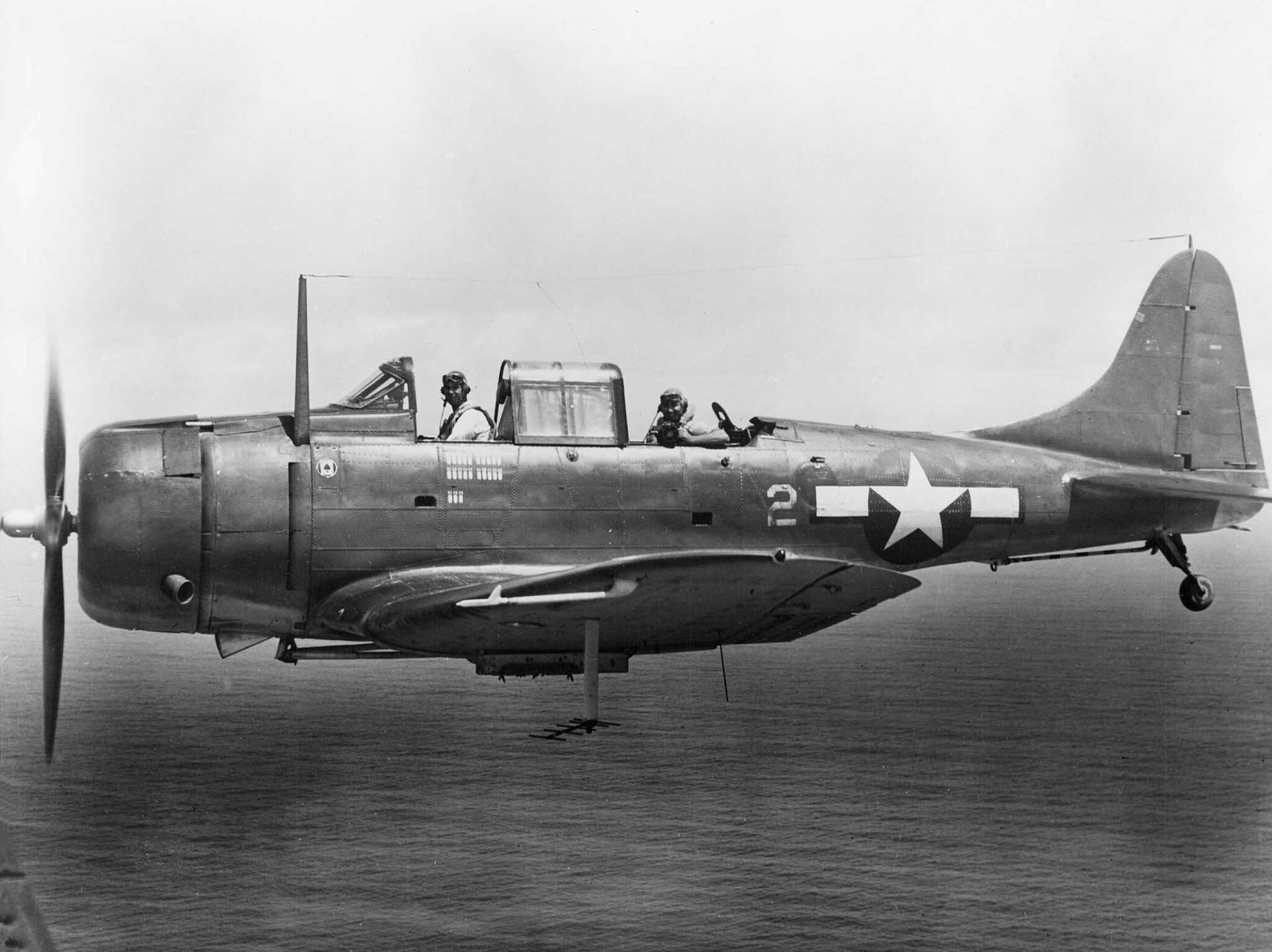
The Douglas SBD Dauntless (Scout Bomber Douglas) was the U.S. Navy’s main carrier-based scout plane and dive bomber from 1940 to 1944. SBDs sank or fatally damaged all four Japanese fleet carriers at the Battle of Midway in June 1942, and crews nicknamed it Slow But Deadly. Douglas built 5,936, including the Army’s A-24 Banshee.
Live Fleet Activity (SBD)
Fetching live data…
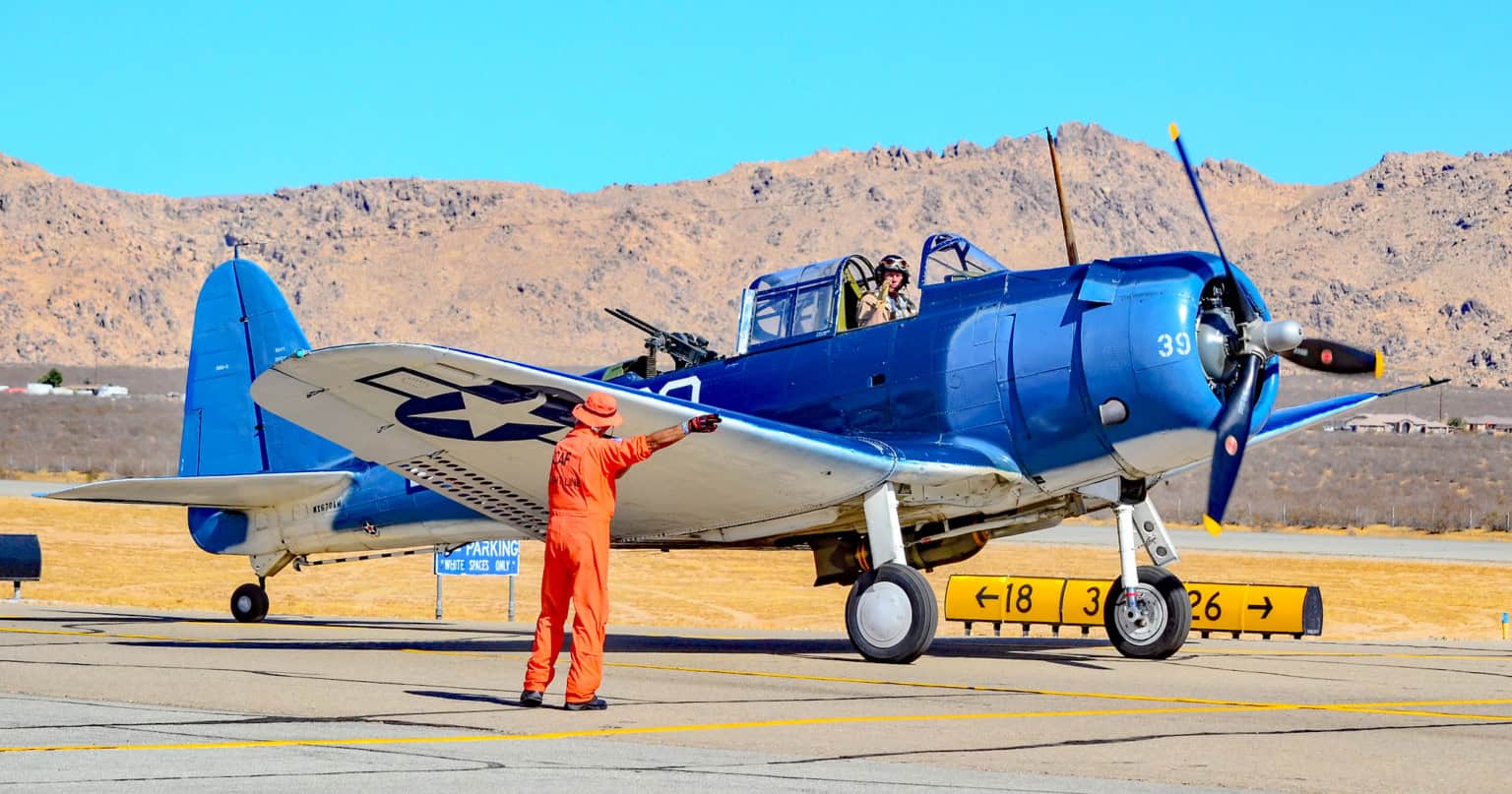

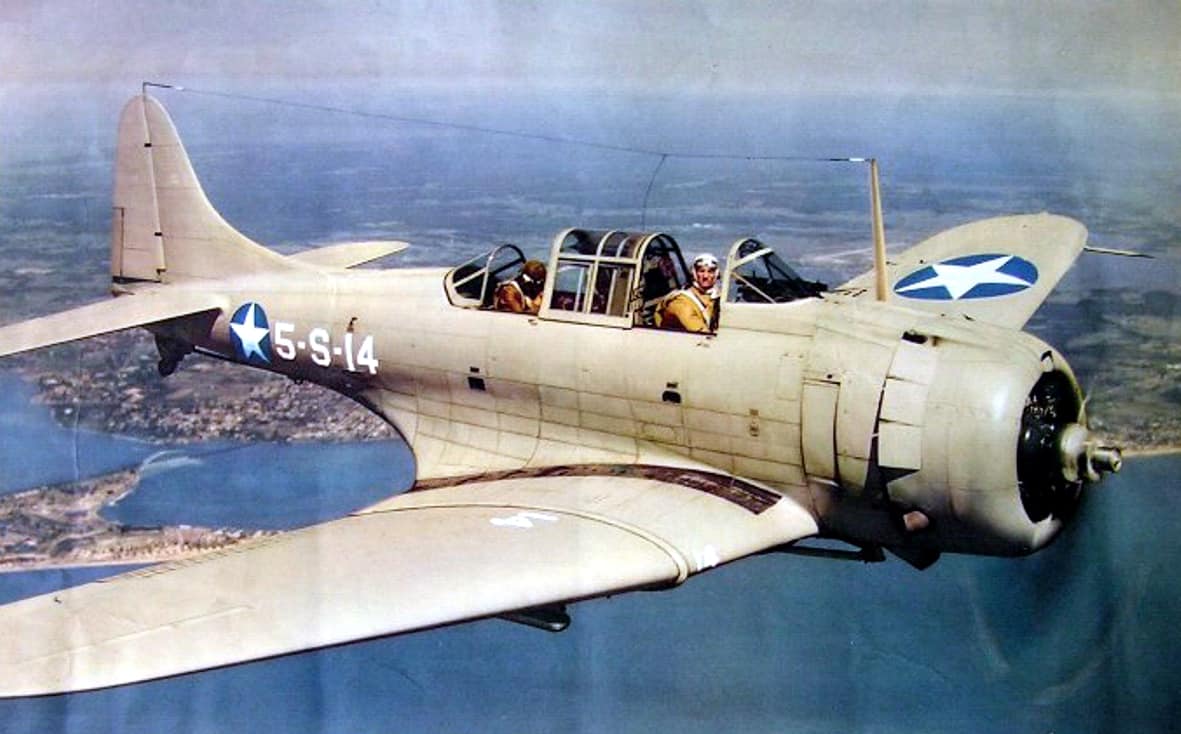


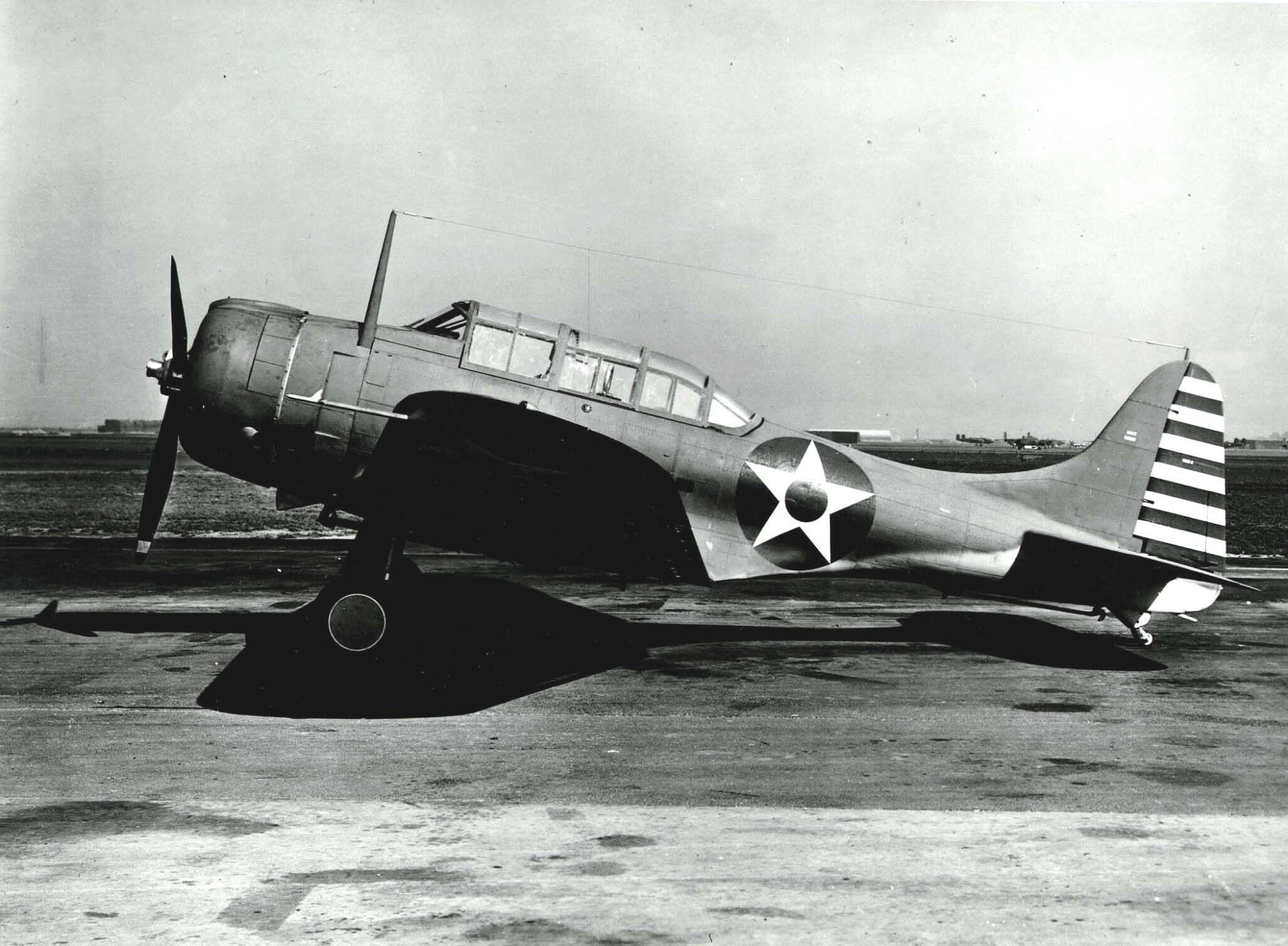

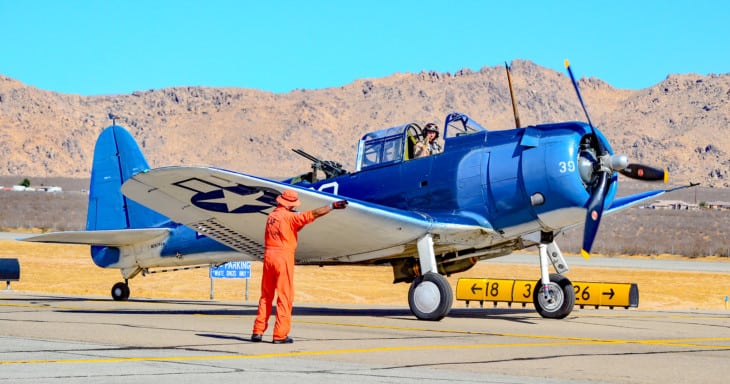
The Douglas SBD Dauntless was the U.S. Navy’s main carrier-based scout plane and dive bomber from mid-1940 to mid-1944. SBD stands for Scout Bomber Douglas, the Navy’s type code for the job and the maker.
It is best remembered for the Battle of Midway in June 1942, where SBDs sank or fatally damaged all four Japanese fleet carriers present. Crews turned the initials into a nickname: Slow But Deadly.
Douglas built 5,936 of them between 1940 and 1944. The Army Air Forces flew a land-based version without the tailhook, the A-24 Banshee.
The Dauntless did not start at Douglas. Design work on its ancestor, the Northrop BT-1, began in 1935, and Douglas took over the Northrop Corporation in 1937.
A team led by Ed Heinemann reworked the design as the BT-2, which became the basis for the SBD. The SBD-1 first flew on May 1, 1940, and the Navy received its first Dauntless on September 6, 1940.

The SBD-1 went to the Marines in late 1940 and the SBD-2 to the Navy in early 1941. They replaced the biplane Vought SBU Corsair and Curtiss SBC Helldiver squadrons on U.S. carriers.
Two design choices defined the aircraft. The first was the perforated split flaps on the wing trailing edges, added on the BT-1 to stop tail buffeting in a dive.
The second was leaving out folding wings, unusual for a carrier aircraft, in favor of structural strength. That made the SBD rugged in a dive, at the cost of deck and hangar space.
A dive bomber aims the whole airplane at the target. The pilot rolls into a steep dive, lines the aircraft up on the ship below, releases the bomb low, and pulls out.
The hard part is speed. Without extra drag, an aircraft pointed at the sea picks up speed fast, which makes it harder to aim and harder to pull out in time.
The SBD’s perforated dive brakes opened out from the wing’s trailing edge to hold the dive speed down. The holes let air pass through the flaps, which kept the tail from buffeting and gave the pilot a steady aiming platform.

The crew was two: a pilot up front and a radioman-gunner facing aft. The pilot flew the airplane, aimed the bomb, and fired two forward .50-caliber machine guns in the cowling.
The gunner covered the tail with one or two flexible .30-caliber guns. In a scouting role the long range mattered as much as the bomb, since finding the enemy fleet came before hitting it.
The SBD’s first major battle was the Coral Sea in May 1942. SBDs and TBD Devastators sank the Japanese light carrier Shōhō and damaged the fleet carrier Shōkaku.
SBDs also flew anti-torpedo patrols over their own carriers there. Lt. (j.g.) William E. Hall of Scouting Squadron 2 on the USS Lexington received the Medal of Honor for his actions during the battle on May 7 and 8.
A month later came Midway. On June 4, 1942, three Navy SBD squadrons (VS-6, VB-6 and VB-3), totaling 47 aircraft, reached the Japanese carrier force at the same time as the torpedo planes of VT-3.

The roughly 40 defending Zeros concentrated on the low-flying torpedo bombers, and most of the TBDs were shot down. That left the dive bombers above them unhindered by fighters.
The SBDs disabled the carriers Akagi, Kaga and Sōryū in about six minutes. Later that day they caught Hiryū, the fourth. SBDs, joined by more from the USS Hornet, then caught two straggling heavy cruisers and damaged both so badly that Mikuma sank.
Not every SBD crew at Midway had the same day. Marine squadron VMSB-241, flying from Midway Atoll, had only just converted from the SB2U Vindicator and was not yet trained in dive bombing.
Its pilots used a shallower glide-bombing attack instead, and many were shot down. One of those Marine SBDs, an SBD-2, survives at the National Naval Aviation Museum in Pensacola.
SBDs flew from carriers and from Henderson Field throughout the six-month Guadalcanal campaign. They were deadly to Japanese ships that had not cleared the Slot, the channel through the Solomons, by daylight.
SBDs sank the carrier Ryūjō near the Solomon Islands on August 24, 1942. During the Naval Battle of Guadalcanal they sank a cruiser and nine transports.
The gunnery was more than defensive. SBD pilot Stanley “Swede” Vejtasa was attacked by three A6M2 Zeros, shot down two, and cut the wing off the third with his own wingtip in a head-on pass.
In the Atlantic, SBDs from the USS Ranger and two escort carriers flew during the Operation Torch landings in North Africa in November 1942. In October 1943 Ranger’s SBDs attacked German shipping around Bodø, Norway.
The last big carrier battle for the type was the Philippine Sea in June 1944. On the long twilight strike against the retreating Japanese fleet, only 115 of 215 aircraft made it back, but all 26 SBDs returned.
A 1944 Naval Aviation News tally credited SBDs with six Japanese carriers, 14 cruisers, six destroyers and 15 transports or cargo ships sunk. The Commemorative Air Force puts the total at more than 300,000 tons of enemy shipping.
By 1944 the Navy was replacing the SBD with the Curtiss SB2C Helldiver. The Helldiver had a more powerful engine, a higher top speed, and could carry nearly 1,000 pounds (450 kg) more bombs.
Many dive bomber pilots still preferred the SBD. It was lighter and handled better at low speed, which counted most in the last seconds of a carrier landing.
The two types fought side by side until the war ended, and Marine squadrons kept flying SBDs to the end. The last SBD left the El Segundo line on July 21, 1944.
Each SBD model was a step up in protection, power or ammunition rather than a new design. Production numbers below come from the variant list in the type’s Wikipedia entry.
German dive-bombing success in Poland and France convinced the U.S. Army to buy its own dive bombers. In 1941 it ordered the Dauntless as the A-24, which flew in the Louisiana maneuvers that September.
Its war went badly. Fifty-two crated A-24s bound for the Philippines were diverted to Australia after Pearl Harbor and arrived worn out and missing gun parts.
On July 26, 1942, seven A-24s attacked a convoy off Buna, New Guinea, and only one came back. Army pilots came to regard the type as too slow, too short-ranged and too poorly armed, and it was moved to training and target towing.
Much of the gap with the Navy’s record came down to training, since Army crews lacked specialized dive-bombing schooling, and their early aircraft were worn out and unarmored. The few A-24s left in 1947 passed to the new Air Force, became F-24s, and were scrapped in 1950.
No. 25 Squadron of the Royal New Zealand Air Force flew SBD-5s in combat in the Solomon Islands in 1944 before switching to the Vought F4U Corsair. A few went to the Royal Navy for evaluation.
Free French units flew A-24Bs against German forces in southern France and on the French Atlantic coast in 1944 and 1945. Mexico and Chile also received the type.
The full specification table for the SBD-5 is on this page. A few of its figures get quoted against each other, so here is what they mean.
Range. The panel shows the published range of 969 nm (1,120 mi) on internal fuel. The same SBD-5 figures give a ferry range of 1,565 miles, and the Air Force Museum lists 950 miles for the A-24 carrying 1,200 pounds of bombs. They describe different loads, not a disagreement.
Top speed. The 255 mph (222 kt) maximum was reached at 14,000 feet (4,300 m) on the 1,200 hp SBD-5. Earlier 1,000 hp models are listed at about 250 mph.
Bomb load. The panel’s payload is the SBD-5’s maximum of 2,250 lb (1,000 kg). Figures for earlier models are lower: the National WWII Museum lists a 1,000-pound maximum for the SBD-3.
Yes. As of September 2026, six SBDs are listed as airworthy, all in the United States.

Many more are on static display, including SBDs recovered from Lake Michigan, where carrier-qualification trainees lost them during the war. The National WWII Museum’s SBD-3 in New Orleans is one of those.
For where the Dauntless sits among its contemporaries, see our guides to the American bombers of WW2 and the aircraft at Pearl Harbor.
SBD stands for Scout Bomber Douglas: SB for the scout bomber role, D for the manufacturer. Crews read it as “Slow But Deadly.”
Yes. As of September 2026, six are listed as airworthy, all in the United States, including examples at Planes of Fame and Yanks Air Museum in Chino, California, and with the Commemorative Air Force in Georgia.
By results, yes. It sank four Japanese fleet carriers at Midway and was credited with six carriers in total by April 1944, and many pilots preferred it to its faster replacement for its handling.
The Curtiss SB2C Helldiver replaced it from 1944. The two served side by side until the end of the war, and the last SBD was built on July 21, 1944.
Douglas built 5,936 between 1940 and 1944, including the Army’s A-24 Banshee versions. The SBD-5 was the most numerous model, at 2,965.
A nine-cylinder Wright R-1820 Cyclone radial. Early models had 1,000 hp, the SBD-5 had the 1,200 hp R-1820-60, and the SBD-6 had 1,350 hp.
The SBD-5 reached 255 mph (411 km/h) at 14,000 feet. It cruised at about 185 mph (298 km/h).
Sources and references used for research and fact-checking.


.jpg)