

Table of Contents
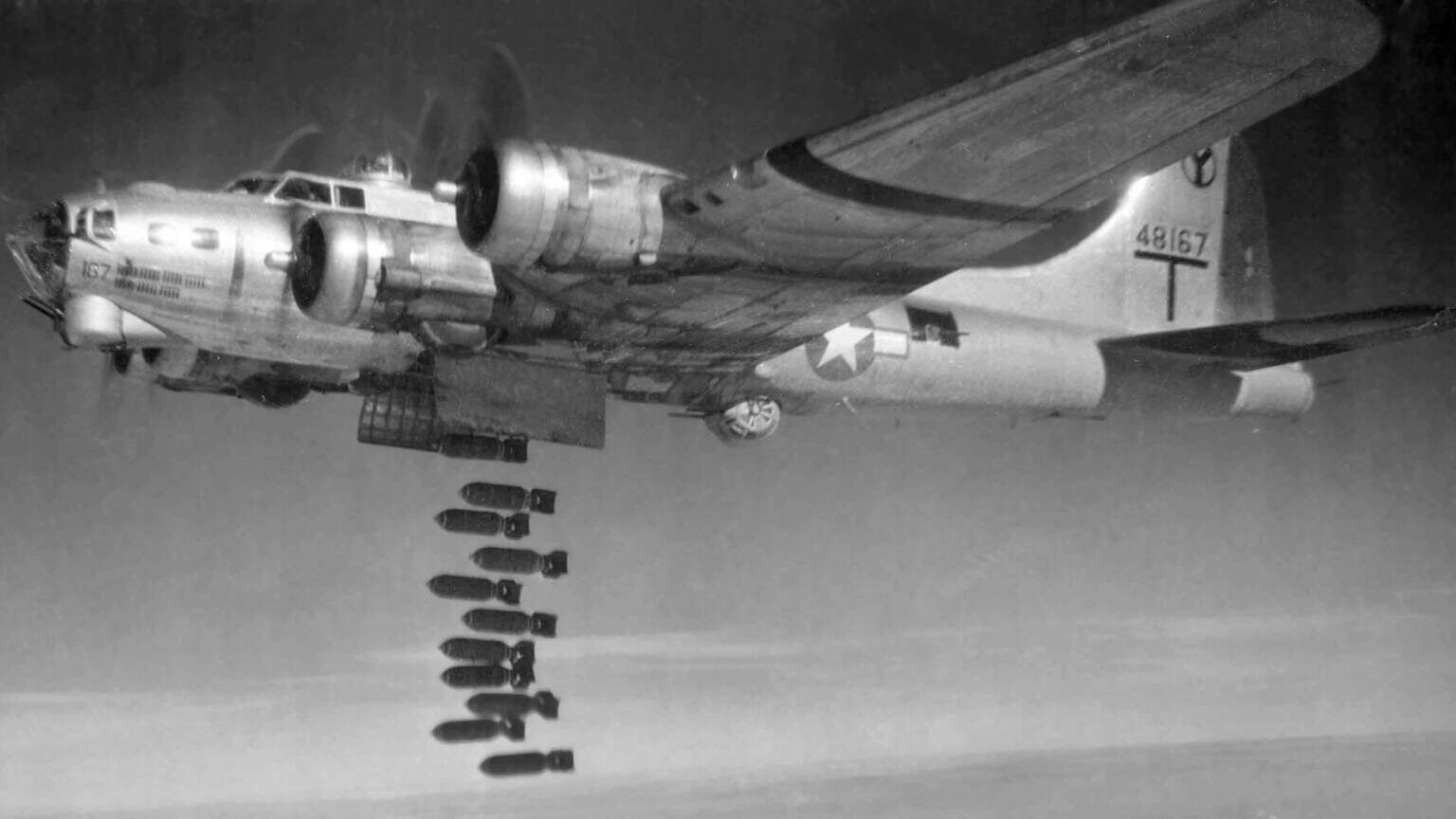
The most important American bomber of World War II was the Boeing B-17 Flying Fortress. The B-24 Liberator was built in bigger numbers and the B-29 Superfortress dropped the atomic bombs, but B-17s alone dropped more than two of every five tons of bombs the Allies dropped on Nazi Germany and the territory it occupied.
That is the measure used here: combat impact and production scale. A bomber earns its place by what it did, how many were built, and whether the war would have gone differently without it.
The list covers ten types across every job America gave its bombers: four-engine heavies, twin-engine mediums, fast light attack bombers, and the Navy’s carrier dive and torpedo bombers. The fighters that escorted them are ranked separately in our guide to American fighter planes of WW2.
The Most Important American Bombers of WW2, Ranked
| Rank | Aircraft | Role | Built | Top speed |
|---|---|---|---|---|
| 1 | Boeing B-17 Flying Fortress | Heavy bomber | 12,731 | 295 mph (475 km/h) |
| 2 | Consolidated B-24 Liberator | Heavy bomber | ~18,500 | 297 mph (478 km/h) |
| 3 | Boeing B-29 Superfortress | Long-range heavy bomber | 3,970 | 357 mph (575 km/h) |
| 4 | Douglas SBD Dauntless | Carrier dive bomber | 5,936 | 255 mph (410 km/h) |
| 5 | North American B-25 Mitchell | Medium bomber | 9,816 | 272 mph (438 km/h) |
| 6 | Grumman TBF Avenger | Carrier torpedo bomber | 9,839 | 278 mph (447 km/h) |
| 7 | Martin B-26 Marauder | Medium bomber | 5,288 | 287 mph (462 km/h) |
| 8 | Douglas A-20 Havoc | Light attack bomber | 7,478 | 317 mph (510 km/h) |
| 9 | Curtiss SB2C Helldiver | Carrier dive bomber | 7,140 | 295 mph (475 km/h) |
| 10 | Douglas A-26 Invader | Light attack bomber | 2,503 | 359 mph (578 km/h) |
How this ranking was made
Bombers are ranked on combat impact and production scale: the campaigns and battles each type decided, the tonnage or ships it accounted for where a figure exists, and how many were built. Navy carrier bombers are ranked alongside the Army Air Forces types, because one of them won the Battle of Midway. Ranked on top speed or bomb load alone, the order would look nothing like this.
The difference between a heavy, a medium and a light bomber is mostly range and load, and it is explained in full in our guide to the types of bomber planes.
1. Boeing B-17 Flying Fortress
The B-17 Flying Fortress is first because it carried the daylight bombing campaign against Germany. Of the roughly 1.5 million tons of bombs Allied aircraft dropped on Nazi Germany and its occupied territories, over 640,000 tons, or 42.6%, came from B-17s.
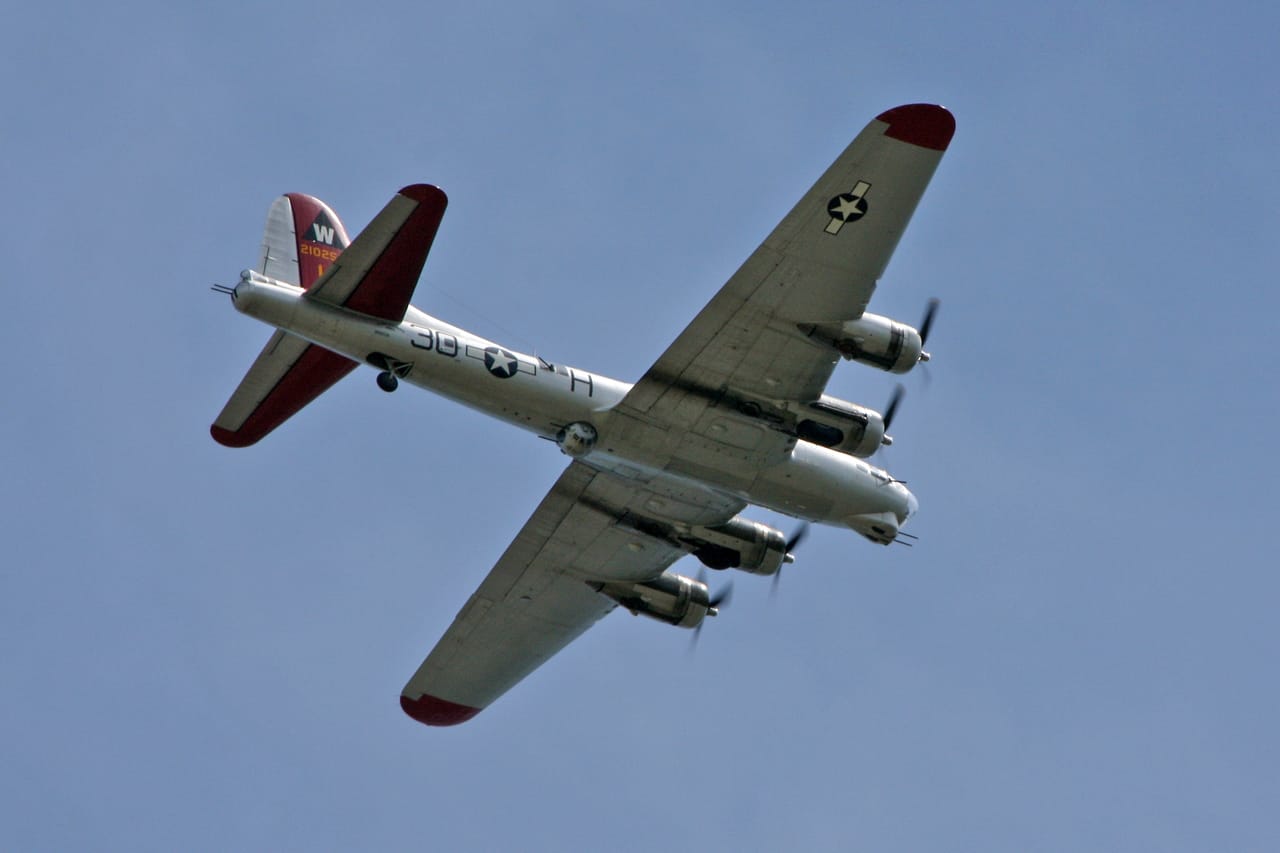
Boeing’s Model 299 prototype first flew on 28 July 1935. A Seattle Times reporter, Richard Williams, saw the guns bristling from the new aircraft and captioned a photo of it a “15-ton flying fortress.”
By the final B-17G version that name was earned. The G carried 13 .50 caliber machine guns and a crew of 10, flew at up to 295 mph (475 km/h) at 25,000 feet, and had a range of about 2,000 miles (3,219 km) with a 6,000-pound (2,700 kg) bomb load.
Its real reputation was for coming home. Stories circulated of B-17s returning with shredded tails, destroyed engines and large parts of their wings shot away, and one pilot said it could be cut almost to pieces and still bring its crew home.
They needed to. As the heavy bomber force over Germany grew through 1943, any raid that flew beyond the range of its P-47 escorts risked being mauled by Luftwaffe fighters. American doctrine bet everything on daylight precision bombing, a gamble our history of the Norden bombsight examines.
A B-17 crash gave aviation the pilot's checklist
On 30 October 1935 the Model 299 prototype stalled and spun in just after takeoff, killing Major Ployer Peter Hill and Boeing test pilot Leslie Tower. The control surface gust lock had not been released. The preflight checklist adopted afterward to prevent a repeat spread to other crews, other aircraft types and eventually the whole aviation world.
A total of 12,731 were built by Boeing, Douglas and Lockheed-Vega.
2. Consolidated B-24 Liberator
The B-24 Liberator is the most-produced American military aircraft in history. At roughly 18,500 built, it also holds the records for the most-produced bomber, heavy bomber and multi-engine aircraft ever made.

On paper it beat the B-17. It first flew on 29 December 1939, reached 297 mph (478 km/h) at 25,000 feet, and could carry 8,000 pounds (3,630 kg) of bombs on a short mission, which is why the Army’s planners favored it.
Crews tended to prefer the Fortress anyway. The Liberator had poor low-speed handling and a lower ceiling, at 28,000 feet.
Its range decided where it went. On 1 August 1943, 177 B-24s flew from North Africa to bomb the oil refineries at Ploiești in Romania in Operation Tidal Wave, and 54 were lost.
Range also made it the standard American heavy bomber in the Pacific and a U-boat killer in the Atlantic. Long-range Liberators helped close the mid-Atlantic air gap, and were credited in full or in part with sinking 93 U-boats.
Ford built a B-24 every hour
Ford Motor Company built 8,685 Liberators. Its purpose-built Willow Run plant near Detroit had the largest assembly line in the world. At its peak in 1944, Willow Run turned out one B-24 an hour and about 650 a month.
Production at that scale is a theme our look at the most produced aircraft in WW2 follows across all combatants.
3. Boeing B-29 Superfortress
The B-29 Superfortress was built with state-of-the-art technology, and it carried the atomic bombs. On 6 August 1945 the B-29 Enola Gay dropped the atomic bomb on Hiroshima, and three days later the B-29 Bockscar dropped the second on Nagasaki.


It was the first Allied production bomber with a pressurized cabin, built for a crew of 11. A computer-controlled fire-control system let its gunners direct four remote machine gun turrets.
It first flew on 21 September 1942 and entered service on 8 May 1944. It could reach 357 mph (575 km/h), carry up to 20,000 pounds (9,070 kg) of bombs, and fly 3,250 miles (5,230 km).
The B-29 cost more than the atomic bomb
Designing and building the B-29 cost about $3 billion, far more than the $1.9 billion spent on the Manhattan Project. The aircraft that delivered the bomb was the more expensive program of the two.
Its weak point was its Wright R-3350 engines, which had dangerous reliability problems. Cylinders had to be replaced every 25 hours and whole engines every 75.
The B-29 raid on Tokyo on the night of 9 to 10 March 1945 is described as the most destructive bombing raid in history.
It ranks third, not first, because it arrived late and fought in one theater. Only 3,970 were built, against more than 31,000 B-17s and B-24s combined.
4. Douglas SBD Dauntless
The SBD Dauntless was a slow two-seat Navy dive bomber, and it delivered the decisive strikes at the Battle of Midway. In June 1942, Dauntlesses sank all four Japanese carriers lost in the battle.


Akagi, Kaga and Soryu were disabled within about six minutes on 4 June. Hiryu was hit later the same day.
Crews said SBD stood for Slow But Deadly. Its top speed was only 255 mph (410 km/h), and it carried up to 2,250 pounds (1,020 kg) of bombs.
It is credited with sinking more enemy shipping in the Pacific than any other Allied bomber. A total of 5,936 were built between 1940 and 1944.
5. North American B-25 Mitchell
The B-25 Mitchell flew America’s first strike on the Japanese home islands. On 18 April 1942, sixteen B-25s took off from the aircraft carrier USS Hornet for the Doolittle Raid on Japan, four months after Pearl Harbor.

All but one of the 16 were destroyed in crashes after the raid, and the last landed at Vladivostok in the Soviet Union.
As a medium bomber it had a top speed of 272 mph (438 km/h) and carried a 3,000-pound (1,360 kg) bomb load.
Later versions became flying gunships. The B-25G carried a 75 mm cannon in its nose, and the B-25H paired a lighter 75 mm gun with up to 18 .50 caliber machine guns.
A total of 9,816 were built, and 862 went to the Soviet Union. On 28 July 1945 a B-25D crashed into the Empire State Building, killing 14 people.
6. Grumman TBF Avenger
The TBF Avenger had the worst possible start. At Midway, six new Avengers flew from Midway Island against the Japanese fleet, and five were shot down.


It recovered from that debut. Avengers played crucial roles in sinking Japan’s super battleships Yamato and Musashi, and were credited with about 30 submarine kills in the Pacific and the Atlantic.
The big three-seat bomber reached 278 mph (447 km/h) and carried a 2,000-pound (907 kg) torpedo or the same weight in bombs. Japan’s own carrier torpedo bombers are covered in our guide to Japanese bombers of WW2.
A total of 9,839 were built, nearly three-quarters of them by General Motors as the TBM. One Avenger pilot, a young George H. W. Bush, was shot down over Chichi Jima on 2 September 1944.
7. Martin B-26 Marauder
The B-26 Marauder is the bomber with the most misunderstood reputation of the war. Early crews called it the Widowmaker, and it finished the war with the lowest loss rate of any bomber the USAAF flew.
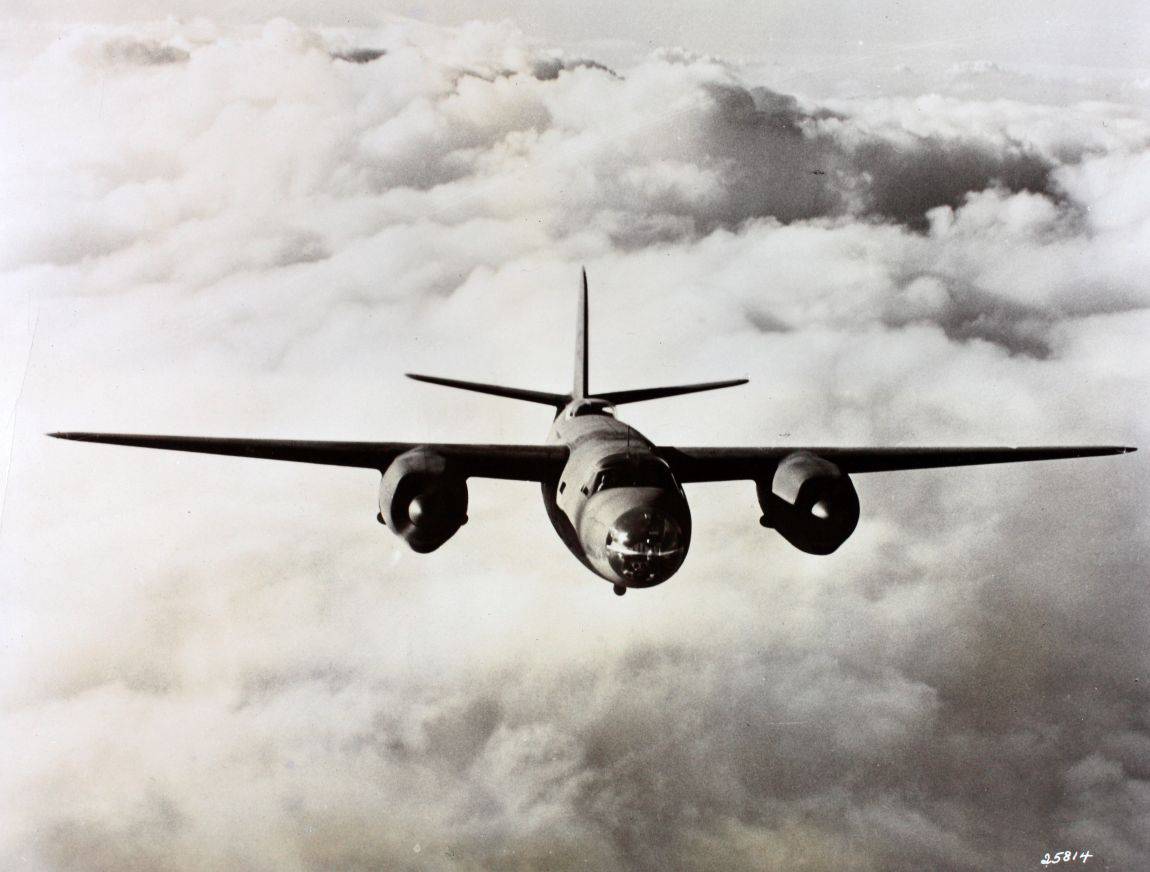
The problem was its small wing. Early Marauders had a wing loading of 53 pounds per square foot (260 kg per square meter), the highest of any aircraft the USAAF had accepted before the B-29, and they approached the runway at about 150 mph (240 km/h).
Early models had a high accident rate on takeoff and landing as a result. Once crews learned to handle it, its combat record turned around completely.
The Widowmaker finished with the best loss rate in the USAAF
Most accounts stop at the nickname. By the end of World War II, the B-26 had the lowest loss rate of any bomber the USAAF operated, and one Marauder, Flak-Bait, survived 207 operational missions over Europe, more than any other American aircraft of the war.
The Marauder carried up to 4,000 pounds (1,800 kg) of bombs at 287 mph (462 km/h). A total of 5,288 were built between February 1941 and March 1945.
8. Douglas A-20 Havoc
The A-20 Havoc is the American bomber most people have never heard of, and one the Soviet Union relied on heavily. A total of 7,478 were built, and 3,414 of them went to the Soviet Union, where more than a third of all A-20s served.
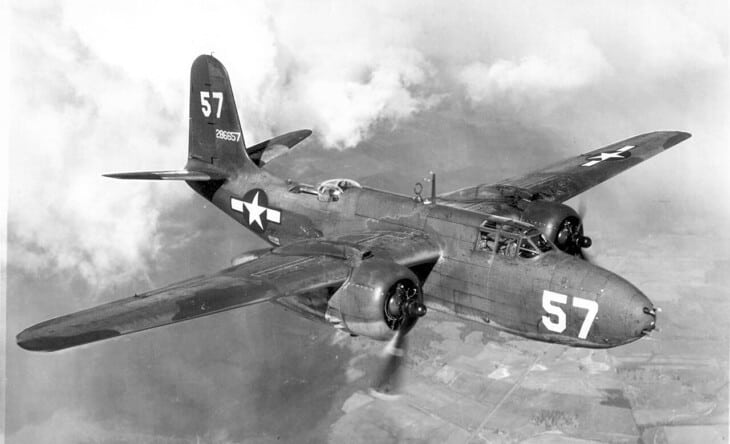
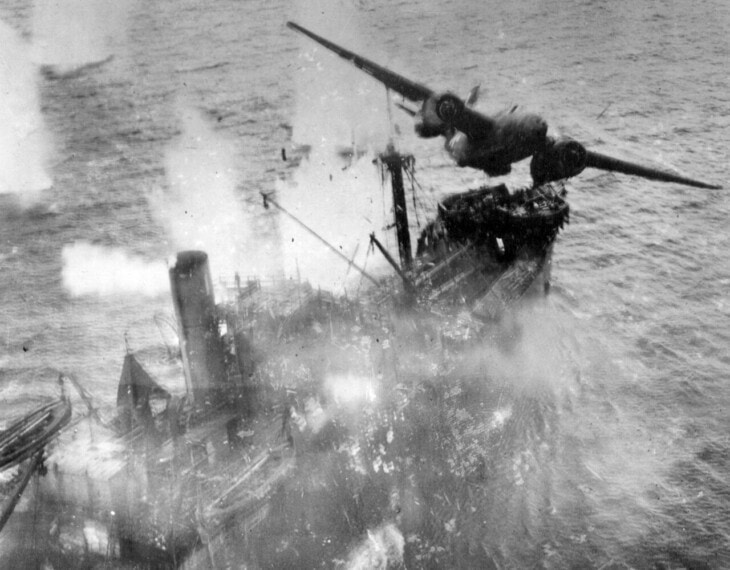
It was fast for a bomber, at 317 mph (510 km/h), and carried up to 4,000 pounds (1,800 kg) of bombs. British and Commonwealth air forces flew it as the Boston, alongside the home-built types in our guide to British bombers of WW2.
It was also part of the Eighth Air Force’s first combat in Europe. On 4 July 1942, 12 crews from the 15th Bombardment Squadron became the first members of the Eighth Air Force to go into combat.
The A-20G dropped the glass nose for a solid one holding four 20 mm cannon and two .50 caliber machine guns. That made it a low-level strafer as much as a bomber.
9. Curtiss SB2C Helldiver
The SB2C Helldiver was built to supplement the Dauntless, and its crews disliked it. They expanded its SB2C designation into Son of a Bitch 2nd Class, after its difficult handling.


It first flew in December 1940 but did not see combat until 11 November 1943, when squadron VB-17 flew it from USS Bunker Hill against Rabaul.
It was faster than the Dauntless at 295 mph (475 km/h) and carried 2,000 pounds (910 kg) of bombs internally. A total of 7,140 were built. Helldivers were credited with a share in sinking Yamato and Musashi, though Avengers probably did more of the damage.
10. Douglas A-26 Invader
The A-26 Invader arrived in the last year of the war, and at 359 mph (578 km/h) it was the fastest bomber on this list.


It first flew on 10 July 1942 and went into action on 23 June 1944, when four A-26Bs attacked targets near Manokwari in New Guinea. It carried up to 6,000 pounds (2,700 kg) of bombs with a crew of three.
It ranks last because it came late and only 2,503 were built. Its second career is the reason it matters: Invaders flew the first USAF bombing mission on North Korea in June 1950 and fought again in Vietnam.
In 1948 the Air Force redesignated it the B-26, which is why it is so often confused with the unrelated Martin B-26 Marauder. The last one left US military service in 1972.
Two American Bombers That Did Not Make the List
Consolidated B-32 Dominator
The B-32 Dominator was ordered as a fallback in case the B-29 failed. Only 118 were built, and it flew about 10 combat missions from May 1945.

It still earned a place in history. On 18 August 1945, B-32 crews flying reconnaissance over Japan were attacked by Japanese fighters, in the last air combat engagement of the war.
Sergeant Anthony Marchione, a photographer’s assistant, was fatally wounded, the last American killed in air combat in World War II. No complete B-32 survives today.
Douglas TBD Devastator
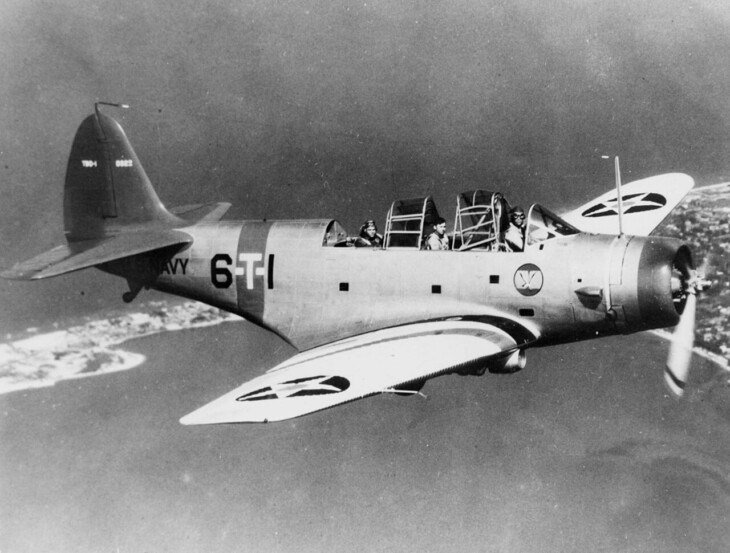
The TBD Devastator is the answer to which American bomber of WW2 was the worst. It was already outdated when the war began, with a top speed of just 206 mph (332 km/h), and only 130 were built.
At Midway, 41 Devastators were launched from Hornet, Enterprise and Yorktown. Only six came back, and Ensign George Gay was the only survivor of Hornet’s Torpedo Squadron 8.
The Navy withdrew the 39 remaining TBDs from front-line units immediately afterward. Other aircraft that failed their crews are collected in our roundup of the worst non-fighter planes of WW2.
What Was the Biggest American Bomber of WW2?
The B-29 Superfortress, and it was one of the largest aircraft of the war. It was 99 feet (30.18 m) long with a wingspan of 141 feet 3 inches (43.05 m).
Its backup, the B-32, came close with a 135-foot (41.1 m) wingspan, but was 17 feet shorter. The B-17 looks small beside both, at 74 feet 4 inches (22.66 m) long with a 103-foot 9-inch (31.62 m) wingspan.
How Many Bombers Did America Build in WW2?
More than 35,000 four-engine heavy bombers. Adding up the B-17, B-24, B-29 and B-32 production totals gives about 35,300 aircraft.
The two main medium bombers, the B-25 and B-26, add about 15,100 more. The A-20 and A-26 light bombers add nearly 10,000, and the Navy’s Dauntless, Avenger and Helldiver about 22,900.
That is roughly 83,000 bombers across the eleven main types in this article. The totals include every variant and the aircraft built for allies such as Britain and the Soviet Union, so not all of them flew under American colors.
What those numbers faced on the other side is covered in our guide to German bombers of WW2.
Are Any American WW2 Bombers Still Flying?
A few are. Counts of airworthy B-17s vary with how they are defined, but Wikipedia’s survivor tally listed three in flying condition as of October 2025, with several more being restored and about 50 on display or in storage.
Europe’s only airworthy B-17, Sally B, flew from Duxford in England on 29 May 2026 for its first flight of the year.
Only two B-29s fly. FIFI belongs to the Commemorative Air Force, and Doc returned to the air from Wichita, Kansas, on 17 July 2016 after 60 years on the ground.
The line these aircraft started continues in today’s fleet, ranked in our list of the best bombers in the world.
FAQ
Sources and references used for research and fact-checking.
- Wikipedia, Boeing B-17 Flying Fortress
- Wikipedia, Consolidated B-24 Liberator
- National Museum of the United States Air Force, Consolidated B-24D Liberator
- National Museum of the United States Air Force, Heavy Bombers
- Wikipedia, Boeing B-29 Superfortress
- Wikipedia, Douglas SBD Dauntless
- Wikipedia, North American B-25 Mitchell
- Wikipedia, Doolittle Raid
- Wikipedia, Grumman TBF Avenger
- Wikipedia, Martin B-26 Marauder
- Wikipedia, Douglas A-20 Havoc
- Wikipedia, Curtiss SB2C Helldiver
- Wikipedia, Douglas A-26 Invader
- Wikipedia, Consolidated B-32 Dominator
- Wikipedia, Douglas TBD Devastator
- Vintage Aviation News, Europe's Only Airworthy B-17 Flying Fortress Returns to the Skies
Get the Newsletter
The latest aviation news and stories sent to your inbox.
About the Author

Tim is the owner and lead editor of AeroCorner since 2019, overseeing aviation content covering aircraft, airlines, airports, and the broader aviation industry. Through years of researching, writing, editing, and publishing aviation-focused content, he has developed extensive practical knowledge of commercial aviation and air travel. Based in Asia and a frequent traveler himself, Tim also brings firsthand passenger experience to AeroCorner’s coverage. Outside of publishing, he has also explored aviation firsthand through hands-on flight training in New Zealand.