Military Propellor Planes
Boeing B-47 Stratojet
ICAO: B47
The most expensive US weapons program of WWII
Updated: by Tim de Vries

The latest aviation news and stories sent to your inbox.
The Boeing B-29 Superfortress was a four-engine American heavy bomber and the most advanced aircraft of its class to fly in the Second World War. It was the first Allied production bomber with a pressurized crew compartment and remote-controlled gun turrets aimed by analog computers, and the only aircraft ever to deliver a nuclear weapon in war. Boeing, Bell and Martin built 3,970 between 1943 and 1946; 22 survive today and two still fly.
Live Fleet Activity (B29)
Fetching live data…
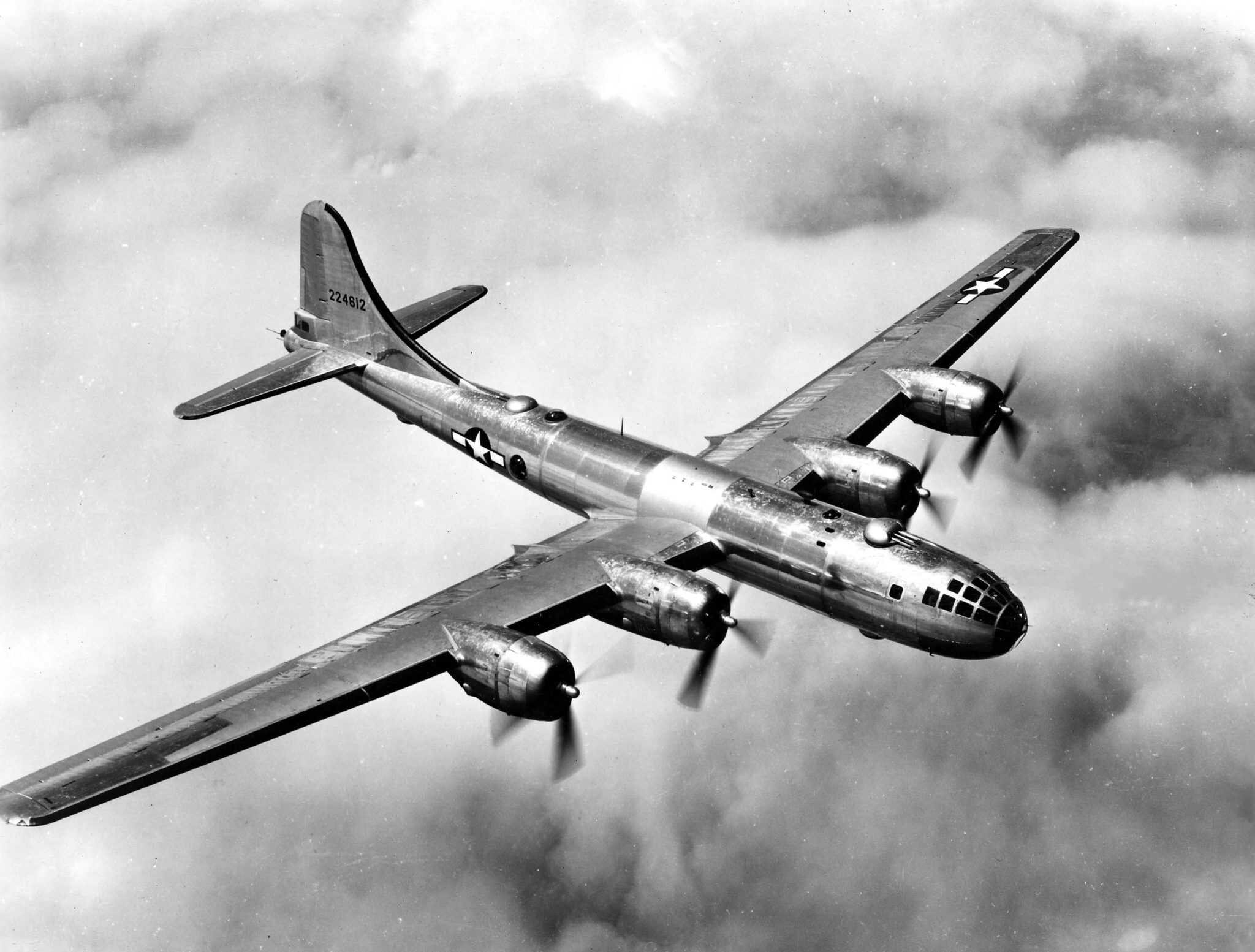


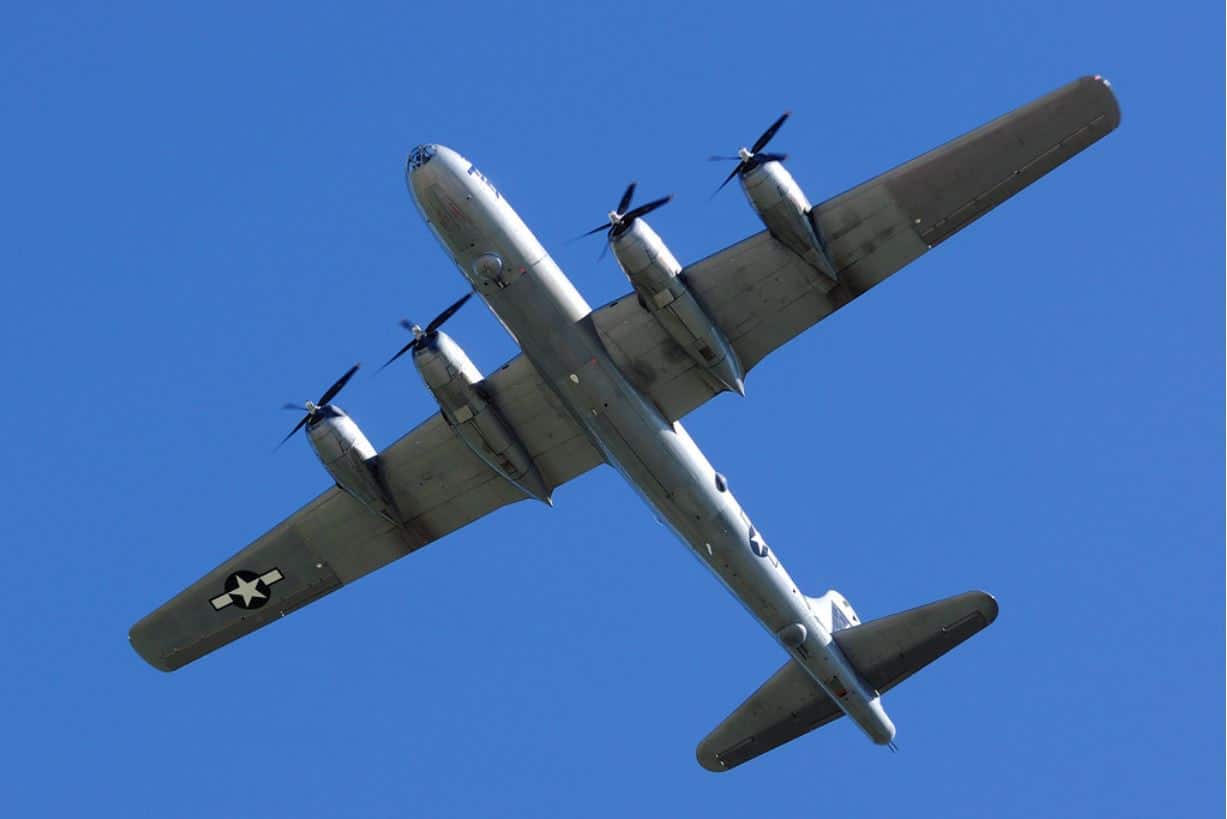
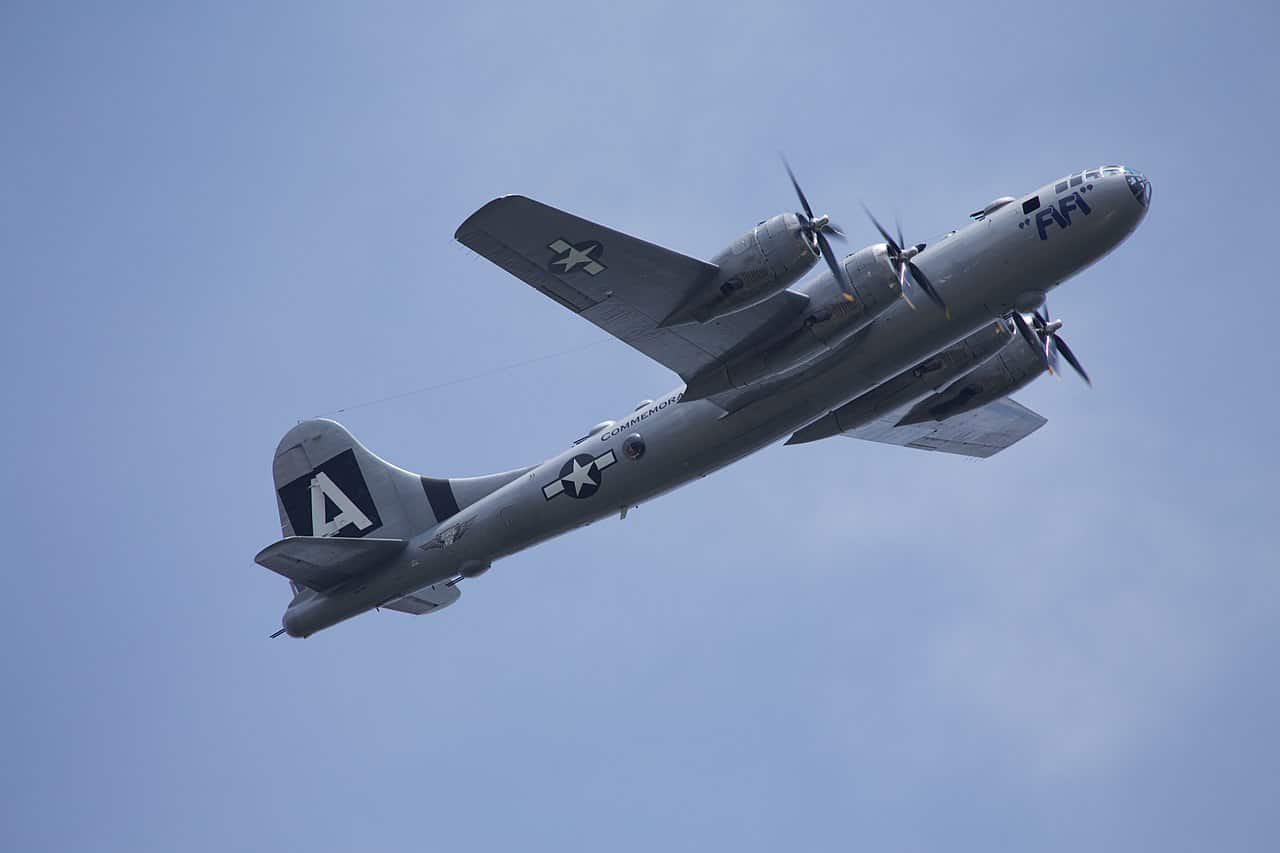

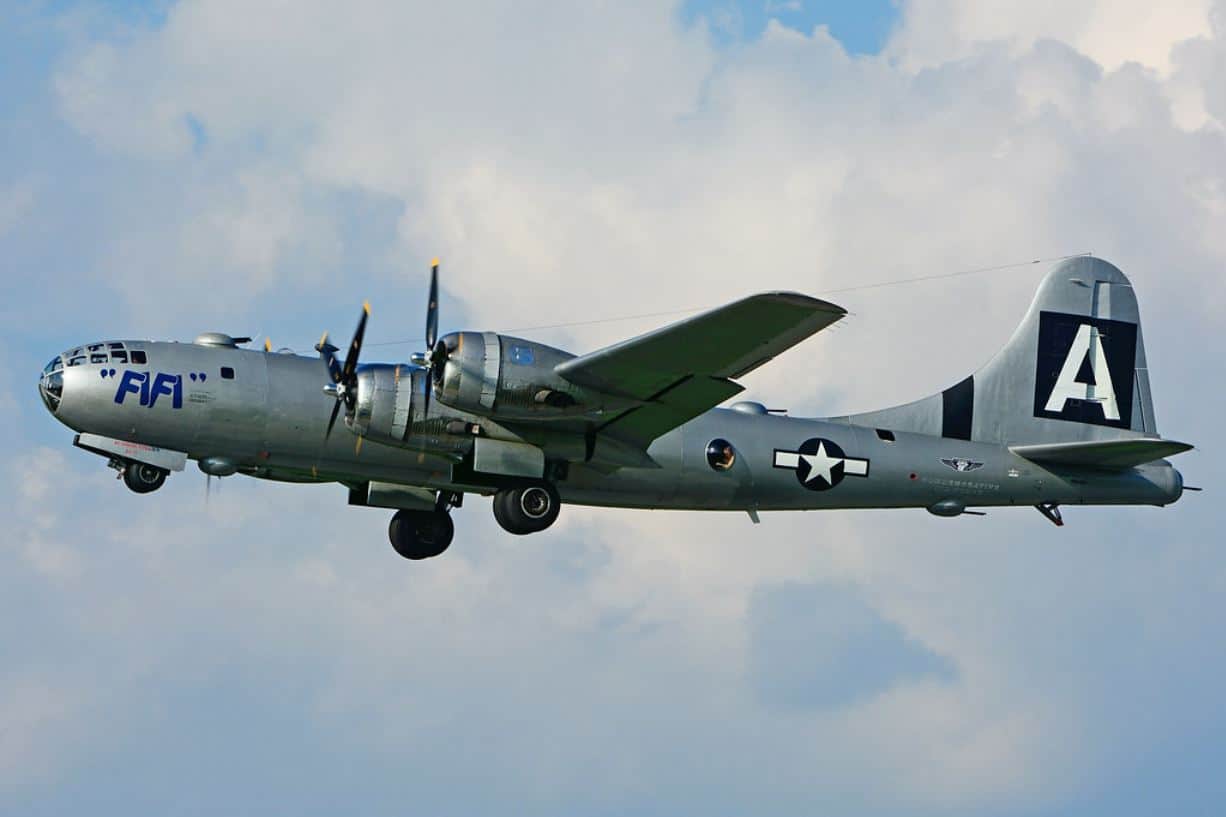


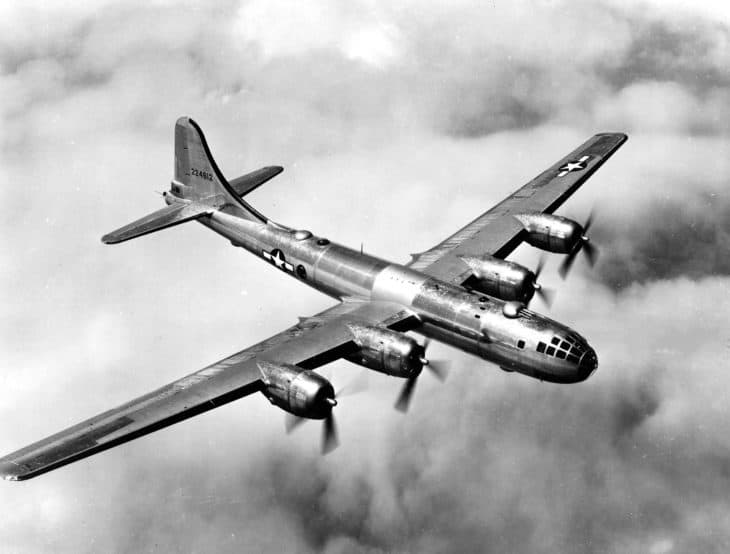
The Boeing B-29 Superfortress was the most expensive American weapons program of the Second World War. Design and production cost about $3 billion, more than the $1.9 billion spent on the Manhattan Project.
It was the first Allied production bomber with a pressurized crew compartment, and it carried remote-controlled gun turrets aimed by analog computers. It was also the aircraft that dropped the atomic bombs on Hiroshima and Nagasaki, and it remains the only aircraft ever to deliver a nuclear weapon in war.
Boeing and its partners built 3,970 of them between 1943 and 1946. Twenty-two survive today, and two of those still fly.
Boeing began studying long-range bombers in 1938, well before the United States entered the war and before most of the other American bombers of WWII were on paper. The Model 334 was a pressurized development of the B-17 Flying Fortress with nosewheel undercarriage, and when the Air Corps could not fund it, Boeing carried on with its own money.
In December 1939 the Air Corps issued a formal specification for a “superbomber” that could carry 20,000 pounds (9,100 kg) of bombs to a target 2,667 miles (4,292 km) away at 400 mph (640 km/h). Those numbers were far beyond anything then flying.
Boeing submitted its Model 345 on 11 May 1940, against designs from Consolidated, Lockheed and Douglas. On 24 August 1940 it received an order for two flying prototypes designated XB-29, and by January 1942 the production order had grown to 500 aircraft.
The first prototype flew from Boeing Field in Seattle on 21 September 1942. The name Superfortress was not assigned until March 1944, by which point the aircraft had been in development for four years and was still not combat ready.
The B-29’s defining feature was comfort at altitude. Garrett AiResearch developed the first cabin pressurization system fitted to an Allied production bomber, letting the crew work without oxygen masks and heated suits at heights where a B-17 crew froze.
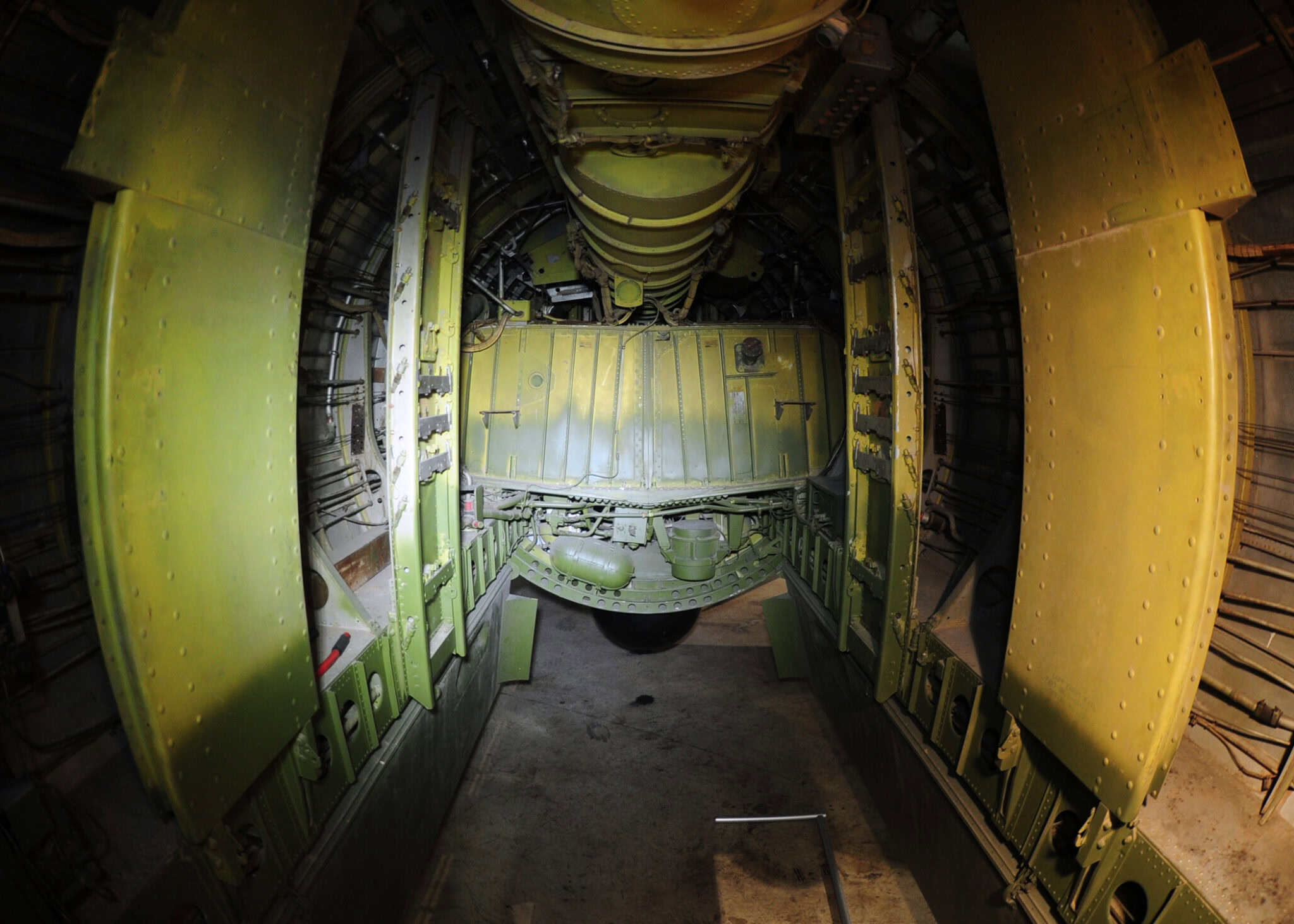
The bomb bays could not be pressurized, so the designers split the aircraft into forward and rear pressurized compartments joined by a long tunnel over the bays. Crew could crawl between the two when they had to.
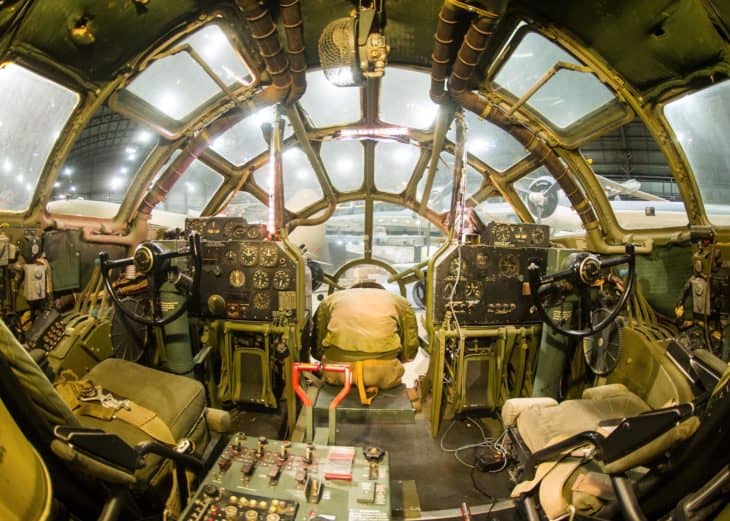
The General Electric Central Fire Control system directed four remotely controlled turrets, each with two .50 caliber Browning M2 machine guns. Five sighting stations, in the nose, the tail and three fuselage blisters, fed five analog computers that corrected for airspeed, lead, gravity, temperature and humidity.
One gunner could operate two or more turrets at once, and the upper gunner acted as fire control officer, handing turrets around the crew as a fight developed. The tail position carried two more .50 caliber guns and a 20 mm M2 cannon, though the cannon was later removed from many aircraft.
The USAF museum fact sheet describes the standard fit as eight .50 caliber guns in the remote turrets plus the two guns and the cannon in the tail. Wikipedia’s specification block lists ten in the turrets, because the forward upper turret’s armament was later doubled to four guns.
A crew of 11 flew the aircraft: pilot, co-pilot, bombardier, flight engineer, navigator, radio operator, radar observer, three gunners and a central fire control gunner.
The Wright R-3350 Duplex-Cyclone was the B-29’s worst problem. The 18-cylinder radial later became a dependable engine in large piston aircraft, but early examples caught fire with alarming regularity.
The second prototype flew on 30 December 1942 and the flight was cut short by a serious engine fire. On 18 February 1943 it caught fire again and crashed into Seattle, killing Boeing test pilot Edmund T. Allen and his ten-man crew, 20 workers at the Frye Meat Packing Plant and a Seattle firefighter.
Fixes came in layers. Propeller cuffs forced more cooling air into the intakes, baffles directed airflow onto the exhaust valves, oil flow to the valves was increased, and asbestos baffles were fitted around the push rod seals to stop oil loss.
Maintenance schedules absorbed the rest of the risk. Ground crews replaced the top five cylinders every 25 engine hours and whole engines every 75 hours. The problem was not properly solved until the B-29D and B-50 program moved to the Pratt & Whitney R-4360 Wasp Major, which arrived too late for the war.
Pilots adapted their technique as well. Radial engines need airflow to stay cool, so a B-29 crew chased airspeed after liftoff rather than altitude, and some checked the magnetos during the takeoff roll instead of during a static run-up.
By the end of 1943, almost 100 B-29s had been delivered and only 15 of them were airworthy. Changes were arriving so fast that aircraft flew from the production lines straight to modification depots to be rebuilt to the latest standard.
Some of those depots had no hangar big enough for a B-29, so the work was done outdoors in freezing weather. General Henry “Hap” Arnold intervened and sent production staff from the factories to the modification centers.
The effort became known as the Battle of Kansas, and it modified 150 aircraft in five weeks between 10 March and 15 April 1944. Four main assembly plants built the type: Boeing at Renton and Wichita, Bell at Marietta, Georgia, and Martin at Bellevue, Nebraska.
The original plan was to base the B-29 in Egypt for raids on Germany. By late 1943 that had changed, and the aircraft was committed entirely to the Pacific.
Operation Matterhorn put XX Bomber Command at forward bases around Chengdu in southern China, supplied through India. The logistics were brutal and only a limited part of Japan was in reach, which is why the Marianas mattered.
US forces invaded Saipan on 15 June 1944 and secured it by 9 July, with Guam and Tinian following by August. Seabees built five major airfields, each sized for a bomb wing of four groups, or 180 B-29s.
The first B-29 reached Saipan on 12 October 1944. On 24 November 1944 the 73rd Bomb Wing sent 111 B-29s against Tokyo, the first attack on the Japanese capital since the Doolittle Raid in April 1942.

In early 1945 Major General Curtis LeMay, commanding XXI Bomber Command in the Marianas, switched the force from high-altitude daylight bombing with high explosives to low-altitude night raids with incendiaries.
The incendiary campaign opened against Kobe on 4 February 1945 and peaked on the night of 9 to 10 March 1945 over Tokyo, in what is generally recorded as the most destructive bombing raid in history.
LeMay also ordered most defensive armament and sighting equipment stripped from his aircraft, which let them carry more fuel and bombs. Bell Atlanta built 311 B-29Bs with no turrets at all except a tail position fitted with AN/APG-15 gun-laying radar.
Less famous but arguably as damaging was Operation Starvation, the aerial mining of Japanese ports and shipping lanes from April 1945. It cut Japan’s ability to feed its population and move its troops.
The Silverplate aircraft were B-29s modified to carry nuclear weapons. The British Avro Lancaster was considered first because it needed less modification, but the B-29’s range and high-altitude performance settled the matter, and modification work began in November 1943.
The biggest change was an enlarged bomb bay able to take either Little Boy or Fat Man. Silverplate aircraft also had fuel injection and reversible-pitch propellers, and were stripped of every gun except the tail position to save weight.
Enola Gay, flown by Colonel Paul Tibbets, dropped Little Boy on Hiroshima on 6 August 1945. Bockscar, flown by Major Charles W. Sweeney, dropped Fat Man on Nagasaki three days later.

Sixty-five airframes were eventually built to the Silverplate and successor Saddletree specifications, through to the end of 1947. Three of them survive.
Four B-29s came down in Soviet territory during 1944 after battle damage or engine failure on raids against Japan and Manchuria. One crashed after its crew bailed out, and the rest were interned despite American requests for their return.
Stalin ordered the Tupolev design bureau to copy the aircraft for quantity production. The work was not simple: Soviet aluminum came in metric gauges rather than imperial, so the whole airframe had to be re-engineered, and Tupolev substituted his own airfoil sections and the Shvetsov ASh-73 radial.
The Tupolev Tu-4, NATO reporting name Bull, appeared in 1947 along with the Tu-70 transport derivative. The Soviets built 847 of them.
Production ended when Boeing’s Renton factory completed the last aircraft on 28 May 1946. Many went straight into storage and were scrapped as surplus, while others equipped Strategic Air Command when it formed on 21 March 1946.
The B-29 went back to war in Korea from 1950. Daylight strategic missions worked at first, but North Korea had few strategic targets and the arrival of Soviet MiG-15 jets changed the calculation.
After 28 aircraft were lost, raids were restricted to night missions, mostly interdicting supplies. B-29s dropped the 1,000 pound (450 kg) Razon and 12,000 pound (5,400 kg) Tarzon radio-guided bombs against bridges and dams.
Across the war B-29s flew 20,000 sorties and dropped about 200,000 tons of bombs. Gunners were credited with 27 enemy aircraft, and 78 B-29s were lost, 57 in action and 21 to non-combat causes. The last B-29 mission of the war was flown on 27 July 1953 by the 91st Strategic Reconnaissance Squadron.
The arrival of the Convair B-36 pushed the B-29 down to medium bomber status. The type was retired from US military service on 21 June 1960.
The variants looked alike from outside but differed in the wing center section, which changed the span slightly. The Renton-built B-29A-BN used a different subassembly process and was a foot longer in span, while the Georgia-built B-29B saved weight by deleting armament.
Conversions covered a wide spread of roles: CB cargo carriers, SB rescue aircraft, WB weather ships, TB trainers and KB aerial tankers. Some B-29s flew as relay television transmitters under the Stratovision program.
Others became motherships. A B-29 air-launched the Bell X-1 supersonic research aircraft, and B-29s carried the McDonnell XF-85 Goblin parasite fighter and the experimental jet engines tested by the XB-29G.
The airframe seeded a family. The re-engined B-29D became the B-50 Superfortress, the C-97 Stratofreighter led to the Boeing 377 Stratocruiser, and the KB-29 and KC-97 tankers followed. The Soviet Tu-4 sat on the other side of the same lineage.
The Royal Air Force operated 87 loaned aircraft as the Washington B.1 from March 1950 until March 1954, filling the gap until the English Electric Canberra arrived. Two of those were passed to the Royal Australian Air Force in 1952 for trials.
The full specification table for the aircraft is on this page. A few of its figures move a long way depending on which source and which configuration you read, so they are worth unpacking.
Range is the worst offender. The specification block figure is 3,250 miles (5,230 km) at 25,000 feet with a 5,000 pound bomb load, which is the 2,824 nautical miles in the panel. The USAF museum fact sheet quotes 3,700 miles, the ferry range was 5,600 miles, and Google’s knowledge panel usually shows a figure near that ferry number rather than the combat one.
Practical operational radius was smaller still, roughly 1,600 to 1,800 miles. That is the number that explains the whole Marianas campaign: Tokyo sits about 1,500 miles north of Saipan.
Bomb load works the same way. The 20,000 pound (9,072 kg) maximum applies to short distances at low altitude. Over a 1,600 mile radius the aircraft carried 12,000 pounds at medium altitude or 5,000 pounds at high altitude.
Speed is cleaner. The specification block gives a maximum speed of 357 mph (310 kt) and a cruise speed of 220 mph (191 kt), both exactly as the panel shows them, and ICAO’s own type record for the B29 designator lists the same pair.
Service ceiling is quoted as 31,850 feet by Boeing, which is the panel figure, while the USAF museum fact sheet gives 33,600 feet. Both are in the band where Japanese fighters struggled to reach the aircraft at all, which was the B-29’s best defense for most of 1944.
Maximum takeoff weight is 133,500 lb (60,500 kg), with 135,000 pounds quoted as a combat overload. Postwar B-29s with later R-3350-79 and -81 engines were cleared to 140,000 pounds, which is why some reference works list a higher weight for the same designation.
Unit cost was $639,188 in 1945 dollars, and the panel carries that as the flyaway figure. The prototype cost $3,392,396.60, and the program as a whole ran to around $3 billion.
Twenty-two B-29s survive. Twenty of them are in the United States, with just two abroad: It’s Hawg Wild at the Imperial War Museum Duxford, and one at the KAI Aerospace Museum in Sacheon, South Korea.
Three of the surviving airframes are Silverplate aircraft. Enola Gay is at the Smithsonian’s Steven F. Udvar-Hazy Center outside Washington Dulles, Bockscar is at the National Museum of the United States Air Force, and 45-21748 is at the National Museum of Nuclear Science and History in Albuquerque.
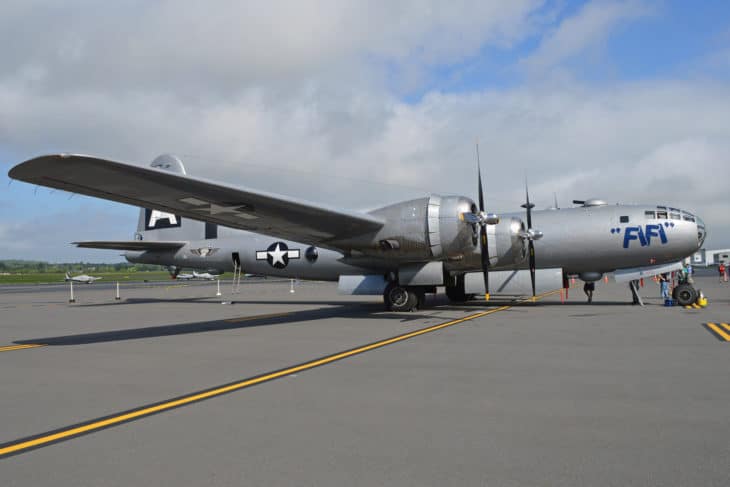
Two of the 22 are airworthy. FIFI belongs to the Commemorative Air Force and headlines its AirPower History Tour, and Doc belongs to Doc’s Friends in Wichita and first flew again on 17 July 2016 after 60 years on the ground.
Both were flying as of September 2026. Doc pushed several early-season 2026 tour stops later in the year to finish engine maintenance, and the Commemorative Air Force published a full 2026 national tour schedule built around FIFI.
Twenty-two B-29s are preserved worldwide, and two of them still fly: FIFI, operated by the Commemorative Air Force, and Doc, operated by Doc’s Friends in Wichita. Both were active in the 2026 airshow season. Only two of the 22 are outside the United States.
It was demanding, mostly because of its engines. The Wright R-3350 was prone to fires, and crews climbed away from the runway chasing airspeed rather than altitude, because a radial engine starved of cooling airflow could fail and burn.
Ground crews replaced the top five cylinders every 25 engine hours and whole engines every 75 hours to keep the risk manageable. The airframe itself was modern and pressurized, and by 1945 standards it was a comfortable aircraft to operate at altitude.
The best-documented figures come from the Korean War, where 78 B-29s were lost in total: 57 in action and 21 to non-combat causes. Twenty-eight of those losses came after Soviet MiG-15s appeared over Korea in 1950, which pushed the fleet onto night missions for the rest of the war.
In the same war, B-29 gunners were credited with shooting down 27 enemy aircraft, though Soviet records confirm only one MiG-15 lost to a B-29, on 6 December 1950.
By the destruction it caused, the B-29 has the strongest claim. The incendiary raid it flew against Tokyo on the night of 9 to 10 March 1945 is generally recorded as the most destructive bombing raid in history, exceeding either of the atomic missions.
Silverplate B-29s then dropped the only two nuclear weapons ever used in war, on Hiroshima and Nagasaki in August 1945. No other aircraft type has done either.
3,970 were built between 1943 and 1946, across four main assembly plants: Boeing at Renton and Wichita, Bell at Marietta, Georgia, and Martin at Bellevue, Nebraska. The last one was completed at Renton on 28 May 1946.
A standard B-29 carried ten .50 caliber Browning M2 machine guns in four remotely controlled turrets, plus a tail position with two more .50 caliber guns and a 20 mm M2 cannon. The cannon was removed from many aircraft later in the war.
The turrets were aimed optically from five sighting stations and computed by five General Electric analog computers, which let one gunner run more than one turret. Maximum bomb load was 20,000 pounds (9,072 kg).
Boeing gives a service ceiling of 31,850 feet, and the USAF museum fact sheet quotes 33,600 feet. Either way the aircraft cruised above the practical reach of most Japanese interceptors, which was the point of the pressurized, turbosupercharged design.
Maximum speed was 357 mph (574 km/h) and normal cruise was 220 mph (354 km/h). Those convert to the 310 knots and 191 knots in the specification panel, and ICAO’s type record for the B29 designator lists the same figures.
The re-engined B-50 Superfortress took over first, then the Convair B-36 pushed the B-29 down to medium bomber status. The jet-powered Boeing B-47 Stratojet replaced the B-50 in the early 1950s, and the B-52 Stratofortress replaced the B-47.
The Royal Air Force flew 87 loaned aircraft as the Washington B.1 between March 1950 and March 1954, and passed two of them to the Royal Australian Air Force in 1952. The US Navy operated four as P2B patrol bombers.
The Soviet Union never received any officially. It interned B-29s that diverted to Soviet territory in 1944 and reverse-engineered them into the Tupolev Tu-4, of which 847 were built.
Sources and references used for research and fact-checking.