

Table of Contents
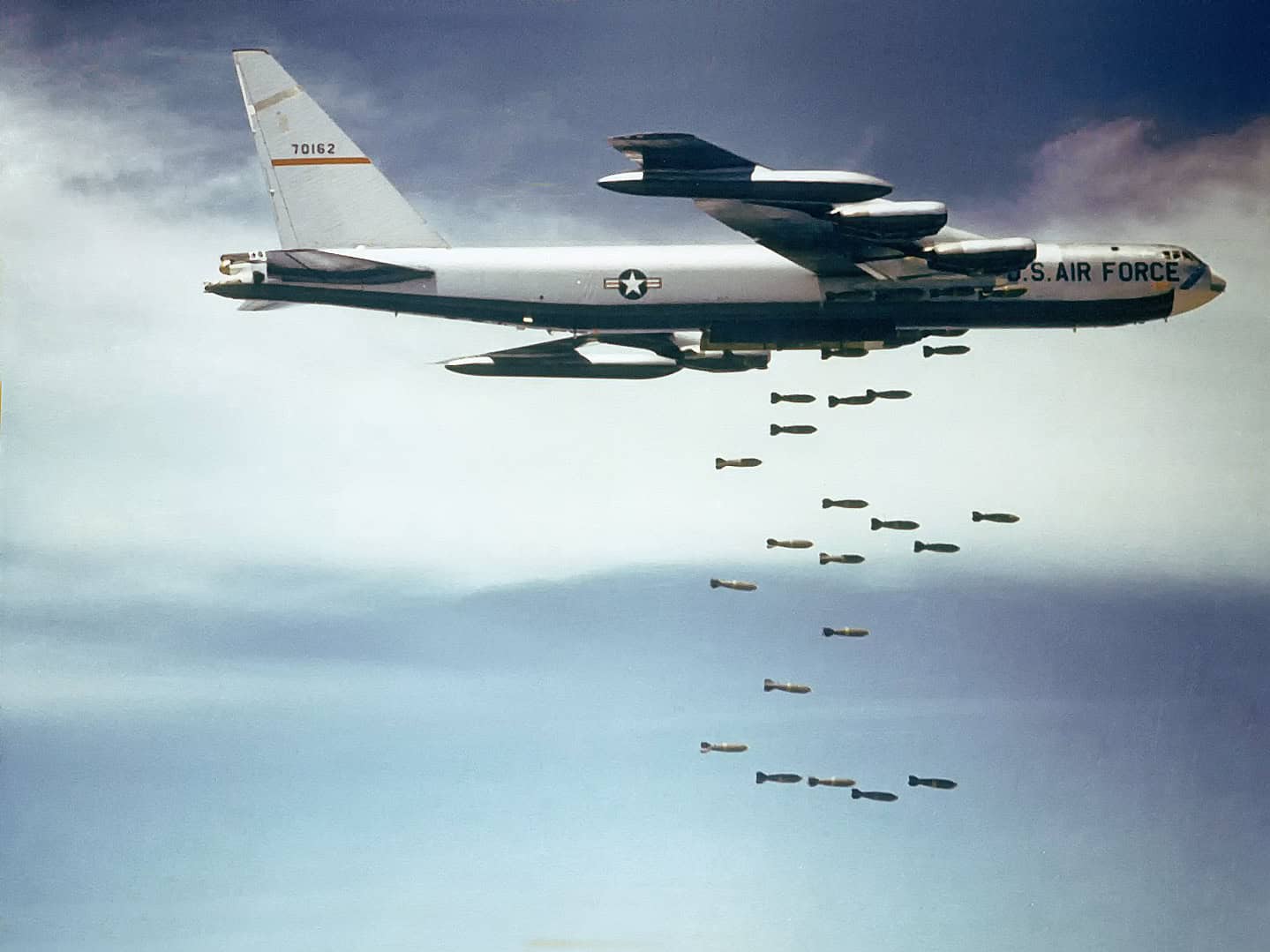
Bomber planes are military aircraft built to drop bombs, launch torpedoes, or fire cruise missiles at targets on the ground or at sea. They are sorted two ways: by mission (strategic or tactical) and by size (heavy, medium, or light), plus a set of specialist types such as dive bombers, torpedo bombers, and stealth bombers.
Only three countries still fly strategic heavy bombers in 2026: the United States, Russia, and China. Most of the other types on this list are history, their jobs absorbed by fighters and attack jets that carry bombs of their own.
This guide covers all 12 types, what each one does, and the aircraft that defined it. It is the bomber chapter of our wider guide to the types of military planes, and the table below is the quick version.
| Type | What it does | Status in 2026 | Defining example |
|---|---|---|---|
| 1. Strategic bomber | Hits factories, bases, and supply lines far behind the front | In service (US, Russia, China) | B-52 Stratofortress |
| 2. Tactical bomber | Supports the ground battle at shorter range | Role now flown by strike aircraft | Panavia Tornado IDS |
| 3. Heavy bomber | Largest payload and longest range of its era | In service | B-29 Superfortress |
| 4. Medium bomber | Mid-size bomb loads over medium distances | Class ended after WWII | B-25 Mitchell |
| 5. Light bomber | Small, fast, about one ton of bombs | Class ended after WWII | de Havilland Mosquito |
| 6. Dive bomber | Dives straight at the target for accuracy | Retired after WWII | Junkers Ju 87 Stuka |
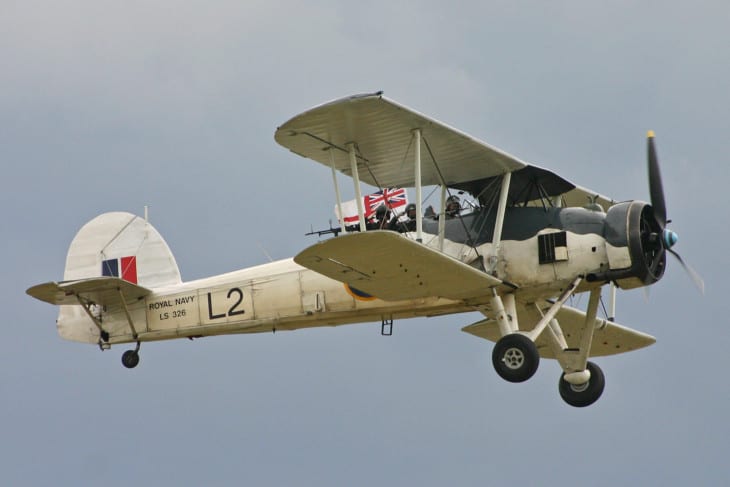
| 7. Torpedo bomber | Drops torpedoes at ships | Retired after WWII | Fairey Swordfish |
| 8. Patrol bomber | Hunts ships and submarines over the sea | Now called maritime patrol aircraft | PBY Catalina |
| 9. Fighter-bomber | A fighter that also carries bombs | Now called the strike fighter | P-47 Thunderbolt |
| 10. Attack aircraft | Strikes targets close to friendly troops | In service | A-10 Thunderbolt II |
| 11. Supersonic bomber | Trades payload for speed to get through defenses | In service | Tu-160 Blackjack |
| 12. Stealth bomber | Evades radar to reach defended targets | In service; B-21 in testing | B-2 Spirit |
Why one bomber can be three types at once
The categories overlap because they measure different things. Strategic and tactical describe the mission, heavy, medium, and light describe the size, and stealth or supersonic describe the design. The B-52 is a strategic bomber by mission and a heavy bomber by size, yet in Vietnam, Afghanistan, and Iraq it flew mostly tactical missions.
Looking for which bomber is actually the best rather than how they are classified? That question gets its own ranking in our list of the best bombers in the world.
What Makes a Plane a Bomber?
A bomber is a combat aircraft whose main weapons point at the ground or the sea: bombs, torpedoes, or air-launched cruise missiles. That sets it apart from a fighter, which exists to destroy other aircraft.
The design follows from the job. A bomber is built around payload and range, so it carries a large internal weapons bay, a big fuel load, and a crew sized for long missions. The B-52 flies with five crew members, the B-1B with four, and the B-2 with two.
In the US system, bombers carry the letter B in their designation, as in B-52 or B-2. Aircraft that drop bombs but were designed for something else, such as the F-15E or the A-10, carry F or A instead.
A Short History of the Bomber
The first bombs dropped from an airplane were hand grenades. On November 1, 1911, during the Italo-Turkish War in Libya, Italian Second Lieutenant Giulio Gavotti dropped four of them on enemy positions.
A year later, on October 16, 1912, Bulgarian observer Prodan Tarakchiev dropped bombs on the Turkish railway station at Karağaç from an Albatros F.2. That raid is generally counted as the first use of an aircraft as a bomber.
Aircraft designed for bombing from the start followed in 1913 with the Italian Caproni Ca 30 and the British Bristol T.B.8. What Italy flew a generation later is covered in our guide to the Italian bombers of WW2.
The First World War turned the idea into a weapon. By December 1914, a Russian squadron of ten Sikorsky Ilya Muromets was bombing German positions on the Eastern Front, and from May 1917 German Gotha bombers raided London, killing 162 civilians in a single attack on June 13, 1917.
Most of the types on this list first appeared in that war, which you can follow in our guide to the airplanes of WW1. The Second World War then made the bomber the centerpiece of air power, as covered in our overview of the airplanes of WW2.
1. Strategic Bombers
.jpg)
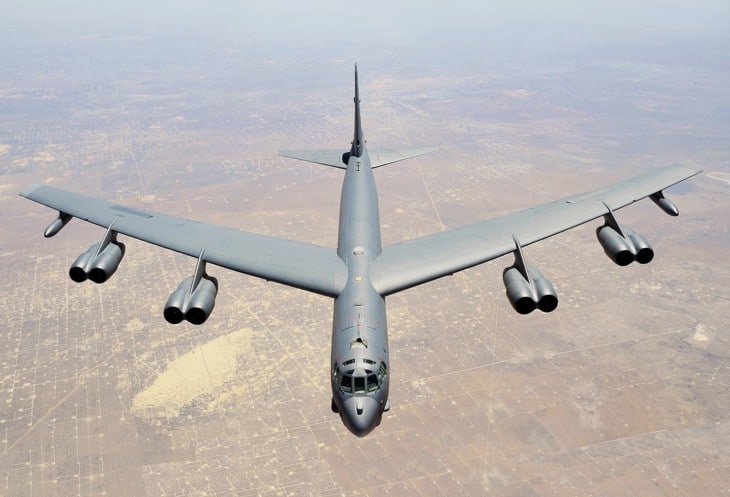
A strategic bomber flies long distances to drop large loads on the targets that keep an enemy fighting: factories, logistics hubs, military installations, and infrastructure. The aim is to wreck the enemy’s capacity to wage war, not to win one battle.
Strategic bombers are also one leg of the nuclear triad, alongside land-based ICBMs and submarine-launched missiles. During the Cold War, some squadrons were kept airborne around the clock so they could not be caught on the ground.
The Boeing B-52 Stratofortress is the definitive example. It carries up to 70,000 pounds (31,750 kg) of mixed weapons, cruises at up to 650 mph (1,050 km/h), and has an unrefueled combat range of more than 8,800 miles (14,160 km), according to the Air Force.
In practice, strategic bombers rarely fly strategic missions anymore. Since the Cold War they have dropped only conventional weapons, and in Desert Storm B-52s delivered 40 percent of all the weapons dropped by coalition forces.
The B-52 could reach 100 years of service
The prototype YB-52 first flew on April 15, 1952, and the last B-52H was delivered in October 1962. The Air Force now expects to fly the type into the 2050s after swapping its eight TF33 engines for Rolls-Royce F130s, a program that cleared its critical design review in May 2026. Some airframes would then approach a century in service.
2. Tactical Bombers
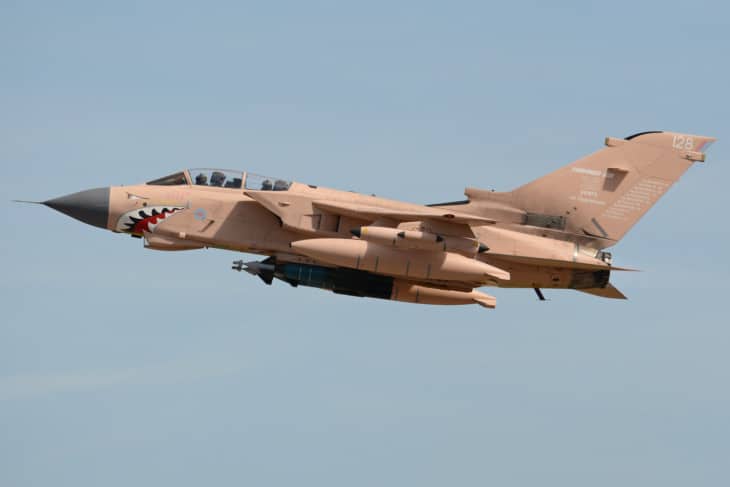
A tactical bomber supports the fight on the ground. Instead of targeting an economy, it attacks troops, vehicles, and equipment in or near the combat zone, usually at shorter range and with smaller aircraft.
Most of the sub-types below, from medium and light bombers to dive bombers and fighter-bombers, were tactical aircraft. Medium, light, and heavy describe how big the airplane was; tactical describes what it was sent to hit.

After the Second World War, the role moved to jets that were no longer called bombers at all. The F-111 Aardvark and the Soviet Su-24 did a medium bomber’s job but were classified as tactical strike aircraft.
The Panavia Tornado IDS is the classic European example. First flown on August 14, 1974, it used a variable-sweep wing to attack at low level, and the Royal Air Force flew it until 2019.
3. Heavy Bombers

A heavy bomber is the aircraft that carries the largest payload over the longest range of its era. The label is relative: Britain’s Handley Page O/100 heavy bomber of the First World War carried about 2,000 pounds (910 kg), roughly what a light bomber carried a generation later.
The Second World War was the heavy bomber’s peak. The US flew the B-17 and B-24 by the thousands, as detailed in our guide to American bombers of WW2, while Britain’s Avro Lancaster routinely carried 14,000 pounds (6,350 kg) of bombs and up to 22,000 pounds (9,980 kg) when modified.
How the Lancaster compares with the RAF’s other bombers is covered in our list of British bombers of WW2.
The Boeing B-29 Superfortress closed out the war with payloads over 20,000 pounds (9,070 kg) and a range of 3,250 miles (5,230 km). On August 6, 1945, the B-29 Enola Gay dropped the atomic bomb on Hiroshima, and on August 9 the B-29 Bockscar dropped the second on Nagasaki.
The US Air Force lists both the B-52 and the B-1B as heavy bombers, and both are also its strategic bombers. That overlap is why the two terms are so often used interchangeably.
4. Medium Bombers

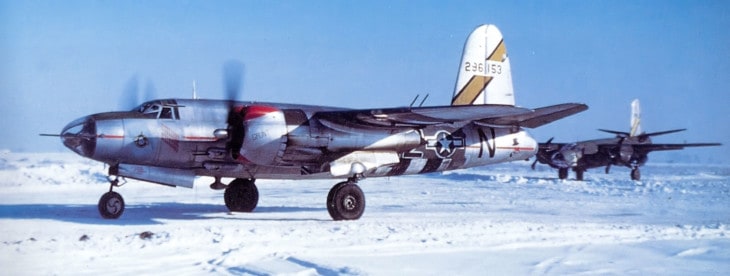


A medium bomber carries a mid-size load over a medium distance. In the Second World War that meant roughly 4,000 pounds (1,800 kg) of bombs over 1,500 to 2,000 miles (2,400 to 3,200 km), between the light bomber’s one ton and the heavy bomber’s four or more.
The US built the B-25 Mitchell and the B-26 Marauder, and Britain the Vickers Wellington. Germany’s Heinkel He 111 and Junkers Ju 88 were mediums too, as our guide to German bombers of WW2 explains.
The class did not survive the war. Better engines and designs let light bombers, tactical bombers, and later jet fighter-bombers take over its roles.
The label hung on briefly in the 1950s, when Strategic Air Command called the B-47 Stratojet a medium bomber to separate it from the bigger B-52. By then the distinction was more bureaucratic than real.
5. Light Bombers
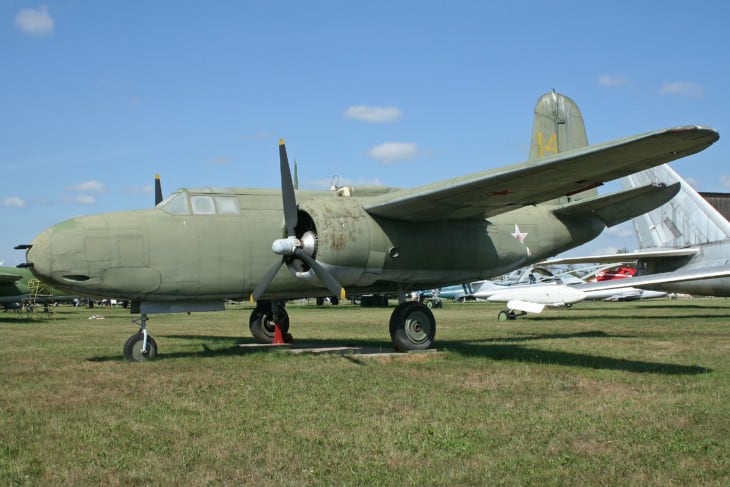
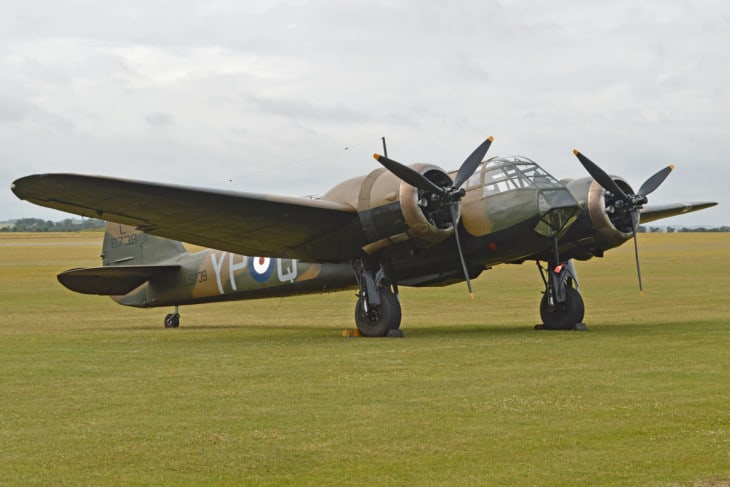
A light bomber is a small, fast bomber that typically carried no more than about one ton of bombs. It was the workhorse of tactical bombing from the First World War until the late 1940s.
The Airco DH.4 and the Breguet 14 were the best-known light bombers of the First World War, single-engine biplanes carrying between 110 and 880 pounds (50 to 400 kg) of bombs.
By the Second World War, the class had grown into twin-engine designs such as the Bristol Blenheim, introduced in 1937, and the Douglas A-20 Havoc. The de Havilland Mosquito, a fast multirole twin, pointed to the multirole aircraft that would replace the class.
Purpose-built light bombers had disappeared by the end of the war. Attack aircraft, fighter-bombers, and multirole jets could deliver the same load or more with better performance and better protection.
6. Dive Bombers


.jpg)
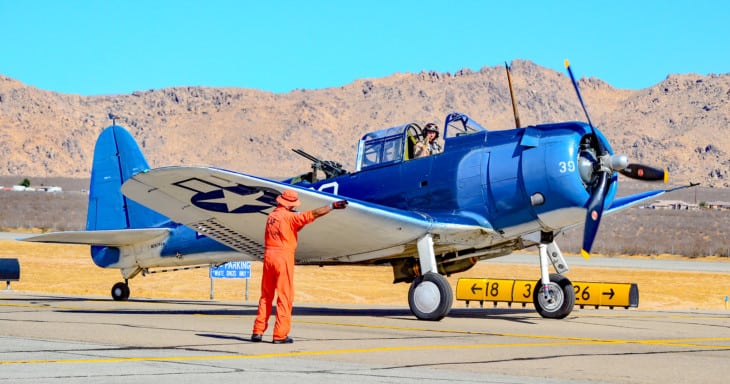
A dive bomber attacks by pointing its nose at the target and diving steeply before releasing its bomb. Diving at 45 to 60 degrees, and in some aircraft up to 80, made the bomb more accurate than one dropped from level flight.
Germany’s Junkers Ju 87 Stuka was the most famous. It was built to dive almost vertically and became a key part of the blitzkrieg, standing in for artillery support for the advancing army.
The type’s most decisive day came at Midway on June 4, 1942. Douglas SBD Dauntless dive bombers from USS Yorktown and USS Enterprise caught the Japanese carriers Akagi, Kaga, and Soryu mid-refueling and sank all three.
Japan’s own Aichi D3A is credited with sinking more Allied warships than any other Axis aircraft. After the war, rockets, precision-guided weapons, and heavier anti-aircraft defenses made the specialist dive bomber obsolete.
7. Torpedo Bombers
_flying_in_formation.jpg)
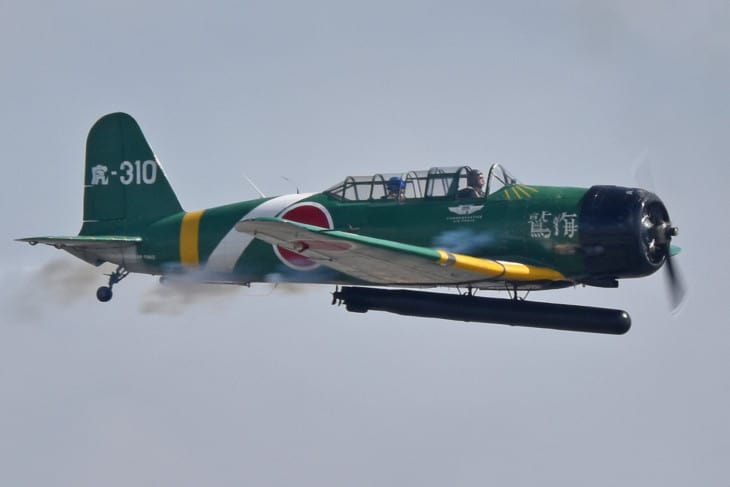
A torpedo bomber attacks ships by dropping a torpedo into the water close to its target. The torpedo then runs under its own power and strikes the ship below the waterline.
Britain pioneered it. Arthur Longmore made the first aerial torpedo drop on July 28, 1914, releasing an 810-pound (370 kg) torpedo from a Short Type 81, and on August 17, 1915, Flight Commander Charles Edmonds sank a Turkish transport north of the Dardanelles from a Short 184.
The Second World War proved the idea. On November 11, 1940, 21 Fairey Swordfish attacked the Italian fleet at Taranto and put three battleships out of action for the loss of two aircraft, and in May 1941 a Swordfish torpedo jammed the rudder of the German battleship Bismarck, which sank the next day.
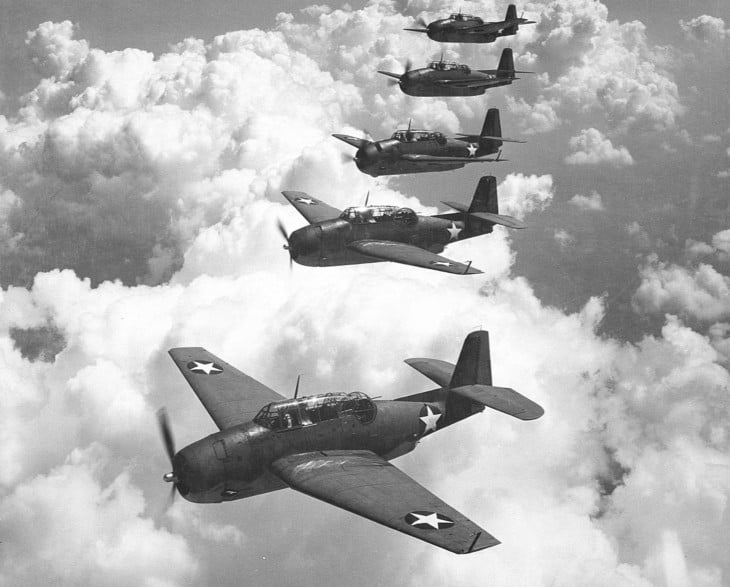
At Pearl Harbor, Japan sent 40 Nakajima B5N torpedo bombers against the battleships at anchor, a story told in our guide to Japanese bombers of WW2. America’s Grumman TBF Avenger improved as its crews gained experience and helped sink the light carrier Ryujo in August 1942.
By 1945 the specialist was no longer needed. From 1946 the US Navy folded its torpedo and dive bombers into a single attack category.
8. Patrol Bombers


Patrol bomber was the US Navy’s name for a long-endurance aircraft that searched the ocean for enemy ships and submarines and attacked what it found. The PB in designations such as the PBY Catalina and the PB4Y-2 Privateer stood for patrol bomber.
In the Second World War the job fell to flying boats like the PBY Catalina and the Short Sunderland, and to land planes converted for the role. The PB4Y-2 Privateer was derived from the B-24 Liberator, and the Lockheed Hudson began life as an airliner.
The type never disappeared; only the name did. Today it is called a maritime patrol aircraft, and the P-3 Orion, the Boeing P-8 Poseidon, and Japan’s Kawasaki P-1 carry on the mission, as covered in our guide to the types of navy planes.
9. Fighter-Bombers

.jpg)
_F-104G_Starfighter,_Germany_-_Air_Force_AN1712021.jpg)
A fighter-bomber is a fighter that has been modified, or is mainly used, to drop bombs. Unlike a purpose-built bomber, it starts life as a fighter and keeps enough performance to defend itself.
The idea began on the Western Front. In March 1918, Sopwith Camels dropped 25-pound (11 kg) Cooper bombs on the advancing German army, and the armored Sopwith Salamander, derived from the Snipe, is generally credited as the first purpose-built fighter-bomber.
In the Second World War it became a front-line type. The Republic P-47 Thunderbolt paired eight .50-caliber machine guns with 2,500 pounds (1,130 kg) of bombs, and the Hawker Typhoon, disappointing as a fighter, found its real niche as a fighter-bomber from September 1942.
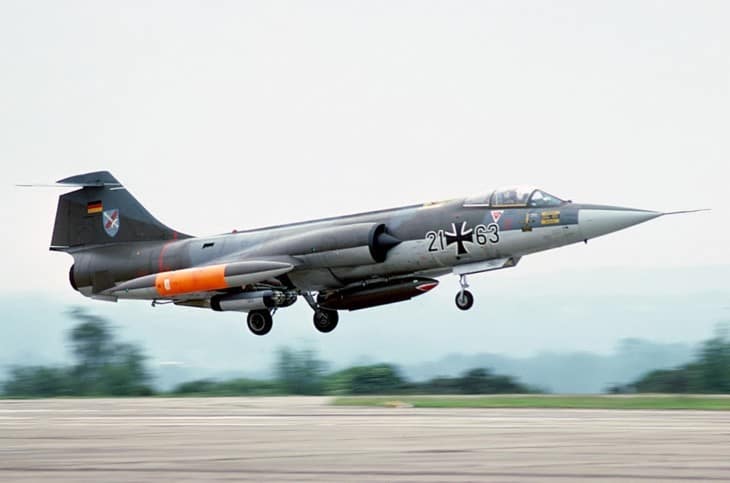
The Cold War pushed it further. NATO’s F-104G Starfighter took a day fighter and reworked it to carry a 2,000-pound (910 kg) nuclear weapon under the fuselage.
The term has since given way to strike fighter. The F-15E Strike Eagle, the Su-34, and the F-35 all do the fighter-bomber’s job, as our guide to the types of US fighter jets shows.
10. Attack Aircraft (Ground-Attack Bombers)

An attack aircraft strikes targets on the battlefield with more precision than a bomber, and is built to survive heavy fire from the ground. Its targets are tanks, vehicles, and troop concentrations, often close to friendly forces.
The Soviet Ilyushin Il-2 Sturmovik defined the type in the Second World War and became the most-produced military aircraft in history. The US Navy formalized the category in 1946, renaming the BT2D bomber the AD Skyraider under a new attack letter.
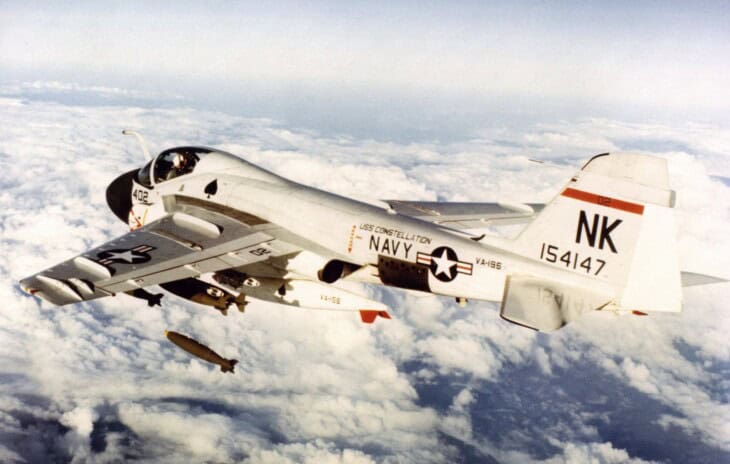
The best-known dedicated attack jets are the American A-10 Thunderbolt II and the Soviet Su-25. Carrier types such as the A-6 Intruder filled the role at sea, until multirole fighters absorbed most of it.
11. Supersonic Bombers

A supersonic bomber trades some payload and range for speed, betting that it can outrun defenses it cannot avoid. Every supersonic bomber built so far is a Cold War design, and three types are still flying.
The Convair B-58 Hustler was the first bomber capable of Mach 2, reaching 1,319 mph (2,122 km/h) at 40,000 feet. It entered service in 1960 and was retired in January 1970, after only 116 were built.
The Rockwell B-1B Lancer uses swing wings and afterburning engines to reach 900-plus mph (1,450 km/h), Mach 1.2 at sea level. It carries 75,000 pounds (34,000 kg), the largest conventional payload in the US Air Force.
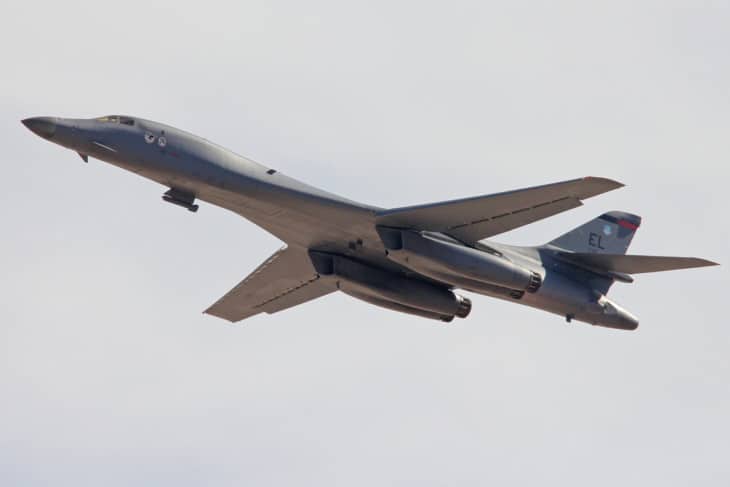
The B-1B can no longer carry nuclear weapons
The US dropped the B-1’s nuclear mission in 1994. Under the New START treaty, the Air Force then physically removed nuclear-unique cable connectors from the weapons bays, finishing the conversion in March 2011. America’s supersonic bomber is now a conventional-only aircraft.
Russia flies two supersonic bombers. The Tu-22M3 Backfire is a swing-wing long-range and maritime strike bomber from a family that first flew in 1969, and the Tupolev Tu-160 Blackjack reaches Mach 2.05.
A supersonic bomber that outweighs the B-52
The Tu-160 has a maximum takeoff weight of about 606,000 pounds (275,000 kg), well above the B-52’s 488,000 pounds (221,350 kg), and at 177 feet (54 m) it is longer too. Yet it can fly at twice the speed of sound. It first flew on December 18, 1981, and entered service in 1987.
12. Stealth Bombers
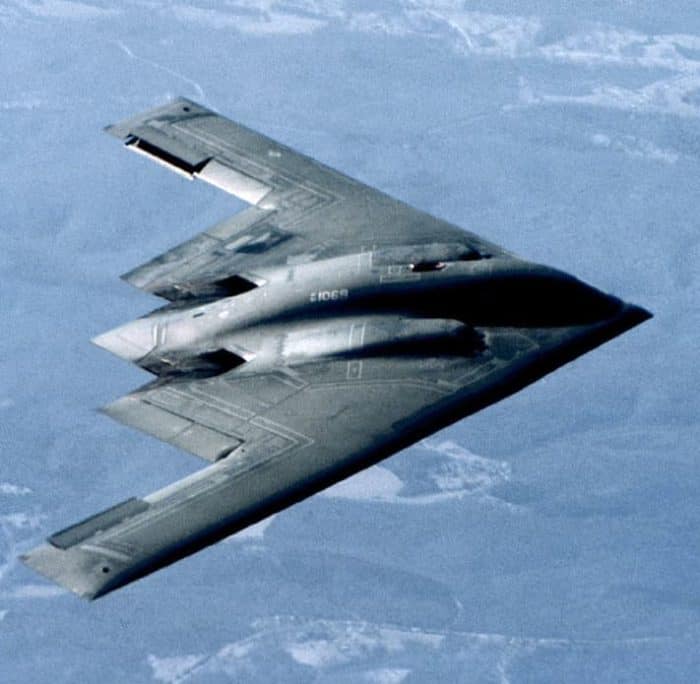
A stealth bomber is designed to be hard to see on radar, so it can fly into heavily defended airspace instead of around it. Where the supersonic bomber bet on speed, the stealth bomber bets on not being found.
The Northrop Grumman B-2 Spirit first flew on July 17, 1989. It carries 60,000 pounds (27,200 kg) of conventional or nuclear weapons with a crew of just two, and cost about $1.157 billion each in fiscal 1998 dollars.
Only 21 were built, and 19 remain. One crashed on takeoff at Guam in 2008, and the Air Force decided in 2024 not to repair another damaged in a landing-gear collapse at Whiteman Air Force Base in December 2022.
Its replacement is already flying. The B-21 Raider first flew on November 10, 2023, two test aircraft are now flying, and the Air Force plans to buy at least 100, with the first operational aircraft due at Ellsworth Air Force Base in 2027.

China is building its own. The Xian H-20 flying-wing bomber is officially under development, but no flight has been confirmed, and US intelligence assessed in December 2024 that it may not be fully operational until the 2030s. For how the B-2 compares with stealth fighters and drones, see our ranking of the best stealth aircraft in the world.
Which Bomber Planes Are Still in Service in 2026?
Three countries operate strategic heavy bombers today, flying seven types between them, with the B-21 in flight testing and China’s H-20 in development. The US publishes its fleet numbers; Russia and China do not, so their figures below are open-source estimates.
| Country | Bomber | Type | Fleet (2026) |
|---|---|---|---|
| United States | B-52H Stratofortress | Strategic heavy bomber | 76 |
| United States | B-1B Lancer | Supersonic heavy bomber | 45 |
| United States | B-2 Spirit | Stealth heavy bomber | 19 |
| United States | B-21 Raider | Stealth bomber | 2 test aircraft flying |
| Russia | Tu-160 Blackjack | Supersonic strategic bomber | About 20 to 21 (estimate) |
| Russia | Tu-95MS Bear | Turboprop strategic bomber | About 36 (estimate) |
| Russia | Tu-22M3 Backfire | Supersonic long-range bomber | Not published; heavy war losses |
| China | Xian H-6K / H-6N | Strategic bomber | About 120 (2025 estimate) |
| China | Xian H-20 | Stealth bomber | In development |
All three US types have seen combat recently. In June 2025, seven B-2s flew from Whiteman Air Force Base to drop 14 GBU-57 bunker busters, each weighing 30,000 pounds (13,600 kg), on Iranian nuclear sites in the first combat use of the weapon.
Reporting in early March 2026 put all three back in combat during Operation Epic Fury. B-2s and B-1s struck missile facilities deep inside Iran, and B-52s hit ballistic missile and command posts in the operation’s first 100 hours.
The US B-1B fleet was cut from 62 to 45 aircraft in 2021, and budget projections reported in January 2026 showed further retirements starting in fiscal 2028. The B-52 is heading the other way, with all 76 set to be re-engined as the B-52J.
Russia’s oldest bomber is also, by open-source estimates, its most numerous. The Tupolev Tu-95 first flew in 1952, is the only turboprop strategic bomber still in operational use, and is expected to serve until at least 2040.
That fleet has been hit hard. Ukraine’s Operation Spiderweb drone attack on June 1, 2025, struck at least eight Tu-95MS and twelve Tu-22M3 bombers by a preliminary count, and Simple Flying reported in August 2026 that no Tu-160 is known to have been lost.
China’s Xian H-6 is a license-built Soviet Tu-16, first flown in China in 1959. Its modern versions are heavily updated: the H-6K first flew in 2007 with new engines and carries cruise missiles, and the nuclear-capable H-6N adds an air-refueling probe.
What about the F-35 and F-15E? Aren't they bombers?
No, even though they drop bombs. The F-35 and F-15E are strike fighters, the modern descendant of the fighter-bomber, and carry F designations for that reason. A bomber is defined by payload and range: the B-52 alone carries up to 70,000 pounds of weapons across intercontinental distances, a mission fighters are not designed for.
FAQ
Sources and references used for research and fact-checking.
- U.S. Air Force, B-52H Stratofortress fact sheet
- U.S. Air Force, B-1B Lancer fact sheet
- U.S. Air Force, B-2 Spirit fact sheet
- Air & Space Forces Magazine, Air Force Will Retire, Not Repair, Damaged B-2
- Air & Space Forces Magazine, B-21 Raider
- Simple Flying, How Many B-1 Bombers Are Left?
- Simple Flying, Will Russia Even Be A Strategic Bomber Power By 2030?
- Militarnyi, Spiderweb Operation: How Many Tu-95MSs, Tu-22M3s and A-50s Destroyed at Russian Airbases
- Military Times, B-52 engine replacement clears critical design review, first modifications to begin this year
- Military Times, The US Air Force just used its oldest bomber to attack Iran
- Defense One, B-1, B-52 bombers join Trump's war on Iran
- The Aviationist, Operation Midnight Hammer: How U.S. B-2 Bombers Struck Iran Undetected
- Wikipedia, Bomber
- Wikipedia, Strategic bomber
- Wikipedia, Heavy bomber
- Wikipedia, Medium bomber
- Wikipedia, Light bomber
- Wikipedia, Dive bomber
- Wikipedia, Torpedo bomber
- Wikipedia, Short Type 184
- Wikipedia, Maritime patrol aircraft
- Wikipedia, Fighter-bomber
- Wikipedia, Attack aircraft
- Wikipedia, Lockheed F-104 Starfighter
- Wikipedia, Panavia Tornado
- Wikipedia, Convair B-58 Hustler
- Wikipedia, Tupolev Tu-160
- Wikipedia, Tupolev Tu-22M
- Wikipedia, Tupolev Tu-95
- Wikipedia, Xian H-6
- Wikipedia, Xi'an H-20
Get the Newsletter
The latest aviation news and stories sent to your inbox.
About the Author

Tim is the owner and lead editor of AeroCorner since 2019, overseeing aviation content covering aircraft, airlines, airports, and the broader aviation industry. Through years of researching, writing, editing, and publishing aviation-focused content, he has developed extensive practical knowledge of commercial aviation and air travel. Based in Asia and a frequent traveler himself, Tim also brings firsthand passenger experience to AeroCorner’s coverage. Outside of publishing, he has also explored aviation firsthand through hands-on flight training in New Zealand.