


Table of Contents
The best sunglasses for pilots are non-polarized aviators with neutral gray lenses that let 15 to 30% of visible light through, in a frame that does not fight your headset. That is the FAA’s own guidance, and our top pick, the Randolph Aviator, comes from the company that builds the U.S. military’s issue flying sunglasses.
Every pair below was checked against the FAA Civil Aerospace Medical Institute brochure Sunglasses for Pilots: Beyond the Image: tint, light transmission, polarization, lens material and frame fit. Fashion picks that fail those tests, such as pink gradient and photochromic lenses, are out.
AeroCorner is reader-supported. As an Amazon Associate we earn from qualifying purchases, at no extra cost to you.
| Pick | Best for | Lens |
|---|---|---|
| Randolph Aviator | Best overall | Mineral glass, bayonet temples |
| American Optical Original Pilot | Military heritage | Glass or nylon, bayonet temples |
| Ray-Ban RB3025 Aviator Classic | Easiest to find | G-15 crystal glass |
| Randolph Sportsman | Flying without a headset | Glass, skull temples |
| Ray-Ban RB3136 Caravan | A squarer aviator | Crystal glass, 55 mm |
| Ray-Ban RB3386 | Larger faces | Plastic, 67 mm |
| Oakley Holbrook Metal | Impact resistance | Polycarbonate, 55 mm |
How We Picked
No FAA regulation tells a pilot what sunglasses to wear. The FAA’s advice lives in a pilot safety brochure from its Civil Aerospace Medical Institute, published in 2005 as AM-400-05/1 and revised in 2024.
We used its tests as the ranking measure. A pick had to come non-polarized, offer a neutral gray or close-to-neutral lens, and have a frame that works with a headset. Then we ranked on lens material, fit options and how widely you can buy it.
The 7 Best Sunglasses for Pilots
1. Randolph Aviator: Best Overall
Randolph Engineering builds the HGU-4/P, the U.S. military’s standard-issue flyer’s sunglasses, to the MIL-S-25948J military standard. The company says it recently renewed that contract for another five years.
The civilian Aviator shares the design: bayonet temples made to slide under helmets, and mineral glass lenses with a non-polarized option. Randolph says every frame is hand-built and inspected in the USA.
Pick the non-polarized gray lens and you have the closest thing to the FAA brochure’s ideal in a shop window. Check the Randolph Aviator price on Amazon.
2. American Optical Original Pilot: Best Military Heritage
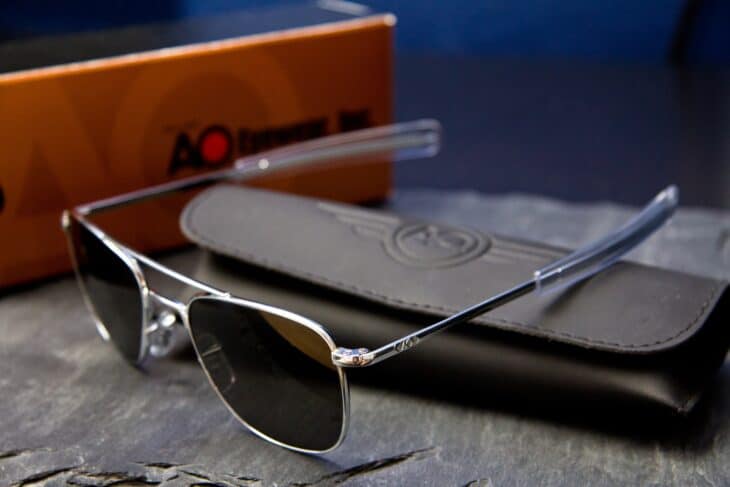

American Optical first built the Original Pilot in 1958 for American military pilots, when it was called the FG-58. AO says the frame traveled to the Moon in the survival kits of Apollo astronauts.
It comes in three sizes (52, 55 and 57 mm) with bayonet temples, and in SkyMaster glass or lighter AOLite nylon lenses. AO lists it at $250 to $345 as of November 2026, and it is made in the USA from premium components.
AO sells a polarized version, but its own product page says polarized lenses are often not recommended because they can interfere with LCD control panels. Check the AO Original Pilot price on Amazon.
3. Ray-Ban RB3025 Aviator Classic: Easiest to Find
Ray-Ban’s listing says the Aviator was designed in 1937 for U.S. pilots, and the RB3025 is still the version in every sunglass shop. Sporty’s Pilot Shop, which sells only non-polarized sunglasses, stocks the classic Ray-Ban Aviator with the G-15 lens in 55, 58 and 62 mm, at $139.95 each as of November 2026.
G-15 is a gray-green tint. The FAA brochure calls gray-green an excellent choice but recommends neutral gray because it distorts color least. For most private flying it is a fine compromise, and it is the easiest pair on this list to try on in person. Check the Ray-Ban Aviator Classic price on Amazon.
4. Randolph Sportsman: Best for Flying Without a Headset
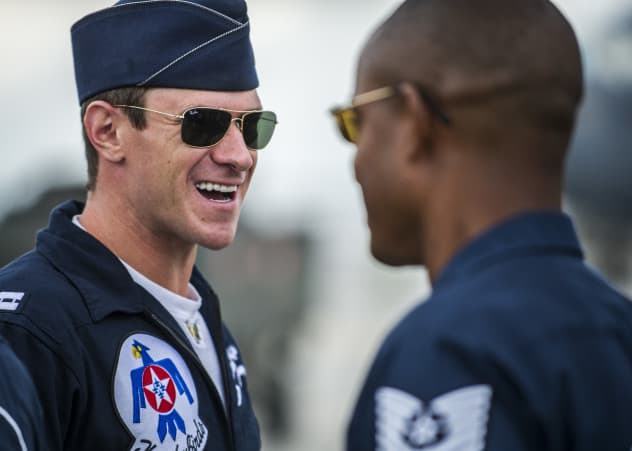
The Sportsman swaps bayonet arms for classic skull temples that curve behind the ear, and adds an acetate brow bar. Randolph says it is handcrafted in the USA through 200 steps over six weeks.
Skull temples suit pilots who fly with a lightweight headset or none, but they can press against thick ear seals. The listing below defaults to polarized lenses, so choose the non-polarized version before you buy. Check the Randolph Sportsman price on Amazon.
5. Ray-Ban RB3136 Caravan: Best Squarer Aviator
The Caravan keeps the aviator’s metal frame but squares off the lens. The 55 mm version comes with non-polarized crystal glass lenses.
It suits pilots who find the teardrop shape too round. Check the Ray-Ban Caravan price on Amazon.
6. Ray-Ban RB3386: Best for Larger Faces
The RB3386 is an oversized aviator with a wrapped frame and 67 mm non-polarized plastic lenses. The big lens covers more of the eye than a standard aviator.
The FAA brochure warns that small lenses may not be practical in the cockpit, and this is the opposite. Check that the wrapped arms clear your headset before a long flight. Check the Ray-Ban RB3386 price on Amazon.
7. Oakley Holbrook Metal: Best for Impact Resistance
Not every pilot wants an aviator. The Holbrook Metal (OO4123) is a metal-framed square with 55 mm polycarbonate lenses, an 18 mm bridge and 132 mm arms, and Oakley’s listing says its Plutonite lenses block all UVA, UVB and UVC.
Polycarbonate is the most impact-resistant lens material available, according to the FAA brochure, which matters in an open cockpit. Buy the non-polarized lens. Check the Oakley Holbrook Metal price on Amazon.
What to Look For in Pilot Sunglasses
Non-Polarized Lenses
Polarized lenses cut glare off water and roads, which is exactly the problem. The FAA brochure says polarization can hide instruments that use anti-glare filters and mask the glint of sunlight off another aircraft’s wing or windscreen, costing reaction time in see-and-avoid traffic.
Sporty’s Pilot Shop does not sell polarized sunglasses at all. It says polarized lenses can make cockpit instruments and glass panels unreadable, and an iPad screen blacks out in portrait orientation behind them. We cover the full argument in can pilots wear polarized sunglasses.
Neutral Gray, Letting Through 15 to 30% of Light
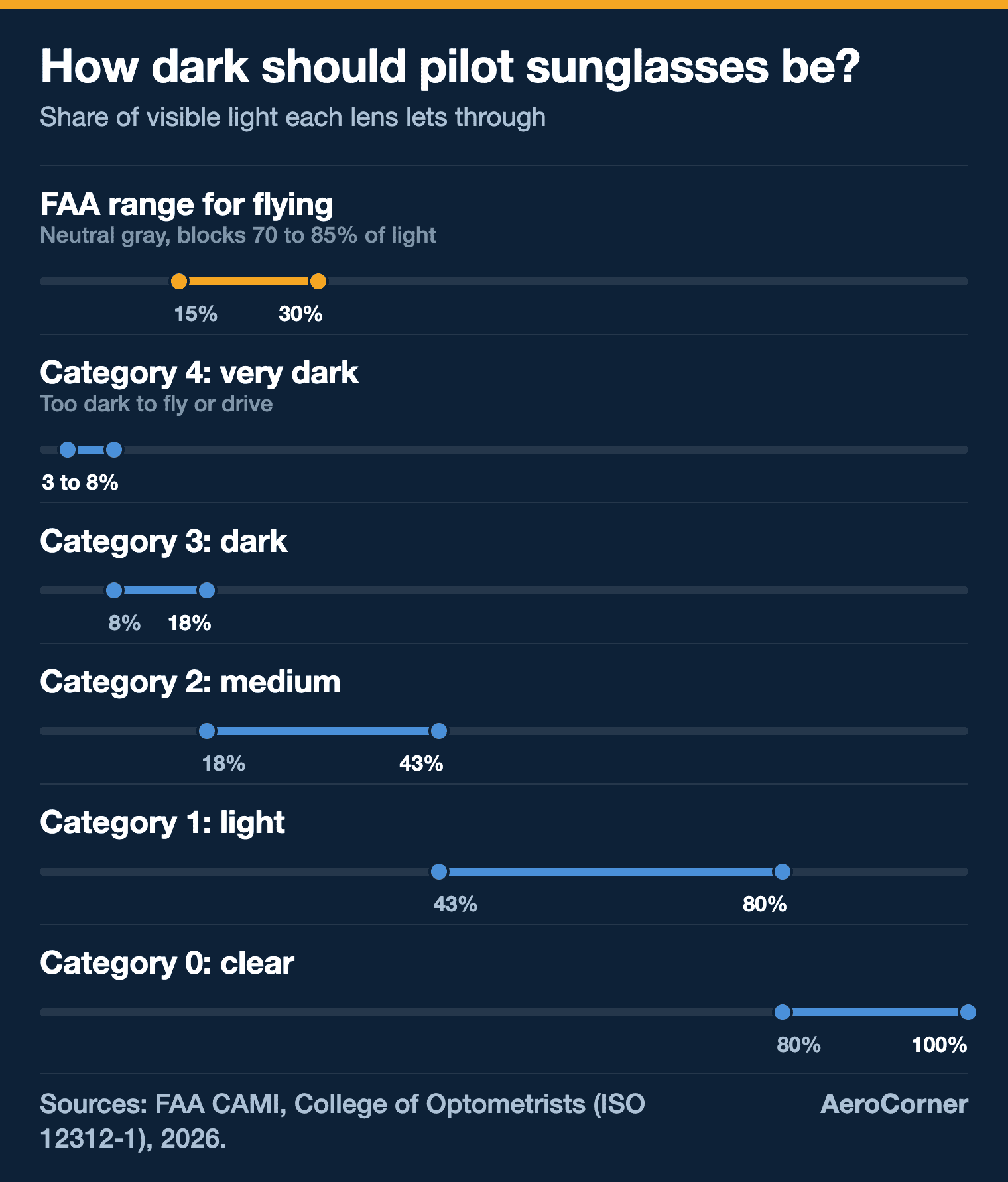
The FAA says sunglasses for flying should screen out only 70 to 85% of visible light, and that tints blocking more than 85% are not recommended. Gray is its preferred color because it distorts color the least.
On the ISO 12312-1 filter-category scale, that FAA band straddles the light end of category 3 and the dark half of category 2. Category 4 lenses, which let through 3 to 8%, are darker than the FAA’s limit.
UV matters more in the air: the brochure says exposure rises about 5% for every 1,000 feet of altitude. It points to the American Optometric Association’s advice of 99 to 100% UVA and UVB protection. Our explainer on whether airplanes have radiation covers the rest of the dose at altitude.
Skip photochromic and blue-blocker lenses
Photochromic lenses darken in UV light, but the FAA brochure says warm temperatures above 70 degrees F and the reduced UV in a cockpit limit how dark they get. Yellow, amber and orange blue-blockers distort colors, making navigation lights, signals and color-coded displays harder to read.
Lens Material: Glass, CR-39 or Polycarbonate
Crown glass is the most scratch-resistant lens, but the FAA notes it is heavier and less impact-resistant than plastic. CR-39 plastic is lighter and more impact-resistant than glass, but scratches more easily.
Polycarbonate is the lightest and most impact-resistant of all, but it has a low Abbe value, which the FAA says indicates more optical aberration. Glass for clarity, polycarbonate for protection: that is the real trade-off.
Temples and Headset Fit
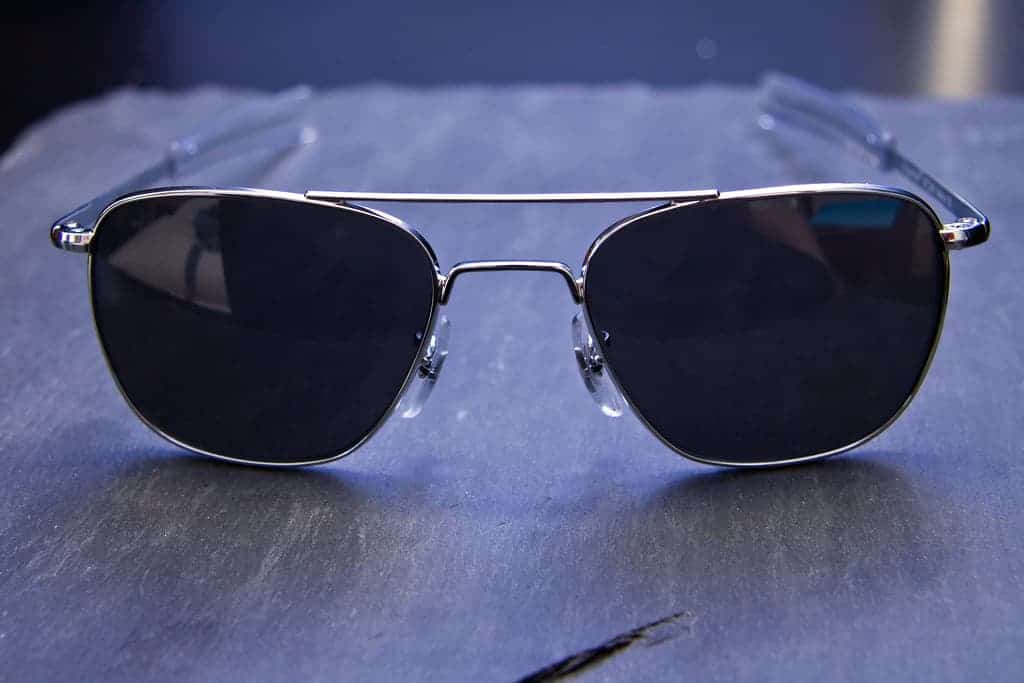
The FAA says frames must not interfere with communication headsets or protective breathing equipment such as oxygen masks. Straight bayonet temples were developed to slide under flight helmets, which is why most pilot-specific frames use them.

Skull temples curve behind the ear and stay put better on the ground. If you fly with a headset, try the pair with it on before buying, and see our guide to the best aviation headsets for ear seals that tolerate glasses.
The spec behind the military aviator
U.S. military aircrew sunglasses are the HGU-4/P, built to military standard MIL-S-25948. Randolph says American Optical held the original contract in the 1950s and Randolph took over production in the 1980s. Randolph’s HGU-4/P has bayonet temples for helmets and neutral gray lenses chosen for true color perception.
Shopping for a pilot this holiday season? Good sunglasses pair well with the picks in our gifts for pilots guide and our roundup of the best pilot watches.
FAQ
Sources and references used for research and fact-checking.
- FAA Civil Aerospace Medical Institute, Sunglasses for Pilots: Beyond the Image (pilot safety brochure)
- U.S. DOT ROSA P, Sunglasses for Pilots: Beyond the Image, AM-400-05/1
- College of Optometrists, Tints and driving (filter categories, BS EN ISO 12312-1)
- Randolph Engineering, What is the HGU4/P?
- Randolph Engineering, Sunglasses
- American Optical, Original Pilot
- American Optical, Original Pilot, AOLite Nylon
- Sporty's Pilot Shop, Ray-Ban Small Aviator Sunglasses, 55mm
- Amazon, Randolph Aviator, 23K Gold, Bayonet Temple
- Amazon, Ray-Ban RB3025 Classic Aviator
- Amazon, Randolph Sportsman Aviator
- Amazon, Ray-Ban RB3136 Caravan
- Amazon, Ray-Ban RB3386 Aviator
- Amazon, Oakley Holbrook Metal OO4123
Get the Newsletter
The latest aviation news and stories sent to your inbox.
About the Author

Tim is the owner and lead editor of AeroCorner since 2019, overseeing aviation content covering aircraft, airlines, airports, and the broader aviation industry. Through years of researching, writing, editing, and publishing aviation-focused content, he has developed extensive practical knowledge of commercial aviation and air travel. Based in Asia and a frequent traveler himself, Tim also brings firsthand passenger experience to AeroCorner’s coverage. Outside of publishing, he has also explored aviation firsthand through hands-on flight training in New Zealand.