


Table of Contents
Yes, you are exposed to radiation on every flight, but it does not come from the airplane. It is cosmic radiation from space, which the atmosphere mostly absorbs before it reaches the ground and lets through far more freely at cruising altitude.
The dose is small. The CDC puts a one-way flight from the US East Coast to the West Coast at about 0.035 millisieverts (mSv), and says two of those trips add up to roughly one chest X-ray.
For a passenger taking a few trips a year, that is a small addition to the 3.11 mSv of natural background radiation the average American gets every year on the ground. The people with a real dose to manage are pilots and flight attendants, whom a UN scientific committee ranks the fourth most exposed group of workers.
| Route (one way) | Time in the air | Highest cruise altitude | Cosmic radiation dose |
|---|---|---|---|
| New York to Tokyo | 13.0 hours | 43,000 feet | 55.1 µSv |
| London to Los Angeles | 10.5 hours | 39,000 feet | 44.6 µSv |
| Los Angeles to Tokyo | 11.7 hours | 40,000 feet | 35.1 µSv |
| London to New York | 6.8 hours | 37,000 feet | 27.3 µSv |
| New York to Seattle | 4.9 hours | 39,000 feet | 20.2 µSv |
| Washington, DC to Los Angeles | 4.7 hours | 35,000 feet | 15.1 µSv |
| Los Angeles to Honolulu | 5.2 hours | 35,000 feet | 12.2 µSv |
| New York to Chicago | 1.8 hours | 39,000 feet | 6.6 µSv |
| Houston to Austin | 0.5 hours | 20,000 feet | 0.19 µSv |
Where the Radiation on a Plane Comes From
The FAA names two sources. Galactic cosmic radiation comes from outside the solar system, mainly from exploding stars (supernovae), and solar cosmic radiation comes from the sun.
On the ground, miles of air and Earth’s magnetic field soak up most of it. At typical cruising altitudes there is far less air above you, so more of it reaches the cabin.
You get some cosmic radiation even at home. The National Council on Radiation Protection and Measurements (NCRP) puts the cosmic share of the average American’s yearly dose at 0.33 mSv, or 11% of all natural exposure.
That 0.33 mSv figure is often quoted as everyone’s total yearly dose, including in an earlier version of this article. It is only the cosmic share: the full natural total is 3.11 mSv, and nearly three quarters of it comes from radon and thoron gas.
The airplane itself does not give off radiation, and neither does the body scanner at security. The CDC says the millimeter-wave technology in those scanners does not use X-rays and adds nothing to your ionizing radiation dose.
How Much Radiation Do You Get on a Flight?
Three things set the dose: how long you are in the air, how high you fly, and how far from the equator the route runs. The CDC and the FAA both list the same three.
Measured dose rates on airliners sit in the low single digits of microsieverts per hour. Studies collected by the Health Physics Society found an average of 2.38 µSv per hour across Xinjiang Airlines flights from 1997 to 1999, 3 µSv per hour from Paris to Buenos Aires and 6.6 µSv per hour from Paris to Tokyo.
The highest rate in that set, 9.7 µSv per hour, was measured on Concorde in 1996 and 1997.
Latitude matters more than most people expect. The FAA says galactic cosmic radiation over the polar regions runs about twice the level over the geomagnetic equator at the same altitude, because Earth’s magnetic field shields least near the poles.
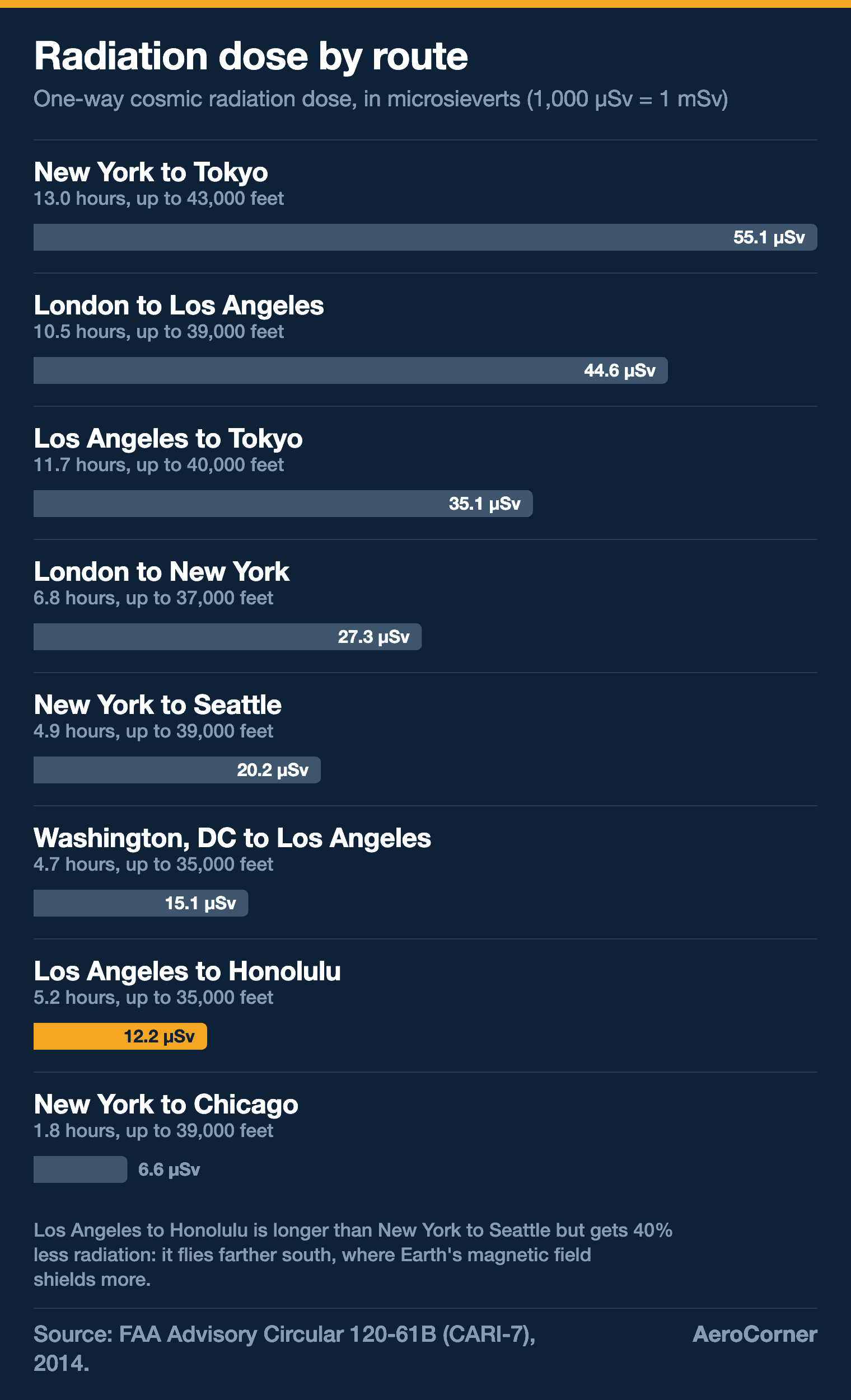
The FAA table above shows it. Los Angeles to Honolulu spends 5.2 hours in the air and collects 12.2 µSv, while the shorter New York to Seattle trip, flown farther north, collects 20.2 µSv.
High-latitude routes sit at the top of the range, and the polar routes that fly near the North Pole get the least magnetic shielding of all. New York to Tokyo, 13 hours up to 43,000 feet, is the highest dose in the FAA’s list at 55.1 µSv.
Altitude works the same way at the other end. A half-hour hop from Houston to Austin at 20,000 feet collects 0.19 µSv, and the Health Physics Society estimates that a pilot flying below about 5,900 feet (1,800 m) would need roughly 10,000 hours aloft to reach 1 mSv.
How Many Flights Equal a Chest X-Ray, Mammogram or CT Scan?
Using the CDC’s 0.035 mSv for a one-way coast-to-coast flight, a chest X-ray equals about three flights and a chest CT scan equals about 174. The doses for each exam come from RadiologyInfo.org, run by the American College of Radiology and the Radiological Society of North America.
| Exposure | Typical dose | Coast-to-coast flights with the same dose |
|---|---|---|
| Chest X-ray | 0.1 mSv | 3 |
| Screening mammogram | 0.28 mSv | 8 |
| Head CT scan | 1.6 mSv | 46 |
| Natural background radiation, one year (US) | 3.11 mSv | 89 |
| Chest CT scan | 6.1 mSv | 174 |
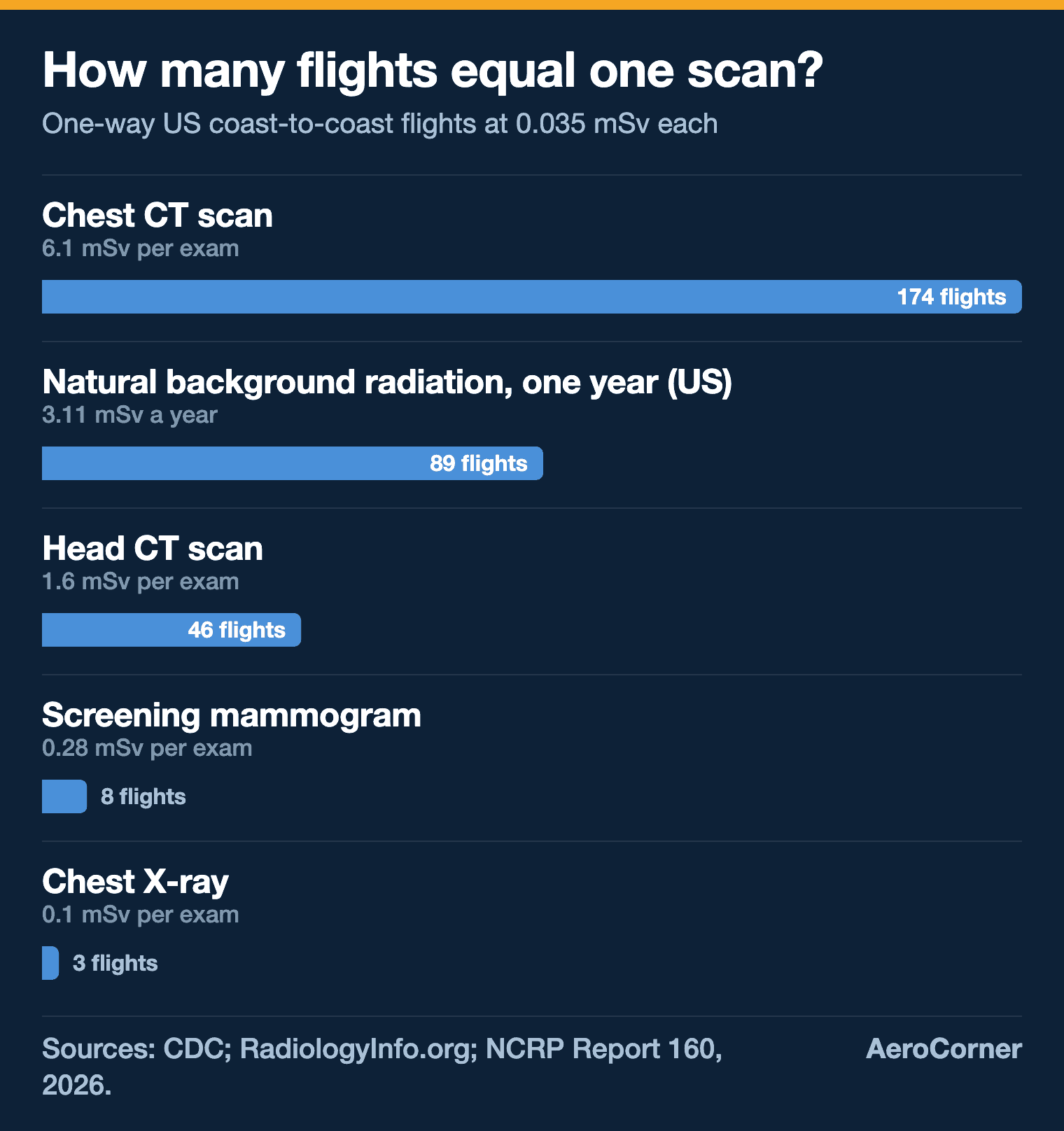
Those counts are, if anything, low. The FAA’s CARI-7 model puts Washington, DC to Los Angeles at 15.1 µSv and New York to Seattle at 20.2 µSv, both well under the CDC’s rounded 35 µSv.
Why every source gives you a different comparison
The flight is not the only number that moves. RadiologyInfo.org puts a chest X-ray at 0.1 mSv, while the UK Health Security Agency puts it at 0.014 mSv, so the same flight can be a third of an X-ray or several X-rays depending on whose figure you use. The UK agency also puts a transatlantic flight at 0.08 mSv, about three times the FAA model’s 27.3 µSv for London to New York.
Does Flying at Night Reduce Radiation?
No. Most of the dose is galactic cosmic radiation, which arrives from deep space from every direction, day and night, so taking a red-eye flight changes nothing.
Spaceweather.com tested it in 2015 with a research flight launched at night during a lunar eclipse. Its readings at aviation altitudes matched a daytime flight from a few days earlier to within about 3%.
The sun does change your dose, but in the opposite direction from what you might guess. The UK Civil Aviation Authority says flight doses run about 20% below average at the peak of the sun’s 11-year activity cycle and about 20% above average at its low point.
NASA and NOAA declared in October 2024 that the sun had reached the maximum of Solar Cycle 25. As that cycle winds down toward its minimum, background doses at cruising altitude should drift toward the higher end of that range.
Solar Storms: The Rare Time the Dose Jumps
The exception is a solar particle event, a burst of energetic particles from a solar storm. The FAA says the extra dose is usually very small compared with normal galactic radiation, but on rare occasions it can be significantly greater, and it can last from a few minutes to more than a day.
The increase is greatest near the magnetic poles and fades quickly toward the equator. The FAA notes that flying lower in response to a solar radiation alert can cut the dose significantly on high-latitude routes.
During the November 2025 solar storm, measurements led by the University of Surrey’s Space Centre found radiation at high altitudes briefly rose to nearly ten times normal flight conditions. A NIOSH study of flight attendants recorded a dose of 0.45 mGy on a single flight during one of the solar events it examined.
The Surrey team’s study, published in August 2026 in the Journal of Space Weather and Space Climate, estimated that a repeat of the strongest recorded storm, in February 1956, could expose passengers to the equivalent of a year’s worth of flight-related cosmic radiation. It proposes a new radiation scale for aviation, with set thresholds for monitoring, rerouting or grounding flights.
How Much Radiation Do Pilots and Flight Attendants Get?
Crew get about 3 mSv a year on average. The FAA cites the United Nations Scientific Committee on the Effects of Atomic Radiation, which in 2000 ranked aircrew the fourth most exposed group of workers at that average.
Individual studies land close by. One collected by the Health Physics Society found an average of 2.27 mSv a year for cabin crew and 2.19 mSv for long-haul captains, and a study of long-haul routes estimated 2 to 5 mSv a year depending on route, assuming 700 flight hours.
For comparison, a crew member’s yearly flight dose is roughly the same again as the natural background radiation they get on the ground. The FAA’s recommended limit for crew is far higher: an average of 20 mSv a year over five years, with no more than 50 mSv in any single year.
In the US that limit is guidance, published in an FAA advisory circular. In the UK and the European Union, airlines must by law assess their crew’s cosmic radiation dose, tell each crew member their dose and take it into account when building schedules, under rules that implement EU Directive 2013/59/Euratom.
Whether that dose causes harm is still being studied. A 2018 Harvard study of 5,366 US flight attendants found a higher prevalence of every cancer it examined than in the general population, especially breast cancer, melanoma and non-melanoma skin cancer among women.
That study cannot pin the difference on radiation. The cancer data were self-reported, and the researchers named disrupted sleep and circadian rhythms and cabin chemical contaminants as exposures alongside cosmic radiation.
Is It Safe to Fly While Pregnant?
For a passenger, yes. The American College of Obstetricians and Gynecologists, in 2018 guidance it reaffirmed in 2026, says the risks to the fetus from cosmic radiation are negligible for most air travelers, though aircrew and frequent flyers may exceed recommended limits.
The FAA recommends that a pregnant crew member keep the dose to her unborn child under 0.5 mSv a month. At the CDC’s coast-to-coast figure, a passenger would need about 14 one-way flights across the US in a single month to reach that.
The miscarriage question is not settled
An earlier version of this article said no evidence links flight radiation to miscarriage. That was too strong. A 2015 NIOSH study of 840 pregnancies among 673 flight attendants found that 0.1 mGy or more of cosmic radiation in the first trimester may be associated with a 70% higher risk of miscarriage. The clearer links were elsewhere: miscarriage was 50% more likely with 15 or more hours of flying during normal sleep hours, and about two and a half times as likely with high physical job demands.
NIOSH’s own summary puts the level linked to that possible risk at 0.36 mSv or more in the first trimester. A passenger would need about 10 one-way flights across the US to match it, which is why the guidance separates crew from passengers.
Is Airplane Radiation Safe for Babies?
Yes, for ordinary travel. Asked about a toddler on a 12-hour flight and the return trip, the Health Physics Society said the dose is only a few percent of the difference in natural background radiation between one place and another, with no evidence of harm.

Radiation is not the thing to plan around when flying with a baby. Ear pressure, feeding schedules and the airline’s age rules matter far more to how the trip goes.
Can You Protect Yourself From Radiation on a Plane?
Not in any practical way, and an occasional traveler has no need to. A lead apron is not needed for a dose this small, and the security scanner adds nothing.
The only real levers are the ones the FAA lists: less time in the air, lower altitudes and routes closer to the equator. NIOSH advises crew who want to cut their dose, including during pregnancy, to limit very long flights, high-latitude flights and flights over the poles.
A very frequent flyer who wants a number can use CARI-7, the FAA’s free downloadable program that estimates galactic cosmic radiation dose for any route. The longest nonstop flights in the world are where those numbers climb highest.
FAQ
Sources and references used for research and fact-checking.
- CDC, Facts About Radiation from Air Travel
- CDC, Radiation from Airport Security Screening
- Federal Aviation Administration, AC 120-61B, In-Flight Radiation Exposure
- Federal Aviation Administration, CARI-7 and CARI-7A
- Health Physics Society, Radiation Exposure During Commercial Airline Flights
- RadiologyInfo.org (ACR and RSNA), Radiation Dose in X-Ray and CT Exams
- UK Health Security Agency, Ionising radiation: dose comparisons
- Spaceweather.com, Flying at night doesn't protect you from cosmic rays
- UK Civil Aviation Authority, Aircrew exposure to cosmic radiation
- legislation.gov.uk, The Air Navigation (Cosmic Radiation: Protection of Air Crew and Space Crew and Consequential Amendments) Order 2019
- NOAA Space Weather Prediction Center, Joint Solar Maximum Announcement from NASA and NOAA
- University of Surrey via Newswise, Extreme space weather could disrupt flights and expose passengers to high radiation, study warns
- NIOSH, Aircrew and Cosmic Ionizing Radiation
- NIOSH, NIOSH Study Evaluates Risks for Pregnant Flight Attendants
- NIOSH, NIOSH Update, January 8, 2015
- American College of Obstetricians and Gynecologists, Air Travel During Pregnancy, Committee Opinion No. 746
- Harvard Gazette, Harvard study finds elevated cancer risk among U.S. flight attendants
Get the Newsletter
The latest aviation news and stories sent to your inbox.
About the Author

Tim is the owner and lead editor of AeroCorner since 2019, overseeing aviation content covering aircraft, airlines, airports, and the broader aviation industry. Through years of researching, writing, editing, and publishing aviation-focused content, he has developed extensive practical knowledge of commercial aviation and air travel. Based in Asia and a frequent traveler himself, Tim also brings firsthand passenger experience to AeroCorner’s coverage. Outside of publishing, he has also explored aviation firsthand through hands-on flight training in New Zealand.