Military Transport Planes
Douglas C-124 Globemaster II
ICAO: C124
The military DC-3 that dropped the D-Day paratroopers and flew the Hump into China
Updated: by Tim de Vries
The latest aviation news and stories sent to your inbox.
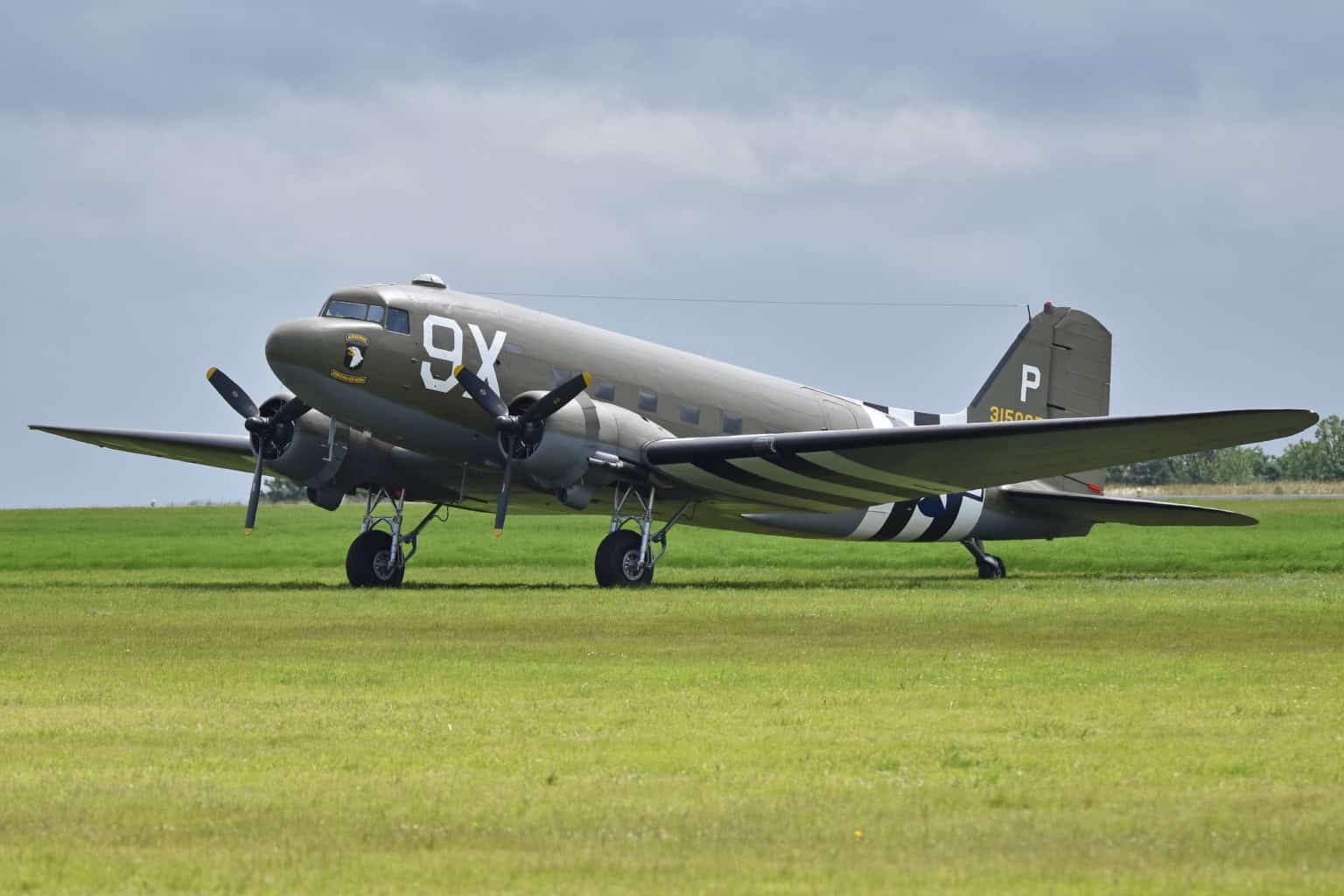
The Douglas C-47 Skytrain is the military transport version of the DC-3 airliner, fitted with a wide cargo door, a strengthened floor and more powerful engines. More than 10,000 were built during World War II. C-47s dropped the Allied paratroopers into Normandy on D-Day, flew supplies over the Hump into China and served in the Berlin Airlift, Korea and Vietnam.
Live Fleet Activity (DC3)
Fetching live data…


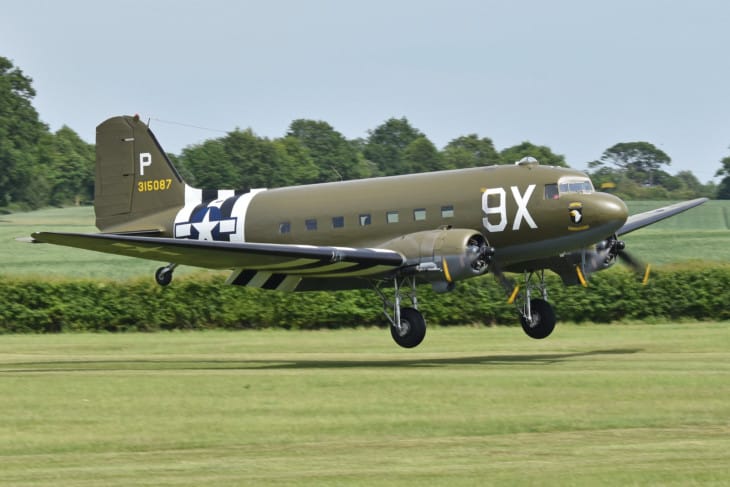
The Douglas C-47 Skytrain is the military transport version of the Douglas DC-3 airliner. It carried troops, cargo, paratroopers and wounded for the Allies in World War II, and more than 10,000 were built.
The British called it the Dakota, the U.S. Navy called it the R4D, and the crews who flew it called it the “Gooney Bird.” It first flew on December 23, 1941, and some are still flying today, more than 80 years later.
If one aircraft moved the Allied armies around the world, it was this one. The C-47 dropped the paratroopers into Normandy on D-Day, flew supplies over the Himalayas into China, and was still hauling cargo in the Berlin Airlift, Korea and Vietnam.
The DC-3 entered airline service in 1936, and the U.S. Army Air Corps ordered its first C-47s in 1940. The airliner needed real changes before it could go to war.
Douglas fitted a large cargo door on the left side of the rear fuselage, strengthened the cabin floor and floor beams for heavy loads, and added a hoist attachment. The tail cone was shortened to take glider-towing shackles, and an astrodome in the cabin roof gave the navigator a view of the stars.
The cargo doorway is 84.5 inches (2.15 m) wide, according to DesertAir Alaska, which still flies C-47-door freighters. A standard DC-3 has a passenger door instead.
A sister design, the C-53 Skytrooper, kept the airliner’s small door and lighter floor. It was built purely to carry troops, and only 380 were produced because the C-47 could do everything the C-53 did and haul cargo too.
More than 10,000 C-47s were built at Long Beach and Santa Monica in California and at Oklahoma City. The Oklahoma City plant alone turned out 5,354 between March 1943 and August 1945.
The U.S. Army Air Forces procured 9,348 by the end of the war, according to the National Museum of the U.S. Air Force. The U.S. Navy and Marine Corps took theirs as R4Ds.
Counting the civil DC-3 and the Soviet and Japanese license-built versions, the whole family reached 16,079 aircraft. Only 607 of those were civil airliners, which makes the C-47 the real bulk of the DC-3 story and one of the most produced aircraft of World War II.

The first large airborne operation flown in C-47s was the invasion of Sicily in July 1943, when they dropped 4,381 Allied paratroopers. It set the pattern for every big airborne assault that followed.
On D-Day, June 6, 1944, more than 1,000 C-47s carried U.S. paratroopers into Normandy. More than 1,400 flew in Operation Market Garden, and 836 took part in Operation Varsity, the Rhine crossing, in March 1945.
C-47s also towed the gliders that landed troops and equipment behind the lines. Some crews could even “snatch” a parked glider off the ground with a hook and tow it back to England for reuse.
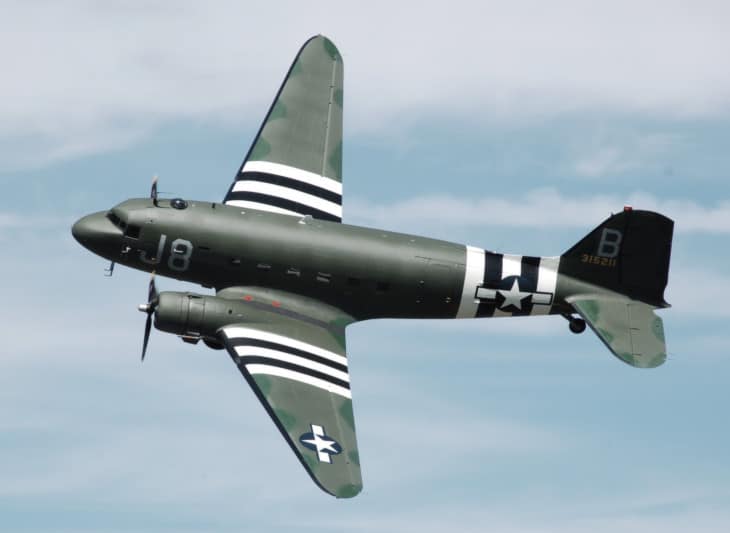
The hardest flying was over “the Hump,” the Himalayan route from India into China. With China cut off by land, C-47s and Curtiss C-46 Commandos kept it supplied by air, crossing mountains at altitudes of up to 17,000 feet (5,200 m).
The weather, the terrain and the occasional Japanese fighter claimed so many aircraft that crews called the route the “aluminum trail.” In Europe, C-47s also dropped supplies to the encircled American troops at Bastogne during the Battle of the Bulge.
About 2,000 C-47s went to Britain and the Commonwealth under Lend-Lease, where they became the Dakota. The name is often traced to the acronym DACoTA, for Douglas Aircraft Company Transport Aircraft.
A C-47 could carry 28 passengers, 18 to 22 fully equipped paratroopers, about 6,000 lb (2,700 kg) of cargo, or 18 stretchers with three medical staff. Troops sat on seats running along both cabin walls.
The cargo floor is 32 ft 4 in (9.86 m) long and the cabin is 6 ft 2 in (1.88 m) high, according to DesertAir Alaska’s figures for its C-47-door freighters.

The full specification table for the C-47 is on this page. A few of its figures need context, because the numbers quoted for this aircraft vary widely from source to source.
The panel’s figures are for the C-47B, from the manufacturer history by René Francillon. Its top speed of 195 kt (224 mph, 361 km/h) is measured at 10,000 feet, while the National Museum of the U.S. Air Force quotes 232 mph (373 km/h) and a range of 1,513 miles (2,435 km), without saying under what conditions.
The panel’s range is the normal range. Francillon also lists a ferry range of 3,600 miles (5,790 km), the figure for a delivery flight rather than a working load.
The maximum takeoff weight is the wartime military limit. After the war, the FAA certified converted C-47s for civil cargo work at no more than 26,900 lb (12,200 kg). A C-47 also carries less fuel in its four wing tanks than the 822 gallons (3,110 L) of a civil DC-3.
The engines explain the C-47B itself. Its Pratt & Whitney R-1830-90C Twin Wasps had two-speed superchargers, which kept more power at altitude for the high China-Burma-India routes.

More than 60 variants of the aircraft were produced. The main production models differ in their electrics and engines rather than in their shape.
Two later rebuilds changed the airframe itself. The U.S. Navy had 100 R4Ds remanufactured as the R4D-8 “Super DC-3,” later the C-117D, with a longer fuselage, new wings, a taller tail and Wright R-1820 engines.
The Basler BT-67 goes further still. It is a C-47 with a stretched fuselage, a strengthened structure, modern avionics and two Pratt & Whitney Canada PT6A-67R turboprops.
C-47s played a major part in the Berlin Airlift, until the larger C-54 Skymaster replaced them. In Korea they hauled supplies, dropped paratroopers, evacuated the wounded and dropped flares for night attacks.
On October 31, 1956, a U.S. Navy R4D-5L named Que Sera Sera became the first aircraft to land at the South Pole. No one had stood there since Robert Scott’s expedition in 1912.
In Vietnam the old transport found new jobs. The AC-47 Spooky became a gunship, EC-47s tracked enemy radio transmitters, and HC-47s flew psychological warfare missions over South Vietnam and Laos.
The U.S. Air Force retired its last C-47 in June 1975, and that aircraft, a C-47D, flew to the National Museum of the U.S. Air Force. Thousands of surplus C-47s had long since been converted into airliners and freighters around the world.
Around 164 DC-3s of all variants, C-47s and Dakotas included, were flying regularly in late 2023, according to DC-3 Appreciation Society data reported by Simple Flying. About 89 of those registrations were in the United States and 19 in Canada.
None still flies scheduled passenger service. The survivors haul cargo in remote places, fly airshows and pleasure flights, and a few still serve with air forces, some of them as turboprop conversions that appear on lists of the oldest military planes still in service.
New ones keep returning to the air. The D-Day veteran C-47A Night Fright, which dropped paratroopers of the 101st Airborne Division into Normandy, flew again on June 9, 2026, after a decade-long restoration.
For the 75th anniversary of D-Day in June 2019, 14 American C-47s joined a group of European Dakotas to fly the English Channel crossing to Normandy once again.
The C-47 and the DC-3 share the same basic airframe. The FAA treats them as the same type: a C-47 converted for civil use flies under the DC-3’s type certificate.
The differences are all about cargo. The C-47 has the wide double cargo door, the strengthened floor, the hoist fitting, the glider tow point and the astrodome, and it was built without the airliner’s passenger interior.
That is why so many “DC-3s” flying today began life as C-47s. After 1945 there were thousands of surplus military airframes and only 607 purpose-built civil DC-3s, so most DC-3s in postwar airline service were converted military aircraft.
Not quite. The AC-47 Spooky is a C-47 converted into a gunship with three side-firing miniguns, and the C-47 is itself the military version of the DC-3. All three share the same basic airframe.
Around 164 DC-3s of all variants, including C-47s, were flying regularly in late 2023, according to DC-3 Appreciation Society data. Most fly in the United States and Canada, with others working in places such as Colombia.
Yes. The U.S. Air Force flew C-47s in Vietnam as transports, as AC-47 Spooky gunships, as EC-47 electronic intelligence aircraft and on psychological warfare missions. It retired its last C-47 in 1975.
The National WWII Museum calls it one of the most successful aircraft ever built. It served in every theater of World War II, stayed in U.S. Air Force service until 1975, and some are still flying commercially more than 80 years after the first one flew.
Gooney bird is a nickname for the albatross. One story ties the name to the C-47’s European service, another to a Marine Corps R2D, the military DC-2, that was the first aircraft to land on Midway Island, once home to the albatross.
More than 10,000, at Long Beach, Santa Monica and Oklahoma City. The U.S. Army Air Forces alone procured 9,348 by the end of World War II, and the Navy and Marine Corps flew theirs as R4Ds.
The C-53 Skytrooper was a dedicated troop transport. It lacked the C-47’s wide cargo door, reinforced floor and hoist, so only 380 were built before the more versatile C-47 took over.
Sources and references used for research and fact-checking.