Military Transport Planes
Douglas C-47 Skytrain
ICAO: DC3
Heavy-lift piston transport with clamshell nose doors, better known as Old Shaky
Updated: by Tim de Vries
The latest aviation news and stories sent to your inbox.
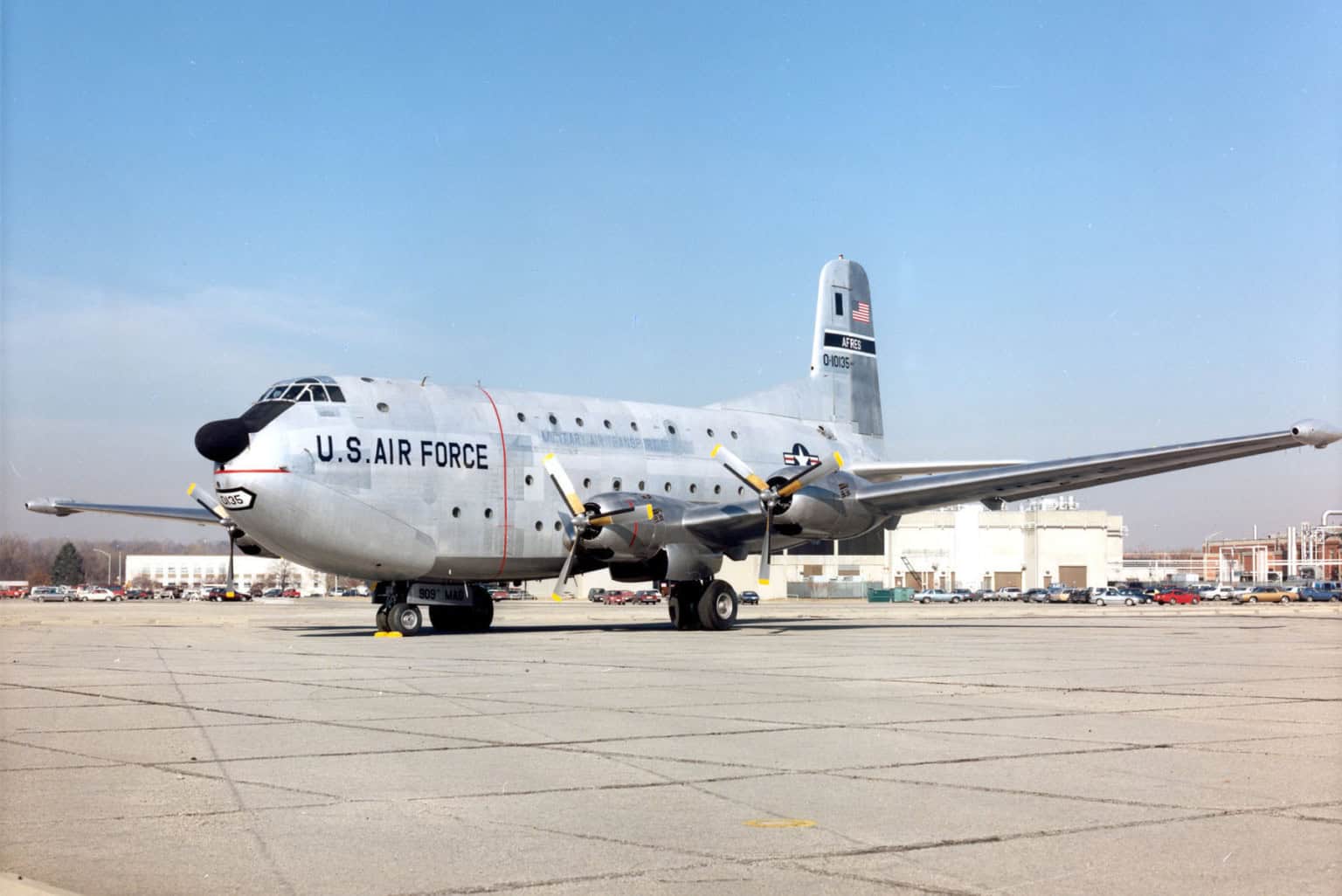
The Douglas C-124 Globemaster II, nicknamed Old Shaky, was the heavy-lift workhorse of the U.S. Air Force in the 1950s and early 1960s. Its clamshell nose doors and ramp let it swallow tanks, bulldozers and trucks that no other transport of its day could carry. Four huge Pratt & Whitney radial engines powered it through Korea, Antarctica and Vietnam until it was retired in 1974.
Live Fleet Activity (C124)
Fetching live data…


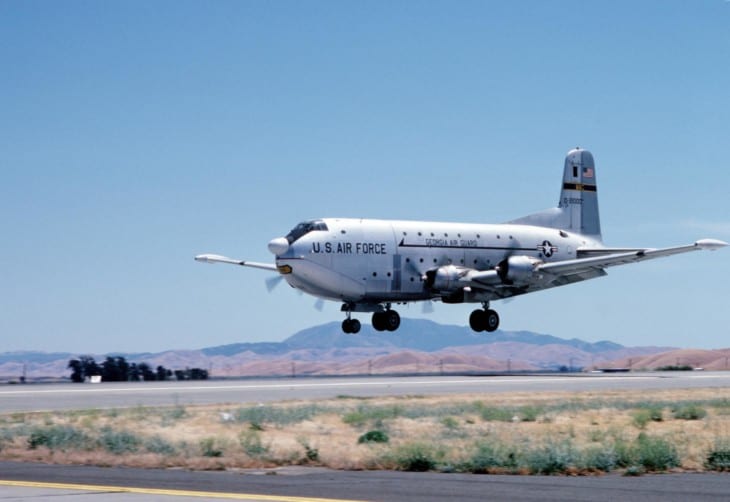
The Douglas C-124 Globemaster II was a four-engine piston transport built to carry cargo that other aircraft of the early 1950s could not fit through the door. Crews nicknamed it “Old Shaky,” sometimes spelled “Old Shakey.”
It first flew on November 27, 1949, and the Air Force bought 448 of them before production ended in 1955. It was the main heavy-lift transport of the Military Air Transport Service (MATS) until the Lockheed C-141 Starlifter entered service.
The full specification table for the aircraft is on this page. The sections below explain the numbers and the story behind them.
Douglas developed the C-124 from 1947 to 1949 as a rebuild of the wartime C-74 Globemaster, with a new fuselage and lessons drawn from the Berlin Airlift. The first prototype, the YC-124, flew with four R-4360-39 engines.
Production came in two main versions. The C-124A, delivered from May 1950, used less powerful R-4360-20WA engines, and 204 were built.
The C-124C followed with the R-4360-63A engines, more fuel, wingtip combustion heaters and an APS-42 weather radar in a “thimble” radome on the nose. Douglas built 243 of them, and most C-124As were later retrofitted with the radar and heaters.
The C-124 was designed around its nose. Two large clamshell doors opened to expose a hydraulically operated ramp, so trucks, tanks and bulldozers could drive straight in.
A cargo elevator sat under the rear fuselage. Overhead hoists ran along the cargo compartment to move heavy loads. Sources disagree on the rated lift of each hoist, with one museum listing 16,000 lb and another reference listing 8,000 lb.
Fitted with a double-decked cabin, the same aircraft could carry 200 fully equipped soldiers. As an air ambulance it carried 127 litter patients and their attendants, according to the National Museum of the U.S. Air Force. Other references give 123.
The Air Force museum notes that the aircraft could handle tanks, field guns, bulldozers and trucks. Wikipedia adds that it was the only aircraft of its time able to move fully assembled heavy equipment of that size.

Four Pratt & Whitney R-4360-63A Wasp Major radial engines powered the C-124C. Each is a 28-cylinder, air-cooled radial turning a three-blade Curtiss propeller.
The National Museum of the U.S. Air Force calls the R-4360 the most technically advanced and complex reciprocating aircraft engine produced in large numbers in the United States. It also powered the B-36 Peacemaker and the C-97 Stratofreighter.

The C-124 was never fast. Its maximum speed of 264 kt (304 mph, 489 km/h) was reached at 20,800 ft, and it normally cruised at 200 kt (230 mph, 370 km/h).
The Air Mobility Command Museum notes that a round trip from Travis Air Force Base in California to Tan Son Nhut Air Base in South Vietnam took 97 hours of flight time.
Range depends on load. The 3,500 nmi figure in the table assumes a payload of only 4,030 lb (1,830 kg), which is a tiny fraction of what the aircraft could carry. With nothing aboard, the ferry range was 5,930 nmi, according to Wikipedia.
Payload has the same catch. The maximum payload is listed at 74,000 lb (33,600 kg), while Wikipedia’s text gives a cargo capacity of 68,500 lb (31,100 kg). The two figures are quoted for different loading conditions, so treat them as a range rather than a contradiction.
Size is the other half of the story. The wingspan is 174 ft 1 in (53.07 m). Overall length is 130 ft 5 in (39.75 m), and the cargo compartment inside it is 77 ft 0 in (23.47 m) long.
Strategic Air Command was the first operator. It ran 50 C-124s from 1950 to 1962, mainly to move nuclear weapons between air bases and to carry personnel and equipment on overseas deployments.
MATS then became the primary operator until it was renamed Military Airlift Command in January 1966.
The C-124 flew heavy loads in the Korean War, when it was the only aircraft that could carry many of the Army’s vehicles. It resupplied Antarctica for Operation Deep Freeze, evacuated refugees from the Congo and flew relief missions to Morocco and Chile after floods and disasters.
From 1959 to 1961 it carried Thor missiles across the Atlantic to England. In 1961 it supported the troop build-up in Europe during the Berlin Wall crisis.
It also hauled materiel from the United States to Vietnam, working alongside the Douglas C-133 Cargomaster, until the Lockheed C-141 Starlifter arrived.
Most C-124s went to the Air Force Reserve and Air National Guard by 1970. The Georgia Air National Guard’s 165th Tactical Airlift Group retired the last two in September 1974.

The C-124 carried large numbers of people, so its accidents were severe. On November 22, 1952, a C-124 struck Colony Glacier near Anchorage, Alaska, killing all 52 people aboard. Debris and remains were found in June 2012.
On June 18, 1953, a C-124 crashed after an engine failed on takeoff from Tachikawa Air Base in Japan, killing all 129 aboard (7 crew and 122 passengers).
The strangest case is March 23, 1951. A C-124 flying from Loring Air Force Base, Maine, to RAF Mildenhall, England, reported a cargo fire, jettisoned crates and then ditched about 700 miles (1,100 km) southwest of Ireland.
The crew reached life rafts. A B-29 spotted the rafts, but no other aircraft or ship reached the site for over 19 hours, and only charred crates and a partly deflated raft were found. What happened to the airmen is still unknown.
Eight C-124s survive, all as museum displays. The Air Mobility Command Museum at Dover Air Force Base holds the only surviving A-model.
The National Museum of the U.S. Air Force in Dayton, Ohio, keeps a C-124C that visitors can walk inside. Other examples are at the Pima Air & Space Museum, the Museum of Aviation in Georgia, the McChord Air Museum, the Hill Aerospace Museum in Utah, the Travis Heritage Center in California and a museum in Sacheon, South Korea.
According to Wikipedia, the last recorded flight of a C-124 was on October 9, 1986, when the aircraft now at McChord flew nonstop from Selfridge Air National Guard Base in Michigan to Washington state. As of October 2026, no C-124 is known to be airworthy.

The C-124’s heavy-lift job passed to the C-141 Starlifter and then the C-5 Galaxy. Wikipedia notes that until the C-5A entered service, the C-124 and the C-133 were the only aircraft able to carry very large loads.
For modern comparisons, see our guides to the biggest military airplanes and the largest cargo planes.
Crews nicknamed it “Old Shaky,” also spelled “Old Shakey.” The Air Force museum calls the name affectionate. The sources I found do not explain its origin.
The Air Force bought 448 C-124s before production ended in 1955. Production versions included 204 C-124As and 243 C-124Cs.
No. Eight survive in museums, and the last recorded flight was in October 1986. As of October 2026 none is known to be airworthy.
No. The An-124 Ruslan is one of the largest aircraft in service, but the six-engine An-225 Mriya was bigger. It was based on the An-124 design with a greater wingspan and payload, and Ukrainian officials reported it destroyed at Hostomel airport in February 2022.
That depends on whether you measure weight, length or wingspan. The C-124 was among the largest transports of the early 1950s, but today’s list is led by far larger types. See our ranking of the biggest military airplanes for the current answer.
No. The C-123 Provider is a much smaller twin-engine transport from a different manufacturer. The C-124 is the four-engine Douglas heavy lifter described on this page.
Sources and references used for research and fact-checking.