Military Transport Planes
Lockheed Martin C-130J Super Hercules
ICAO: C130
The strategic airlifter built for heavy intercontinental transport.
Updated: by Tim de Vries

The latest aviation news and stories sent to your inbox.
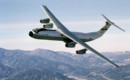
The Lockheed C-5 Galaxy is one of the largest military transport aircraft ever built and the biggest ever flown by the U.S. Air Force. It entered service in 1970 to move tanks, helicopters, and other outsize cargo between continents. Every C-5 flying today is a re-engined C-5M Super Galaxy, and the fleet is planned to serve until 2050.
Live Fleet Activity (C5M)
Fetching live data…
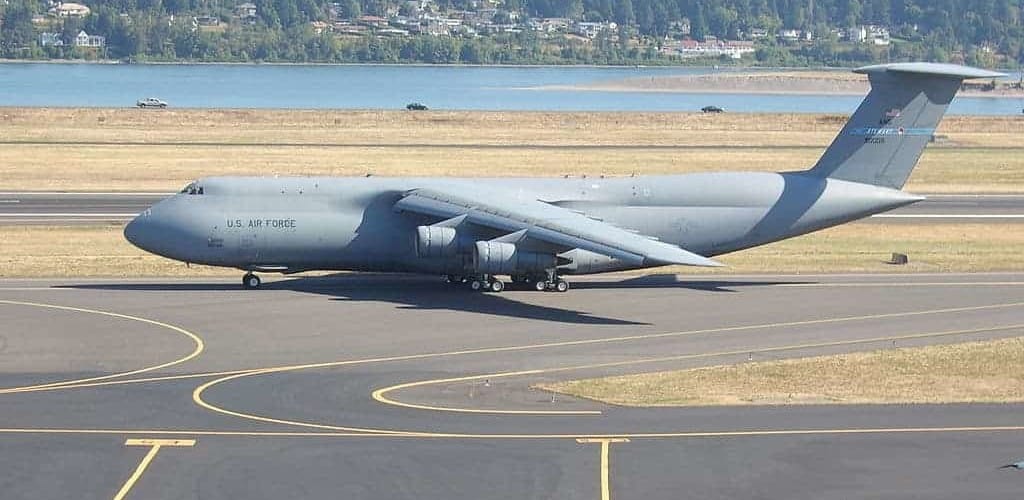
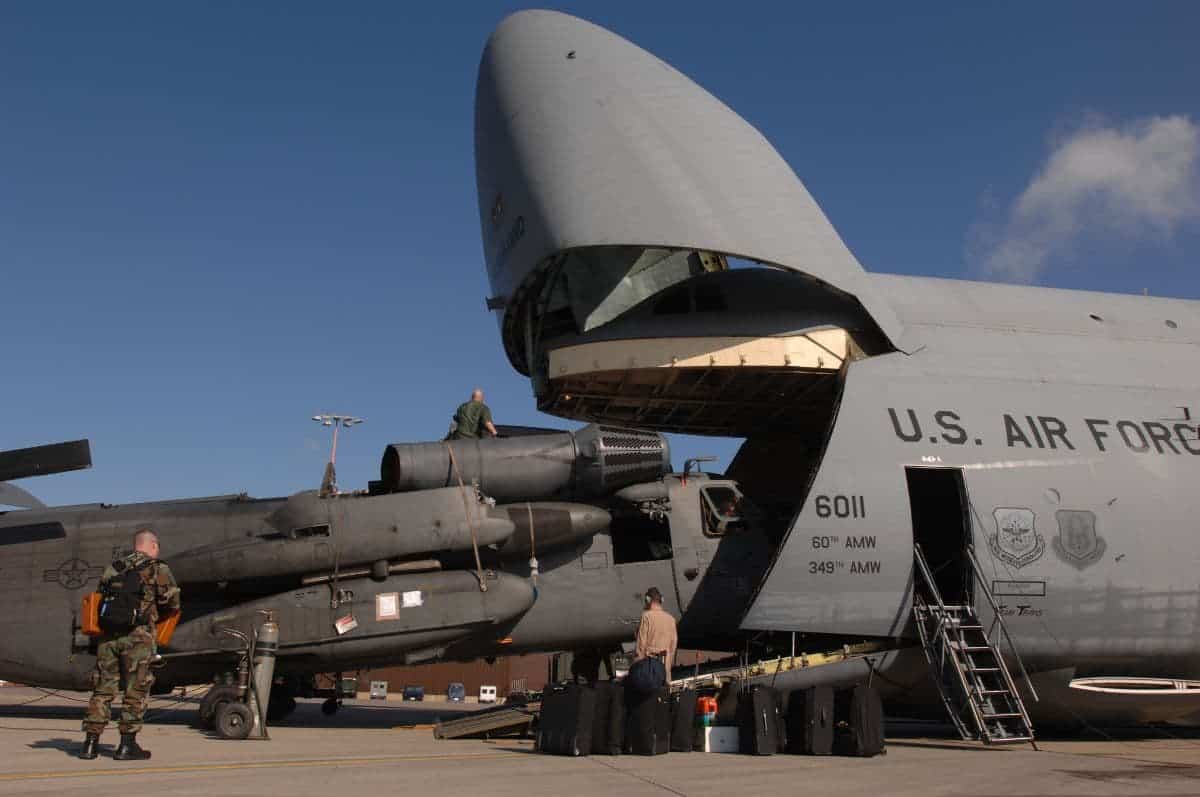
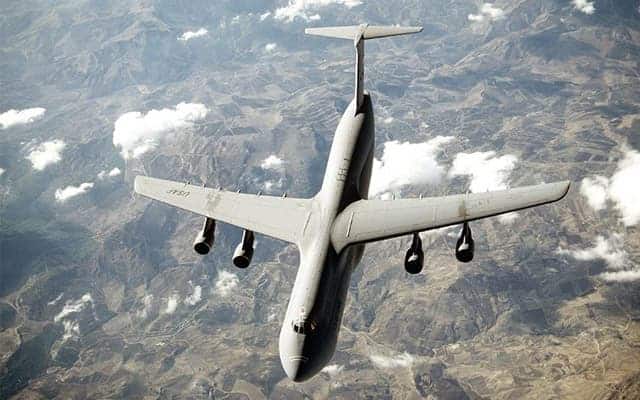
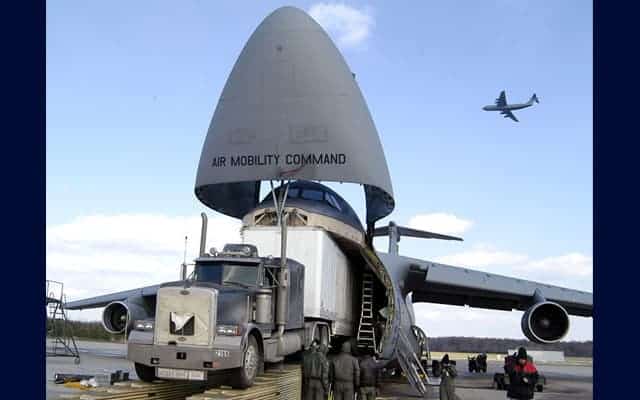
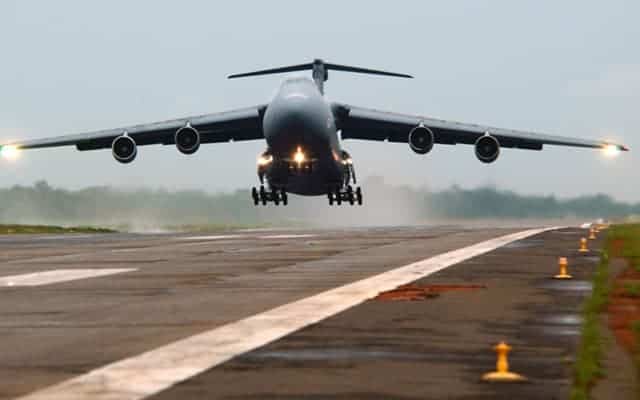

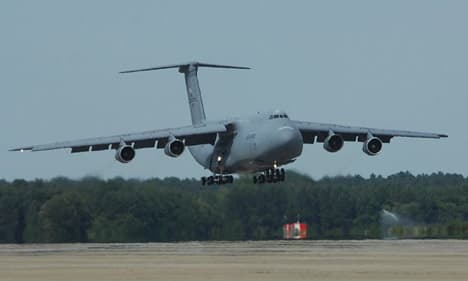

The Lockheed C-5 Galaxy is a strategic military transport built to move oversized and overweight cargo between continents. It is the largest aircraft the U.S. Air Force has ever operated, and one of the largest military aircraft in the world.
A C-5 can carry loads that no other airlifter in the American fleet can accept, including main battle tanks, heavy helicopters, and bridging equipment. It first flew in 1968 and remains in service more than five decades later.
Every C-5 flying today is a C-5M Super Galaxy, a rebuilt version with new engines and modern avionics. The Air Force now plans to keep the fleet in service until 2050. The full specification table for the aircraft is on this page.
The Galaxy grew out of a 1960s Air Force requirement called the Heavy Logistics System, or CX-HLS. The goal was a jet transport far larger than the C-141 Starlifter, able to replace the propeller-driven C-133 Cargomaster and haul Army equipment that the C-141 could not fit.
Boeing, Douglas, General Dynamics, Lockheed, and Martin Marietta all submitted proposals. Lockheed was selected in September 1965 and given the contract in December 1965, in part because its bid carried the lowest total cost.
General Electric won the engine competition in August 1965 with the TF39, the first high-bypass turbofan to enter production. Its eight-to-one bypass ratio was a major leap over earlier engines and set the pattern for every large jet engine that followed. The lineage runs directly to today’s commercial engine makers, covered in our guide to the largest aircraft engine manufacturers.
The first C-5A rolled out at Marietta, Georgia, on March 2, 1968, and flew on June 30, 1968. The program then became one of the most notorious procurement stories of its era.
The C-5 was bought under a fixed-price approach called Total Package Procurement. Development costs ran roughly $1 billion over the original figures, the first American program to overrun by that much, and Congress opened investigations in 1968 and 1969.
A. Ernest Fitzgerald, a civilian financial analyst in the Air Force, told Congress about the overruns in 1968 and lost his job the following year. The Defense Department dropped Total Package Procurement as a result of the C-5 experience.
The strain nearly sank the company. In 1971, with C-5 costs and the struggling L-1011 airliner program both draining cash, Lockheed needed federal loan guarantees to stay in business.
The C-5A was the original production model. Lockheed built about 81 of them between 1968 and 1973, and the first operational aircraft went to the 437th Military Airlift Wing at Charleston Air Force Base in June 1970.
Early C-5As were plagued by wing fatigue, described in the next section, and spent years restricted to reduced cargo weights.
The C-5B was a second production run authorized in 1982 after airlift shortfalls during exercises and real-world operations. Lockheed delivered 50 aircraft between 1986 and 1989, with the first flight in September 1985.
The C-5B used improved TF39-GE-1C engines, stronger wings built to the corrected design from the start, updated avionics, and a simpler landing gear that dropped the C-5A’s complex crosswind steering system.
Two C-5As were rebuilt in the late 1980s as C-5C Space Cargo Modified aircraft for NASA payloads. The troop compartment was removed, the rear pressure bulkhead was moved aft, and the aft doors were widened so the aircraft could carry large satellites and other space hardware.
Both C-5Cs are based at Travis Air Force Base, California, and remain in the fleet.
The C-5M is not a new airframe. It is the result of two upgrade programs applied to existing C-5B, C-5C, and one C-5A aircraft.
The Avionics Modernization Program, begun in 1998, replaced the flight deck with flat-panel displays, a modern autopilot, and communication and navigation equipment that meets current air traffic requirements. The first upgraded aircraft flew in December 2002.
The Reliability Enhancement and Re-engining Program, begun in 2006, added General Electric F138 engines, new pylons and auxiliary power units, and reworked structure and systems. In total, 52 aircraft were converted, made up of 49 C-5B, both C-5C, and a single C-5A. The last one was delivered in August 2018.
The Air Force expects the C-5M program to save more than $20 billion over the fleet’s remaining service life through better reliability and fuel efficiency.
Fatigue cracks showed up in C-5 wings during ground testing before the fleet was even complete. By 1980, peacetime C-5A cargo loads had been cut to 50,000 pounds (22,700 kg), a fraction of what the aircraft was designed to lift.
Lockheed developed an entirely new wing using aluminum alloys that had not existed when the C-5 was designed. A program costing about $1.5 billion re-winged the C-5A fleet between 1980 and 1987, restoring full capability.
The episode is a standard case study in aircraft structural life, alongside other airframes covered in our look at the biggest military airplanes.
The C-5’s cargo hold runs the full length of the fuselage, roughly 143 feet (43.8 m) end to end including the loading ramps, 19 feet (5.8 m) wide and 13 feet 6 inches (4.1 m) high. Both the nose and the tail open, so vehicles can drive straight through.
The floor takes 36 standard 463L pallets. Typical outsize loads include two M1 Abrams main battle tanks, several helicopters, or an armored bridge-laying system. The kneeling landing gear lowers the aircraft so the cargo floor sits at truck-bed height.
The upper deck behind the wing holds a rear-facing passenger compartment with 73 seats, used to move troops with their equipment on the deck below. Forward, above the flight deck, there are seats for a relief crew and two bunk rooms.
For a sense of where the Galaxy sits among heavy haulers, see our ranking of the largest cargo planes.
The original C-5A and C-5B flew on four General Electric TF39 turbofans, each rated at about 41,000 pounds of thrust (182 kN). Those engines were reliable for their era but hard to maintain and thirsty by modern standards.
The C-5M’s F138 engine is the military version of the commercial CF6-80C2 that powers many Boeing 747 and 767 airliners. Each one produces roughly 50,000 pounds of thrust (222 kN), about 22 percent more than the TF39.
That extra power is why the C-5M climbs faster and needs a shorter runway than the older versions despite weighing the same. The thrust and engine figures in the specification panel on this page are for the current C-5M.
Published range figures for the C-5 vary widely because they describe different missions, so it helps to separate them. With a 120,000-pound (54,400 kg) payload, a C-5M flies about 4,800 nautical miles unrefueled, the figure shown in the panel.
Loaded to its maximum cargo weight, range drops to roughly 2,300 nautical miles. With no cargo at all, the ferry range is about 7,000 nautical miles. Aerial refueling removes the limit entirely, so a C-5 mission is bounded only by crew endurance.
Cruise speed is about Mach 0.77, which works out near 450 knots at altitude. The panel lists the maximum speed of 462 knots; the C-5 is not a fast aircraft for its size, and it trades speed for the ability to lift almost anything.
The C-5 and the C-17 Globemaster III are often compared, but they do different jobs. The C-5 is a strategic airlifter built for maximum load over long distances between major airfields.
The C-17 carries a maximum payload of about 170,900 pounds (77,500 kg), a little over half what a C-5 can lift, but it can operate from short, rough runways that the Galaxy cannot use. The Air Force flies far more C-17s, and they handle most day-to-day airlift.
In practice the C-5 is the aircraft called on when a load is simply too big or too heavy for anything else, such as another helicopter, a locomotive, or oversized satellite hardware.
The C-5 is larger than the classic Boeing 747-400 in both length and wingspan. The newer and stretched 747-8 is slightly bigger than the C-5, at about 250 feet long against the Galaxy’s 247 feet.
Size is not the real difference. A 747 freighter loads through a side door and, on some versions, a hinged nose, and it needs a paved runway and ground equipment. The C-5 loads at truck height through doors at both ends, kneels on its landing gear, and can carry vehicles and outsize cargo that will not fit in any 747.
The Air Force operates 52 C-5Ms from Dover, Travis, Lackland, and Westover. The last C-5A was retired on September 7, 2017.
Keeping a 1980s airframe flying is getting harder. Air Force leaders told Congress in April 2026 that the C-5 fleet’s mission-capable rate had fallen to about 37 percent, meaning fewer than 20 of the 52 aircraft are typically ready to fly on a given day.
Even so, there is no replacement in sight. The service’s Fiscal Year 2027 budget request assumes the C-5M will keep flying until 2050, when a Next-Generation Airlift aircraft is expected to take over. The youngest Galaxy would be past 60 years old by then.
Yes. The U.S. Air Force operates 52 C-5M Super Galaxy aircraft, all upgraded from earlier C-5B and C-5C models. The original C-5A version was fully retired in September 2017, and the fleet is currently planned to serve until 2050.
It depends on the 747. The C-5 is longer and has a wider wingspan than the Boeing 747-400 and earlier models. The stretched 747-8 is slightly larger than the C-5. What sets the Galaxy apart is its full-length cargo floor and doors at both ends, which let it carry loads no 747 can accept.
The C-5 is much bigger. Its cargo hold is about 50 percent longer than the C-17’s, and it can lift roughly 281,000 pounds against the C-17’s 170,900 pounds. The C-17 is the more flexible aircraft because it can use short and unpaved runways, which is why the Air Force operates far more of them.
Yes. The upper deck has lavatories and galleys in both the forward crew area and the rear passenger compartment. The forward section also has two bunk rooms so a relief crew can rest on long flights.
The C-5B had a flyaway cost of about $179 million in fiscal 1998 dollars, and the earlier C-5A about $152.8 million on the same basis. No new Galaxy has been built since 1989. Billions of dollars were then spent across the fleet to rebuild the aircraft to C-5M standard.
A C-5M can carry a maximum payload of about 281,000 pounds (127,460 kg) across 36 pallet positions. Typical outsize loads include two M1 Abrams main battle tanks or several helicopters. The exact figures are in the specification panel on this page.
Aircrews call the C-5 “FRED,” a joking acronym that reflects decades of frustration with the aircraft’s maintenance demands and reliability. It is used with a certain amount of affection for an aircraft that can do things nothing else can.
Sources and references used for research and fact-checking.