
Military Propellor Planes
Lockheed P-38 Lightning
ICAO: P38
The Electra-based sub hunter that patrolled the Cold War oceans for half a century
Updated: by Tim de Vries
The latest aviation news and stories sent to your inbox.
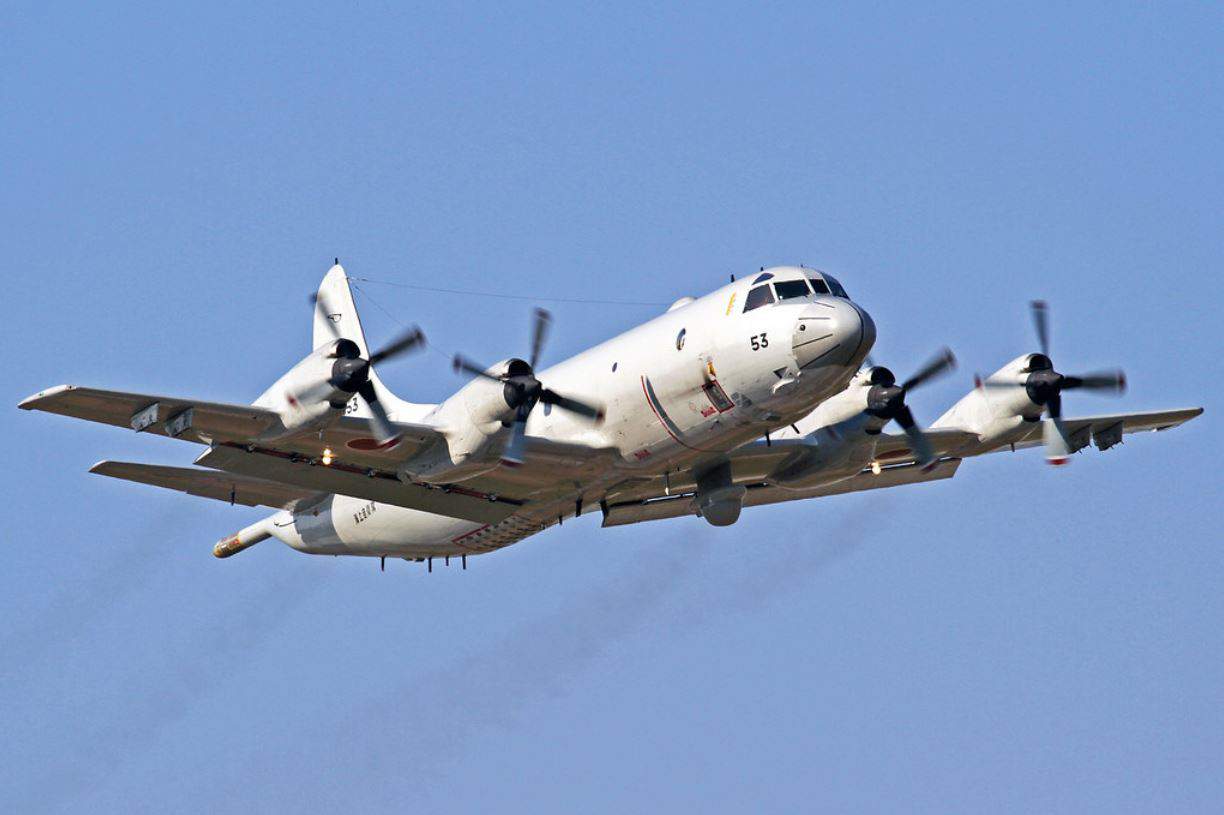
The Lockheed P-3 Orion is a four-engine turboprop maritime patrol and anti-submarine aircraft developed from the L-188 Electra airliner. It entered U.S. Navy service in August 1962, and Lockheed and Kawasaki built 757 by the most widely cited count. The Navy has replaced it with the P-8 Poseidon, but Japan, Canada, South Korea, Taiwan and NOAA’s hurricane hunters still fly it.
Live Fleet Activity (P3)
Fetching live data…


The Lockheed P-3 Orion is a four-engine turboprop built to find and sink submarines. The U.S. Navy introduced it in 1962, and at its Cold War peak it equipped 24 active-duty Navy patrol squadrons.
It started life as the Lockheed L-188 Electra airliner. The easiest way to tell the two apart is the tail: the Orion carries a long “stinger” boom behind the fin that houses its magnetic anomaly detector.
Lockheed and Kawasaki built 757 of them by the most widely cited count. The U.S. Navy has retired its patrol fleet, but Japan, Canada, South Korea, Taiwan and other operators still fly the type, as do NOAA’s hurricane hunters.
In August 1957 the Navy asked for a replacement for its piston-engined P2V Neptune and Martin P5M Marlin. Adapting an existing airframe promised lower cost and a faster route into service, and Lockheed proposed a military version of the L-188 Electra, which had not yet flown.
Lockheed won the competition in April 1958. An aerodynamic prototype, converted from the third Electra airframe and designated YP3V-1, flew on 19 August 1958.
The production design shared the Electra’s philosophy but not its structure. The fuselage was 7 feet (2.1 m) shorter forward of the wing, and Lockheed added a bomb bay, a more pointed radome, the tail stinger and wing hardpoints.
The Electra’s early reputation was a problem. Two airliner crashes in 1959 and 1960 were traced to engine mounts too weak to damp a whirling motion in the outboard engines, and Lockheed strengthened the mounts and wing structure on every Electra it had built.
The first production P3V-1 was launched on 15 April 1961. Deliveries to Patrol Squadrons VP-8 and VP-44 at NAS Patuxent River, Maryland, began in August 1962, and on 18 September 1962 the new tri-service designation system renamed the aircraft the P-3 Orion.

The P-3A became operational in August 1962, followed by the P-3B. The P-3C, the version most people mean by “P-3 Orion,” reached the fleet in August 1969.
The P-3C was built around a digital computer. In 1963 the Navy contracted Univac to build one to tie the sensors and displays together, an ambitious step when airborne computers were in their infancy, and the result led directly to the P-3C’s production system.
Many variants followed. The ones that matter most are:
Airframe life became the limiting factor as the fleet aged. Lockheed Martin’s mid-life upgrade replaces the outer wings, the lower center wing section and the horizontal stabilizer with new parts, adding 15,000 flight hours.
The Orion’s Cold War job was to localize Soviet ballistic missile and attack submarines that undersea listening networks had already detected, and to destroy them if war broke out.
The search starts with sonobuoys, dropped from launch tubes in the lower fuselage to listen for a submarine and relay what they hear. The final fix comes from the magnetic anomaly detector in the tail, which senses the disturbance a steel hull makes in the Earth’s magnetic field.
That detector only works at close range and low altitude, so it is used to pinpoint a target just before an attack. It sits in a fiberglass boom, far from the aircraft’s other electronics and ferrous metal, because the sensor is so easily disturbed.
Weapons ride in an internal bomb bay under the forward fuselage and on ten wing stations. The Navy rated the P-3C for 20,000 pounds (9,072 kg) of ordnance, including Mk 46, Mk 50 and Mk 54 torpedoes, AGM-84 Harpoon and SLAM-ER missiles, and AGM-65 Maverick.
A Navy P-3C flew with a crew of 11: three pilots, two naval flight officers, two flight engineers, three sensor operators and an in-flight technician.

The full specification table for the P-3C is on this page. Some of its figures read differently once you know the conditions behind them.
Speed. The 411-knot (473 mph, 761 km/h) top speed is measured at 15,000 feet and a weight of 105,000 pounds. The economical cruise is 328 knots (377 mph), and the speed that matters on a hunt is far lower: about 203 knots (234 mph) at 1,050 feet (320 m).
Range and endurance. The 4,830-nautical-mile ferry range is a one-way repositioning figure. On a real patrol the P-3C’s mission radius is 1,345 nautical miles (1,548 miles), with three hours on station at 1,500 feet at the far end.
Endurance is 12 hours 20 minutes on four engines at 15,000 feet. Running on two engines at the same altitude, Jane’s gives 17 hours 12 minutes, which is how the Orion stretches a patrol.
Weight. The panel’s maximum takeoff weight is the 142,000 lb (64,500 kg) maximum permissible figure. The normal maximum takeoff weight is lower, at 135,000 pounds (61,235 kg).
In October 1962, weeks after joining the fleet, P-3As flew blockade patrols around Cuba during the missile crisis. It was the type’s first real-world operational use.
The Vietnam War brought losses. In 1968 VP-26 lost two P-3Bs on Operation Market Time patrols off Phu Quoc Island: one was shot down by anti-aircraft fire in April, and one that crashed in February may also have been shot down. Both crews of 12 were lost.
On 28 January 1971, Commander Donald H. Lilienthal flew a P-3C to a world speed record for heavyweight turboprops of 501 mph (806 km/h). That beat the 452 mph record set by the Soviet Il-18 in 1968.
In the 1991 Gulf War, P-3Cs targeted 55 of the 108 Iraqi vessels destroyed. On 1 April 2001, an EP-3E ARIES II collided with a Chinese J-8II fighter off Hainan Island. The Chinese pilot was killed, and the badly damaged EP-3 made an emergency landing on Hainan, setting off an international dispute.
The Navy’s replacement is the Boeing P-8 Poseidon, a 737 derivative that entered service in 2013. In May 2020, Patrol Squadron 40 completed its switch to the P-8, ending P-3C service in active-duty patrol squadrons.
In February 2025, VQ-1 retired its last EP-3E and P-3C. That left the Navy’s remaining Orions, six by published counts, with two test and research squadrons, VX-30 and VXS-1.
Japan has been the largest user outside the United States. Kawasaki built the aircraft under licence, and the Japan Maritime Self-Defense Force flew 40 P-3Cs as of March 2022 while the Kawasaki P-1 gradually replaces them.
Canada still flies the CP-140M Aurora. South Korea, Taiwan, Chile, Argentina, Brazil, Portugal, Greece and Pakistan also operate P-3s in some form, and Chile plans to keep its aircraft flying past 2030 with new wings and engine upgrades.
Others have moved on. Spain retired its last Orion in December 2022, and Norway and New Zealand retired theirs in 2023.
By 2012 the P-3 had joined the B-52, KC-135, CH-47 and C-130 in a small club of aircraft the U.S. military had used for more than 50 years, the same company found on lists of the oldest military planes still in service.
Several P-3s have been civil-registered for government science and security work. NOAA flies two WP-3D Orions into hurricanes to gather the data forecasters use for track and intensity, a job explained in can planes fly in hurricanes.
NOAA says the WP-3Ds have operated since the mid-1970s. It has ordered two specially modified C-130J Super Hercules to replace them, with the new aircraft expected in 2030.

NASA’s P-3, N426NA, was built in 1966 and joined the Airborne Science Program in 1991. It carries instruments for atmospheric, ocean and ice research, and NASA quotes up to 12 hours’ endurance and an 18,000-pound (8,165 kg) useful payload.
U.S. Customs and Border Protection flies P-3s against drug smuggling. One version carries a rotating radar dome adapted from the E-2 Hawkeye, and another uses a radar adapted from the F-16.
The type also fought fires. Aero Union operated eight ex-Navy P-3As as air tankers leased to the U.S. Forest Service and California’s firefighting agency before the company went bankrupt, putting the Orion among the ex-military firefighting airplanes.
The most widely cited total is 757: 650 by Lockheed and 107 by Kawasaki. Lockheed’s own production ended in 1990.
Kawasaki’s own figure is lower: the company says it built 98 P-3Cs between 1978 and 1997. Kawasaki also first assembled five airframes produced by Lockheed, and the published sources do not fully reconcile the two totals.
Only in small numbers. Active-duty patrol squadrons finished moving to the P-8 Poseidon in May 2020, and VQ-1 retired its last EP-3E and P-3C in February 2025. The Navy’s remaining Orions, six by published counts, fly test and research missions with VX-30 and VXS-1.
The P-3C’s maximum speed is 411 knots (473 mph, 761 km/h) at 15,000 feet. It normally cruises at about 328 knots (377 mph) and patrols at low level at around 203 knots (234 mph). A P-3C set a heavyweight turboprop speed record of 501 mph (806 km/h) in 1971.
The most widely cited total is 757: 650 by Lockheed and 107 by Kawasaki in Japan. Kawasaki’s own figure is 98 P-3Cs built between 1978 and 1997.
Yes. NOAA flies two WP-3D hurricane hunters, NASA flies one P-3 for Earth science, and U.S. Customs and Border Protection uses P-3s for drug interdiction. Several ex-Navy P-3As have also served as firefighting air tankers.
In the U.S. Navy, the Boeing P-8 Poseidon, a jet based on the Boeing 737 that entered service in 2013. Japan is replacing its P-3Cs with the Kawasaki P-1, and NOAA’s WP-3Ds will be replaced by two C-130Js from 2030.
It was developed from the Lockheed L-188 Electra turboprop airliner. The Orion has a fuselage 7 feet (2.1 m) shorter forward of the wing, a bomb bay, a pointed radome and a tail boom for the magnetic anomaly detector.
The boom holds the magnetic anomaly detector, which finds a submerged submarine by the disturbance its steel hull makes in the Earth’s magnetic field. It sits at the tail to keep it away from the aircraft’s electronics and metal, which would otherwise interfere with the reading.
Sources and references used for research and fact-checking.