

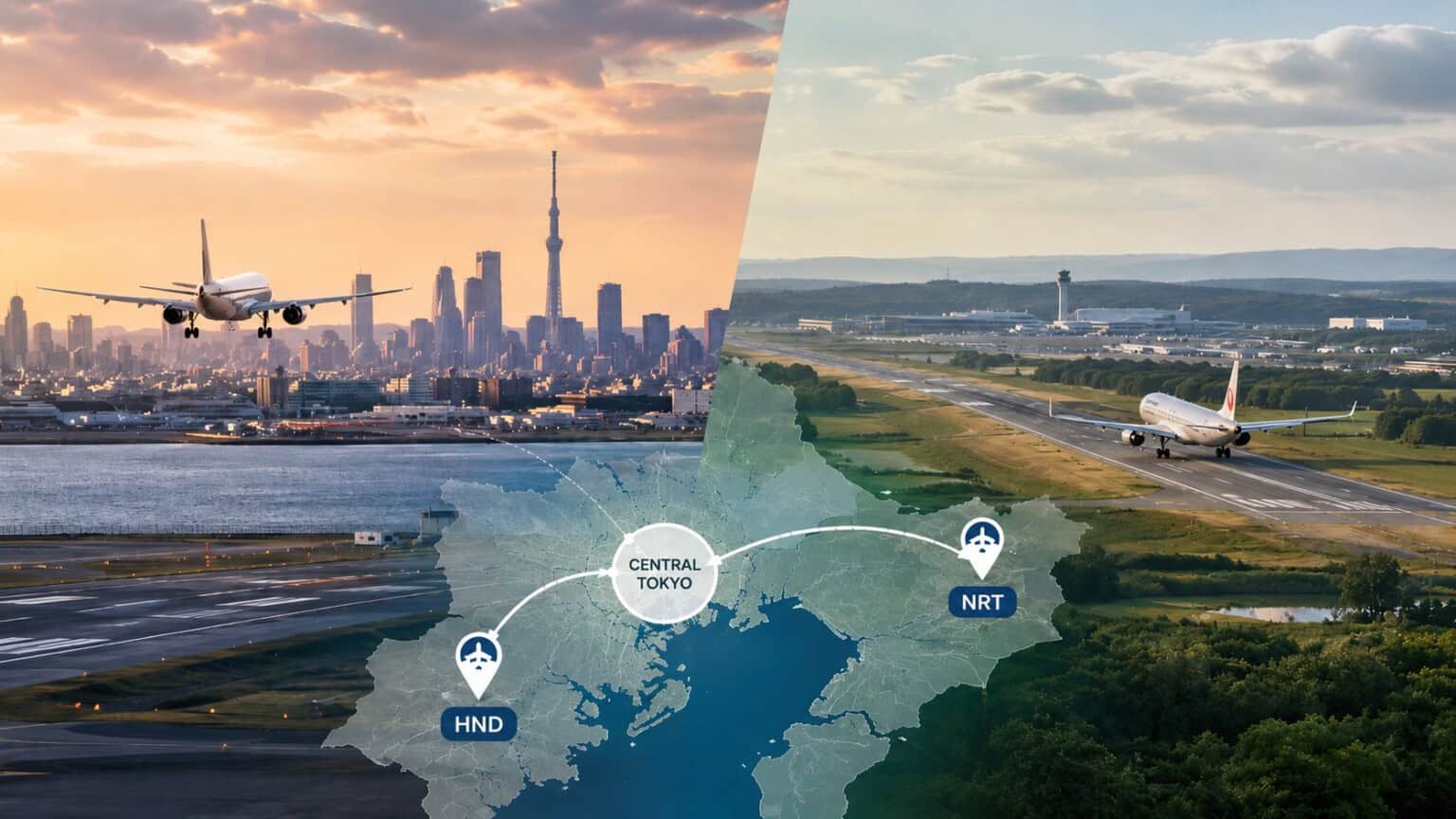
Book a flight to Tokyo and the search results quietly ask you to make a choice. Haneda or Narita, two airports, two codes, and a difference that can cost you an hour and a train transfer before you have even left the platform.
Haneda sits about 9 miles (15 km) from the city, close enough to reach the center in half an hour. Narita is roughly 37 miles (60 km) away in a different prefecture, out past the rice fields of Chiba.
Most cities that grew a second airport did it because the first one simply ran out of room. Tokyo’s story is stranger than that, and it involves a land war that is still not fully over. Here is why Tokyo has two airports, and which one you actually want.
The short answer
Haneda came first. It has been Tokyo’s airport since the 1930s, built on the edge of Tokyo Bay right beside the city.
By the 1960s the jet age had outgrown it, and Japan decided to build a large new international airport. It could not find room near Tokyo, so it went 37 miles (60 km) out into farmland, against ferocious local resistance.
For the next three decades the split was simple: Narita handled international flights, Haneda handled domestic. That neat division has been dissolving since 2010, which is why today both airports do a bit of everything.
The short version
Haneda is Tokyo’s original bayside airport, close to the city. Narita was built far out in Chiba in the 1970s because there was no room and no political will to expand near Tokyo. Narita took the international flights; Haneda kept domestic. Since 2010 Haneda has won international service back, so the old split no longer holds.
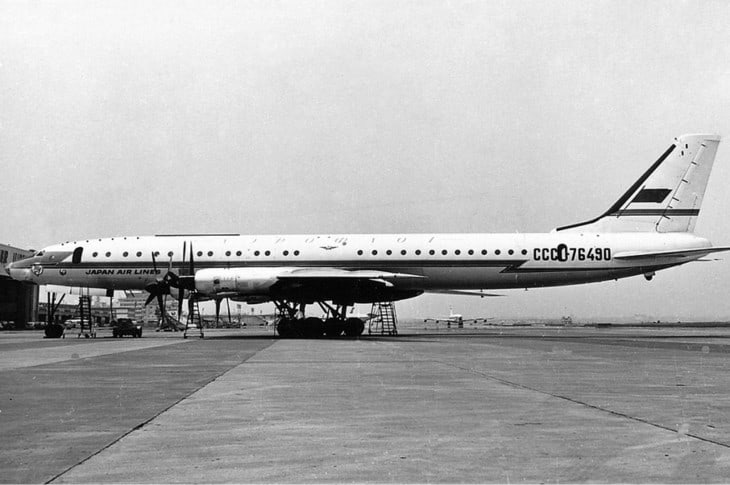

Haneda came first, and it never really left
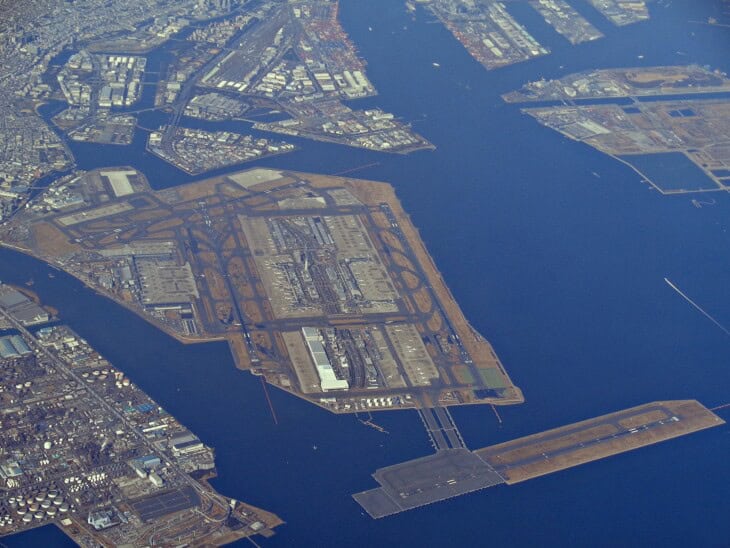
Haneda opened in 1931 as Tokyo’s first dedicated civil airport, built on reclaimed land along the shore of Tokyo Bay. Its position on the water is the whole point: aircraft climb out and descend over the bay rather than over dense neighborhoods.
That gave Haneda room to keep growing offshore, and it let the airport run around the clock without waking a city. Few big-city airports have that luxury.
By the 1960s, though, Japan’s economy and its appetite for international travel were booming, and Haneda was full. Expanding it fast enough, in a crowded city on a busy bay, was not realistic.
So the government decided to build a brand-new international airport with room to grow. The plan was sound. The location turned into one of the most bitter infrastructure fights in postwar Japan.
Why Narita ended up 37 miles away
In 1965 the government selected a site on the Shimosa Plateau near the town of Narita, in Chiba Prefecture. Local farmers, many resettled there after the war, reportedly learned their land was being taken from a news broadcast.
The result was the Sanrizuka Struggle, a years-long resistance movement of farmers joined by student activists. Authorities moved to expropriate the land by force, and the protests turned violent and deadly.
Construction dragged for years. Days before the airport was finally due to open, activists stormed the control tower and smashed its equipment, forcing yet another delay.
Narita, then called New Tokyo International Airport, at last opened on May 20, 1978, more than a decade after the site was chosen.
1931
Haneda opens on Tokyo Bay. Tokyo’s first dedicated civil airport is built on reclaimed land beside the city, with approaches over the water.
1965
A site is chosen in Chiba. The government picks farmland near Narita for a huge new international airport, with little consultation with the people who farmed it.
1966 onward
The Sanrizuka Struggle. Farmers and student activists fight the land seizures for years in protests that turn violent and, at times, fatal.
March 1978
The control tower is stormed. Days before the planned opening, activists break in and destroy equipment, delaying the debut again.
May 20, 1978
Narita finally opens. New Tokyo International Airport begins operations and takes over Tokyo’s international flights from Haneda.
2010
Haneda goes international again. A new international terminal and a fourth runway on reclaimed land let scheduled overseas flights return to the close-in airport.
There is still a farm inside the airport
A handful of families never sold. Decades on, working farmland still sits inside Narita’s perimeter, and the airport’s second runway had to be built shorter than planned and angled around the holdouts. Passengers on some departures can look down on vegetable plots the airport was never able to buy.
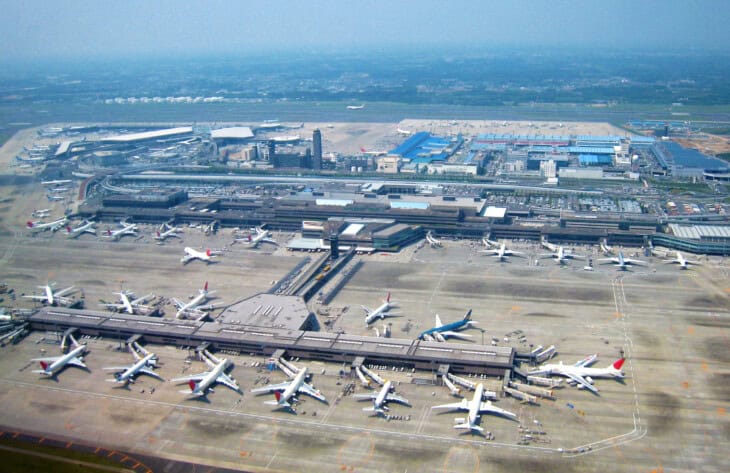
How Haneda won its international flights back
For thirty years the rule held: fly abroad from Narita, fly domestic from Haneda. Business travelers in particular resented the long haul out to Chiba for every international trip.
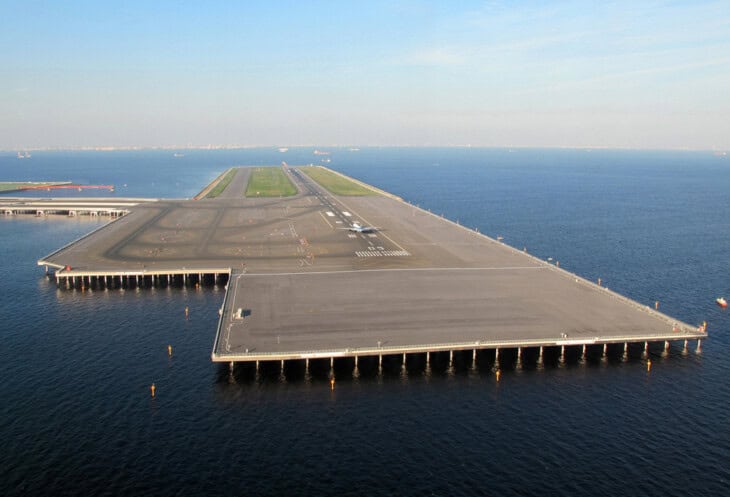
The fix came, again, from the water. Haneda kept expanding offshore onto reclaimed land, and in 2010 it opened a new international terminal and a fourth runway.
International service returned, first on limited night slots and then far more widely. In 2020, new arrival and departure paths over central Tokyo unlocked dozens of daytime slots, pushing Haneda toward roughly 130 international slots a day.
Today both airports handle international and domestic traffic. Haneda is the busier, higher-frequency airport, while Narita carries a broader spread of airlines and more of the long-haul and budget routes.
The turnaround was dramatic. Haneda is now one of the busiest airports in the world by passenger numbers, and the close-in airport its planners once tried to replace has quietly become Tokyo’s flagship again.
So which one should you use?
If your flight gives you a real choice, the honest answer comes down to where you are headed and how much you value time on the ground.
Haneda is closer, faster into the city, and runs a dense schedule, especially for domestic connections. Its single busiest route, Tokyo to New Chitose in Sapporo, sees around 67 departures a day, among the busiest air corridors on earth.
Narita is farther out and has a nighttime curfew, but it hosts more airlines and most of Tokyo’s low-cost and long-haul international flying, which often makes it the cheaper airport to fly through.
Getting into town matters too. From Haneda, the monorail or the Keikyu line reaches central Tokyo in around 30 minutes, while the fastest express trains from Narita still take roughly an hour, and traffic or a slower service can stretch that well past it.
| Haneda (HND) | Narita (NRT) | |
|---|---|---|
| Location | Ota, on Tokyo Bay | Chiba Prefecture, inland |
| Distance to central Tokyo | About 9 mi (15 km) | About 37 mi (60 km) |
| Flights per day | About 729 | About 330 |
| Airlines | About 52 | About 97 |
| Destinations | About 106 | About 114 |
| Best for | Speed into the city, domestic connections | Budget carriers, wide long-haul choice |
Source: AeroCorner airport data, updated July 2026. Figures move week to week.
Narita is also a textbook case of an airport nowhere near the city it is named after, a pattern budget travelers run into all over the world.
The myth: Haneda is domestic, Narita is international
This is the single most common mistake travelers still make about Tokyo, and it is now out of date.
Haneda flies to more than a hundred destinations, including major international routes, and Narita still carries plenty of domestic and regional flights. The clean split belongs to the past, not to your ticket.
The outdated rule
“Haneda is domestic, Narita is international” was true from 1978 to 2010. It is now wrong. Haneda flies dozens of international routes, and Narita still handles domestic flights. Check your actual ticket, not the old reputation.
Next time a Tokyo search offers you Haneda or Narita, you will know you are looking at two very different answers to the same problem.
One is the old airport that kept expanding into the bay until it could take the world back. The other is the airport a government built 37 miles (60 km) out because it could not do that twice. Tokyo is far from alone in ending up with more than one: London juggles six airports and New York runs three, each split by its own tangle of geography, history, and politics.
Sources and references used for research and fact-checking.
Get the Newsletter
The latest aviation news and stories sent to your inbox.
About the Author

Tim is the owner and lead editor of AeroCorner since 2019, overseeing aviation content covering aircraft, airlines, airports, and the broader aviation industry. Through years of researching, writing, editing, and publishing aviation-focused content, he has developed extensive practical knowledge of commercial aviation and air travel. Based in Asia and a frequent traveler himself, Tim also brings firsthand passenger experience to AeroCorner’s coverage. Outside of publishing, he has also explored aviation firsthand through hands-on flight training in New Zealand.