


Table of Contents
Pick Midway for a domestic trip into downtown Chicago, especially on Southwest: the Orange Line reaches the Loop in 20 to 25 minutes for $2.50, the average fare was $49 lower in mid-2026, and its flights ran on time more often than O’Hare’s in both 2025 and 2026.
Pick O’Hare for anything international, for United, American or a long nonstop, or when you are staying on the North Side or in the northwest suburbs. It flies to 294 destinations in 41 countries, and its Blue Line trains run 24 hours a day.
Below, the two are compared on getting downtown, where you can fly, delays, fares and the airports themselves, as of October 2026. The numbers come from the Chicago Transit Authority (CTA), the Chicago Department of Aviation (CDA), the Bureau of Transportation Statistics (BTS), J.D. Power and our own airport database.
| Criterion | Midway (MDW) | O’Hare (ORD) | Edge |
|---|---|---|---|
| Straight-line distance to Millennium Park* | About 9 miles (15 km) | About 16 miles (26 km) | Midway |
| Train to downtown | Orange Line, $2.50, 20 to 25 min; no overnight trains | Blue Line, $5, 40 to 45 min; runs 24 hours | Midway |
| Taxi to downtown (airport’s average) | $35 to $40 | About $50 | Midway |
| Destinations | About 85 on airlines, 9 of them abroad** | 294, of them 81 international | O’Hare |
| Main airlines | Southwest, 95% of domestic departures in 2026 | Hub for United and American | O’Hare |
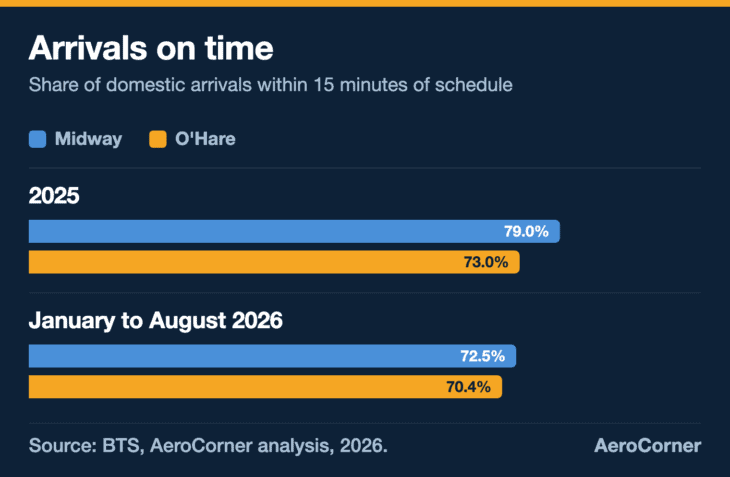
| Domestic arrivals on time, 2025*** | 79.0% | 73.0% | Midway |
| Domestic arrivals on time, January to August 2026*** | 72.5% | 70.4% | Midway |
| Domestic flights cancelled, January to August 2026*** | 1.6% | 3.1% | Midway |
| Average taxi-out, 2025*** | 14.9 min | 26.0 min | Midway |
| Average domestic fare, Q2 2026 | $354.24 | $403.20 | Midway (route mix differs) |
| J.D. Power 2026 | 17th of 27 large airports | Tied last of 20 mega airports | Midway |
How we compared
Train fares and travel times are the ones the CTA listed on October 20, 2026, and taxi figures are the average fares the Chicago Department of Aviation publishes for each airport. On-time, cancellation and taxi-out figures are our own count from the BTS Reporting Carrier On-Time Performance files for January 2025 to August 2026, using the DOT definition: within 15 minutes of schedule, with cancelled and diverted flights counted as late. BTS covers only domestic flights by US airlines, which leaves out O’Hare’s foreign carriers. Destination and runway figures come from the AeroCorner airport database, updated October 2026, and distances were measured in a straight line to Cloud Gate in Millennium Park.
Getting downtown
This is the question most people are asking, and Midway wins it on distance. In a straight line it sits about 9 miles (15 km) from Millennium Park on the Southwest Side, while O’Hare is about 16 miles (26 km) out on the far Northwest Side.
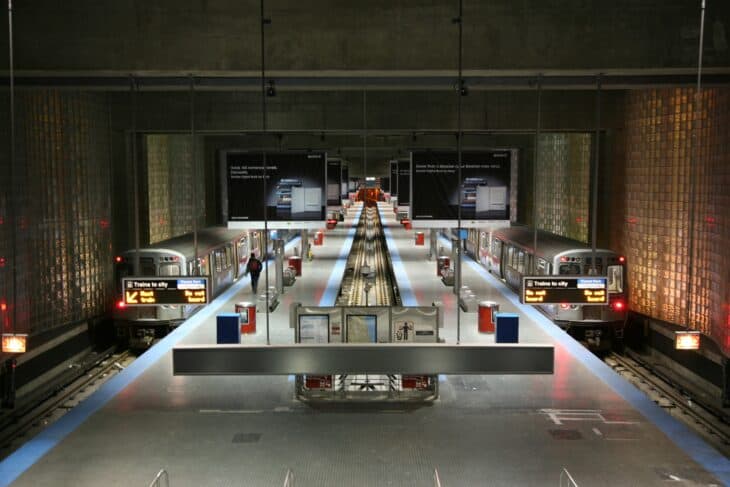
By train, Midway is cheaper and faster. The CTA puts the Orange Line ride to the Loop at 20 to 25 minutes for the standard $2.50 fare, and every train from Midway goes downtown.


O’Hare’s Blue Line takes 40 to 45 minutes and costs $5, because the CTA charges a premium fare when you tap in at the O’Hare station. The ride into the airport is the normal $2.50.
O’Hare’s line has one real advantage: Blue Line trains run 24 hours a day, seven days a week. The Orange Line stops overnight, when the CTA sends riders to the N62 Archer night bus instead.

By taxi, the airports’ own averages are about $50 from O’Hare to downtown and $35 to $40 from Midway. The CTA’s table gives rideshare at about $35 to $50 from O’Hare and $25 to $40 from Midway, with surges past $100 at either, and 25 to 90 minutes from O’Hare against 15 to 40 from Midway.
Geography can flip the answer. For the North Side, Evanston or the northwest suburbs, O’Hare is the closer airport, and Midway suits the South Side, Hyde Park and the southwest suburbs.
Edge: Midway. It is closer to the Loop, half the train fare and about $10 to $15 cheaper by cab, although only O’Hare has trains all night.
Where you can fly
O’Hare is one of the biggest connecting hubs in the world. Our O’Hare airport page counts about 1,512 flights a day to 294 destinations in 41 countries, 81 of them international, and the longest nonstop runs to Hong Kong at about 15 hours 25 minutes.
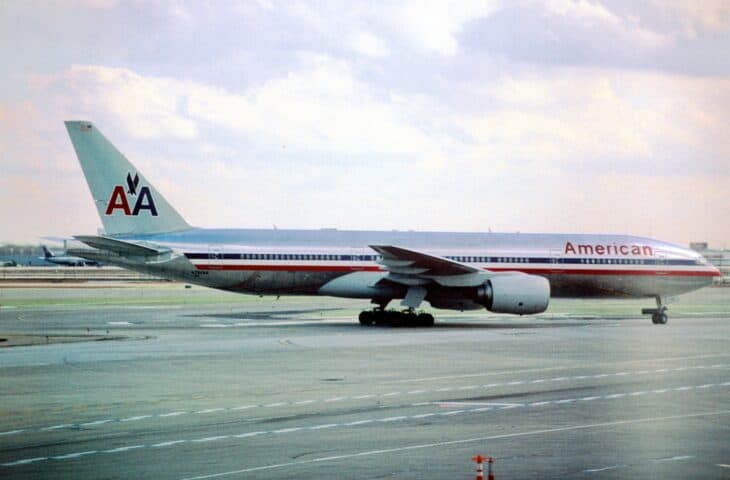

It handled 84.9 million passengers in 2025, according to the CDA’s figures as reported by CAPA. It is also a hub for two airlines at once, United and American, which together with their regional partners flew most of its domestic departures.
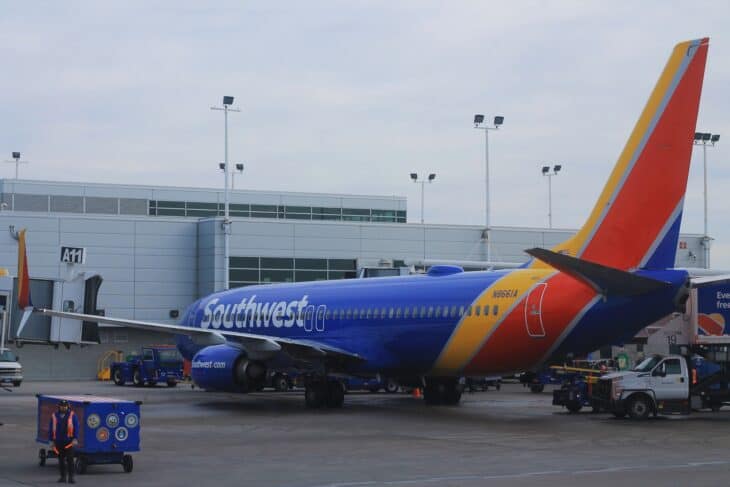
Midway is a Southwest airport. Southwest operated 95.2% of the domestic departures BTS recorded there from January to August 2026, and it stopped flying from O’Hare on June 4, 2026, which leaves Midway as its only Chicago airport.

The CDA counted 19.4 million Midway passengers in 2025, 9.9% fewer than in 2024.
Our Midway airport page lists 218 destinations, but most of them are private-jet trips by operators such as NetJets and Flexjet. Count only airline service and the figure is about 85: Southwest’s 72, plus Volaris to seven Mexican cities, Porter to Toronto’s island airport and a few Allegiant, Frontier and Delta routes.
Midway does handle international flights: 688,222 international passengers passed through it in 2025, mostly on routes to Mexico. For Europe, Asia, the Middle East or South America, though, you fly from O’Hare.
The runways explain the split. O’Hare’s longest runway is 12,979 feet (3,956 m), long enough for the Boeing 777s and 787-9s on its long-haul routes, while Midway’s longest is 6,522 feet (1,988 m), a length that suits the Boeing 737-800 and other narrowbodies Southwest flies. Both lists are in our guide to the longest runways in the US.
Edge: O’Hare. It flies to more than three times as many airline destinations and is Chicago’s only gateway to most of the world.
Delays and cancellations
Midway has been the more punctual airport. On domestic flights by US airlines, 79.0% of its arrivals were on time in 2025 against 73.0% at O’Hare, and from January to August 2026 the figures were 72.5% and 70.4%.
The gap narrowed this year, when Midway’s on-time rate fell more than 6 points. Midway still cancels fewer flights: 1.6% of its domestic departures from January to August 2026 against 3.1% at O’Hare, after 1.1% and 1.7% in 2025.
The biggest daily difference is on the ground. Midway’s departures averaged 14.9 minutes from gate to takeoff in 2025, against 26.0 minutes at O’Hare, where jets often taxi across a sprawling airfield to reach their runway.
O’Hare is also running at its limit. The FAA capped it at 2,708 flights a day in 2026, down from the 3,080 airlines had planned for the summer, and in July it extended the order for another year, saying “significant delay and operational disruption would occur” if the cap expired on October 24.
Midway has its own problem this fall. The CDA closed Runway 22L on October 19, 2026 to repair its overrun arrestor bed and warned of delays and cancellations until the work ends, which it expects by mid-November.
Edge: Midway. More of its flights arrived on time in both 2025 and 2026, and its taxi-outs are about 11 minutes shorter.
Airfares
Midway is cheaper on average. In the second quarter of 2026, BTS put the average domestic itinerary fare from Midway at $354.24, against $403.20 from O’Hare, a gap of $48.96 a ticket, or about $196 for a family of four.
That is not a like-for-like price. O’Hare’s average includes premium cabins and long transcontinental trips that Midway barely serves, so the honest test is to price your own route from both airports on the same dates.
The cheaper airport is also changing. Southwest now charges for checked bags and assigns seats, two changes that J.D. Power’s Michael Taylor said Midway passengers were still adjusting to in 2026. Compare it with the big three in our Southwest vs Delta breakdown.
Edge: Midway. Its average fare is about $49 lower, but check your exact route, because the averages cover different trips.
The terminals and the airport itself
Neither airport scored well with travelers in 2026. In J.D. Power’s North America Airport Satisfaction Study, O’Hare tied with Newark for last place among the 20 mega airports, its first time at the bottom, after 18th in 2024 and 16th in 2025.
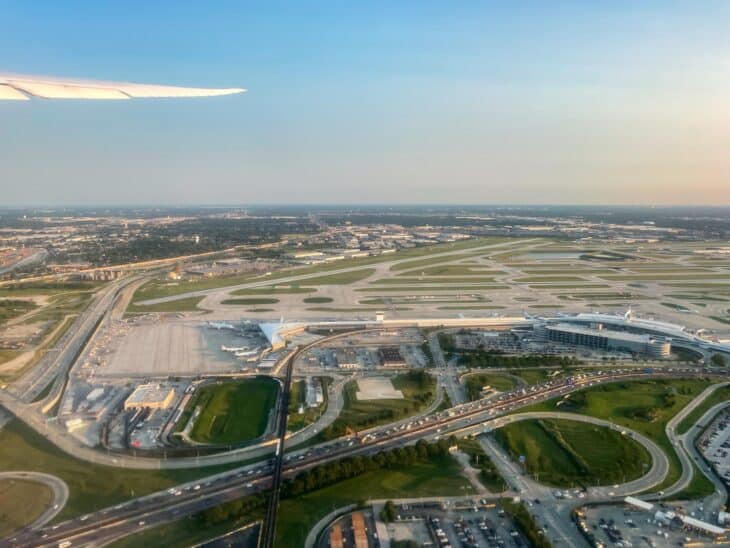

Michael Taylor, J.D. Power’s managing director of travel, hospitality and retail, blamed the concourse construction, telling the Sun-Times that until the renovation is complete, O’Hare will be too small for the number of people it serves. Its $8 billion expansion includes a 19-gate satellite, Concourse D, due in late 2028, and a Global Terminal to replace Terminal 2 by 2033.
Midway ranked 17th of 27 large airports, up from 19th in 2025 and 23rd in 2024. Taylor pointed to its landlocked site, with no room to grow, and to food that passengers rated poorly.
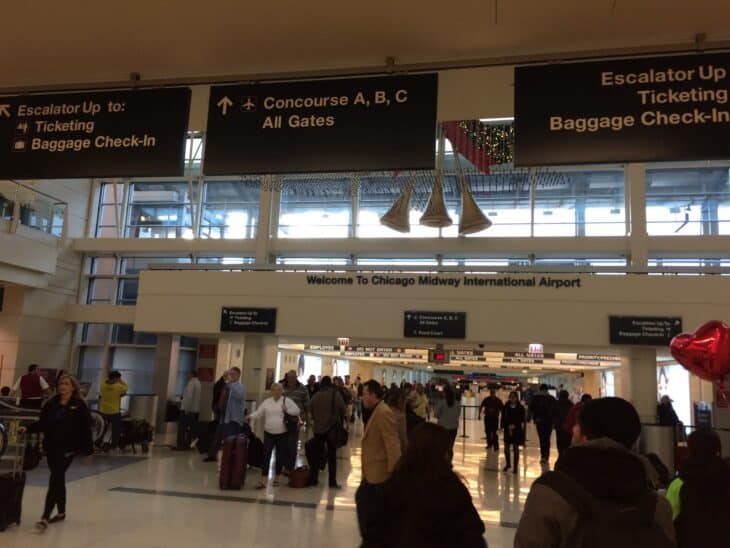
Size cuts both ways. O’Hare’s terminals are spread out, and the Blue Line station serves Terminals 1, 2 and 3 directly, but it has United and American lounges and the long-haul carriers. Midway is a single terminal that is quick to cross, with far fewer places to eat or wait.

Both airports are named for the Pacific war
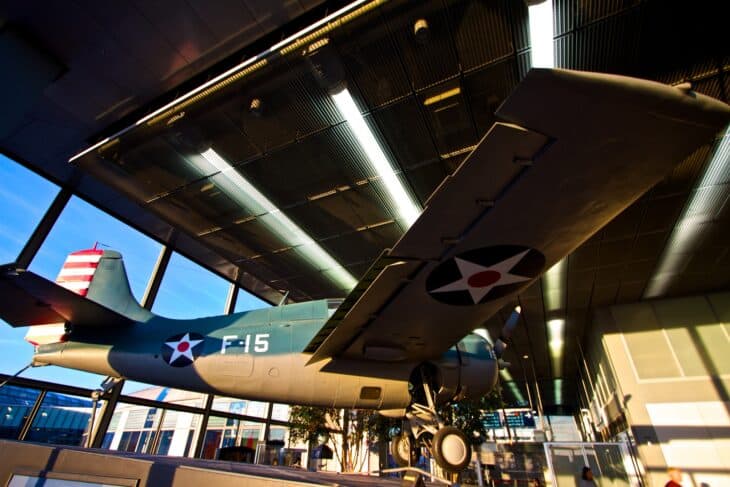
Chicago renamed both airports in 1949. Midway took the name of the June 1942 Battle of Midway, and a Douglas SBD Dauntless dive bomber is on display there as part of its memorial. Orchard Field became O’Hare after Edward “Butch” O’Hare, the Navy’s first flying ace of World War II, and a Grumman F4F Wildcat painted in the markings of his fighter is on display in Terminal 2. The old name survives in O’Hare’s code: ORD, for Orchard.
The history behind the first name is in our story on the Battle of Midway, and the fighter behind the second is on our Grumman F4F Wildcat page.

Edge: Midway. It placed higher in its J.D. Power category in 2026 and has no terminal construction to work around, although O’Hare has far more lounges and long-haul airlines.
Myth: Midway is Chicago's small regional airport
Midway carried 19.4 million passengers in 2025 and ranked 33rd in the country for domestic passengers in the BTS fare tables. It was also the busiest airport in the United States from 1948 to 1960, until jets too big for its square-mile site pushed the airlines to O’Hare.
Who should pick which
| If you… | Pick | Because |
|---|---|---|
| Fly Southwest, or any domestic trip with a hotel in the Loop | Midway | 20 to 25 minutes and $2.50 on the Orange Line |
| Fly to Europe, Asia, the Middle East or South America | O’Hare | Midway’s only international routes go to Mexico and Canada |
| Fly United, American or a long nonstop | O’Hare | It is a hub for both airlines |
| Stay on the North Side or in the northwest suburbs | O’Hare | It is the closer airport |
| Stay on the South Side or in the southwest suburbs | Midway | It is the closer airport |
| Land late at night and want the train | O’Hare | The Blue Line runs 24 hours |
| Care most about arriving on time | Midway | A better on-time record in 2025 and 2026 |
| Want the lowest fare | Price both | Midway averages $49 less, but on a different route mix |
For most domestic travelers headed downtown, Midway is the easier airport. O’Hare earns its place as soon as a trip goes abroad, goes long, or starts on United or American.
FAQ
Sources and references used for research and fact-checking.
- Chicago Transit Authority, Fare information
- Chicago Transit Authority, Getting to and from the airports
- O'Hare International Airport (Chicago Department of Aviation), Taxi
- Midway International Airport (Chicago Department of Aviation), Taxi
- Chicago Department of Aviation, Year-to-date operations, passengers, cargo summary, December 2025, Midway
- CAPA Centre for Aviation, Chicago O'Hare International Airport handles 84.9m pax in 2025
- Bureau of Transportation Statistics, Reporting Carrier On-Time Performance (1987-present)
- Bureau of Transportation Statistics, Average Domestic Airline Itinerary Fares, Q2 2026
- Chicago Sun-Times, O'Hare ranks last in customer satisfaction survey
- Chicago Sun-Times, FAA extends flight limits at O'Hare Airport
- AeroCorner, Chicago Midway Shuts Runway 22L Until Mid-November to Repair Its Overrun Arrestor Bed
- One Mile at a Time, Southwest Airlines ends Chicago O'Hare flights, and that's not surprising
- Wikipedia, Midway International Airport
- Wikipedia, O'Hare International Airport
- Wikipedia, Edward O'Hare
- AeroCorner, Chicago O'Hare airport (KORD)
- AeroCorner, Chicago Midway airport (KMDW)
Get the Newsletter
The latest aviation news and stories sent to your inbox.
About the Author

Tim is the owner and lead editor of AeroCorner since 2019, overseeing aviation content covering aircraft, airlines, airports, and the broader aviation industry. Through years of researching, writing, editing, and publishing aviation-focused content, he has developed extensive practical knowledge of commercial aviation and air travel. Based in Asia and a frequent traveler himself, Tim also brings firsthand passenger experience to AeroCorner’s coverage. Outside of publishing, he has also explored aviation firsthand through hands-on flight training in New Zealand.