

Table of Contents
Pick Heathrow for a flight from the United States: it has nonstops to about 30 US cities, the fastest train into London and the better on-time record, with 76.7% of flights on time in 2025 against Gatwick’s 69.8%.
Pick Gatwick for a cheap European hop, a Florida vacation flight or a trip to the south coast. It is the easyJet and charter airport, it cancelled fewer flights in 2025, and it puts you on a direct train to Brighton or London Bridge without crossing the city.
Below, the two are compared on getting into London, where you can fly, delays, the terminals, driving and the connection between them, as of October 2026. The numbers come from the UK Civil Aviation Authority (CAA), Transport for London (TfL), both airports and our own airport database.
If you are weighing London’s smaller airports too, start with our guide to why London has so many airports.
| Criterion | Heathrow (LHR) | Gatwick (LGW) | Edge |
|---|---|---|---|
| Distance from London | About 14 miles (22 km) west | About 28 miles (46 km) south | Heathrow |
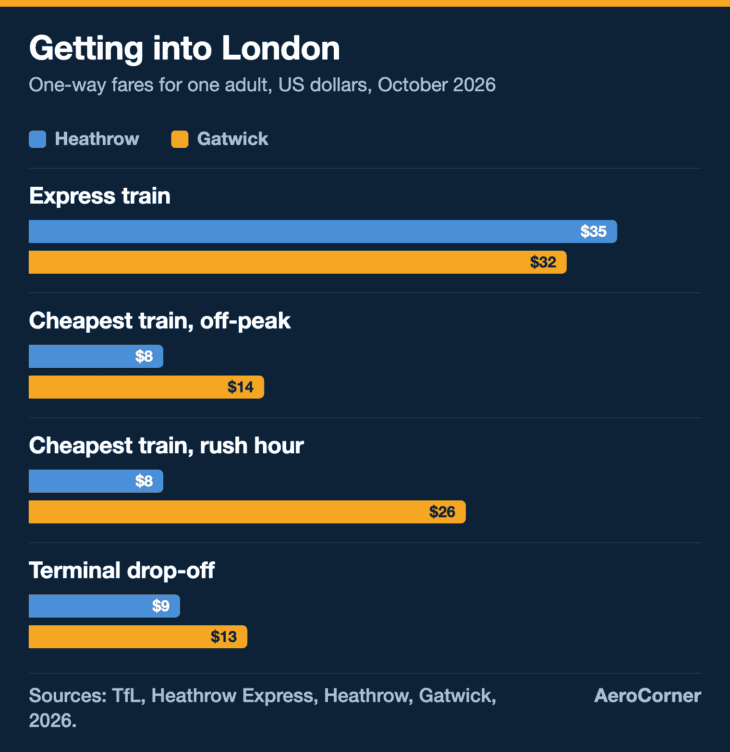
| Fastest train* | Heathrow Express, 15 min to Paddington, £26 (about $35) walk-up, from £10 in advance | Gatwick Express, about 30 min to Victoria, £24 (about $32) | Heathrow |
| Cheapest train* | Piccadilly line, £5.90 (about $8), about 1 hr | Southern or Thameslink, £10.70 (about $14) off-peak, £19.20 (about $26) peak | Heathrow |
| Passengers, 2025 | 84.5 million | 42.8 million | Heathrow (bigger) |
| Nonstop destinations / airlines | 211 / 88 | 203 / 65 | Heathrow, narrowly |
| US cities, nonstop | About 30 | Orlando is the only one on BA and Norse this winter | Heathrow |
| Flights on time, 2025** | 76.7% | 69.8% | Heathrow |
| Average delay, 2025** | 12.8 min | 16.8 min | Heathrow |
| Flights cancelled, 2025** | 1.32% | 0.82% | Gatwick |
| Which? 2026 score | 62% to 66% by terminal | 63% both terminals | Even |
| Terminal drop-off | £7 (about $9) per entry | £10 (about $13) for 10 min, then £1 a minute | Heathrow |
| Runways | Two: 12,799 ft and 12,001 ft | One in routine use: 10,883 ft (plus an 8,402 ft standby) | Heathrow |
How we compared
Fares are the ones TfL, Heathrow Express and Gatwick listed on October 19, 2026, for one adult paying as you go with a contactless card, converted at the European Central Bank rate of $1.3335 per pound (October 16, 2026). Punctuality comes from the CAA’s 2025 annual summary, which counts a flight as on time from early to 15 minutes late. Late share is 100% minus the on-time share, so 23.3% at Heathrow and 30.2% at Gatwick. Destination, airline and US city counts come from the AeroCorner airport database, updated October 12 (Heathrow) and October 14 (Gatwick), 2026. Distances are the official UK AIP figures of 12 and 24.7 nautical miles from London, converted to statute miles.
Getting into London
Heathrow sits about 14 miles (22 km) west of central London and Gatwick about 28 miles (46 km) south, according to the UK’s official aeronautical publication. That doubling of distance matters most by road, and much less by rail.
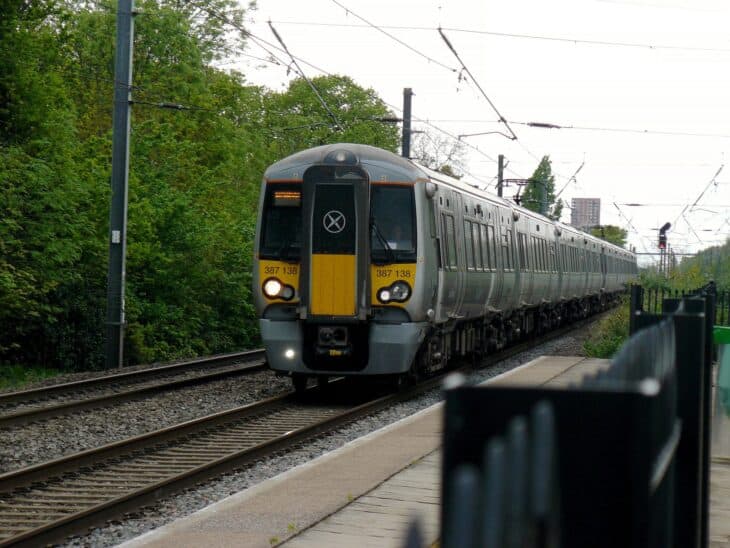
The Heathrow Express is the fastest ride from either airport: 15 minutes nonstop to Paddington, every 15 minutes, for £26 (about $35) walk-up or from £10 (about $13) booked in advance. The Gatwick Express runs twice an hour to Victoria and takes about 30 minutes, and it costs £24 (about $32) by contactless card, with 10% off when booked online.

On a budget, Heathrow wins clearly. The Piccadilly line Tube costs £5.90 (about $8) to Piccadilly Circus at any time, and Heathrow’s own planner puts the Tube ride to Victoria at about an hour. The Elizabeth line reaches Farringdon in about 35 minutes for £15.50 (about $21).
Gatwick’s cheaper Southern and Thameslink trains cost £10.70 (about $14) off-peak to Victoria or Farringdon and £19.20 (about $26) at peak times. Thameslink’s big advantage is that it runs straight through the city, to London Bridge, Blackfriars, Farringdon and St Pancras, without a change.
By taxi, TfL puts a black cab from Heathrow to central London at £70 to £120 (about $93 to $160) and 30 to 60 minutes, plus £1.60 from a Heathrow rank. TfL publishes no Gatwick figure, because Gatwick lies outside Greater London, but the trip is twice as long.
Edge: Heathrow. It has both the fastest train and the cheapest one, and the taxi ride is half as long.
Where you can fly, especially from the US
On raw destination counts the two are closer than most people expect. Our database lists 211 nonstop destinations from London Heathrow on 88 airlines, and 203 from London Gatwick on 65 airlines.
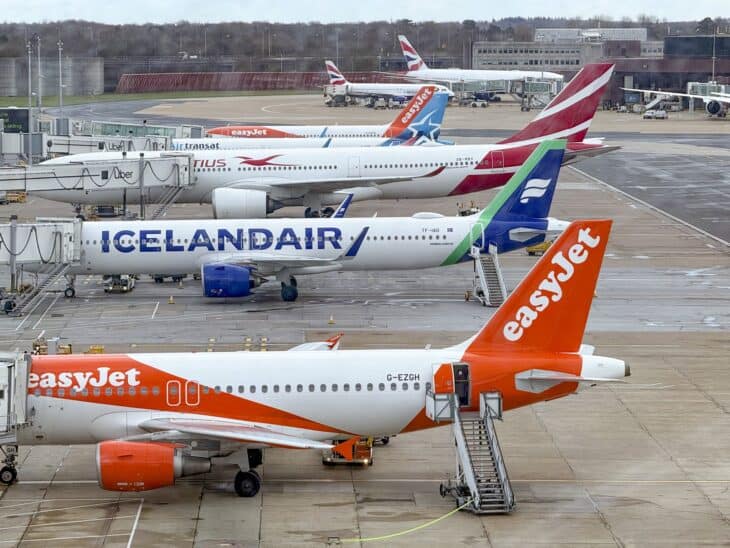
The mix is what differs. Heathrow is British Airways’ hub, its busiest route is New York and its largest international market is the United States. Gatwick’s top airline is easyJet and its busiest route is Málaga, a vacation-flight airport first.
For Americans, that settles most trips. Heathrow has nonstops to about 30 US cities, with American, Delta, United, Alaska, JetBlue, Virgin Atlantic and British Airways all flying there. Heathrow alone handled 20.6 million passengers to and from North America in 2025.
Gatwick’s US list is shrinking this winter. British Airways moves its Tampa flights from Gatwick to Heathrow on October 25, 2026, and Norse Atlantic suspends Gatwick to New York JFK from October 25, 2026 to March 27, 2027. That leaves Orlando as the only US city either airline flies from Gatwick until spring.
Edge: Heathrow. Unless you are flying to Orlando or to a European beach, the flight you want is far more likely to leave from Heathrow.
Delays and cancellations
The CAA tracks every scheduled and charter flight at UK airports. In 2025, 76.7% of Heathrow’s flights were on time, meaning anywhere from early to 15 minutes late, against 69.8% at Gatwick.
Put the other way round, 23.3% of Heathrow flights missed that window and 30.2% of Gatwick flights did. A Gatwick flight was about 30% more likely to run late, and its average delay was 16.8 minutes against Heathrow’s 12.8.
Gatwick has the better cancellation record: 0.82% of its flights were cancelled in 2025, against 1.32% at Heathrow. Both are low, and our guide to why flights get cancelled explains what drives the difference.
One runway doing the work of two
Heathrow moved 84.5 million passengers in 2025 across two runways, about 42.2 million per runway. Gatwick moved 42.8 million almost entirely on its single main runway, because its second strip is a standby that is not in routine use. Each runway at the two airports carries about the same load, which is a big part of why both run so close to their limits.
Edge: Heathrow. It is more punctual by about 7 points and 4 minutes, which outweighs Gatwick’s lower cancellation rate for most travelers.
Size, terminals and the airport experience
Gatwick is not bigger than Heathrow. Heathrow handled 84.5 million passengers in 2025 and Gatwick 42.8 million, almost exactly half.
Heathrow has four terminals, numbered 2 to 5, and British Airways flies mostly from Terminal 5. Gatwick has two, North and South, linked by a free shuttle that takes two minutes.
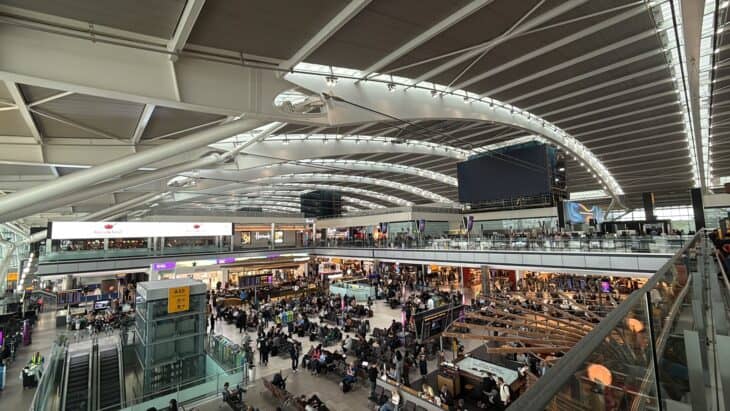

Travelers rate them about the same. In the Which? 2026 survey of 6,067 people, Heathrow’s terminals scored from 62% (Terminal 3) to 66% (Terminals 4 and 5), and both Gatwick terminals scored 63%.
The runways tell the aviation story. Heathrow’s two runways are 12,799 feet and 12,001 feet long, while Gatwick’s main runway is 10,883 feet, with an 8,402-foot standby beside it.
Edge: Even. Heathrow is twice the size, but passengers do not rate the experience any differently.
Driving, drop-off and pick-up
Both airports now charge to stop outside the terminal. Heathrow charges £7 (about $9) every time a vehicle enters a terminal drop-off zone, and the drop-off is free at its Park and Ride car parks with a free bus to the terminal.
Gatwick charges £10 (about $13) for the first 10 minutes, then £1 for each extra minute up to 20 minutes, with a 30-minute maximum stay. At both airports the charge is paid by midnight the next day, and Heathrow’s cameras log every plate.
Edge: Heathrow. Its charge is lower and flat, while Gatwick’s grows by the minute.
Connecting between Heathrow and Gatwick
There is no direct train between the two. Heathrow lists National Express and Flixbus coaches at about 70 minutes and The Airline coach at about 75, before any traffic.
By rail you change in central London. Heathrow’s fastest suggestion is the Heathrow Express and the Elizabeth line to Farringdon in about 30 minutes, where Thameslink trains continue to Gatwick.
We would allow at least three to four hours between flights if you must switch airports, because you clear UK immigration and collect your bags first. A single-airport itinerary avoids all of it, and Heathrow is the airport with the connections.
Edge: Heathrow. As the hub, it is where airlines connect you on one ticket, so you rarely need the transfer at all.
New runways: what changes next
Gatwick is closer to a second runway. The government granted consent for its Northern Runway project on September 21, 2025, the High Court upheld it on June 23, 2026, and the Court of Appeal dismissed the last legal challenge on August 4, 2026, as our report on the Gatwick runway ruling explains.

Heathrow’s third runway is still in the political stage. Its national policy statement was before Parliament on October 12, 2026, and Heathrow’s public consultation runs from October 27 to December 22, 2026.
Edge: Gatwick. Its extra capacity is approved and past the courts, while Heathrow’s has not yet been voted on.
Who should pick which
| If you… | Pick | Because |
|---|---|---|
| Are flying nonstop from the US (outside Orlando) | Heathrow | About 30 US cities against a winter list of one |
| Are connecting to another long-haul flight | Heathrow | It is British Airways’ hub, and the airports are 70+ minutes apart |
| Want the fastest or cheapest train into London | Heathrow | 15 minutes on the Heathrow Express, or £5.90 on the Tube |
| Are staying near London Bridge, the City or St Pancras | Either | Thameslink from Gatwick runs straight through; the Elizabeth line does the same from Heathrow |
| Are heading to Brighton or the south coast | Gatwick | It sits between London and the coast, with direct trains |
| Are flying easyJet, a charter or a European vacation flight | Gatwick | Its biggest airline is easyJet, and its busiest route is Málaga |
| Care most about the flight not being cancelled | Gatwick | 0.82% cancelled in 2025 against 1.32% |
For the same trip at the same price, choose Heathrow. Choose Gatwick when the fare, the airline or where you are staying makes it the obvious answer, because the difference is rarely worth paying much extra for.
New York has the same dilemma with two airports, and the answer is just as uneven: see JFK vs LaGuardia.
Myth: Gatwick is too far from London to be practical
Gatwick is about twice as far from London as Heathrow, but the train gap is small. The Gatwick Express reaches Victoria in about 30 minutes, and Heathrow’s Elizabeth line takes about 35 minutes to Farringdon. Only by road, where the distance matters, is Gatwick clearly the slower choice.
FAQ
Sources and references used for research and fact-checking.
- NATS UK AIP, EGLL London Heathrow, AD 2 aerodrome data (AIRAC 2026-10-01)
- NATS UK AIP, EGKK London Gatwick, AD 2 aerodrome data (AIRAC 2026-10-01)
- UK Civil Aviation Authority, Punctuality statistics, 2025 annual summary
- Heathrow Airport, Heathrow traffic figures, December 2025
- London Gatwick, Strong 2025 performance as investment, innovation and operational excellence positions London Gatwick for future growth
- Heathrow Express, Heathrow Express tickets and fares
- London Gatwick, Trains to and from London Gatwick
- Gatwick Express, Gatwick Express
- Transport for London, Tube and rail fares
- Transport for London, Taxi fares
- Heathrow Airport, Travel between airports
- Heathrow Airport, Which terminal
- Heathrow Airport, Terminal Drop-Off Charge
- London Gatwick, Drop-off charges
- Which?, Best and worst UK airports
- London Gatwick, Future plans: Northern Runway
- Heathrow Airport, Parliament has opportunity to unlock jobs, trade and growth as momentum for Heathrow expansion builds
- Heathrow Airport, Heathrow invites local community to have their say during expansion consultation
- Mickey From The UK, British Airways Tampa flights are moving from Gatwick to Heathrow
- AeroRoutes, Norse Atlantic suspends New York service in NW26
- European Central Bank via Frankfurter, GBP to USD reference rate
Get the Newsletter
The latest aviation news and stories sent to your inbox.
About the Author

Tim is the owner and lead editor of AeroCorner since 2019, overseeing aviation content covering aircraft, airlines, airports, and the broader aviation industry. Through years of researching, writing, editing, and publishing aviation-focused content, he has developed extensive practical knowledge of commercial aviation and air travel. Based in Asia and a frequent traveler himself, Tim also brings firsthand passenger experience to AeroCorner’s coverage. Outside of publishing, he has also explored aviation firsthand through hands-on flight training in New Zealand.