

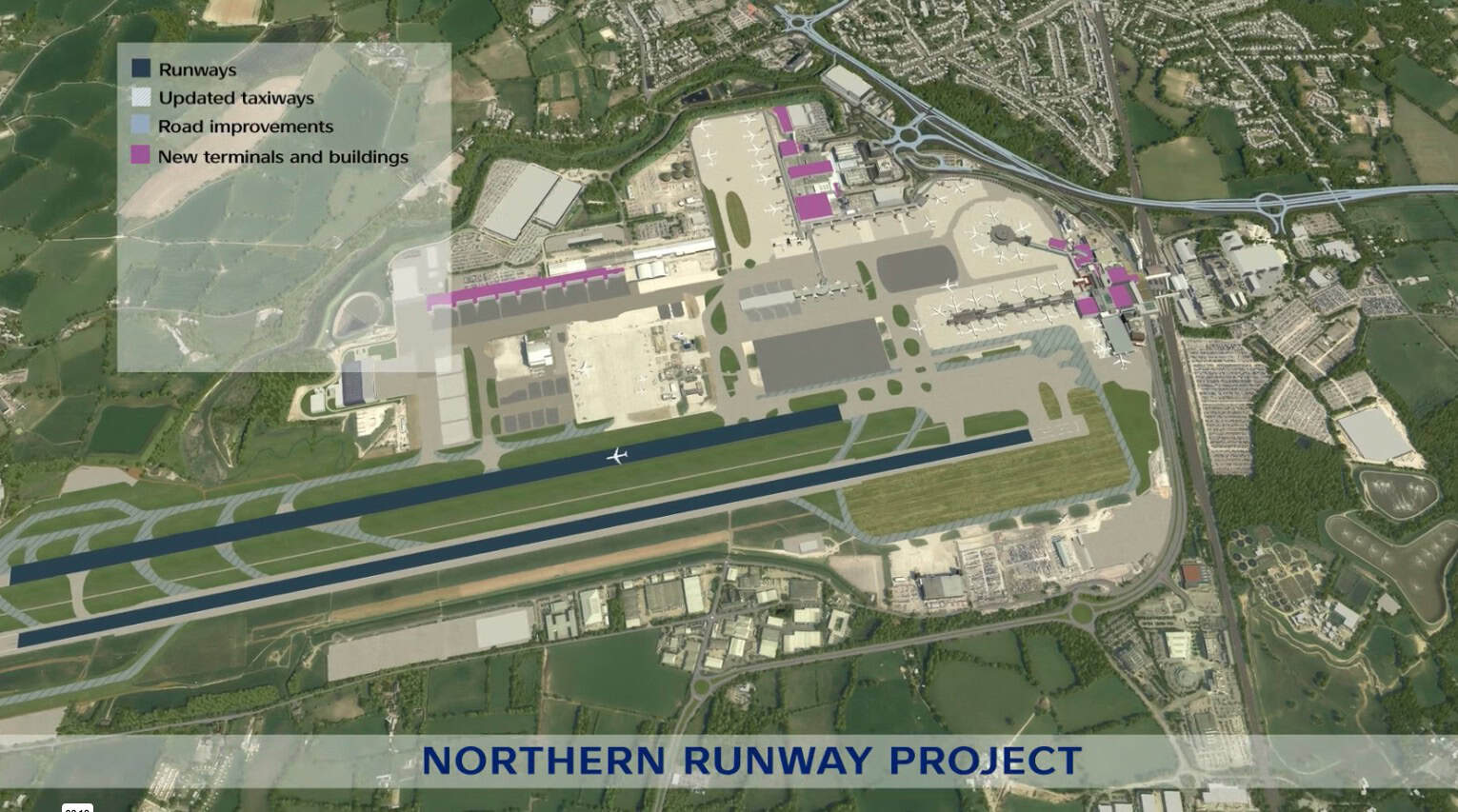
On August 4, 2026, the Court of Appeal refused campaigners permission to challenge the approval of Gatwick’s second runway, clearing the last legal obstacle in front of the project. Lord Justice Holgate and Lord Justice Dove concluded that each of the grounds of appeal raised by each appellant was unarguable.
The appellants were local resident Peter Barclay and the campaign group Communities Against Gatwick Noise Emissions, known as CAGNE. Their case turned on greenhouse gas emissions, the treatment of non-CO2 aviation effects, the deliverability of the UK government’s Jet Zero strategy, and wastewater provision.
Gatwick chief executive Pierre-Hugues Schmit said the ruling means the airport can now press on with bringing the project to life. Transport Secretary Heidi Alexander called it a major milestone that unlocks investment and thousands of jobs.
The Cheapest Runway in Britain
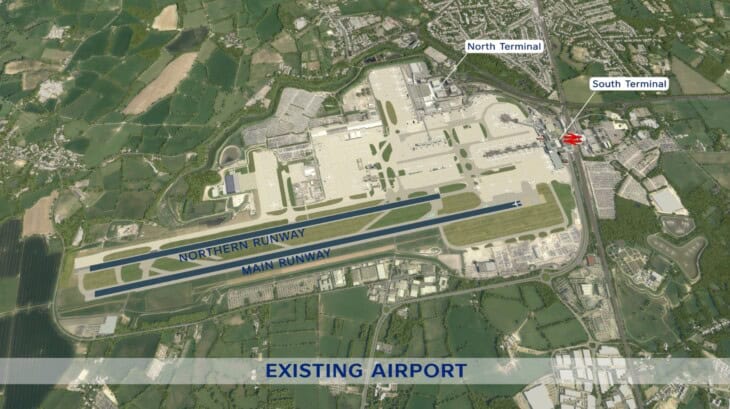
The striking thing about the scheme is how little concrete it actually involves. Gatwick already has a second strip of pavement running parallel to its main runway, but the two centrelines sit only about 656 feet (200 m) apart.
That gap is too narrow for both to be used at once under international safety standards, so today the northern runway serves as a taxiway and is only available for flights when the main runway is out of service. The entire project rests on shifting its centreline 39 feet (12 m) north.
Once that is done, London Gatwick plans to run departures from the northern runway while arrivals continue on the main one. Around it comes the expensive part: taxiways, stands, terminal work, and road access, for a total of £2.2 billion, privately financed.
What "two runways" actually means here
This is not two independently operated parallel runways of the kind you see at large US hubs, where each can handle its own arrivals. At roughly 690 feet (210 m) apart, Gatwick’s pair will work in a segregated mode: one runway takes departures, the other takes arrivals. That split is what the 39-foot shift buys, and it is enough to lift the airport well above a single-runway ceiling.
What It Changes
Gatwick has been the busiest single-runway airport in the world for years, handling 42.8 million passengers in 2025 by pushing movement rates to the edge of what one strip can absorb. The airport projects the second runway will add roughly 100,000 flights and 13 million passengers a year, working toward a ceiling of 80 million.
The added capacity is aimed squarely at narrowbodies, the Airbus A320 and Boeing 737 families that already dominate the airport’s short-haul network. Gatwick estimates 14,000 new jobs and about £1 billion a year for the regional economy.
The contrast with the other London expansion story is hard to miss. Heathrow’s third runway remains years from breaking ground, and the airport has already won permission to start charging passengers for early costs on a runway that does not exist yet.
Gatwick’s route to new capacity is cheaper, faster, and does not require demolishing a village or moving a motorway. It is also, in raw terms, smaller: a segregated-mode second runway is not the same thing as a full new parallel. But it is the one that got through the courts first, which in London’s crowded airport system counts for a great deal.
September 21, 2025
Consent granted. Transport Secretary Heidi Alexander approves the Development Consent Order for the Northern Runway project.
June 23, 2026
High Court upholds it. Legal challenges to the approval are dismissed at first instance.
August 4, 2026
Court of Appeal closes the door. Judges refuse permission to appeal, finding every ground raised by CAGNE and Peter Barclay unarguable.
2030
First flights. Gatwick expects routine dual-runway operations by the turn of the decade, subject to construction.
Construction timing has not been confirmed beyond the airport’s stated aim of being operational around 2030. With the legal route now exhausted, the remaining variables are procurement, build sequencing, and how much of the work can be done without disrupting the runway the airport still depends on.
Sources and references used for research and fact-checking.
Get the Newsletter
The latest aviation news and stories sent to your inbox.
About the Author

Tim is the owner and lead editor of AeroCorner since 2019, overseeing aviation content covering aircraft, airlines, airports, and the broader aviation industry. Through years of researching, writing, editing, and publishing aviation-focused content, he has developed extensive practical knowledge of commercial aviation and air travel. Based in Asia and a frequent traveler himself, Tim also brings firsthand passenger experience to AeroCorner’s coverage. Outside of publishing, he has also explored aviation firsthand through hands-on flight training in New Zealand.