

Table of Contents
The message usually arrives the night before, or at five in the morning, long before you have finished packing. Your flight is cancelled.
You look out of the window at your own airport and the sky is perfectly clear. Nothing you can see explains what just happened.
That gap between what you can see and what the airline just did is the whole story. A cancellation is almost never a verdict on the weather above your head. It is a decision taken in an operations control centre about an aircraft, a crew and a clock that are all somewhere else.
Airlines hate cancelling, which is why a delay is their default answer to almost every problem. This article explains the four things that override that default, and why killing one flight early can save five later ones.
Why Do Flights Get Cancelled?
Because at some point, keeping the flight alive costs the airline more than killing it does. Cancellation is not a weather outcome. It is an economic decision, and it has four common triggers.
A crew runs out of legal duty time. The aircraft is in the wrong city.
A fault appears that the rules will not let the airline defer. Or a hard deadline on the ground expires, such as a night curfew or an air traffic control restriction.
Weather sits upstream of all four. It rarely cancels a flight by itself. It breaks the schedule, and the broken schedule then runs into one of those four walls.
The four things that actually cancel a flight
1. The crew runs out of legal duty time. 2. The aircraft is in the wrong place. 3. A mechanical fault cannot legally be deferred. 4. A curfew or air traffic control deadline expires. Weather usually causes one of these rather than cancelling the flight directly.
Delaying You Is Almost Always Cheaper Than Cancelling
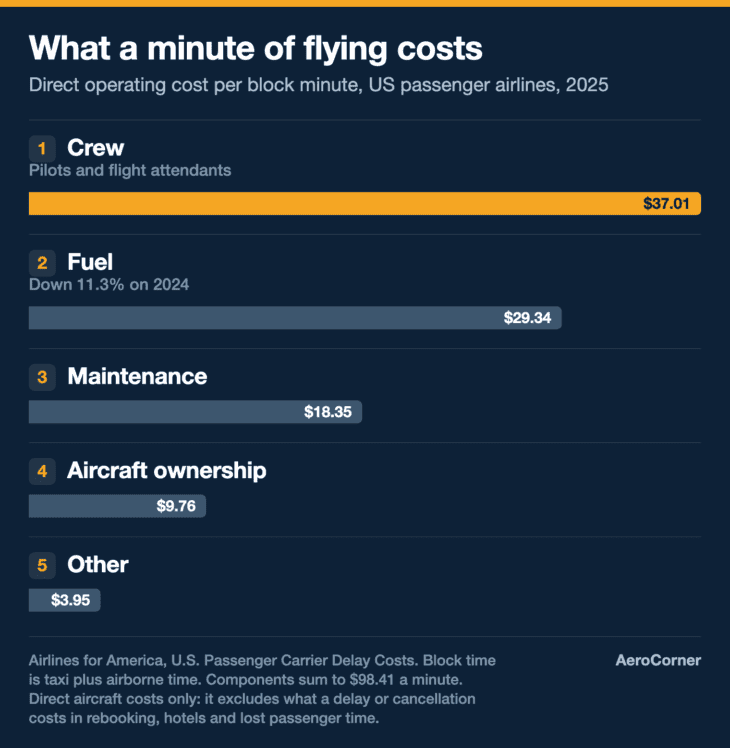
Start with what an aircraft costs to operate. Airlines for America puts the average direct cost of block time for US passenger carriers at $98.41 per minute in 2025.
Crew is the biggest single line at $37.01 a minute, ahead of fuel at $29.34, maintenance at $18.35, aircraft ownership at $9.76 and everything else at $3.95.
So a three-hour delay is genuinely expensive. It is still cheaper than a cancellation, because a delayed flight eventually flies.
It carries its passengers, keeps its revenue, and drops the aircraft and crew where tomorrow morning’s schedule needs them. A cancelled flight does none of that.
It refunds the ticket, strands an aircraft and a crew in the wrong city, and leaves the airline buying hotel rooms and seats on rival carriers. That is why cancellations stay rare even in a bad year.
US airlines cancelled 1.5 percent of scheduled flights across all of 2025, up only marginally from 1.4 percent in 2024, according to the Department of Transportation’s monthly Air Travel Consumer Report. Roughly 98.5 flights in 100 operated.
By world standards that is a very reliable operation. AeroCorner’s own monthly ranking of airports by departure cancellation rate had no US airport anywhere in its July 2026 top ten, which was led by airports in Thailand and Indonesia at rates above 14 percent.
One more thing shapes the decision. Airlines rarely cancel a single flight in isolation, because that strands the jet. They cancel the out-and-back pair, so the aircraft and crew finish the day where the next day expects them.
1. The Crew Runs Out of Legal Time
This is the cancellation passengers find most maddening, because the aircraft is sitting right there at the gate and the crew is standing next to it.
Under 14 CFR Part 117, a US airline pilot’s day is capped twice over. Actual flight time is limited to 8 or 9 hours depending on what time the crew reported for work.
The wider flight duty period is the one that bites. It starts at report and runs until the last set of parking brakes, and it is capped somewhere between 9 and 14 hours depending on report time and how many legs are flown.
| Report time (local) | 1 or 2 legs | 5 legs | 7 or more legs |
|---|---|---|---|
| 0000 to 0359 | 9 hours | 9 hours | 9 hours |
| 0500 to 0559 | 12 hours | 11.5 hours | 10.5 hours |
| 0700 to 1159 | 14 hours | 12.5 hours | 11.5 hours |
| 1300 to 1659 | 12 hours | 11.5 hours | 10.5 hours |
| 1700 to 2159 | 12 hours | 10 hours | 9 hours |
| 2300 to 2359 | 10 hours | 9 hours | 9 hours |
Read the table as a budget. A crew reporting at 7 a.m. for two legs has 14 hours to spend, and every minute at the gate, in a de-icing queue or in a ground stop is spent from the same pot.
The clock does not pause because you are delayed. That is the single most important fact about airline cancellations.
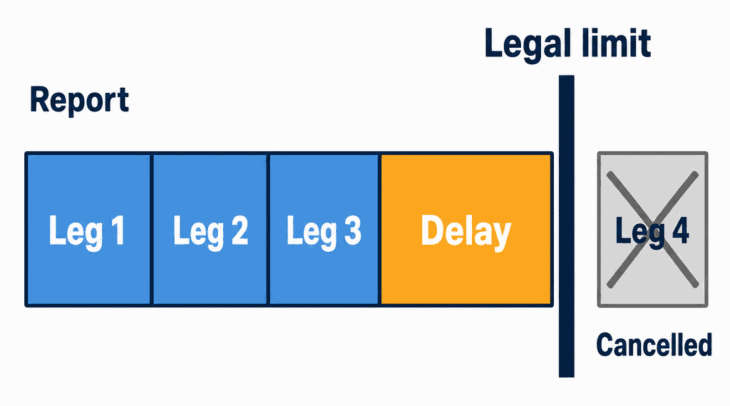
The captain can extend the duty period by up to two hours, but an extension longer than 30 minutes is permitted only once before the crew has to rest. After that, discretion runs out.
The crew must then take at least 10 consecutive hours off containing a minimum of 8 uninterrupted hours of sleep opportunity, and nobody in the company can waive it. Our guide to airline crew rest rules walks through how those limits are built.
Whether your flight then dies depends entirely on geography. Airlines keep reserve crews on standby for exactly this, and at a big hub there are usually several sitting at home within call.
At a small outstation there are none. That is the moment “the crew timed out” turns into “your flight is cancelled”.
2. The Aircraft Is in the Wrong City
Your aircraft is not assigned to your flight. It is assigned to a chain of flights, typically five or six legs in a day, and your flight is one link in it.
The ground time between those legs is deliberately thin, often 30 to 45 minutes, because an aircraft parked at a gate earns nothing. That is the whole point of the modern turnaround.
Thin ground time means no slack. Lose 90 minutes on the first leg of the morning and there is nowhere in the day to get it back.
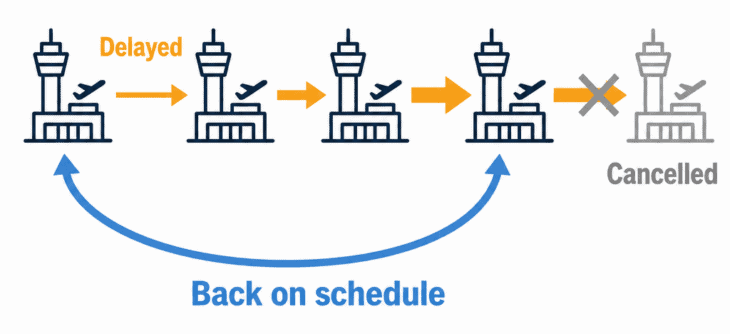
The Bureau of Transportation Statistics tracks this as its own delay category, “late-arriving aircraft”: a previous flight with the same aircraft arrived late, so this one departs late. It is consistently one of the largest buckets in the data.
By the fourth or fifth leg, the delay has compounded, the crew clock is nearly spent, and the cheapest way to stop the bleeding is to delete a flight and let the aircraft catch back up to its own schedule.
This is why your cancellation can be caused by a thunderstorm in a city you have never visited. The storm did not hit you. It hit your aircraft, eleven hours ago.
3. Something Broke That Cannot Be Deferred
Airliners fly with broken equipment all the time, entirely legally. The minimum equipment list is the document that says which items, and for how long.
Deferred items carry a repair clock. Category B items must be fixed within 3 calendar days, Category C within 10, and Category D within 120, with Category A set individually per item.
Cancellations come from the other side of that list. If the failed item is not in the airline’s approved list at all, or its repair interval has already expired, 14 CFR 121.628 simply does not permit dispatch. Our explainer on how the minimum equipment list works covers the mechanics.
Again, geography decides the outcome. At a maintenance base with a spare airframe on the ramp, this costs an hour.
At a spoke airport, the part and a licensed engineer both have to be flown in on the next available flight, and by then the crew has timed out anyway. The flight is gone.
4. A Deadline on the Ground Expires
Many airports are legally shut at night. Frankfurt bans scheduled takeoffs and landings between 11 p.m. and 5 a.m. local, and caps the shoulder hours either side at 133 movements per night.
California’s John Wayne Airport is stricter still, prohibiting commercial departures from 10 p.m. to 7 a.m. and arrivals from 11 p.m. to 7 a.m., with a later start on Sundays.
Miss that window and the flight cannot operate until morning. Rather than hold a full aircraft and an expired crew overnight for a departure nobody can legally make, the airline cancels.
The same clock catches aircraft already in the air, which is one reason a flight can end up diverting to a different airport rather than landing where you booked.
Air traffic control creates the same effect without any curfew involved. When a ground stop or a flow control programme holds departures for hours, it burns the duty clock and the aircraft rotation at the same time.
Why Cancelling One Flight Early Saves Five Later
Here is the part passengers find hardest to accept. Airlines increasingly cancel flights before the disruption arrives, on a clear morning, with the storm still a day out.
The logic is that a cancellation announced 24 hours ahead costs far less than the identical cancellation at the gate. Passengers get rebooked from home, and crews and aircraft get repositioned deliberately rather than chaotically.
Thin the schedule early and the surviving flights have slack in them. Refuse to thin it and the delays compound until crews time out across the network, which is how a single bad day turns into a three-day meltdown.
January 2026 shows both halves of that arithmetic. US airlines cancelled 4.8 percent of scheduled flights that month against 3.1 percent in January 2025, and a single late-January winter storm accounted for more than 14,000 cancellations across one weekend.
When cancellation becomes a deliberate throttle
In November 2025, with air traffic controllers working unpaid through a government shutdown, the FAA ordered airlines to cut flights at 40 major airports, starting at 4 percent and stepping toward 10. In the shutdown’s first 29 days, airlines had cancelled 11 flights for controller staffing. Over the following nine days they cancelled 1,271, including 865 on 7 November alone.
That episode is the clearest illustration of what a cancellation is actually for. When the system cannot carry the schedule that was sold, removing flights in advance is the tool that keeps the rest of it moving.
The Myth: They Cancelled It Because It Was Half Empty
The myth
“They cancelled my flight because it wasn’t full enough.” Almost never true. A single flight is one link in an aircraft rotation and a crew pairing, so cancelling it strands both in the wrong city and costs the airline more than flying it nearly empty would have.
The exception is narrow and it proves the rule. On very high frequency routes where the same pair is flown many times a day, an airline will occasionally drop a whole rotation when demand collapses.
It can do that precisely because the aircraft and crew end up back where they started. Drop one leg out of a long chain and you have created tomorrow’s problem instead of solving today’s.
The second myth is about the weather itself. BTS records a cause for every cancelled US flight using four codes: carrier, weather, national aviation system, and security.
The airline assigns the code. “Weather” means the carrier judged that weather prevented the flight, which can mean weather 600 miles (970 km) away, yesterday, at the airport where your aircraft spent the night.
Non-extreme weather that merely slows the system down, low cloud or a shifted runway configuration, lands in the national aviation system bucket instead. So a clear sky above your head proves nothing at all.
What a Cancellation Costs the Airline, and What It Owes You
In the United States, a cancellation obliges the airline to refund you if you decline the alternative it offers. Under the Department of Transportation’s automatic refund rule, that refund must be automatic and prompt: seven business days for a card payment, 20 calendar days otherwise.
Beyond the refund and whatever the carrier’s own customer service plan promises, there is no federal requirement to pay you anything. That is a striking contrast with being bumped from an overbooked flight, where cash compensation is set by regulation.
Europe runs the opposite arithmetic. Under EU Regulation 261/2004, a cancellation notified less than 14 days before departure triggers compensation of €250 to €600 per passenger on top of the refund, unless the airline proves extraordinary circumstances.
That single difference moves the decision line. In the US a cancellation costs an airline its revenue and its reputation. In Europe it can cost a cash payment to every person booked, which is a powerful incentive to find some way, any way, to operate the flight.
The math flips, and the operation flips with it.
So the next time that notification lands at nine in the evening under a cloudless sky, the useful question is not what the weather is doing where you are standing.
It is where your aircraft is tonight, how many hours its crew has already been on duty, and what time the airport at the other end stops accepting movements. One of those three has almost certainly run out.
Sources and references used for research and fact-checking.
- Legal Information Institute, Cornell Law School, 14 CFR Part 117, Table B: Flight Duty Period, Unaugmented Operations
- Legal Information Institute, Cornell Law School, 14 CFR 117.25: Rest Period
- Legal Information Institute, Cornell Law School, 14 CFR 121.628: Inoperable Instruments and Equipment
- Airlines for America, U.S. Passenger Carrier Delay Costs
- Bureau of Transportation Statistics, TranStats, Airline On-Time Statistics and Delay Causes
- EUR-Lex, European Union, Regulation (EC) No 261/2004 on Compensation and Assistance to Air Passengers
Get the Newsletter
The latest aviation news and stories sent to your inbox.
About the Author

Tim is the owner and lead editor of AeroCorner since 2019, overseeing aviation content covering aircraft, airlines, airports, and the broader aviation industry. Through years of researching, writing, editing, and publishing aviation-focused content, he has developed extensive practical knowledge of commercial aviation and air travel. Based in Asia and a frequent traveler himself, Tim also brings firsthand passenger experience to AeroCorner’s coverage. Outside of publishing, he has also explored aviation firsthand through hands-on flight training in New Zealand.