

Table of Contents
Pick business class for an overnight long-haul flight when you need to sleep and arrive ready to work: it is the only one of the two with a bed. Pick premium economy for daytime flights, or when business costs 2.5 times the premium economy fare or more.
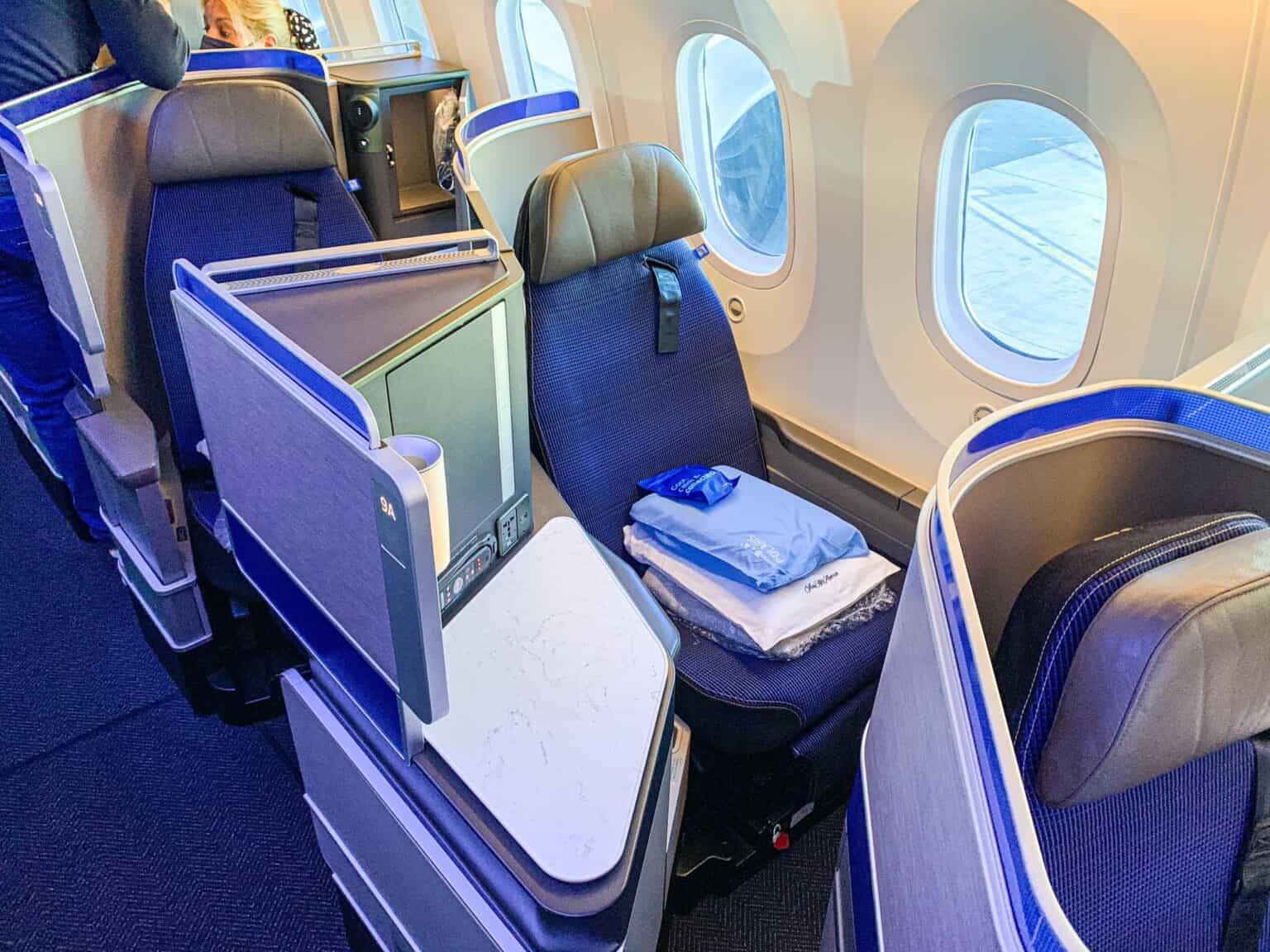
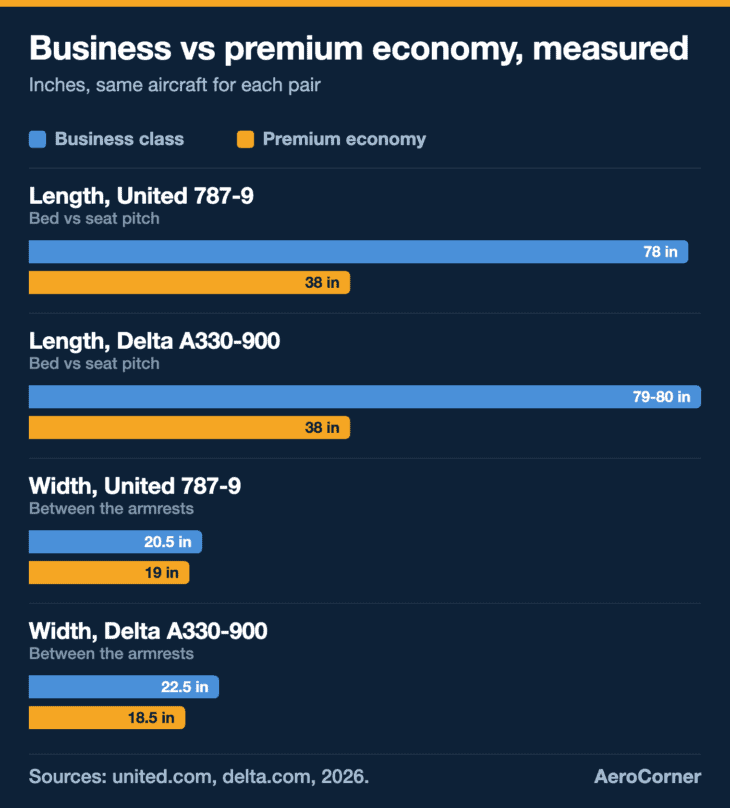
The bed is the whole gap. On United’s Boeing 787-9, business class gives you 78 inches (198 cm) to lie flat in, while premium economy gives you 38 inches (97 cm) of legroom and 6 inches (15 cm) of recline. Between the US and Europe, that bed usually costs about $1,150 to $1,500 extra per flight.
Below, the two cabins are compared on sleep, space, privacy, price, lounges, bags and the new 2026 basic fares, using United’s and Delta’s own cabin tables as of October 2026. For where every cabin and fare code fits, see our guide to flight classes and their codes.
| Criterion | Business class | Premium economy | Edge |
|---|---|---|---|
| Seat type | Lie-flat bed, 180 degrees (United Polaris, Delta One) | Recliner, 6 in of recline (United Premium Plus) | Business |
| Length to stretch out | 78 in sleeping space (United 787-9); 79 to 80 in bed (Delta A330-900) | 38 in seat pitch on both | Business |
| Seat width | 20.5 in (United 787-9); 22.5 in (Delta A330-900) | 19 in (United 787-9); 18.5 in (Delta A330-900) | Business |
| Seats per row, United 787-9 | 4 (1-2-1), every seat on an aisle | 7 (2-3-2), 3 of 7 with no aisle | Business |
| Privacy | Full-height doors on most Delta One A350 and A330-900 suites; a privacy door on American’s Flagship Suite | Privacy headrest wings on American’s 787-9P | Business |
| Lounge | Polaris lounge on United Standard and Flexible fares; Delta One Lounge and Sky Club on Delta One Classic and Extra | Not included (Delta Sky Club only with other credentials) | Business |
| Free checked bags | 2 on standard fares, 1 on Base or Basic; 70 lb (32 kg) each on United | 2 on standard fares, 1 on Base or Basic; 50 lb (23 kg) each on United | Business |
| Round-trip fare, US to Europe | About $3,500 to $5,000 | About $1,200 to $2,000 | Premium economy |
| Extra cost of the bed, per flight | About $1,150 to $1,500 more each way | Baseline | Premium economy |
| Seats per aircraft | 48 on United’s 787-9 (version 1); 51 on American’s 787-9P; 29 on Delta’s A330-900 | 21; 32; 28 on the same jets | Business |
How we compared
Seat dimensions come from the airlines’ own cabin tables, opened on October 13, 2026: United’s Boeing 787-9 version 1 (48 Polaris, 21 Premium Plus, 39 Economy Plus, 149 Economy) and Delta’s Airbus A330-900 (29 Delta One, 28 Premium Select, 56 Comfort, 168 Main). Business class length is the bed or sleeping space the airline publishes; premium economy length is seat pitch. The fare ranges are Simple Flying’s April 2026 US to Europe figures. The cost of the bed compares like with like, cheap fare to cheap fare and peak fare to peak fare: $3,500 minus $1,200 is $2,300 round trip, or $1,150 per flight, and $5,000 minus $2,000 is $3,000, or $1,500 per flight. Fares vary by date and route; these are ranges, not quotes.
Can you sleep in premium economy?
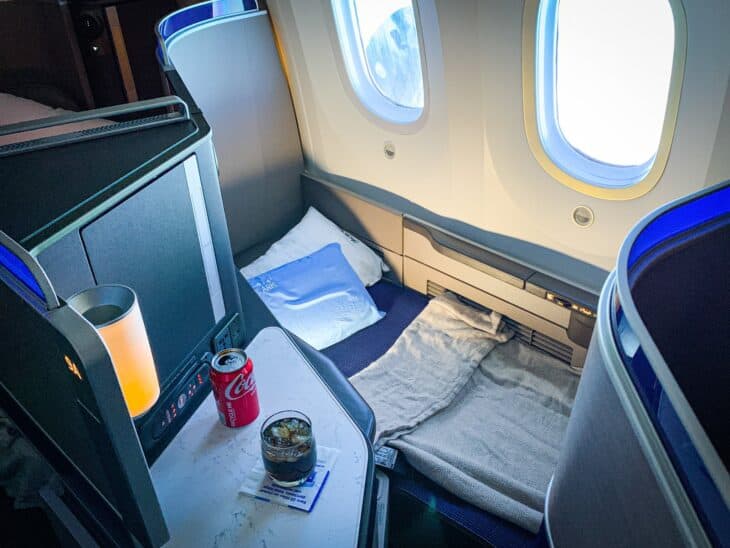
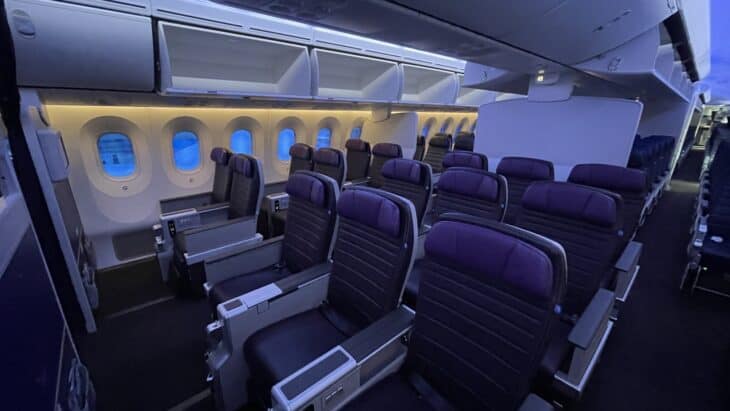
You can doze, but you cannot lie down. Premium economy is an upright seat that tips back: United lists 6 inches of recline in Premium Plus, against a 180-degree flat bed in Polaris business class on the same Boeing 787-9.
The length tells the story. United gives Polaris 6 feet 6 inches (198 cm) of sleeping space, while a Premium Plus seat has 38 inches (97 cm) of pitch. Delta’s Delta One bed on the Airbus A330-900 is 79 to 80 inches (201 to 203 cm) long, against 38 inches in Premium Select.
_(03).jpg)
Multiply width by length and the Polaris bed gives you 1,599 square inches to lie on. That is about 2.2 times the 722-square-inch footprint of a Premium Plus seat.
Premium economy does what it can with the lower half. Delta’s Premium Select seat has an adjustable leg rest and footrest, and both airlines hand out real bedding. Business adds the mattress: Delta lists a lumbar pillow that doubles as a mattress pad, and United offers mattress cushions on request.

Edge: business class. It is the only one of the two with a bed, roughly twice as long as the space premium economy gives you.
Seat width, the row and aisle access
Width moves less than you might expect. On United’s 787-9, a Polaris seat is 20.5 inches (52 cm) wide and a Premium Plus seat is 19 inches (48 cm). Delta’s gap is wider: 22.5 inches (57 cm) in Delta One against 18.5 inches (47 cm) in Premium Select.
The bigger difference is the row. Polaris is laid out 1-2-1, four seats across, so every seat sits on an aisle. Premium Plus is 2-3-2, seven across, which leaves 3 of every 7 passengers climbing over someone to reach the aisle.
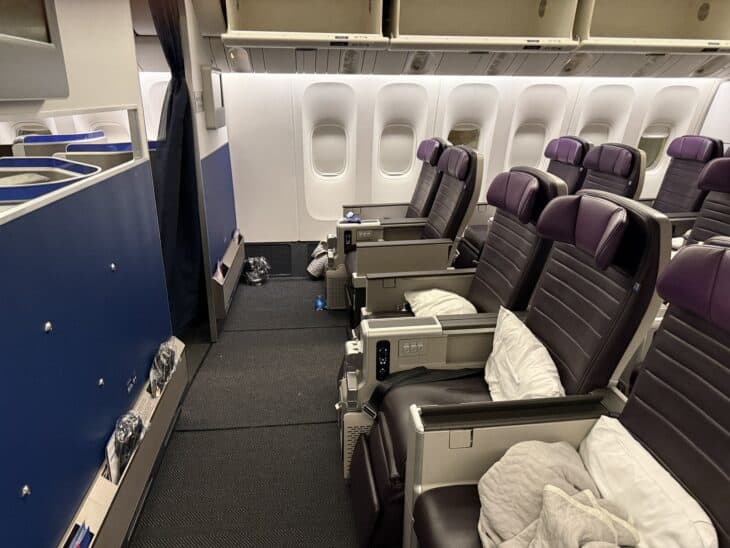

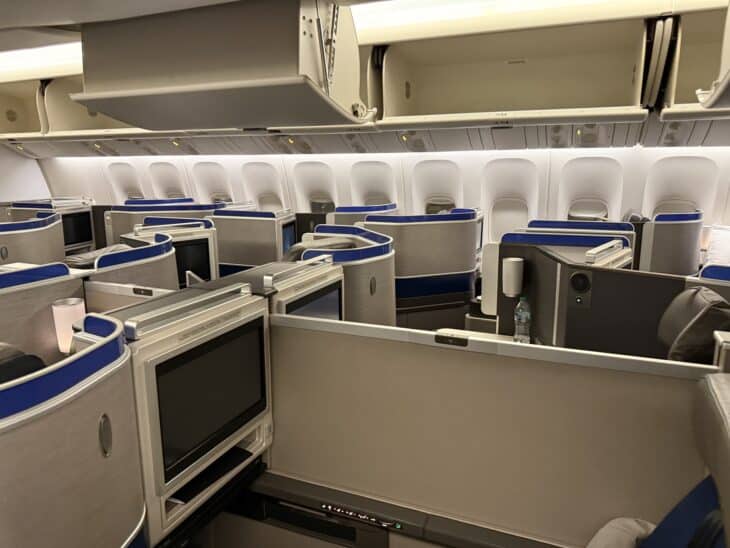

Privacy follows the layout. Delta fits full-height doors to its Delta One suites on most A350 and A330-900 flights, and American’s newest 787-9 gives its Flagship Suite a privacy door. The best premium economy can offer is the privacy headrest wings on that same American jet.
Edge: business class. A slightly wider seat matters less than direct aisle access for everyone and, on Delta and American’s newest jets, a door.
The price gap, and what the bed costs
Business class is the expensive jump. Simple Flying’s April 2026 fare review put premium economy between the US and Europe at about $1,200 to $2,000 round trip, with business class around $3,500 to $5,000.
The same review found the step from premium economy to business often costs 2 to 3.5 times as much, a bigger jump than the one from economy to premium economy. Comparing cheap fare with cheap fare and peak with peak, the bed costs about $1,150 to $1,500 more per flight.
That is the real question to ask: would you pay $1,150 or more for one night in a flat bed? On an overnight flight into a working day, many people would. On a daytime flight, where you would sit up anyway, almost nobody should.
On the newest jets, business is the bigger cabin
United’s 787-9 version 2 carries 64 Polaris seats against 35 in Premium Plus, and American’s new 787-9P has 51 Flagship Suites against 32 Premium Economy seats. Delta’s A330-900 is almost even, with 29 Delta One suites and 28 Premium Select seats.
Edge: premium economy. It costs a fraction of business for the same flight, and the gap only buys you something on an overnight sector.
Lounges, check-in and bags
Lounge access is where business class pulls furthest ahead on the ground. United Polaris passengers on Standard and Flexible fares get the Polaris lounges at Chicago O’Hare, Houston, Los Angeles, Newark, San Francisco and Washington Dulles.
Delta One Classic and Extra fares include the Delta One Lounge at JFK, Boston, Los Angeles and Seattle, plus the Sky Clubs.

Premium economy gets priority lanes, not lounges. United Premium Plus includes Premier Access check-in, security and boarding, and Delta Premium Select includes Sky Priority. Delta’s fare table lists Sky Club access for Premium Select only with other credentials, such as a membership.
Bags are closer than they look. Both cabins include two checked bags on standard fares and one on the new Base or Basic fares. The difference is weight: United allows 70 pounds (32 kg) per bag in Polaris and 50 pounds (23 kg) in Premium Plus.
Edge: business class. A lounge with showers and dining before an overnight flight is worth more than anything premium economy offers on the ground.
Food, drinks and service
Premium economy eats better than economy. United serves meals, alcoholic drinks and upgraded dishware in Premium Plus, and Delta lets Premium Select passengers pre-order from their own menu up to 24 hours before the flight.

Business is a different service. Polaris adds an appetizer, salad and dessert service, mid-flight snacks and an arrival meal, with every drink complimentary. Delta One serves chef-curated meals with sommelier-selected wines, and plated desserts and fruit and cheese from a dessert cart on international flights.
Edge: business class. The meal is better, but on its own it is not worth the fare difference.
The new basic business class fares
In 2026, business class got its own basic fare, and it changes the math. United announced Base fares for Polaris and Premium Plus on April 3, 2026. Base Polaris has paid seat selection, one checked bag, no changes or refunds, and United Club access instead of the Polaris lounge.
“These new tiered options give customers more choice and make it easier to find a fare that includes the benefits they want most.”
Andrew Nocella, United’s chief commercial officer, United newsroom, April 2026
Delta followed in July 2026 with Basic Business, the entry fare for Delta One. You get the same lie-flat suite and meals, but the seat is assigned after check-in and you get one fewer checked bag.
The lounge is the catch. Basic Business keeps Delta One check-in, the Delta One Lounge and the Sky Club through January 18, 2027, then loses them for travel from January 19, 2027.
For a solo traveler with one bag, a basic business fare is the closest business class has come to premium economy pricing, because the bed is identical. For a couple, assigned seating means you may not sit together unless you pay for seats.
Edge: business class. Basic fares keep the bed, which is the part that matters, and cut the price of reaching it.
Who should pick which
| If you… | Pick | Because |
|---|---|---|
| Fly overnight and work the day you land | Business class | A 78 to 80 in flat bed instead of 6 in of recline |
| Fly a daytime flight | Premium economy | You would sit up anyway, so the bed is wasted money |
| Pay your own fare and see business at 2.5 times or more | Premium economy | The bed then costs $1,150 to $1,500 more per flight |
| Travel solo with one bag and find a Base or Basic business fare | Business class | Same bed, lower price; the lounge is what you give up |
| Want the lounge before departure | Business class, standard fare | Base Polaris and, from Jan 19, 2027, Basic Business drop it |
| Travel as a couple on a tight budget | Premium economy, standard fare | Seat selection included, and basic business seats are assigned at check-in |
| Hate climbing over a neighbor | Business class | Every seat in a 1-2-1 row is on an aisle |
Myth: premium economy is a budget business class
It is a better economy seat, not a smaller business seat. On United’s 787-9, Premium Plus has 38 inches of pitch against 31 inches in Economy, a 7-inch gain. Business class gives you a 78-inch flat bed, 40 inches more than premium economy. In length, premium economy sits far closer to economy than to business.
If you are weighing the cabin behind instead, our premium economy vs economy comparison does the same math one step down. For the cabin ahead, see first class vs business class.
FAQ
Sources and references used for research and fact-checking.
- United Airlines, Boeing 787-9 Dreamliner seat map and interior specifications
- United Airlines, United Polaris business class
- United Airlines, United Premium Plus
- United Airlines, Checked bags
- United Airlines Newsroom, United to Introduce Tiered Fare Categories, Giving Customers More Options Across Every Type of Ticket
- Prince of Travel, United Introduces Base Fares for Polaris Business Class and Premium Economy
- Delta Air Lines, Airbus A330-900neo seat maps, specs and amenities
- Delta Air Lines, Delta One
- Delta Air Lines, Delta Premium Select
- Delta News Hub, What to know about Delta's expanded Basic fare options, available now
- AFAR, Delta Unveils New Basic Business Tier Fares
- American Airlines, Presenting the premium Boeing 787-9 (fact sheet)
- Simple Flying, The Cost Of Flying Premium Economy In 2026 Compared To Economy
Get the Newsletter
The latest aviation news and stories sent to your inbox.
About the Author

Tim is the owner and lead editor of AeroCorner since 2019, overseeing aviation content covering aircraft, airlines, airports, and the broader aviation industry. Through years of researching, writing, editing, and publishing aviation-focused content, he has developed extensive practical knowledge of commercial aviation and air travel. Based in Asia and a frequent traveler himself, Tim also brings firsthand passenger experience to AeroCorner’s coverage. Outside of publishing, he has also explored aviation firsthand through hands-on flight training in New Zealand.