Table of Contents
There are two different things people mean by “types of airplane seats,” and mixing them up is why most guides are useless. One is the seat hardware itself, which runs from a fixed-recline slimline shell up to an enclosed suite with a door. The other is where the seat physically sits in the cabin: window, middle, aisle, bulkhead, or exit row.
This guide covers both, with real numbers. Every seat is measured by two figures: width, meaning the space between the armrests, and pitch, meaning the distance from a point on one seat to the same point on the seat in front.
Those two numbers decide almost everything about how a flight feels. An economy seat at 17 inches (43 cm) wide and 28 inches of pitch and an economy seat at 18.5 inches (47 cm) and 34 inches are the same class of ticket and a completely different eight hours.
Airplane Seat Types at a Glance
Here is the full field, ordered from tightest to most spacious, with the typical ranges you will actually encounter in 2026.
| Seat type | Typical width | Typical pitch | Recline | Where you find it |
|---|---|---|---|---|
| Slimline (basic economy) | 17 to 18 in | 28 to 30 in | None, or 2 in pre-recline | Low-cost carriers, short-haul |
| Standard economy recliner | 17 to 18.5 in | 30 to 32 in | 3 to 4 in | Almost every economy cabin |
| Extra-legroom economy | 17 to 18.5 in | 34 to 38 in | 3 to 4 in | Economy Plus, Comfort+, Main Cabin Extra |
| Premium economy recliner | 18.5 to 21 in | 38 to 42 in | 6 to 8 in | Long-haul widebodies |
| Domestic first recliner | 20 to 21 in | 37 to 39 in | 5 to 8 in | US narrowbody first class |
| Angled lie-flat | 20 to 21 in | 55 to 65 in | Reclines to roughly 170 degrees | Older and regional business cabins |
| Fully flat business | 20 to 22 in | Bed of 76 to 82 in | 180 degrees | Long-haul business |
| Enclosed suite | 22 in and up | Bed of 76 in and up | 180 degrees, plus a door | Long-haul first class |
How these numbers are measured
Pitch is not legroom. It is measured from one point on a seat to the same point on the seat ahead, so it includes the thickness of the seat in front of you. A thin slimline shell at 30 inches of pitch can give you more actual knee room than an old thick-backed seat at 31 inches. Width is measured between the armrests, at the point where your hips sit. Both figures come from airline seat specifications and published cabin layouts; neither is set by regulation.
Seat Type Is Not the Same as Cabin Class or Fare Code
Three separate things get called a “seat type,” and they stack on top of each other. The cabin class is the service tier: economy, premium economy, business, first.
The seat type is the physical hardware bolted to the floor inside that cabin. And the fare code is the single letter on your ticket that records what price bucket you bought from, covered in our guide to flight classes and booking codes.
You can buy a business class ticket and get an angled lie-flat seat on one route and a fully flat suite on another, on the same airline, in the same week. The class tells you the service. Only the seat map tells you the seat.
The 8 Types of Airplane Seats
1. Slimline (Basic Economy) Seat
The slimline is the lightest seat in commercial aviation, built with a thin composite back and minimal padding so airlines can fit more rows into the same fuselage.
Many do not recline at all. Others are “pre-reclined,” meaning the seat back is fixed at a slight angle and never moves. Spirit and Ryanair build entire fleets around them, at pitch as tight as 28 inches.
The trade is real but not one-sided. A slimline shell is thinner, so 30 inches of pitch on a modern slimline can feel like 31 inches on a seat from 2005.
2. Standard Economy Recliner
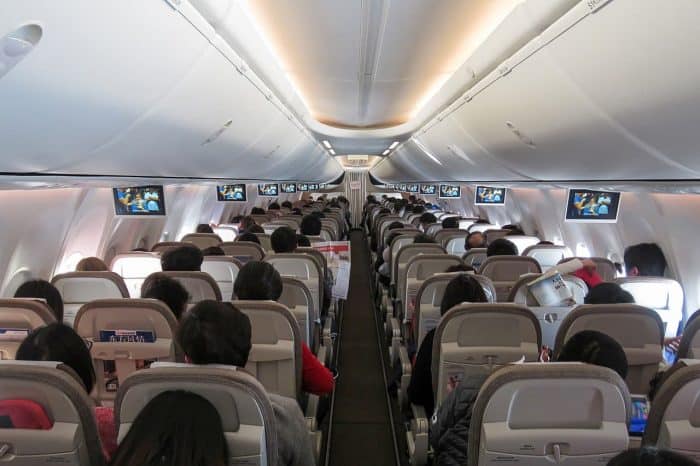
This is the seat almost everyone pictures: 17 to 18.5 inches wide, 30 to 32 inches of pitch, three or four inches of recline, a tray table and a seat-back pocket.
On a narrowbody it is arranged three on each side of a single aisle. On a widebody it is arranged in some version of nine or ten across, which is where the real differences start.
Every standard economy seat also carries a lap belt certified to withstand 16 g of forward force, which is the reason planes have seat belts in the first place and why the belt sign matters more than most passengers assume.
3. Extra-Legroom Economy
United’s Economy Plus, Delta’s Comfort+, and American’s Main Cabin Extra are not a different seat. They are the same economy seat, in rows the airline spaced further apart, usually at 34 to 38 inches of pitch.
Width does not change, because the fuselage does not change. If your problem is shoulder room rather than knee room, extra legroom will not fix it.
This is the single most commonly misunderstood category on any seat map, and it is worth knowing before you pay for the upgrade.
4. Premium Economy Recliner

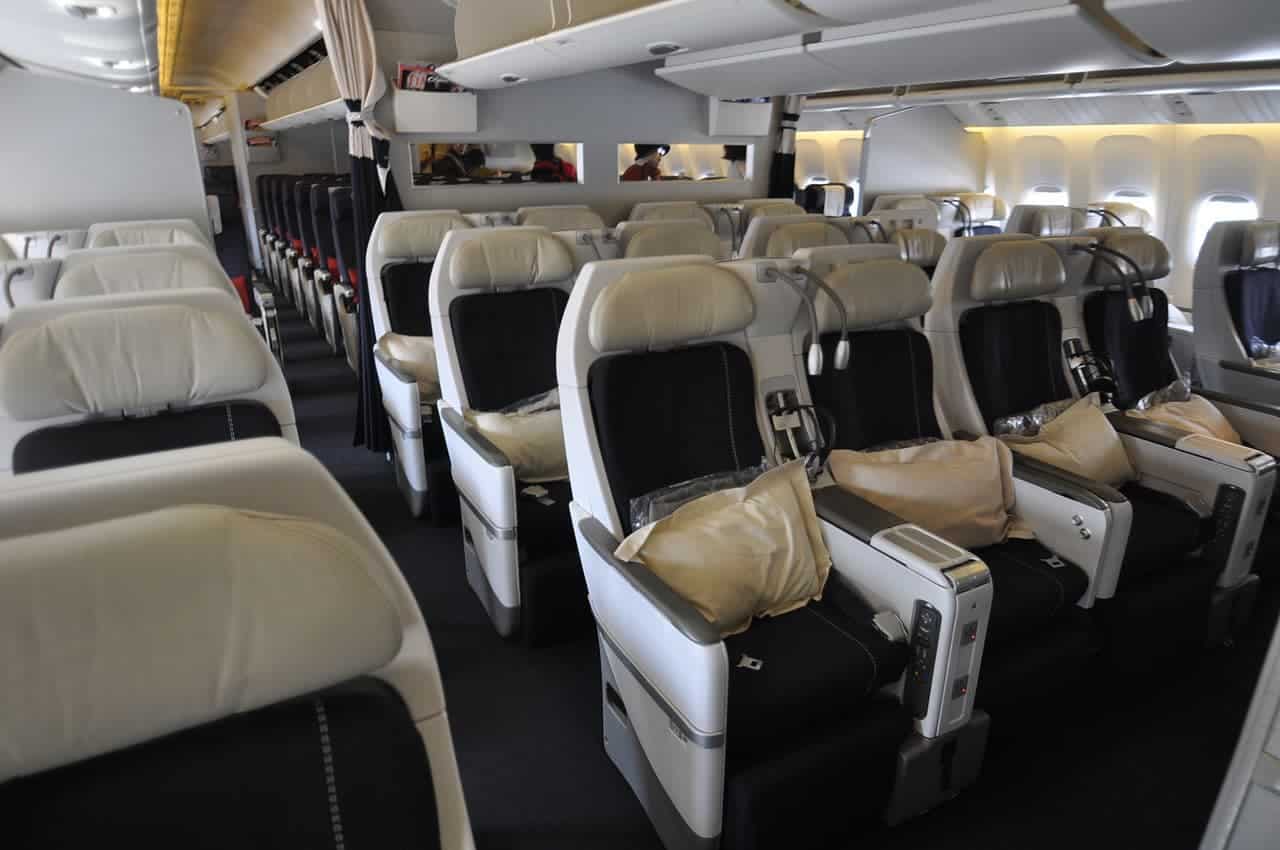
Premium economy is a genuinely different seat, in its own small cabin, laid out with fewer seats per row. Typical figures are 18.5 to 21 inches (47 to 53 cm) wide at 38 to 42 inches of pitch, with six to eight inches of recline, a leg rest, and a foot bar.

EVA Air introduced the class in 1991, and it is now standard on most long-haul widebodies. American, United, and Singapore all sit at 38 inches of pitch; Japan Airlines and EVA Air push to 42.
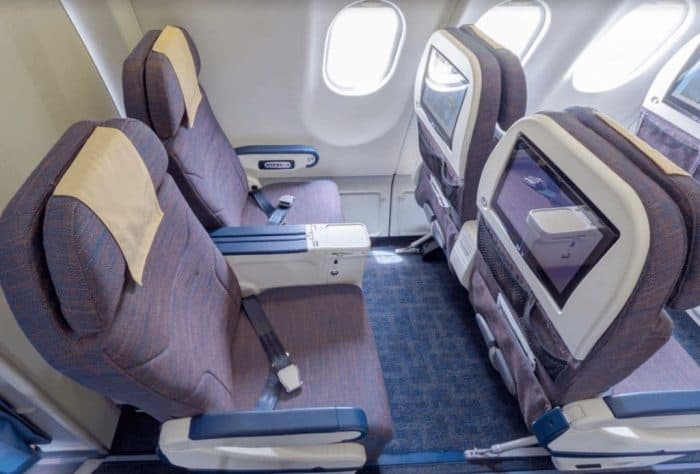
The better modern versions use a sliding pan, so the seat slides forward into its own footprint as it reclines instead of dropping into the lap of the person behind.
5. Domestic First-Class Recliner
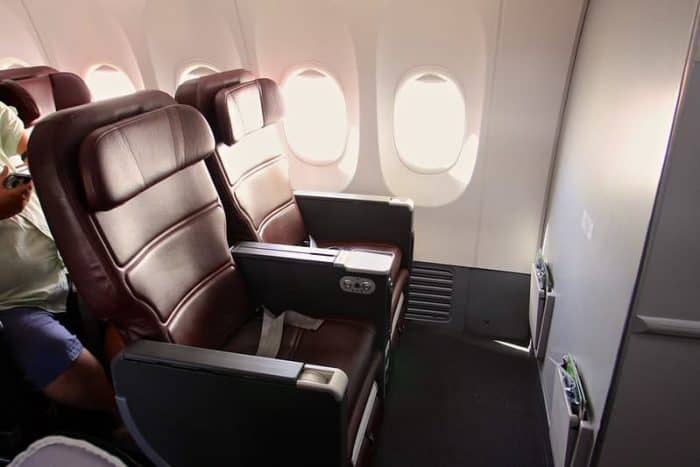
On US narrowbody routes, “first class” means a wide recliner in a two-by-two layout, typically 20 to 21 inches wide at 37 to 39 inches of pitch. It does not lie flat and it is not a suite.
Confusingly, most of the rest of the world calls the identical hardware “business class” when it appears on a short-haul narrowbody. Qantas, British Airways, and Lufthansa all fly recliners under a business badge.
The rule of thumb: if the flight is under about five hours, “first” or “business” almost always means a recliner, not a bed.
6. Angled Lie-Flat Seat
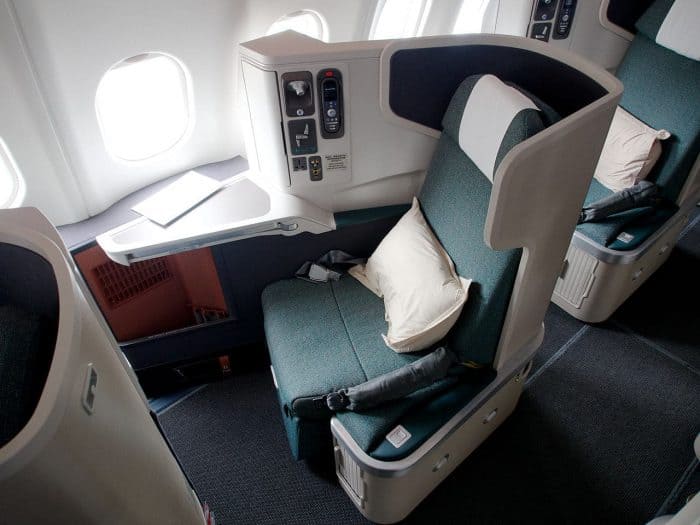
The angled lie-flat, sometimes called a lie-flat or slanted seat, reclines to roughly 170 degrees rather than a true 180. It looks flat on a seat map and sleeps like a slide.
It survives on older widebodies and on regional business routes because it packs more seats into the same floor space than a true flat bed does.
This is the seat type worth checking a map for. The word “flat” in an airline’s marketing copy does not reliably mean 180 degrees.
7. Fully Flat Business Seat
A true flat bed goes to 180 degrees and gives a sleeping surface of roughly 76 to 82 inches (193 to 208 cm). On any of the longest flights in the world, this is the difference between arriving rested and arriving wrecked.
Flat seats come in four common layouts, and the layout matters more than the brand name. Reverse herringbone angles every seat toward the window, so all passengers get direct aisle access and a lot of privacy.
Herringbone angles them toward the aisle instead, which is more open and less private. Staggered layouts offset alternating rows so some seats get a “throne” position with aisle access on both sides.
The fourth is the old two-by-two-by-two arrangement, where window passengers must step over their neighbor to reach the aisle. On a red-eye, that single detail outranks every other spec.
8. Enclosed Suite

The top of the field is a flat bed inside four walls with a closing door. Emirates, Singapore, Etihad, and Qatar all build versions of it, at widths from 22 inches up to the size of a small room.
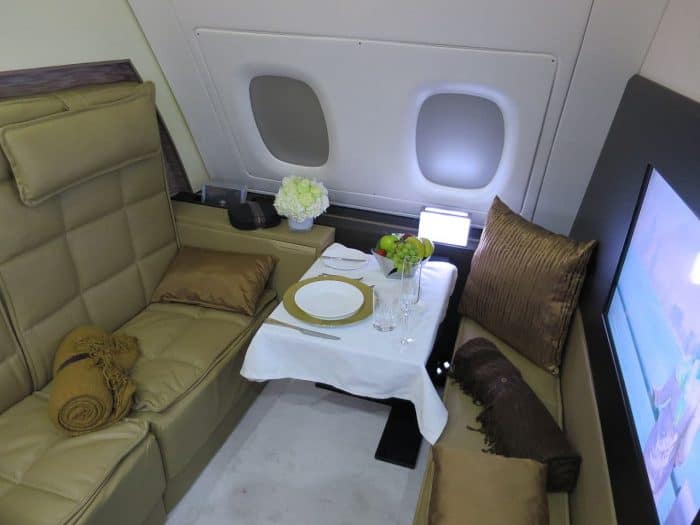
Suites are also the fastest-shrinking category in the industry. Airlines keep working out that two rows of very good business class earn more per square foot than one row of spectacular first class.
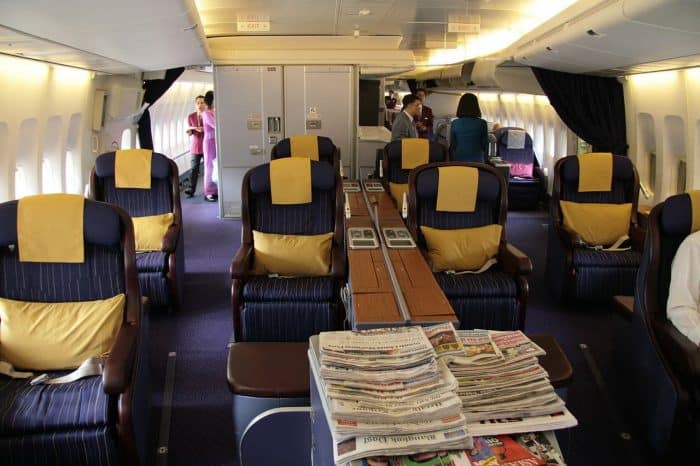
At the prices suites command, the honest comparison is no longer with business class. It is with chartering an aircraft outright, which we break down in private jet vs first class.
Seat Types by Position in the Cabin
The second axis is location. Two identical seats, same width, same pitch, can be a good seat and a bad seat depending on where in the tube they are bolted.
Window, Middle, and Aisle
These are the three basic seat positions, and they are what most people actually mean when they ask about types of seats on a plane.
The window gives you a wall to lean on and control of the shade, at the cost of climbing over people. The aisle gives you legroom to one side and freedom to move, at the cost of trolley strikes and being woken twice a night.
The middle seat gets both armrests by long-standing convention, which is the only compensation on offer. Boarding order is built around these positions too, which is why airlines do not simply board window seats first.
Bulkhead Seats
A bulkhead seat sits behind a wall or divider rather than another seat. Nobody reclines into you and there is open floor in front of your feet.
The costs are consistent: no under-seat storage, so everything goes in the overhead bin for takeoff and landing, and the tray table folds out of the armrest, which narrows the seat slightly.
Bulkhead rows are also where bassinets mount, so on a long-haul flight they are frequently the infant rows.
Exit Row Seats
Exit rows carry the most legroom in economy and the only legal obligations attached to a seat assignment. Under 14 CFR 121.585, US carriers must run an approved exit seating program and screen who sits there.
You must be at least 15 years old, physically able to reach, grip, turn, push, pull, and lift an exit door that can weigh up to 60 pounds (27 kg), able to understand the crew’s instructions, and willing to help.
Two catches are worth knowing. The row directly in front of an exit row often has restricted or no recline, and some exit-row seats are slightly narrower because the tray table lives in the armrest.
Galley, Lavatory, and Last-Row Seats
The back of the cabin collects the seats nobody chooses. The final row usually sits against a rear bulkhead with reduced recline or none at all.
Seats beside a lavatory or galley get door noise, light, and a queue of people standing in your shoulder for eight hours.
They are also the seats most likely to be empty on a lightly loaded flight, which is a genuine argument for taking one if the load factor is low.
How to Read a Seat Map Before You Book
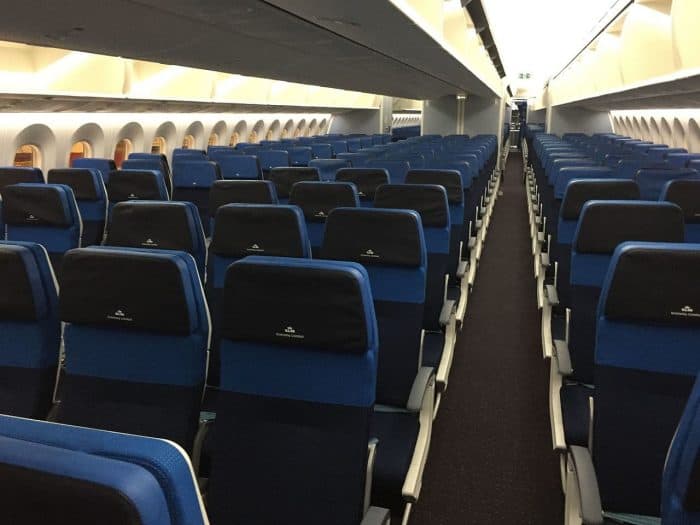
The single most useful skill here is counting seats per row. The number of seats an airline squeezes across a cabin is the thing that sets your seat width, and it varies on the same aircraft type between carriers.
The Boeing 777 was designed for nine economy seats per row in a 3-3-3 layout, giving about 18 inches of width. Most airlines now fly it 3-4-3 with ten across, which drops each seat to 17 to 17.2 inches.
The 787 Dreamliner tells the same story. Nine across in 3-3-3 gives 17.3 to 17.5 inches; Japan Airlines flies it eight across in 2-4-2 at roughly 18.9 inches.
The one inch that costs nothing to find
Airlines do not advertise seat width, but the seat map gives it away for free. Count the seats in a row: 3-3-3 on a Boeing 777 is about 18 inches per seat, 3-4-3 on the identical aircraft is about 17. Same airframe, same ticket price, one inch of shoulder room per passenger. On an Airbus A350, 3-3-3 holds a full 18 inches because the cabin is genuinely wider than the 787’s.
Knowing which type of airplane operates your flight is therefore the first step, and it is printed on the booking page. Third-party seat map sites such as AeroLOPA and SeatGuru then show the exact layout, row by row.
Check three things on the map: seats per row, whether your row reclines, and what sits directly behind you. Those three answers cover most of what makes a seat good or bad.
Is There a Best or Safest Seat?
For comfort, yes, and it is measurable. A bulkhead or exit-row window on a widebody flown eight or nine across is the best economy seat on most aircraft.
For safety, no. The question comes up constantly because of seat 11A, and it deserves a straight answer.
The 11A myth
Seat 11A became famous after the sole survivor of Air India Flight 171 in June 2025 was sitting in it, and again when it emerged that a survivor of a 1998 Thai Airways crash had also been in 11A. It is a coincidence, not a pattern. On the Boeing 787 involved, 11A happened to sit beside an emergency exit; on a different aircraft, 11A is an ordinary window seat in the middle of the cabin. The FAA does not recognize a safest seat, because survivability is set by the circumstances of the accident, not the seat number.
The most cited data point is a 2015 analysis of the FAA’s accident database covering 17 crashes with usable seating charts. Middle seats in the rear third came out best, at a 28 percent fatality rate, against 44 percent for aisle seats in the middle third.
That is a small sample of very different accidents, and the analysts said so themselves. Sitting within five rows of an exit is the only seat-choice advice supported by evacuation research, and it applies to every aircraft rather than to one lucky number.
Why Seats Keep Getting Tighter
Standard economy pitch has fallen from roughly 35 inches in the 1970s to about 31 today, and to 28 on the tightest low-cost fleets.
No US regulation stops it. Congress directed the FAA to set minimum seat dimensions in the FAA Reauthorization Act of 2018, the agency ran evacuation research and took public comment in 2022, and a federal appeals court declined to force the issue in 2023.
The 2024 reauthorization told the FAA to either start the rulemaking or explain to Congress why not. As of 2026 there is still no federal minimum for seat width or pitch, which is why the seat map remains the only reliable protection a passenger has.
Sources and references used for research and fact-checking.
- Electronic Code of Federal Regulations, 14 CFR 121.585: Exit seating
- Federal Aviation Administration, Minimum Seat Dimensions Necessary for Safety of Air Passengers: Request for Comments
- TIME, Where's the Safest Place to Sit on a Plane?
- CBS News, Sole survivor of Air India plane crash was in seat 11A
- AeroLOPA, AeroLOPA: Detailed aircraft seat maps
- Simple Flying, 9 vs 10 Seats Per Row on Boeing 777s
Get the Newsletter
The latest aviation news and stories sent to your inbox.