

Table of Contents
On a long-haul international flight, first class is the small, private cabin above business class: usually a suite with a door, service on demand, and a fare that can run about twice as high. Business class gets you a lie-flat seat, increasingly with a door of its own, for roughly half the price.
On a US domestic flight, the words mean something else. “First class” there is usually a wider recliner with no bed, which puts it below international business class, not above it.
Below, the three are compared on the seat, the space, the service, the airport and the price, using the airlines’ own cabin specs as of September 2026. For how the fare classes and booking codes fit together, see our guide to types of flight classes and their codes.
| Criterion | International first class | Business class (long-haul) | US domestic first class |
|---|---|---|---|
| Where it sits | The top cabin, above business, on the airlines that still sell it | The top cabin on most long-haul jets | The front cabin of a two-cabin domestic jet |
| Seat | Enclosed suite with a door; Singapore Suites pair a 21-inch swivel chair with a separate 76-inch bed | Lie-flat seat; Singapore’s A380 seat is 25 inches wide with a 78-inch bed | Recliner; Delta First gives up to 8 more inches of legroom than Main and up to 5.4 inches of recline |
| Seats per aircraft | 14 on an Emirates A380; 6 on a Singapore A380 | 76 on an Emirates A380; 78 on a Singapore A380 | Varies by aircraft |
| Door | Standard | Increasingly common: Delta One suites on most A350 and A330-900 flights, American’s Flagship Suite | No |
| Seatback screen, Singapore A380 | 32 inches | 18 inches | Delta First: 11 inches on many routes |
| Onboard extras | Emirates A380: Shower Spa (First only) and the Onboard Lounge | Emirates A380: the Onboard Lounge | Not offered |
| Airport | Separate first class lounges at some airlines; Lufthansa adds first class check-in at Frankfurt and Munich | Business lounges; Delta One lounges at JFK, BOS, LAX and SEA | Priority check-in and boarding; lounge access rarely included |
| Round-trip fare, New York to London | $8,000 to $15,000 | $4,000 to $6,000 | Not sold on this route |
| US airlines selling it | None after American’s last sales end (Nov 19, 2026 long-haul; Mar 28, 2027 transcon) | American, Delta, United | American, Delta, United and others |
How we compared
Cabin specs come from the airlines’ own pages and releases, opened on September 17, 2026. Seat width, bed length and screen size are Singapore Airlines’ published figures for its new A380 cabin, because its product sheet lists first and business side by side on the same aircraft. Business seats per first seat divides the published cabin counts: 76 / 14 = 5.4 on Emirates and 78 / 6 = 13 on Singapore. The fare multiple divides Booking.com’s New York to London round-trip ranges: $8,000 / $4,000 = 2 at the low end and $15,000 / $6,000 = 2.5 at the high end. Fares vary by date and airline; these are ranges, not quotes.
The seat and the bed
Both international cabins give you a bed. The difference is what surrounds it. Business class is a lie-flat seat, while first class is usually a suite with walls and a door.
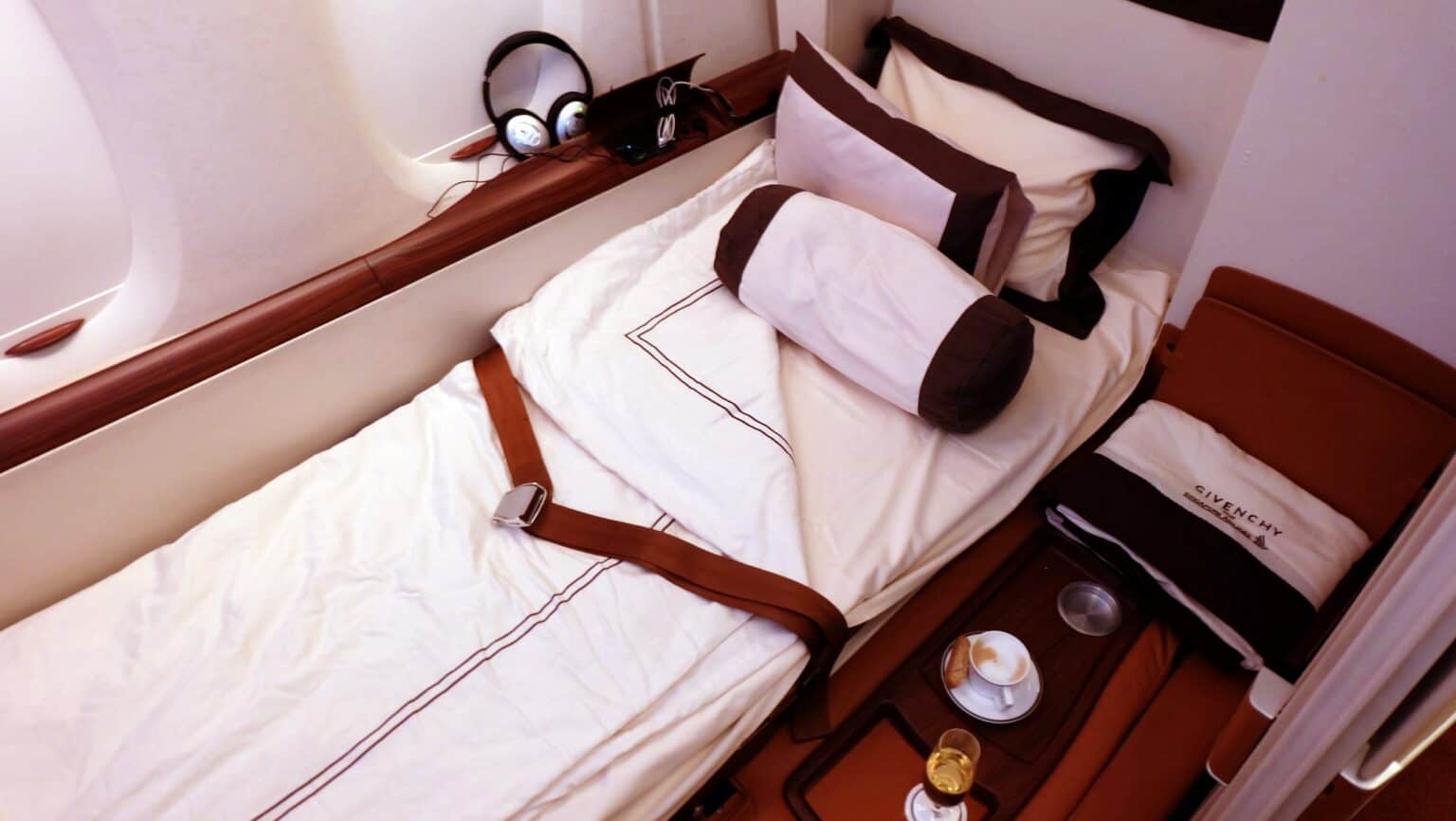
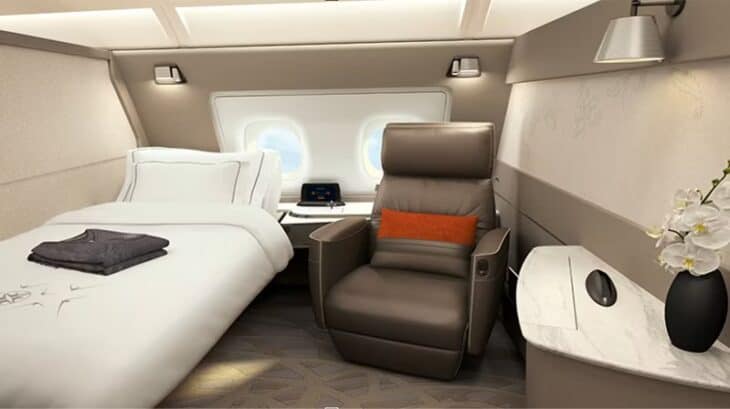
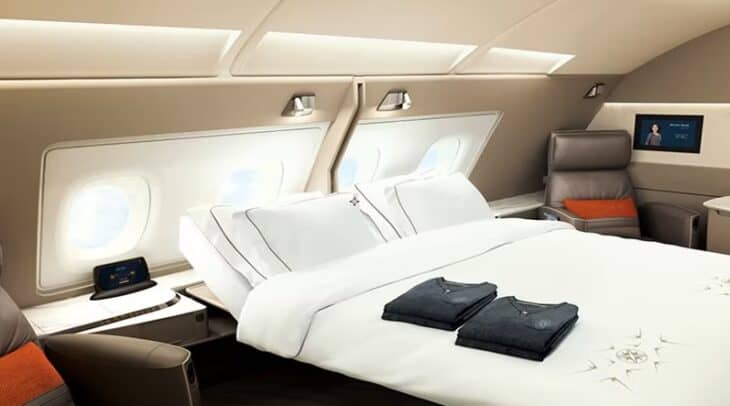
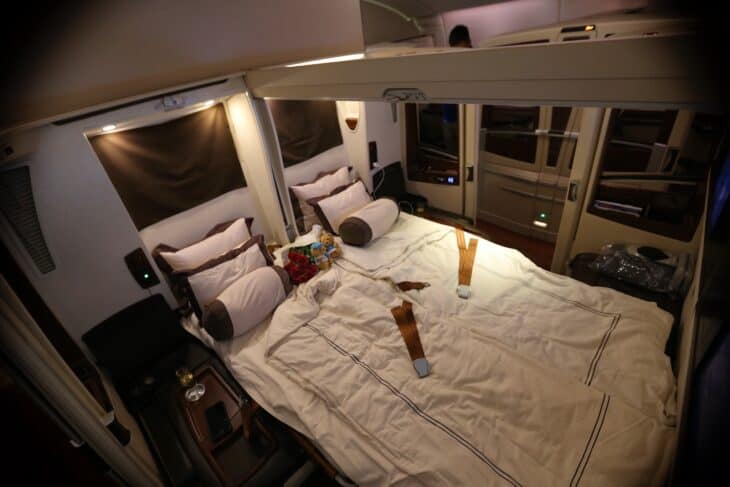
Singapore Airlines shows the gap most clearly. On its A380, a Suites passenger gets a 21-inch (53 cm) swivel armchair and a separate 76-inch (193 cm) bed, plus a 32-inch screen. Book two adjoining Suites and the divider drops to make a double bed.
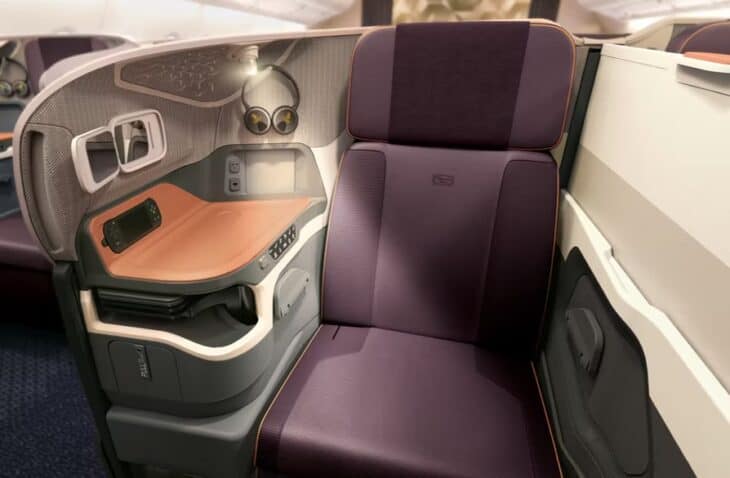
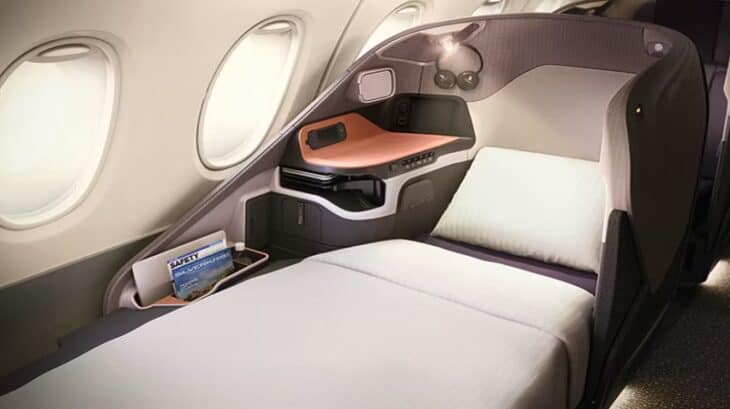
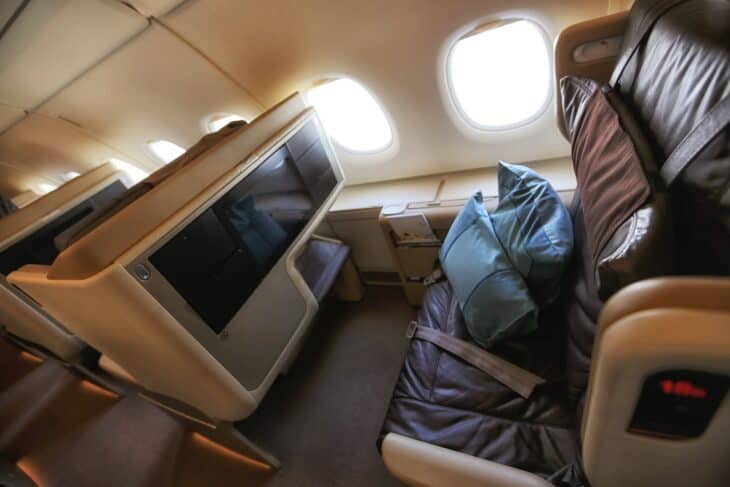
Business class on the same plane is a 25-inch (64 cm) seat that folds into a 78-inch (198 cm) flat bed, with an 18-inch screen. That bed is two inches longer than the Suites bed. What first buys is a room, not a longer mattress.
Lufthansa’s new Allegris first class on the Airbus A350-900 follows the same idea. Its two single suites have ceiling-high walls and a lockable door, seats nearly 39 inches (1 m) wide, and a bed more than 6.5 feet (2 m) long. A third, the Suite Plus, seats two and converts into a double bed.
The takeaway: business class gets you a flat bed; first class gets you a private room around one.
How rare first class is
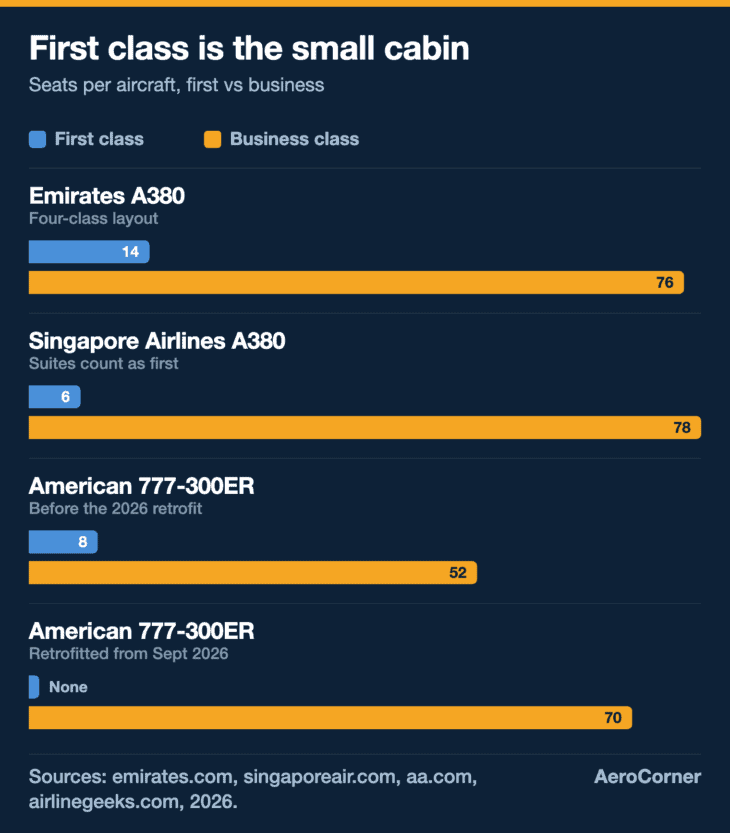
First class is a small cabin, even on the biggest jets. Emirates’ four-class Airbus A380 carries 14 First Class suites and 76 lie-flat Business Class seats, out of 484 seats in total.
That is 5.4 business seats for every first class suite, and first class is under 3% of the aircraft. Singapore’s A380 is starker still: 6 Suites against 78 business seats, or 13 to 1, out of 471 seats.
That scarcity is the product. With a handful of passengers per cabin, the crew can serve each one individually, which is where most of the service gap below comes from.
The takeaway: business class is the premium cabin most long-haul passengers will actually sit in; first class is a few seats at the very front.
Food, service and onboard extras
Both international cabins serve full meals. The usual difference, is that service in first is on demand: you eat what you want, when you want it, rather than when the cart comes round.
Some airlines add hardware that only first class can use. On the Emirates A380, First Class passengers get the onboard Shower Spa, a private suite with sliding doors and a personal minibar.

Emirates also shows how much business class now shares. Its A380 Onboard Lounge is open to Business Class too, and it offers chauffeur-drive to both First and Business Class customers.
The business bed is longer
Singapore Airlines lists a 78-inch flat bed in A380 business class and a 76-inch bed in its A380 Suites. First class passengers pay for the separate armchair, the door and the double-bed option, not for extra length.
The takeaway: first class adds personal, on-demand service and a few first-only extras; the meal itself is often closer than the price gap suggests.
Lounges and the airport
Both international cabins usually come with priority check-in and boarding, plus lounge access. Some airlines that still sell first class, such as Emirates, keep separate First Class and Business Class lounges.
Lufthansa goes furthest. Its first class passengers get their own renovated check-in areas at Frankfurt and Munich and a redesigned First Class Lounge at Munich.

At Delta, where business class is the top long-haul cabin, the best ground experience belongs to Delta One. Its passengers get dedicated check-in and security at Delta’s hubs, priority boarding and access to Delta One lounges at New York JFK, Boston, Los Angeles and Seattle.
The takeaway: first class adds a second, quieter lounge tier at some airlines; at US airlines, business class gets the best of the ground experience.
Price: what first costs over business
Booking.com puts a New York to London round trip at $4,000 to $6,000 in business class and $8,000 to $15,000 in first. On those ranges, first costs about 2 to 2.5 times as much on the same route.
The multiple varies. Booking.com says first class generally costs one and a half to five times more than business, and Simple Flying puts long-haul first at around $5,000 to $15,000 round trip.
Why so much more for a few extra square feet is its own story, told in what a first class seat actually costs the airline to sell you.
The takeaway: on a typical long-haul route, expect first class to cost roughly double business class, and sometimes far more.
Who still sells first class
Fewer airlines every year. United announced its move to a two-cabin international product on June 2, 2016, alongside the launch of Polaris business class.
“As we update our fleet over the next several years to incorporate our signature United Polaris direct-aisle-access seating, we will be phasing out the first class cabin and moving toward a two-cabin experience for international travel.”
United Airlines, June 2016, as quoted by One Mile at a Time
American is next. It will stop selling Flagship First on its Boeing 777-300ER for travel from November 19, 2026, and on transcontinental routes from March 28, 2027. AirlineGeeks calls it the last long-haul international first class product at a US airline.
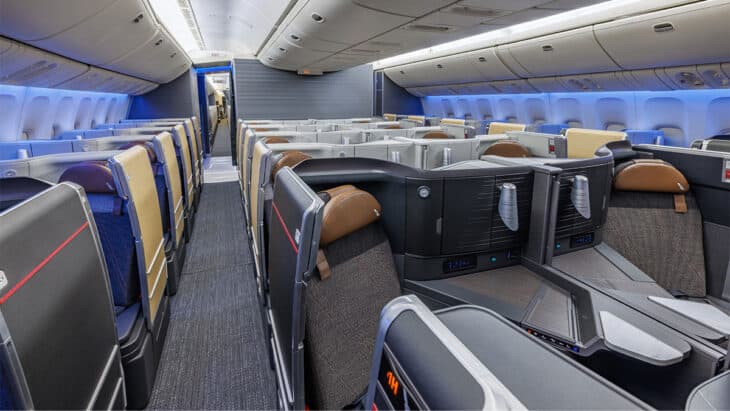
According to AirlineGeeks, American’s 777-300ER used to carry 8 first class and 52 business class seats. The retrofitted jet, which flew its first service from New York JFK to Buenos Aires on September 2, 2026, has 70 Flagship Suite seats with privacy doors and no first class. That is 10 more flat beds than before.
On transcons, AirlineGeeks reports that the Airbus A321XLR, with 20 Flagship Suite seats, is taking over from the A321T, which has 10 Flagship First and 20 business seats.
Some airlines are going the other way. In a March 2025 release on the new Allegris first class, Lufthansa Airlines CEO Jens Ritter said the airline was “completely reinventing the Lufthansa First Class travel experience with Allegris and making it even more exclusive.”
Emirates and Singapore Airlines still fly first class on their A380s, and our list of airlines still flying the A380 shows where the superjumbo goes.
The takeaway: outside the US, first class survives at a few premium airlines; inside the US, business class is now the top of the line.
US domestic first class is a different product
On most flights within the US, the front cabin is called first class, but it is closer to an old-style business class. Simple Flying describes a wider seat with up to 38 inches of pitch that is rarely a lie-flat bed, and says lounge access is rarely included.
Delta First is a typical example. Delta lists up to 8 inches more legroom than a Main seat, up to 5.4 inches of recline, and an 11-inch screen on many routes. Meals are served on flights of 900 miles or more, at select times below 2,300 miles.
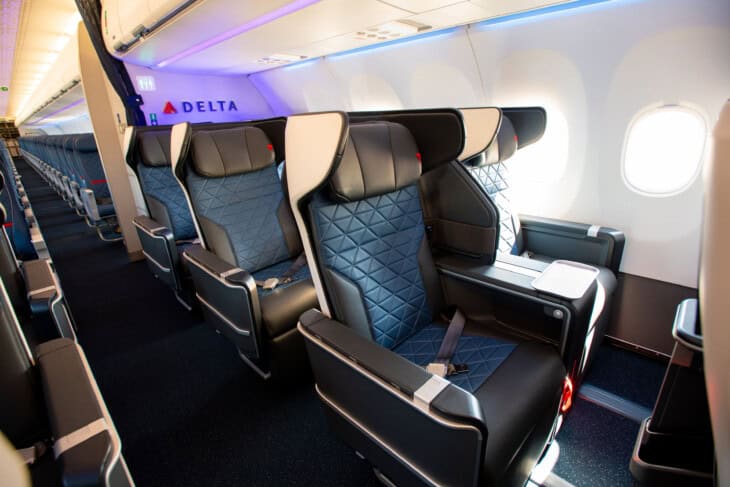
On some long domestic routes, the front cabin is international business class instead. Delta sells Delta One, with 180-degree lie-flat seats, on international flights and select long-haul domestic routes.
So on a flight where you can choose, a business class ticket usually beats a domestic first class ticket. Check the seat map for “lie-flat” before you pay for the word “first”.
The takeaway: in the US, domestic first class sits below long-haul business class, whatever the name suggests.
The difference in one sentence
Business class sells you a flat bed; international first class sells you a private room around it, more personal service and a quieter airport, at roughly twice the fare, while US domestic first class is a recliner that sits below both.
| If you want… | Look for | Because |
|---|---|---|
| To sleep on a long-haul flight | Business class | A flat bed, often as long as first class’s |
| Maximum privacy and a separate bed | International first class | Enclosed suites with doors; Singapore pairs an armchair with a separate bed |
| A door without the first class fare | A business suite with a door | Delta One suites on most A350 and A330-900 flights, American’s Flagship Suite |
| A lie-flat seat inside the US | Delta One on a long-haul domestic route | Domestic first class is usually a recliner |
| A bigger seat on a short domestic hop | Domestic first class | More legroom, recline and priority service |
Myth: first class is always better than business class
Only within the same airline’s long-haul cabin. A US domestic first class recliner is a smaller product than a lie-flat business seat, and even Singapore’s A380 Suites bed, at 76 inches, is shorter than the 78-inch bed in its business class. American’s newest 777-300ER drops first class entirely in favor of 70 business suites with doors.
FAQ
Sources and references used for research and fact-checking.
- Singapore Airlines, Singapore Airlines new A380 product to London
- Singapore Airlines, Fly Suites
- Emirates, Emirates boosts flights to Osaka, introducing A380 fitted with Premium Economy
- Emirates, The Emirates A380 fleet
- Emirates, Emirates A380 First Class cabin features
- Emirates, Emirates A380 Business Class cabin features
- Lufthansa, Lufthansa Allegris First Class
- Lufthansa Group, Lufthansa new First Class premium experience
- American Airlines, Flagship Suite seats are the new first: American Airlines unveils its premium-configured Boeing 777-300ER
- AirlineGeeks, American Sets End Dates for Flagship First
- One Mile at a Time, Official: United Phasing Out International First Class
- United Airlines (PR Newswire), United Airlines Unveils Reimagined International Travel Experience - United Polaris Business Class
- Delta Air Lines, Delta One
- Delta Air Lines, Delta First
- Simple Flying, How Much Do First Class Seats Cost?
- Booking.com, The ultimate guide to business class vs first class
Get the Newsletter
The latest aviation news and stories sent to your inbox.
About the Author

Tim is the owner and lead editor of AeroCorner since 2019, overseeing aviation content covering aircraft, airlines, airports, and the broader aviation industry. Through years of researching, writing, editing, and publishing aviation-focused content, he has developed extensive practical knowledge of commercial aviation and air travel. Based in Asia and a frequent traveler himself, Tim also brings firsthand passenger experience to AeroCorner’s coverage. Outside of publishing, he has also explored aviation firsthand through hands-on flight training in New Zealand.