

Table of Contents
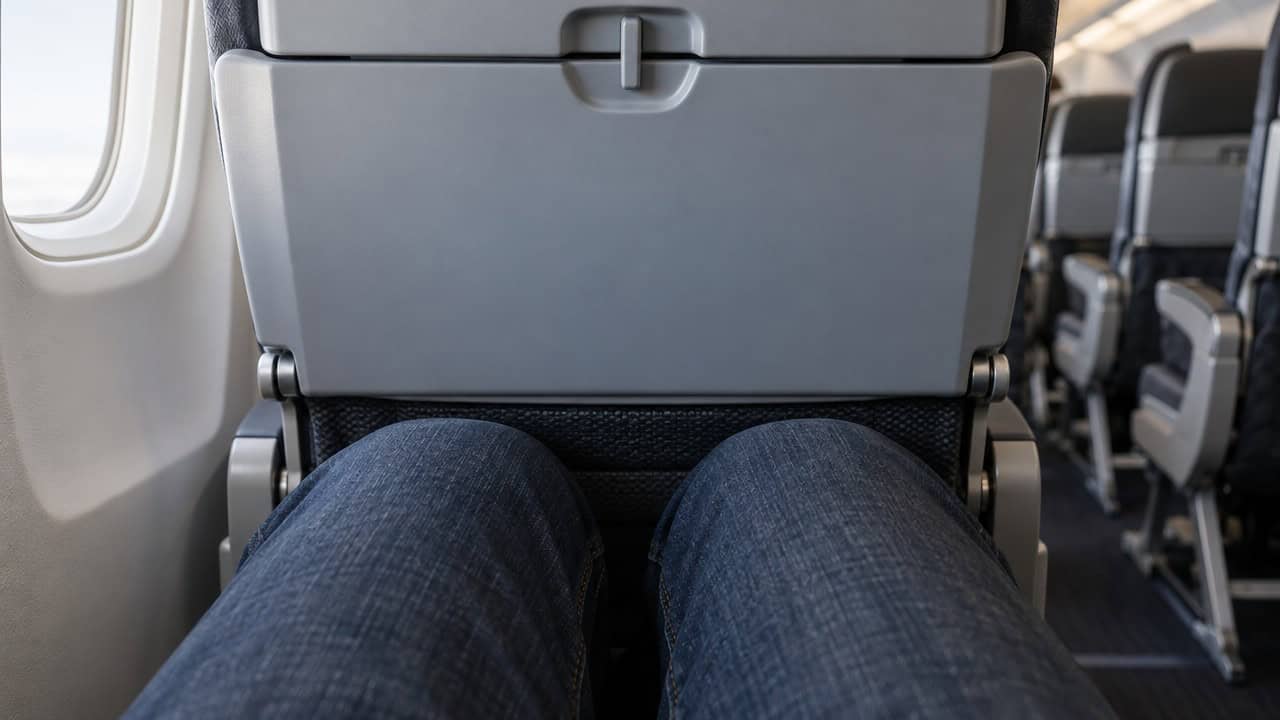
Four inches separate the best and worst standard economy seats among the seven big US airlines still flying, and the airline that built its name on that gap is now shrinking its side of it.
JetBlue has the most standard economy legroom of any big US airline, at 32 inches (81 cm) of seat pitch as of October 2026. Frontier has the least, at 28 inches (71 cm). Delta, Southwest and Alaska sit at about 31 inches (79 cm), with American and United at about 30 inches (76 cm).
That order is about to move. JetBlue’s new BlueFirst cabin makes its first revenue flight on Dec. 8, 2026, and the jets that get it are reported to drop standard economy to about 30 inches, level with American and United.
Seat pitch is the distance from a point on one seat to the same point on the seat in front. It measures row spacing rather than knee room, but it is the number the rankings compare.
Why JetBlue Is Giving Up the Inches It Built Its Name On
Legroom was JetBlue’s calling card by 2006. That December it announced an Airbus A320 layout with at least 36 inches in rows 1-11 and at least 34 inches in rows 12-25. Founder and CEO David Neeleman called it “more inches of legroom than any other U.S. airlines’ coach cabin.”
Slimmer seats later took standard rows down to 32 inches while EvenMore rows went to 35-36, as Cranky Flier recounts. The slogan survived: JetBlue’s May 2018 cabin release still claimed “the most legroom in coach of any U.S. airline,” based on average fleet-wide pitch.
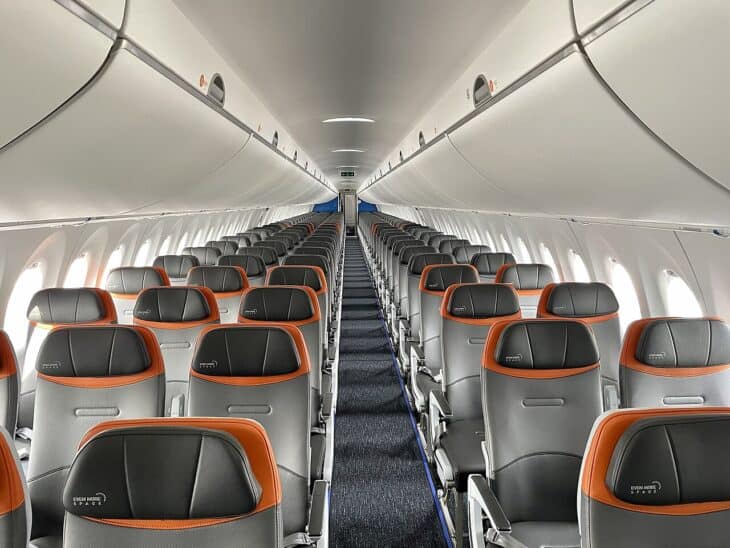
BlueFirst breaks that. JetBlue’s second-quarter 2026 investor deck describes 2×2 seating on three or four rows of every non-Mint aircraft, with total seats across the fleet staying about the same. Wider seats with no lost capacity means the space has to come from the rows behind them.
JetBlue has not published a new figure for its Main cabin, and its releases do not mention one. Its own marketing points the same way, though: BlueFirst offers “up to seven inches” more legroom than Main seats, and One Mile at a Time reports up to 37 inches of pitch up front.
Thirty-seven minus seven is 30, which is the cut One Mile at a Time reports. Cranky Flier puts it at 30 to 31 inches. So the cut is reported and implied, not confirmed on the record.
The reason is money. JetBlue’s deck projects about five points of unit-revenue improvement from BlueFirst once it reaches steady state, and Cranky Flier’s argument is that coach seats with generous legroom have little ability to earn extra.
Every Big US Airline’s Standard Economy Seat, Ranked
The measure here is standard economy pitch, not the extra-legroom rows sold at a premium. It comes from each airline’s own aircraft pages where they publish it, and from the reporting named in the table where they do not.
| Rank | Airline | Standard economy pitch, October 2026 | Upgraded Points average (2023 routes) | Basis for the current figure |
|---|---|---|---|---|
| 1 | JetBlue | 32 in; about 30 in reported on BlueFirst jets | 32.3 in | One Mile at a Time; JetBlue gives no Main figure |
| T-2 | Delta | 31 in on most; 30-32 in across layouts | 31.0 in | delta.com aircraft pages |
| T-2 | Southwest | 31 in | 31.8 in | One Mile at a Time, Cranky Flier; Southwest gives no standard figure |
| T-2 | Alaska | About 31 in | 31.0 in | Alaska fact sheet (787), Alaska release (E175) |
| 5 | American | 30 in on most narrowbodies; 31-32 in on A320, 32 in on A321XLR | 30.2 in | aa.com planes page |
| 6 | United | 30 in; up to 31 in on 737-900 and 737 MAX 9 | 30.1 in | united.com aircraft pages |
| 7 | Frontier | 28 in | 28.0 in | Upgraded Points; Frontier’s aircraft page lists width only |
The Upgraded Points column is the ranking legroom stories keep quoting, and it is older than it looks. The page carries a January 7, 2026, update stamp, but it is titled a 2024 data study and built from OAG’s November 2023 list of the 10 busiest domestic routes.
That is why it still has Southwest in a clear second place at 31.8 inches. Southwest ended open seating on Jan. 27, 2026, and on the 737-800 and 737 MAX 8 its standard seats lost an inch, from 32 to 31, so that 68 of the 175 seats could have 34 inches.
It also still counts Spirit, tied for last at 28 inches. Spirit stopped flying on May 2, 2026, which leaves Frontier alone at the bottom.
Hawaiian, at 29 inches in the study, is now in the Alaska group. Smaller carriers such as Allegiant and Breeze were not in the study and are not ranked here.
Alaska is the softest number on the list. Its 737 pages give no pitch, and the last figure we found for its main cabin overall, 31 to 32 inches, dates from 2015, before it added more Premium Class rows. Its September 2026 fact sheet lists 31 inches on the 787, and a 2022 release gives 31 on the E175.
What an Inch Is Worth, and Why Nothing Stops Frontier at 28
Upgraded Points’ newer study, of more than 5,000 flights on the 10 busiest domestic routes over one week in May 2026, found that flights with below-average legroom (28 to 29.9 inches) averaged $188. Average legroom (30 to 30.9 inches) cost about $225, and above-average legroom (31 to 33 inches) about $276.
That $88 spread is not a price per inch, because the tiers also sort by airline, and Frontier’s whole model is a low fare with fees on top. It does show where the cheap seats live.
Passengers say they care. In the same study’s survey of 500 frequent travelers, 46% called legroom very or extremely important when booking economy, and the typical respondent said they would pay about $45 for more of it.
There is no legal floor under any of this. Congress told the FAA in 2018 to set minimum seat dimensions needed for passenger safety, and the agency’s 2022 request for comments explicitly excluded comfort and convenience. Air Traveler found no numerical minimum adopted as of its August 2026 check.
The Space Is Moving to the Front of the Cabin
JetBlue is the sharpest case of a move most of these airlines are making. American said on Aug. 18, 2026, that it will retrofit most of its narrowbodies to add Main Cabin Extra, taking premium seats from roughly a quarter of narrowbody departure seats to about 40% in the coming years.
Alaska’s retrofit, announced in 2024, takes Premium Class from 24 to 30 seats on its 737-900ERs and 737 MAX 9s. United sells Economy Plus rows at 33 to 40 inches ahead of 30-inch standard rows, and Delta Comfort runs 33 to 34 inches on the A321neo and 737-800.
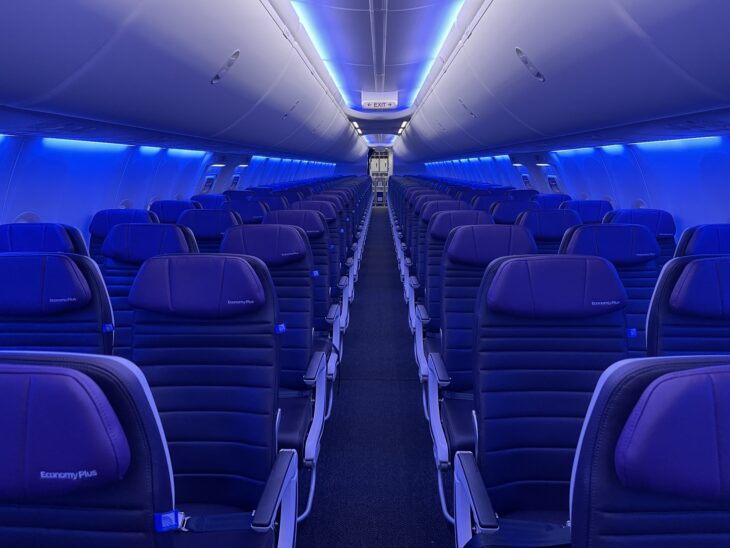

JetBlue’s own swap starts on Dec. 8, on a Boston to Fort Lauderdale flight. One Mile at a Time reports the oldest A320s go first, and JetBlue’s quarterly filing expects most of the retrofit work to be done by the end of 2027.
Until then the same JetBlue ticket could mean 32 inches or about 30, so check the seat map for your flight. JetBlue’s Mint jets are not getting BlueFirst, and nothing published says their Main rows will change, so the airline may not end up at one uniform number.
If the reported cut holds, the best standard seat among these seven becomes about 31 inches, shared by Delta, Southwest and Alaska, with nobody clearly ahead. The biggest legroom numbers in US economy will belong to the rows you pay extra for.
Sources and references used for research and fact-checking.
- Upgraded Points, The U.S. Airlines With the Most and Least Legroom [2024 Data Study]
- Upgraded Points, The Premium Travelers Put on Legroom [2026 Data Study and Survey]
- JetBlue, Meet BlueFirst: JetBlue Puts a Modern Twist on First Class
- JetBlue, JetBlue's BlueFirst New Domestic First Class Now on Sale
- JetBlue, via SEC, Second Quarter 2026 Earnings Presentation
- JetBlue, via SEC, Form 10-Q for the quarter ended June 30, 2026
- JetBlue, Taking the JetBlue Experience to New Heights
- JetBlue, JetBlue Brings Humanity Back to Air Travel All Over Again
- One Mile at a Time, JetBlue BlueFirst First Class: Seats, Amenities, Pricing, Upgrades, & More
- Cranky Flier, JetBlue's BlueFirst Will Be an Instant Money Maker
- One Mile at a Time, End Of An Era: New Southwest Airlines Assigned & Premium Seating Policy Live
- Cranky Flier, A Detailed Look at Southwest's Assigned and Extra Legroom Seating Plan
- Southwest Airlines, Assigned Seating
- Delta Air Lines, Airbus A321neo Seat Maps, Specs & Amenities
- Delta Air Lines, Boeing 737-900ER Seat Maps, Specs & Amenities
- Delta Air Lines, Boeing 737-800 Seat Maps, Specs & Amenities
- Delta Air Lines, Airbus A321-200 Seat Maps, Specs & Amenities
- American Airlines, Our Planes
- American Airlines, American Airlines announces fleetwide upgrade with seatback screens and increased premium seats
- United Airlines, Boeing 737 MAX 8 Seat Map
- United Airlines, Boeing 737 MAX 9 Seat Map
- United Airlines, Boeing 737-900 Seat Map
- United Airlines, Airbus A321neo Seat Map
- Alaska Airlines, Aurora and Leihoku Suites Investor Day Fact Sheet
- Alaska Airlines, Alaska Air Group Orders Eight New E175 Aircraft
- Alaska Airlines, Alaska Airlines to Introduce a New Premium Class Section
- Alaska Airlines, Alaska Airlines announces major expansion of First Class and Premium seating
- Frontier Airlines, Our Aircraft
- FAA, Federal Register, Request for Comments in Minimum Seat Dimensions Necessary for Safety of Air Passengers
- Air Traveler, Why 26,000 comments on airline seat size failed to change FAA rules
Get the Newsletter
The latest aviation news and stories sent to your inbox.
About the Author

Tim is the owner and lead editor of AeroCorner since 2019, overseeing aviation content covering aircraft, airlines, airports, and the broader aviation industry. Through years of researching, writing, editing, and publishing aviation-focused content, he has developed extensive practical knowledge of commercial aviation and air travel. Based in Asia and a frequent traveler himself, Tim also brings firsthand passenger experience to AeroCorner’s coverage. Outside of publishing, he has also explored aviation firsthand through hands-on flight training in New Zealand.