

Table of Contents
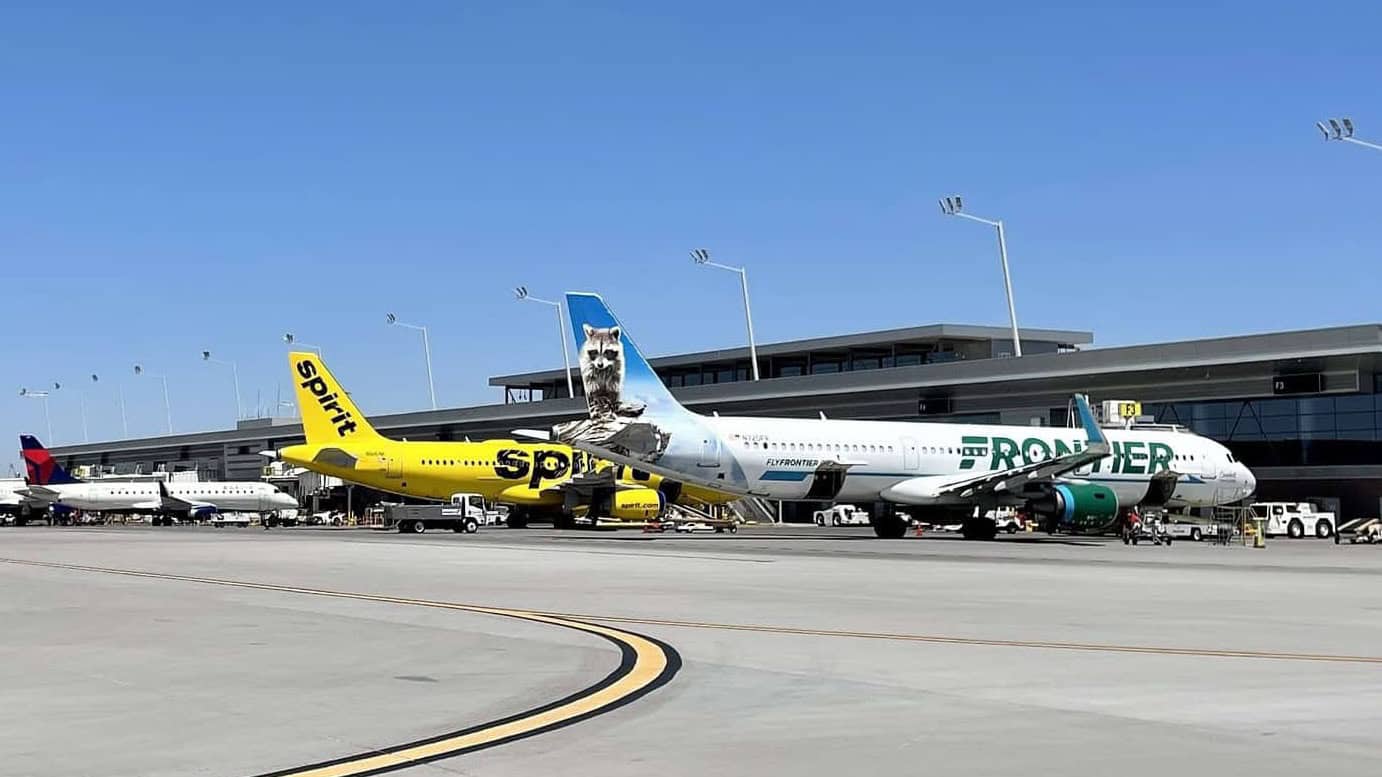
Frontier won, and not because it ran the better airline. In 2025 Spirit arrived on time more often, canceled fewer flights and bumped far fewer passengers, yet it stopped flying on May 2, 2026. Frontier is still in the air because it lost about $290 million from 2020 to 2024 while Spirit lost $3.13 billion.
So if you searched to decide which one to book, the choice is gone. Spirit is a bankruptcy estate selling off its aircraft, and Frontier now flies more than 100 of the routes Spirit used to serve, by its own count.
What follows compares the two on their own SEC filings and on the Department of Transportation’s Air Travel Consumer Report, as of September 2026. For who ended up with Spirit’s pieces, see who owns Spirit Airlines now.
| Measure | Frontier | Spirit | Edge |
|---|---|---|---|
| Status, September 2026 | Flying, 165 aircraft (June 30, 2026) | Stopped flying May 2, 2026; wind-down ordered May 8 | Frontier |
| Business model | Airbus A320 family only, unbundled fares | Airbus A320 family only, unbundled fares | Even |
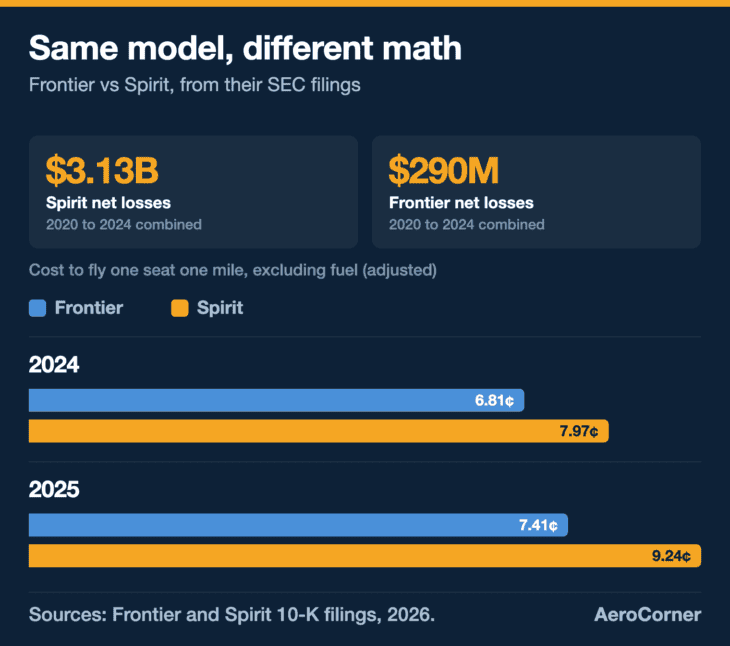
| GAAP net result, 2020 to 2024 combined | -$290 million | -$3.13 billion | Frontier |
| Adjusted cost per seat mile excluding fuel, 2025 | 7.41 cents | 9.24 cents | Frontier |
| Unrestricted cash, December 31, 2025 | $654 million | $273 million | Frontier |
| Fleet, December 31, 2025 | 176 aircraft, average age about 5 years | 131 aircraft, average age about 8 years | Frontier |
| On-time arrivals, 2025 | 70.68% (10th of 10) | 77.25% (4th of 10) | Spirit |
| Flights canceled, 2025 | 1.77% | 1.50% | Spirit |
| Bags mishandled per 100 checked, 2025 | 0.41 | 0.43 | Even |
| Passengers involuntarily bumped per 10,000, 2025 | 2.51 (worst of 10) | 0.20 | Spirit |
How we compared
Financial figures come from each airline’s annual 10-K filings with the SEC, and Frontier’s June 2026 10-Q. The combined 2020 to 2024 result is our sum of the reported GAAP net income or loss for each year: Frontier -225, -102, -37, -11 and +85 million dollars; Spirit -428.7, -472.6, -554.2, -447.5 and -1,229.5 million dollars. Spirit’s 2025 is left out because fresh-start accounting split it into two periods that cannot be added into one reported year. Loss per passenger divides 2024 net result by the DOT’s 2024 enplaned-passenger counts (41,958,580 for Spirit, 31,114,918 for Frontier). Complaints per 100,000 passengers divide the DOT’s January to June 2026 complaint cases (3,673 Frontier, 2,053 Spirit) by the same period’s enplanements (17,429,645 and 7,382,962). Service figures are the DOT’s own, for full-year 2025. Cost per seat mile is each airline’s own adjusted measure; Frontier’s average trip was 919 miles in 2025 and Spirit does not publish one, so the gap is indicative rather than exact.
Are Frontier and Spirit the same airline?
No, they were always separate companies, but they were built by the same people to the same plan. Indigo Partners, the private equity firm run by Bill Franke, held a major stake in Spirit from 2006, sold it in 2013 and bought Frontier the same year. Franke still chairs Frontier’s board.
Both annual reports open their fleet section with the same sentence: “We fly only Airbus A320 family aircraft.” Both sold a bare seat and charged separately for bags, seat choice and flexibility, the model we unpack in why Frontier’s cheap fares were never meant to cover the flight.
Even the executives crossed over. Barry Biffle, Frontier’s chief executive until December 2025, had earlier been an executive at Spirit. James Dempsey replaced him.
Edge: Even. On paper the two were near-identical airlines chasing the same passenger.
Money: who was losing more
Both airlines made money in 2019, Spirit $335 million and Frontier $251 million. Then both lost money every year from 2020 through 2023.
The difference was size. Frontier’s losses shrank each year, from $225 million in 2020 to $11 million in 2023, and it turned an $85 million profit in 2024. Spirit’s losses never dropped below $428 million, and in 2024 it lost $1.23 billion.
Per passenger, that 2024 gap is stark. By our calculation Spirit lost about $29 on every passenger it flew that year, while Frontier made about $2.70 on each of its own.
Frontier has not escaped the losses since. It lost $137 million in 2025 and $362 million in the first half of 2026 as fuel prices spiked.
Edge: Frontier. Over five years it lost less than a tenth of what Spirit did.
The cost of flying a seat, and the engine problem
An ultra-low-cost airline lives or dies on what it costs to fly one seat one mile. Frontier’s adjusted figure, excluding fuel, was 6.81 cents in 2024 and 7.41 cents in 2025. Spirit’s was 7.97 cents and then 9.24 cents.
Much of Spirit’s jump traces to one engine. The Pratt & Whitney GTF that powers Spirit’s Airbus A320neo jets needed accelerated inspections for a flaw in powdered-metal parts, and in early 2024 Spirit estimated it would average about 25 grounded aircraft for the year.
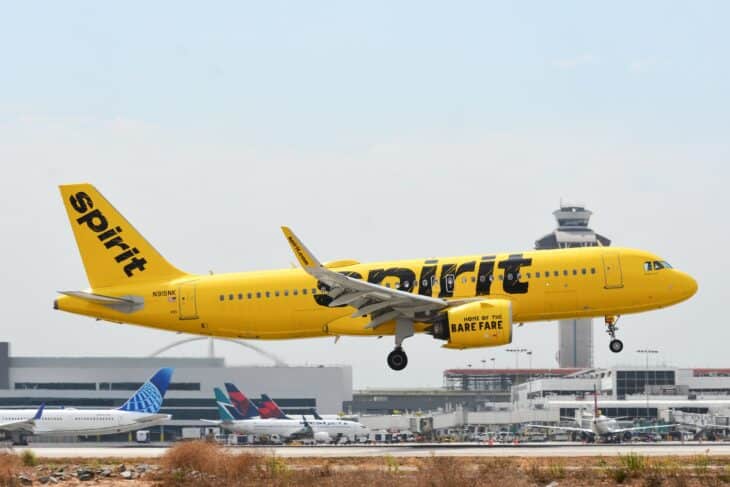
An airline still pays for a jet that sits on the ground, so every grounded aircraft pushed Spirit’s cost per seat up. Pratt & Whitney paid Spirit $150.6 million in compensation for 2024 and $135.3 million for 2025, The same engine crunch is why some A320neos are being scrapped for their engines at just a few years old.
Spirit's jets spent nearly a third less time flying
Spirit flew each aircraft an average of 11.1 hours a day in 2023, 9.9 hours in 2024 and 7.7 hours in 2025. Its own 10-K blames the drop primarily on aircraft pulled from service for the GTF engine inspections. For an airline whose model depends on keeping jets in the air, that is a 31 percent cut in the use of its most expensive asset.
Frontier was exposed too, but less. Roughly half its fleet flies on CFM LEAP engines rather than the GTF, and its 2025 annual report says the inspection program “has not materially impacted our operations.”
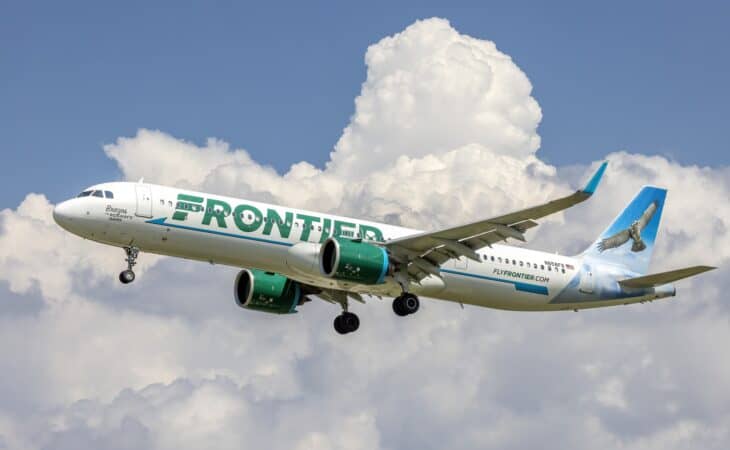
It also ran a younger fleet: 176 jets averaging about five years old at the end of 2025, against Spirit’s 131 at about eight. Its A321neo carries 240 seats, the most of any aircraft in its fleet.

Edge: Frontier. Its costs rose too, but from a lower base and at a slower pace.
Cash in the bank
At the end of 2025, Frontier held $654 million in unrestricted cash plus $220 million of undrawn credit, $874 million in all. By June 30, 2026 that had grown to $1.16 billion.
Spirit ended 2025 with $273 million in cash and nothing left to borrow: it had drawn its whole $275 million revolving credit line in August 2025. Its 10-K warned of “substantial doubt about our ability to continue as a going concern.”
When jet fuel jumped in the spring of 2026, that cushion decided everything. Spirit sought about $500 million in federal support and did not get it.
“The sudden and sustained rise in fuel prices in recent weeks ultimately has left us with no alternative but to pursue an orderly wind-down of the Company.”
Dave Davis, Spirit president and CEO, May 2, 2026
Edge: Frontier. It entered the fuel shock with more than twice Spirit’s cash and an untouched credit line.
On time and canceled flights
Here the ranking flips. In 2025 Spirit arrived on time on 77.25% of its flights, fourth of the ten marketing carriers the DOT ranks. Frontier finished last at 70.68%.
Cancellations told the same story. Spirit canceled 1.50% of its 2025 flights and Frontier 1.77%.
Spirit’s operation only broke in its final months. Between January and its shutdown in early May 2026 it canceled 7.47% of scheduled flights, and in March it managed just 48.4% on time.
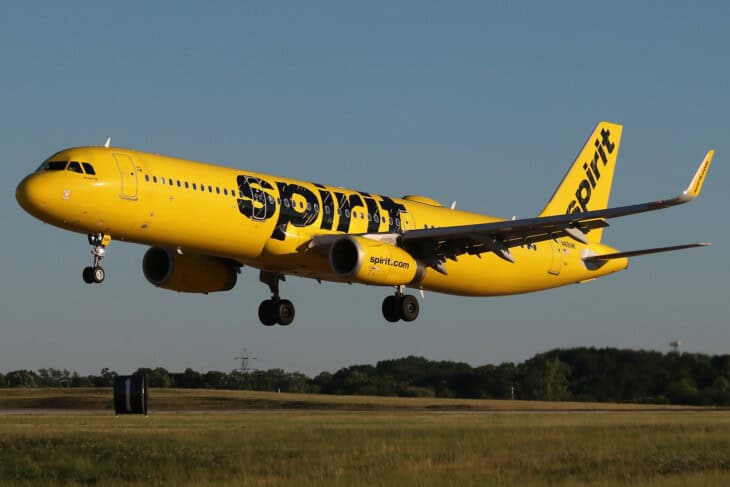
Myth: Spirit failed because it was the worse airline
The DOT’s full-year 2025 numbers say the opposite. Spirit ranked 4th of 10 for on-time arrivals and Frontier ranked last; Spirit canceled fewer flights and involuntarily bumped about one passenger for every twelve Frontier bumped. Spirit failed on its balance sheet, not its operation. The airline with the better 2025 service record is the one that is gone.
Edge: Spirit. In its last full year it was the more punctual and more reliable of the two.
Bags, bumping and complaints
Bag handling was a near-tie. In 2025 Frontier mishandled 0.41 bags per 100 checked and Spirit 0.43.
Bumping was not. Frontier involuntarily denied boarding to 2.51 passengers per 10,000 in 2025, the worst of the ten carriers and about nine times the industry rate of 0.28. Spirit’s rate was 0.20.
Frontier has stayed worst on bumping in 2026, at 1.42 per 10,000 from January to June. On complaints the two were close: by our calculation Frontier drew about 21 complaints to the DOT per 100,000 passengers in that period, and Spirit about 28 during its final months.
Edge: Spirit. Bags were even, but a Frontier passenger was far more likely to be bumped.
What flying Frontier looks like without Spirit
On the day Spirit shut down, Frontier said it already served more than 100 routes Spirit had flown and offered rescue fares of up to 50% off base fares for travel through November 19, 2026. It started eight more former Spirit routes in early July, including Detroit to Fort Lauderdale and Boston to Orlando.
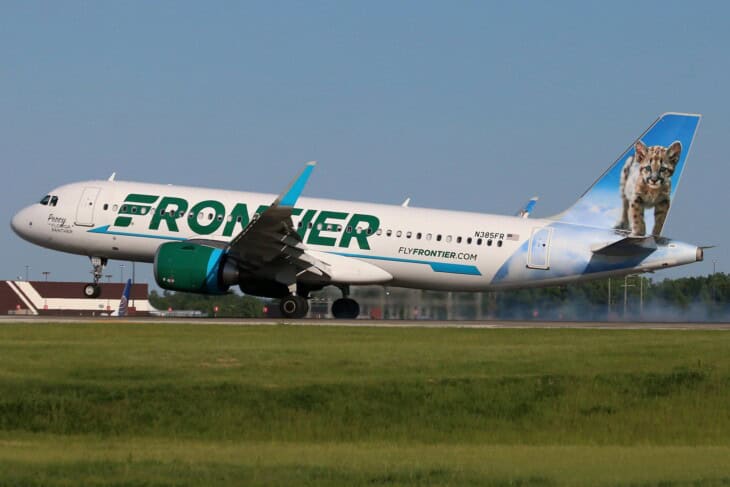
Less competition shows up in the numbers. Frontier reported record second-quarter revenue of about $1.3 billion in 2026, which it credited partly to “favorable competitive capacity,” but still lost $90 million because fuel averaged $4.17 a gallon.
It is also getting smaller in aircraft terms. Frontier agreed in March 2026 to hand back 24 A320neos early, agreed in August to return 13 more, and is leasing 10 larger A321neos to keep capacity roughly level.
Some fees are going up. For Basic and Standard fares booked from September 25, 2026, Frontier charges $149 to cancel and $149 to change within 59 days of departure.
Edge: Frontier. By default: it is the one still selling tickets.
So who actually won?
Frontier won on the balance sheet, and that turned out to be the only scorecard that mattered. Spirit won three of the four service rows and still went out of business.
The irony is that Frontier spent nearly four years trying to buy the rival it outlasted, and never closed a deal.
February 2022
The merger is agreed. Frontier and Spirit sign a merger agreement on February 5 and announce it on February 7.
July 2022
Spirit walks away. The two terminate the deal on July 27, and Spirit takes JetBlue’s higher offer instead.
January 2024
A court blocks JetBlue. A federal judge blocks the JetBlue deal on January 16, and JetBlue terminates it on March 4.
January 2025
Frontier tries again. With Spirit in its first Chapter 11, Frontier makes a new offer on January 29. Spirit rejects it and a revised bid on February 11.
November 2025
One more bid. Three months into Spirit’s second Chapter 11, Frontier makes another offer, which Reuters reported was deemed unviable.
May 2026
Spirit stops flying. All flights end at 3:00 a.m. Eastern on May 2, and the court orders a wind-down on May 8.
“Spirit could have survived if they had accepted our agreement and merged with us.”
Barry Biffle, former Frontier CEO, to Forbes, May 2026
That is Biffle’s claim, not a proven fact. Frontier’s own survival is not settled either: it lost money in 2025 and in the first half of 2026, and its guidance assumes fuel falls from $4.17 a gallon in the second quarter to $3.70 in the third and $3.50 in the fourth.
What the filings do show is that Frontier has no going-concern warning, $1.16 billion in liquidity and one fewer rival on its busiest routes. For now, that is the whole difference between the two airlines.
FAQ
Sources and references used for research and fact-checking.
- US Securities and Exchange Commission, Frontier Group Holdings Form 10-K for fiscal year 2025
- US Securities and Exchange Commission, Frontier Group Holdings Form 10-K for fiscal year 2024
- US Securities and Exchange Commission, Frontier Group Holdings Form 10-K for fiscal year 2021
- US Securities and Exchange Commission, Frontier Group Holdings Form 10-Q for the quarter ended June 30, 2026
- Frontier Group Holdings, Frontier Airlines Delivers Record Second Quarter 2026 Revenue
- US Securities and Exchange Commission, Frontier Group Holdings Form 8-K, August 2026 fleet transactions
- US Securities and Exchange Commission, Spirit Aviation Holdings Form 10-K for fiscal year 2025
- US Securities and Exchange Commission, Spirit Airlines Form 10-K for fiscal year 2024
- US Securities and Exchange Commission, Spirit Airlines Form 10-K for fiscal year 2021
- Spirit Airlines, Spirit Airlines fourth quarter 2023 earnings release
- Spirit Aviation Holdings, Spirit Airlines announces orderly wind-down of operations
- US Department of Transportation, Air Travel Consumer Report, February 2026 (full-year 2025 data)
- US Department of Transportation, Air Travel Consumer Report, February 2025 (full-year 2024 data)
- US Department of Transportation, Air Travel Consumer Report, August 2026 (January to June 2026 data)
- Frontier Airlines, Frontier Airlines announces discounted rescue fares to support Spirit Airlines customers
- Frontier Airlines, Frontier beginning service this week on eight routes previously operated by Spirit Airlines
- Frontier Airlines, Optional services and fees
- Frontier Airlines, Frontier Group Holdings names James G. Dempsey as President and Chief Executive Officer
- View from the Wing, Frontier CEO Barry Biffle is out today with a strategy reset ahead
- The Motley Fool, Spirit Airlines' biggest shareholder is selling
- US Securities and Exchange Commission, Frontier Group Holdings Form 10-Q for the quarter ended September 30, 2022
- US Department of Justice, Justice Department statements on district court decision to block JetBlue's acquisition of Spirit
- JetBlue Airways, JetBlue and Spirit terminate merger agreement
- PBS NewsHour (AP), Frontier makes another bid for Spirit as budget airlines struggle
- CNBC, Spirit Airlines rejects acquisition offer from Frontier again
- Post and Courier (Reuters), Investor enters talks to buy bankrupt Spirit as Frontier bid deemed unviable
- CNN Business, Spirit Airlines canceled all flights and is going out of business
- Washington Examiner, Frontier, Spirit: ex-CEO Barry Biffle says merger would have saved Spirit
- Bloomberg Law, JetBlue wins Spirit's 22 LaGuardia slots at bankruptcy auction
- CNN Business via Yahoo Finance, Will Frontier learn from Spirit's mistakes?
Get the Newsletter
The latest aviation news and stories sent to your inbox.
About the Author

Tim is the owner and lead editor of AeroCorner since 2019, overseeing aviation content covering aircraft, airlines, airports, and the broader aviation industry. Through years of researching, writing, editing, and publishing aviation-focused content, he has developed extensive practical knowledge of commercial aviation and air travel. Based in Asia and a frequent traveler himself, Tim also brings firsthand passenger experience to AeroCorner’s coverage. Outside of publishing, he has also explored aviation firsthand through hands-on flight training in New Zealand.