

Table of Contents
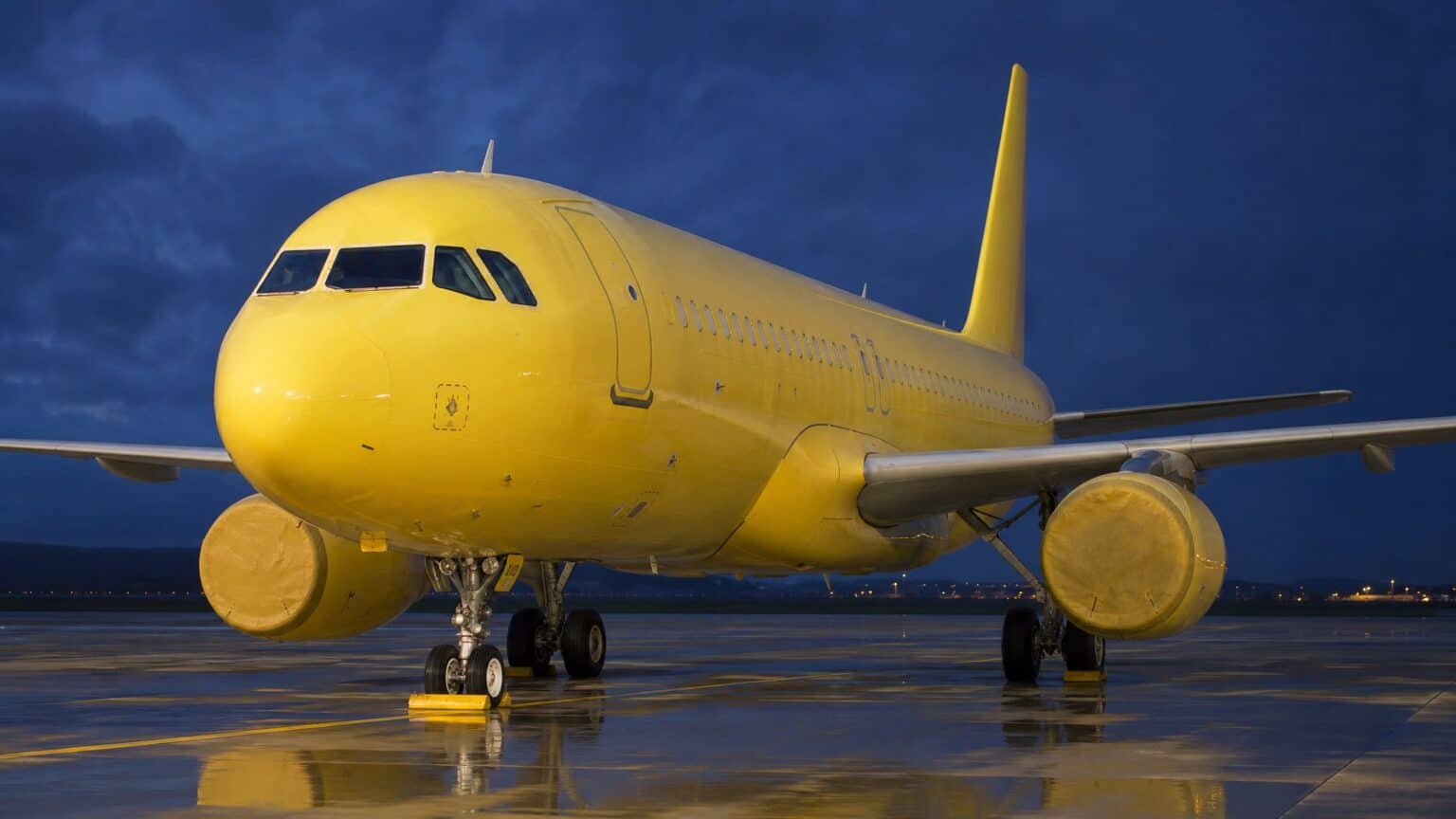
There is a building in Dania Beach, Florida, with yellow accents on the outside, chosen years ago to match the paint on the aircraft. It sits on 8.3 acres next to Fort Lauderdale-Hollywood International Airport, which was Spirit Airlines’ biggest base.
On August 13, 2026, it was sold to a Boston hedge fund for $93.25 million. The yellow is still on the building. The airline it belonged to stopped flying three and a half months earlier.
“Who owns Spirit Airlines” turns out to be one of the hardest ownership questions in American aviation, because the answer changed four times in five years and the current answer is genuinely strange. Here is who owned it, who owns what is left, and what a bankruptcy actually does to the people holding the shares.
Who Owns Spirit Airlines?
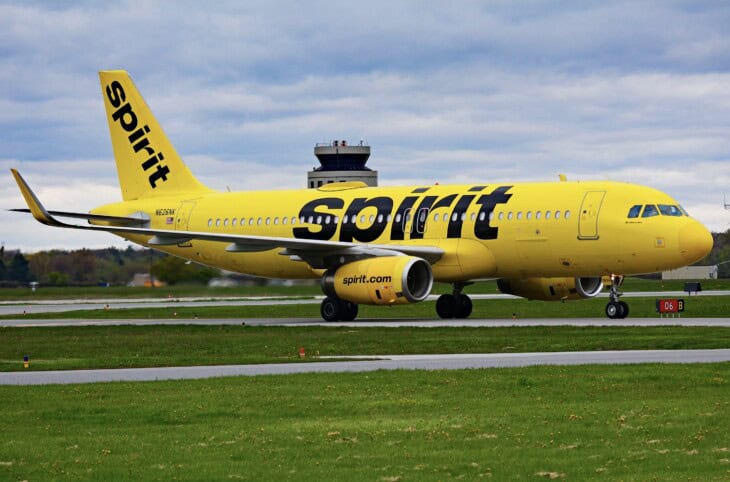
No one owns Spirit Airlines as a functioning airline, because there is no longer a functioning airline to own. It stopped flying at 3:00 a.m. Eastern on May 2, 2026, and it is not coming back in the form people remember.
The legal entity, Spirit Aviation Holdings, still exists. It is a debtor in a Chapter 11 case in the U.S. Bankruptcy Court for the Southern District of New York, and everything it used to own now sits in a bankruptcy estate that a court supervises while it is sold off piece by piece.
So the honest answer has two halves. The assets are being bought by whoever wins each auction: JetBlue took the LaGuardia slots, a hedge fund took the headquarters, Google took the internal data. The money from those sales belongs to Spirit’s creditors, who are the closest thing the company still has to owners.
The short version
Spirit was taken private by its bondholders in a 2025 bankruptcy, which wiped out every ordinary shareholder. Those bondholders became the owners, then filed a second bankruptcy five months later. When that one failed in 2026, the airline shut down. What is left is an estate selling assets to pay creditors, not a company with an owner.

How Spirit Went From Private Equity to Public Company to Nothing
Spirit’s ownership history is unusually well documented, because for thirteen years it was a public company and had to tell everyone exactly who held it.
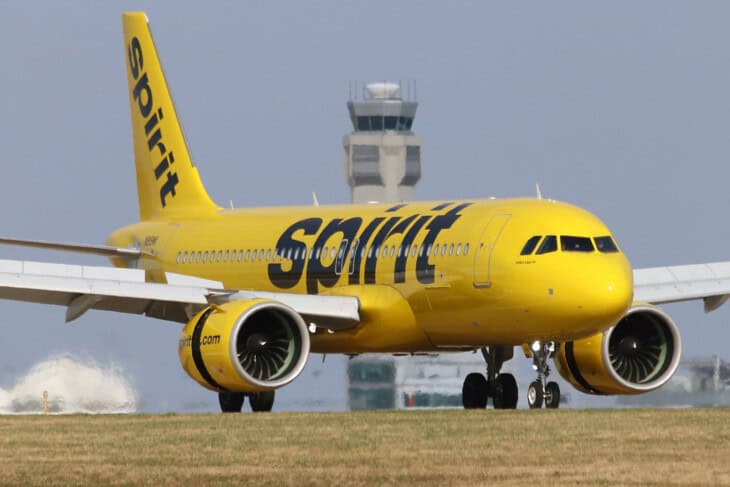
The airline that most Americans think of as Spirit was really built after 2004, when Oaktree Capital Management put in $125 million and took majority control. Indigo Partners, the private equity firm run by Bill Franke, bought in during 2006 and installed the ultra-low-cost model: strip the fare down to the seat, then charge for everything else.
That model is the reason Spirit’s fares looked impossible next to legacy carriers, and it is the same unbundling logic that has since spread across the whole industry, as our breakdown of how airline ticket pricing actually works explains.
2004
Oaktree Capital takes control. A $125 million investment buys a majority of a small Florida carrier almost nobody outside Detroit and Fort Lauderdale had heard of.
2006
Indigo Partners buys in. Bill Franke’s private equity firm takes a controlling interest and converts Spirit into an ultra-low-cost carrier.
2011
The IPO. Spirit goes public under the ticker SAVE. Indigo and Oaktree still hold roughly 71.8 percent between them immediately after the offering.
2013
Indigo sells out and buys Frontier. Franke exits Spirit’s board, then acquires Frontier Airlines from Republic Airways the same year.
2017
SAVE moves to the NYSE. Spirit transfers its listing from Nasdaq in December, now a widely held public company with no controlling owner.
2024
The first bankruptcy. Spirit files Chapter 11 on November 18 after two failed merger attempts, and the shares are delisted.
2025
The bondholders take it private. Spirit emerges on March 12 owned by its creditors, then files a second Chapter 11 on August 29.
2026
The wind-down. Flying stops on May 2. The court enters a wind-down order on May 8 and the assets go to auction.
One detail in that sequence is worth pausing on. Indigo Partners sold its Spirit stake in 2013 and bought Frontier Airlines the same year, which means Bill Franke’s firm owned the ultra-low-cost pioneer, let it go, and then spent 2022 trying to buy it back.
The Two Mergers That Would Have Given It an Owner
In February 2022, Frontier and Spirit agreed to merge in a deal worth about $6.6 billion including assumed debt. JetBlue then jumped in with a hostile offer, and Spirit’s shareholders rejected the Frontier deal in July 2022.
JetBlue’s agreed price was $33.50 a share, roughly $3.8 billion, and Spirit’s shareholders approved it. The Department of Justice sued to block it, arguing the deal would mean higher fares and fewer seats for millions of travelers.
A federal judge blocked the merger on January 16, 2024. JetBlue formally terminated the agreement on March 4, 2024, and Spirit was left as a standalone airline with heavy debt, a grounded chunk of its fleet from a separate engine problem, and no buyer. Ten months later it filed for bankruptcy.
What Chapter 11 Actually Does to the Owners
This is the part most people get wrong, and it is the mechanism behind every confusing answer to the ownership question.
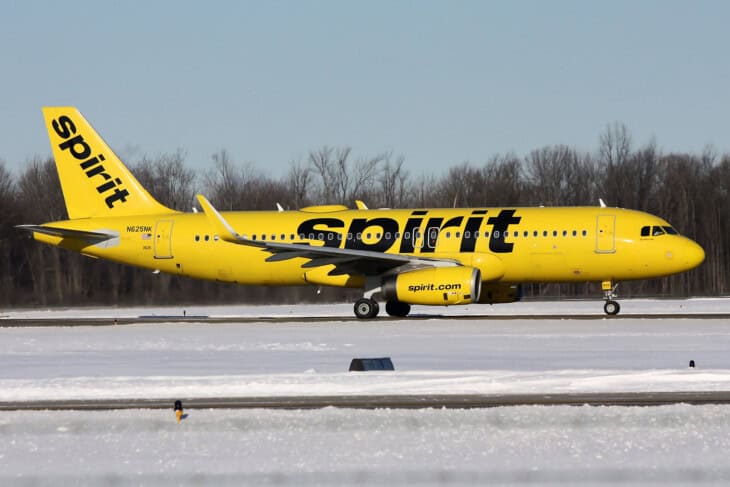
In a bankruptcy, claims get paid in a strict order. Secured creditors come first, unsecured creditors next, and shareholders are dead last. Shareholders are the residual owners: they get whatever is left after everyone else is made whole, which in a failing airline is usually nothing at all.
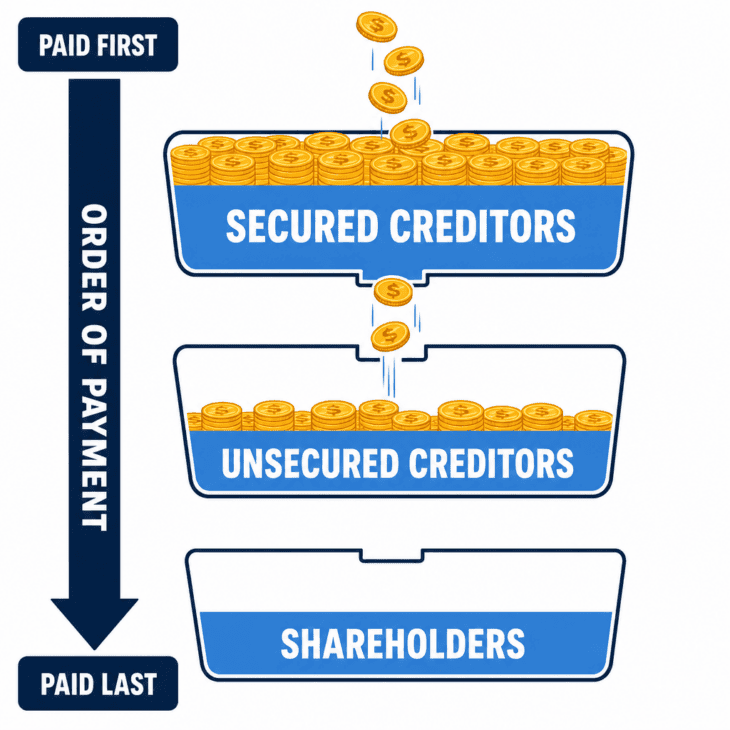
Spirit’s first Chapter 11 ran that playbook almost perfectly. The company equitized $795 million of funded debt, took $350 million of fresh equity investment from its existing bondholders and convertible noteholders, and issued them $840 million of new secured notes. It emerged on March 12, 2025.
The people who had lent Spirit money became the people who owned it. Reported holders of that new equity included PIMCO, Western Asset Management, AllianceBernstein, Arena Capital Advisors and the hedge fund Citadel. Everyone who had simply bought SAVE shares on the open market was wiped out, and the stock was gone from the NYSE.
Owning an airline can mean owning its debts
Spirit’s bondholders did not buy the airline in any normal sense. They converted $795 million of debt they were owed into shares, put in another $350 million of new money to keep it flying, and took $840 million of new secured notes. Five months after they became the owners, the company filed for bankruptcy again.
Why the Second Bankruptcy Ended in a Wind-Down
Spirit filed its second Chapter 11 on August 29, 2025, listing roughly $8.1 billion of debts against $8.6 billion of assets. Bankruptcy lawyers call a repeat filing like this a “Chapter 22,” and the joke is not affectionate: a company that fails twice usually has a cost problem no balance sheet can fix.
The plan was to shrink. Spirit began selling aircraft even before the end, and 20 Airbus jets, 13 A320s and seven A321s, went to CSDS Asset Management under a stalking-horse bid of $533.5 million. A smaller airline flying fewer, cheaper routes was supposed to survive.
It did not. Spirit filed a restructuring support agreement and a reorganization plan on March 13, 2026, then watched jet fuel prices climb through the spring. The company blamed the increase on the 2026 Iran war and said the ultra-low-cost model had become unsustainable at those prices.
An ultra-low-cost carrier has almost no margin to absorb a fuel shock, because its entire proposition is the lowest seat cost in the market. That is the same razor-thin arithmetic that pushes airlines into practices like deliberately overbooking flights, and Spirit had less room than anyone.
A last attempt at roughly $500 million in federal support went nowhere. Spirit stopped flying on May 2, 2026, after 34 years, cancelling every remaining flight overnight and telling passengers not to come to the airport. Counting contractors alongside its own staff, the shutdown cost around 17,000 jobs.
Six days later, on May 8, the court entered a wind-down order. That is the moment ownership stopped being a business question and became an auction schedule.
Who Owns the Pieces Now
Once a wind-down begins, an airline is no longer a single thing anyone can own. It becomes a list of separable assets, and each one goes to a different buyer.
| Asset | Buyer | Price | Date |
|---|---|---|---|
| 20 Airbus A320-family jets | CSDS Asset Management | $533.5 million (stalking-horse bid) | 2026, pre-shutdown |
| LaGuardia takeoff and landing slots | JetBlue | $58.5 million | July 2026 |
| Dania Beach headquarters campus | Hill City Capital | $93.25 million | August 13, 2026 |
| Internal corporate data | $10 million | August 17, 2026 |
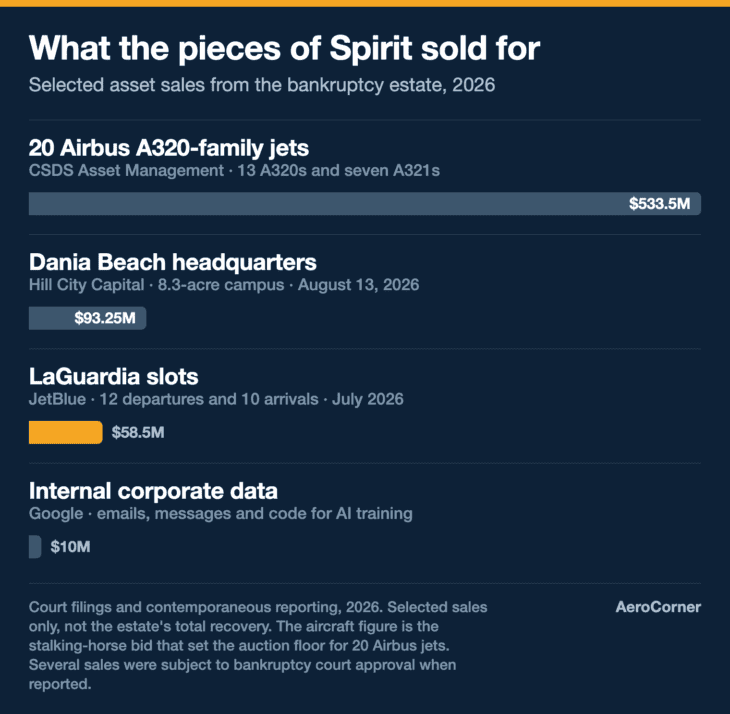
The LaGuardia sale is the one that should stop you. JetBlue won 12 daily departure slots and 10 arrival slots on July 20, 2026, bidding $58.5 million and edging out Frontier at $57.5 million.
Slots are permission to use a runway at a congested airport at a specific time, and at a capacity-controlled field like LaGuardia they are among the most valuable things an airline holds. They are also a reminder that an airport’s scarce capacity is an asset in its own right, which is part of how airports actually make their money.
JetBlue got the piece it wanted, two years late
A federal judge blocked JetBlue from buying Spirit Airlines for about $3.8 billion in January 2024. In July 2026 JetBlue bought Spirit’s LaGuardia slots out of the bankruptcy estate for $58.5 million, and said it was evaluating up to 12 added LaGuardia round trips for 2027.
The strangest sale is the least physical one. Google paid $10 million on August 17, 2026, for Spirit’s internal corporate data, beating a $7.5 million counterbid, and acquired roughly 100 million company emails, hundreds of millions of Teams messages and about 30 million lines of code to train AI models on.
We covered that sale in detail when it happened, including the flight attendants’ union objection over personal data, in our report on Google’s $10 million purchase of Spirit’s internal records. A dead airline’s paperwork turned out to be worth real money to somebody who has never sold a plane ticket.
Who Is Even Allowed to Own a US Airline
There is a constraint hanging over all of this that most passengers never think about. A US airline cannot be owned by just anyone with the money.
Federal law caps foreign ownership of a US carrier’s voting stock at 25 percent, and requires that the airline actually be under the control of US citizens. Longstanding Department of Transportation practice allows total foreign equity, voting and non-voting combined, to reach 49 percent.
The 49 percent figure is an administrative practice rather than a safe harbor, and the DOT looks past the percentages to a separate question: who actually controls the airline.
A foreign investor holding well under 25 percent of the votes can still be found to have real control. A stake approaching half the equity can carry almost no influence at all.
This is why no overseas carrier appeared with a checkbook to save Spirit. Foreign money can help fund a US airline, but it cannot buy one outright and run it, which narrows the list of possible rescuers considerably.
The Myth: Someone Will Buy Spirit and Bring It Back
The misconception
That because the Spirit name and its trademarks still exist and can be sold, a buyer could acquire the brand and relaunch the airline more or less as it was. Brands are the cheapest part of an airline and the least useful on their own.
An airline is not a logo. It is an air carrier certificate, a fleet, a maintenance organization, trained crews, gates, slots, and the operating approvals that took decades to accumulate. Spirit’s estate has been selling those components separately to different buyers for months.
The jets went to an asset manager. The LaGuardia slots went to a competitor who is planning to fly them itself.
The headquarters went to a hedge fund. The crews took jobs elsewhere the week the flying stopped.
Someone could certainly buy the name and paint it on aircraft. That would be a new airline wearing an old brand, which has happened before in this industry, and it would have to build every one of those components again from scratch.
The second misconception is subtler. A Chapter 11 filing is not automatically a rescue, and a Chapter 7 is not the only route to liquidation.
Spirit never converted to Chapter 7. It liquidated inside its Chapter 11 case under a wind-down order, which is why the case number from August 2025 is still the one on the filings that sold its buildings in 2026.
So the next time someone asks who owns Spirit Airlines, the accurate answer is that ownership ran out. Private equity built it, the public market held it, a merger was blocked, bondholders inherited it, and a court now supervises the sale of what is left.
The yellow building in Dania Beach has a new owner. Almost everything else that was Spirit has one too, and none of them are the same person.
Sources and references used for research and fact-checking.
- Wikipedia, Spirit Airlines
- Chapter11Cases.com, From Reorganization to Wind-Down: Spirit Airlines Moves to Auction Its Remaining Assets
- ch-aviation, Citadel among Spirit Airlines bondholders entering ownership
- American Journal of Transportation, JetBlue wins auction for Spirit's LaGuardia flight slots
- Simple Flying, Spirit's HQ Sells For $93M And The Highest Bid Lost
- U.S. Government Accountability Office, U.S. Airlines: Information on DOT's Oversight of and Stakeholders' Perspectives on Foreign Ownership
Get the Newsletter
The latest aviation news and stories sent to your inbox.
About the Author

Tim is the owner and lead editor of AeroCorner since 2019, overseeing aviation content covering aircraft, airlines, airports, and the broader aviation industry. Through years of researching, writing, editing, and publishing aviation-focused content, he has developed extensive practical knowledge of commercial aviation and air travel. Based in Asia and a frequent traveler himself, Tim also brings firsthand passenger experience to AeroCorner’s coverage. Outside of publishing, he has also explored aviation firsthand through hands-on flight training in New Zealand.