

Table of Contents
You booked your ticket three months ago for $280 and felt pleased about it. The person in the seat next to you, you discover mid-flight, paid $490 for theirs last week. Behind you, someone booked six weeks ago for $195. The row in front has two people who each paid $340 on the same day. All of you are in economy class on the same aircraft, heading to the same place at the same time.
The variation is not random and it is not an error. It is the output of one of the most sophisticated pricing systems in any consumer industry, one that has been continuously refined since American Airlines first deployed it in the 1980s to fend off the newly deregulated low-cost carriers that were threatening to undercut them out of business. The system is built on a single insight: different passengers are willing to pay different amounts for the same seat, and the airline’s job is to extract as much of that willingness as possible, one booking at a time.
Understanding how it works does not make the price differences less surprising, but it does explain why they exist, why ticket prices generally rise rather than fall as the departure date approaches, and why the middle seat in row 28 is sometimes the last thing on the plane to sell.
How fare buckets work
When an airline puts a flight on sale, it does not list a single price. It creates a stack of fare buckets, each one assigned a booking class code and a price point. A typical narrow-body domestic flight might have anywhere from 10 to 26 distinct fare classes in economy alone, ranging from the cheapest promotional fares at the bottom to the most expensive fully flexible fares at the top. These codes are invisible to most passengers: booking systems show a price, but behind it is a code like Q, K, M, B, or Y that determines exactly what the passenger has bought and at what rate the airline is crediting the revenue.
The Revenue Management System, the software at the heart of airline pricing, controls how many seats are allocated to each fare bucket and when those allocations open and close. When a flight first goes on sale, some number of seats are released into the cheapest bucket. As those sell, the bucket closes and the next one up opens. The physical seat does not change. The price does. The system is tracking the pace at which bookings are arriving and comparing it to the forecast the airline built for that route and date. If bookings are arriving faster than expected, the cheaper buckets close sooner and prices rise. If they are arriving more slowly, cheaper inventory stays open longer or is released again from a higher bucket at a discount to stimulate demand.
The metric that ties all of this together is PRASM, or Passenger Revenue per Available Seat Mile. Every seat on every flight represents one available seat mile for each mile it travels. An empty seat generates zero revenue but still costs the airline nearly as much as a full one, because the fixed costs of operating the flight, crew, fuel, aircraft ownership, landing fees, are incurred regardless of how many people are sitting down. The revenue management system is constantly optimising toward a point where load factor (how full the plane is) and yield (average fare per seat) produce the highest possible PRASM. Filling the plane cheaply is not the goal. Neither is charging high prices for an empty aircraft. The goal is the right combination of both.
The two passengers airlines are pricing for
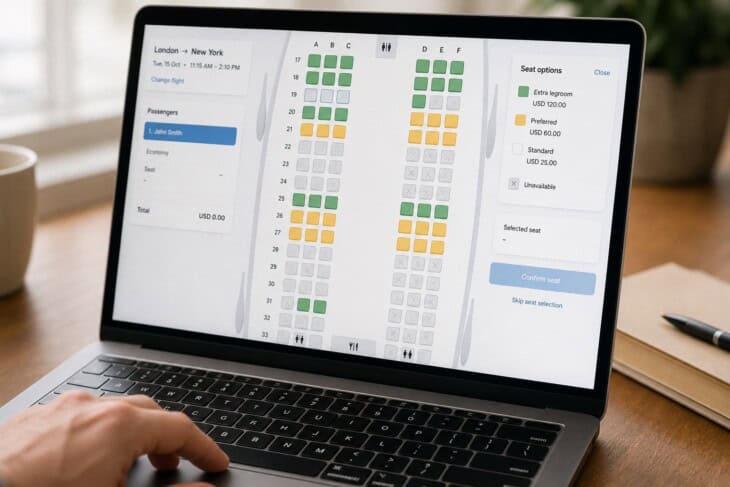
The entire logic of airline yield management rests on a distinction that most passengers never think about: the difference between a leisure traveller and a business traveller, not as categories of person but as categories of demand. Leisure travellers, in the revenue management model, are price-sensitive, plan ahead, and have flexibility. If the fare to Miami in February is too high, they can go in March, or go somewhere else, or not go at all. Business travellers, at least those travelling for work with a corporate booking, are the opposite: they need to be in Chicago on Tuesday because the client is in Chicago on Tuesday, and the company is paying. They will book at whatever fare is available close to departure.
This distinction is why ticket prices almost always rise as the departure date approaches, rather than falling. The common intuition is that airlines should discount last-minute seats to fill an otherwise empty plane. The revenue management logic runs the other way: the passengers most likely to be booking in the final 48 to 72 hours are business travellers with tight schedules and someone else’s money. Lowering fares to fill those last seats would give a discount to the most price-insensitive buyers in the market, which is the opposite of what the system is trying to do. Airlines know from decades of booking data that for business-heavy routes, last-minute demand is real and it will pay. So the last seats on those flights are priced accordingly.
There are routes and departure dates where this logic breaks down: leisure-heavy holiday routes where business demand is thin, or flights that have simply not sold well. On those, prices can fall as departure approaches. But these are exceptions the system produces when the forecast was wrong, not a general policy of discounting unsold inventory. Airlines have also learned the hard way that training passengers to expect last-minute deals is dangerous. Once passengers believe that waiting produces cheaper fares, the booking curves change and the entire revenue management model has to adapt around the distortion.
Why the same seat can sell at a dozen prices
Fare buckets: Each economy cabin has 10 to 26 distinct fare classes, each at a different price, opening and closing as demand builds. Booking timing: Seats in lower buckets sell earliest; later buyers access progressively higher-priced inventory. Demand signals: If bookings arrive faster than forecast, the system closes cheap inventory early and protects seats for later high-fare buyers. Passenger type: The system is designed to charge leisure travellers the lowest price they will accept and business travellers close to the maximum they will pay. Pass-through costs: Fuel surcharges, airport taxes, and government fees are added to every fare and do not vary with demand. The pricing discretion sits entirely in the net base fare above these costs.

What happens when the maths doesn’t work out
One consequence of the revenue management system that most passengers find difficult to accept is overbooking. Airlines routinely sell more tickets for a flight than there are physical seats on the aircraft. This is not an oversight. It is a deliberate calculation based on historical no-show rates. On any given flight, a predictable percentage of passengers who hold confirmed bookings will not appear at the gate: they cancelled, missed a connection, rebooked, or simply did not show up. If the airline sold exactly as many tickets as there are seats, all those no-shows would produce empty, revenue-generating seats in the cabin. Overbooking fills them in advance. The Revenue Management System estimates the expected no-show rate for each flight, adjusts for the day of the week, route characteristics, and booking mix, and authorises the sale of a calculated number of extra seats accordingly.
When the model is right, the plane departs full. When it is wrong, more passengers arrive at the gate than the aircraft can carry. In that situation, the airline first asks for volunteers to take a later flight in exchange for compensation, typically a travel voucher and a confirmed rebooking. If not enough volunteers come forward, passengers can be denied boarding involuntarily, with compensation set by DOT regulations. Involuntary denied boarding affects a very small fraction of passengers, roughly 0.09 percent of travellers on US carriers in recent years. But when it happens, it is visible and it is the sharpest possible illustration of the gap between what the revenue management system optimises for and what the passenger experiences.
United Express Flight 3411, April 9, 2017
A United Express flight from Chicago O’Hare to Louisville had already boarded when the airline determined it needed to transport four crew members to Louisville for an operating assignment. With no volunteers willing to give up their seats for the offered compensation, a passenger, Dr. David Dao, was selected for involuntary removal and physically dragged from the aircraft by airport security after refusing to comply. The footage circulated globally within hours. United’s market capitalisation fell by roughly $1 billion in the days that followed, and the incident prompted the airline to change its policies on involuntary denied boarding and increase the maximum compensation offered to volunteers. It also triggered a broader public conversation about exactly what passengers have agreed to when they buy a ticket on an overbooked flight.
The seat next to you cost what it did because of when it sold, who was likely to be buying at that moment, and where the demand forecast sat relative to the available inventory. None of that is visible to the passenger at the time of purchase. What is visible is the price, which is the output of a system calibrated around decades of data about how people like you and the person next to you behave when buying flights. The system is not designed to be fair in any intuitive sense. It is designed to maximise what the airline earns from a fixed set of seats on a fixed schedule. Understanding that makes the price differences no less real, but somewhat less mysterious. For the bigger picture of how ticket revenue fits into the full operational machine behind every flight, the How Airlines Actually Work series covers everything from the fuel decision before departure to why a single delay can cascade through an entire day’s schedule.
FAQ
Sources and references used for research and fact-checking.
- Scarcity, Inventory, and Inequity: A Deep Dive into Airline Fare Buckets - GetJetBack Blog
- How Airline Pricing Works: Why Flight Prices Change - The Flying Engineer
- The Story of Airline Pricing Strategies - OAG
- Price Elasticities of Demand for Passenger Air Travel - Tinbergen Institute
- Airline Revenue Management Software: Maximizing Earnings Per Seat - AltexSoft
- Airline Finance Fundamentals: PRASM, CASM and More - DWU Consulting
- Bumping and Oversales - US Department of Transportation
- United Express Flight 3411 incident - Wikipedia
Get the Newsletter
The latest aviation news and stories sent to your inbox.
About the Author

Tim is the owner and lead editor of AeroCorner since 2019, overseeing aviation content covering aircraft, airlines, airports, and the broader aviation industry. Through years of researching, writing, editing, and publishing aviation-focused content, he has developed extensive practical knowledge of commercial aviation and air travel. Based in Asia and a frequent traveler himself, Tim also brings firsthand passenger experience to AeroCorner’s coverage. Outside of publishing, he has also explored aviation firsthand through hands-on flight training in New Zealand.