

Table of Contents
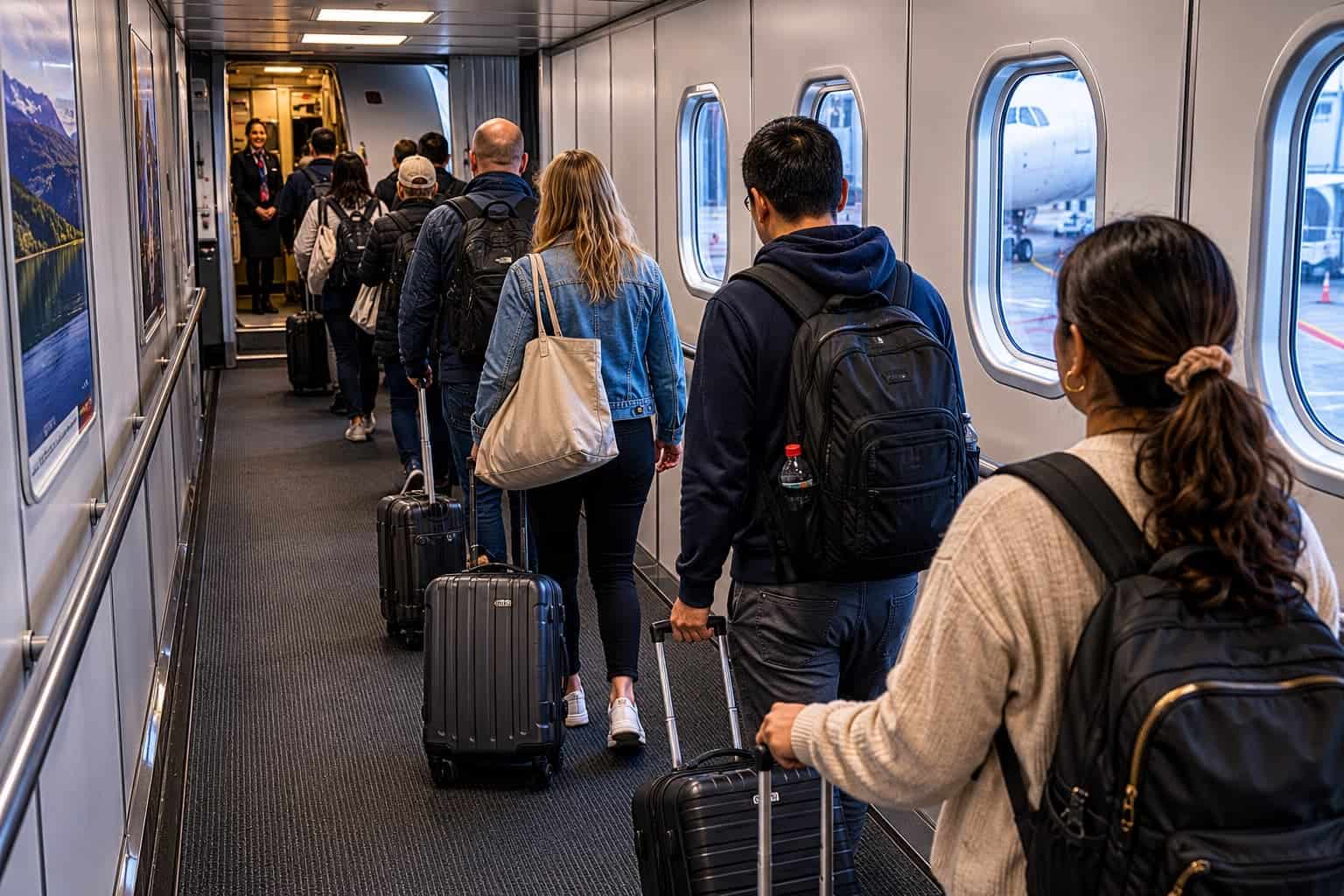
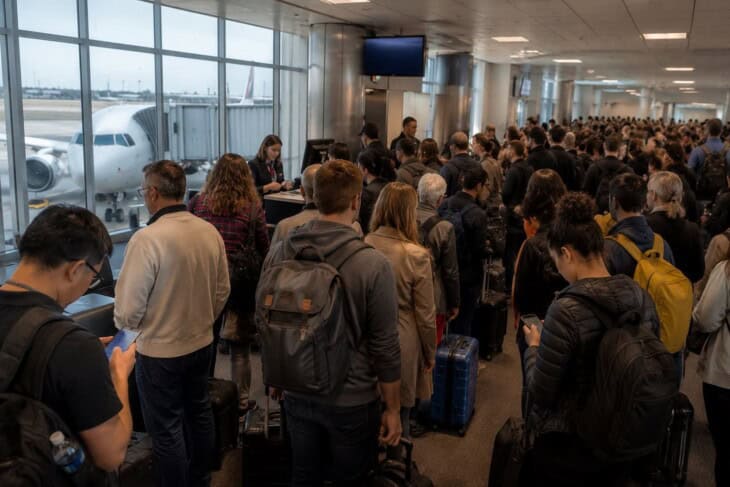
The gate agent announces Group 4. A crowd of about 50 people rises from their seats, shuffles toward the desk, and forms a loose, anxious mass by the door. This is Group 4 of 8. The plane seats 180 people. Somewhere inside it, two people are trying to fit a rolling suitcase into a bin designed for smaller bags, while a family of four negotiates overhead space across three different rows. The queue at the gate is barely moving.
Boarding a narrow-body aircraft typically takes between 25 and 45 minutes from the moment the first passenger steps through the door to the moment the last one sits down. For a process the airline repeats dozens of times a day, that number is strikingly hard to improve. Researchers have studied it. Physicists have modelled it. One astrophysicist spent years developing what he demonstrated was the mathematically optimal boarding sequence. Airlines have largely ignored all of it.
The reason boarding takes as long as it does has less to do with passengers being slow and more to do with a set of physical constraints that no amount of signage can fix, combined with commercial incentives that make the efficient option economically unattractive. Understanding both is the key to understanding why this particular problem persists despite everyone involved knowing it is a problem.
The bottleneck is the aisle, not the gate
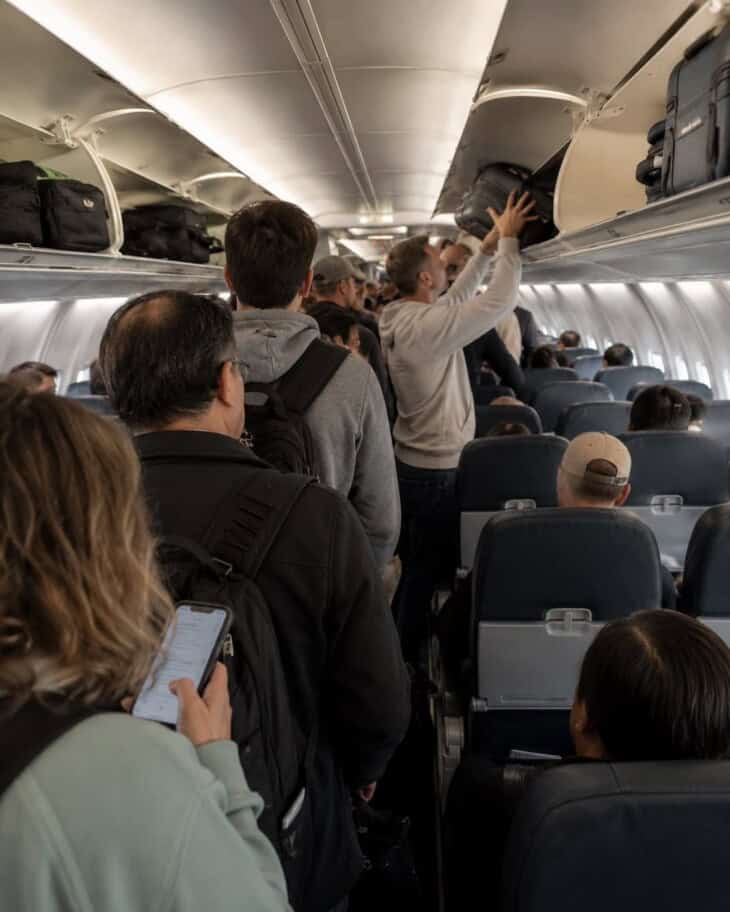
The fundamental problem with boarding a narrow-body aircraft is that the aisle is roughly 17 to 19 inches wide. One person fits. When that person stops to lift a bag overhead, the entire column of people behind them stops too. This is not a passenger behaviour problem. It is a geometry problem, and it is the dominant constraint in every boarding model researchers have tested.
The back-to-front boarding sequence that many carriers use, or have used at some point, seems logical on paper: fill the back rows first, then work forward, so nobody is climbing over seated passengers. In practice, it reliably underperforms almost every alternative. The reason is that boarding groups from the same section of the plane all arrive at roughly the same time, creating a cluster of people simultaneously reaching for overhead bins in adjacent rows. The aisle jams. Back-to-front essentially guarantees the worst version of the geometry problem by concentrating the bag-stowing activity instead of spreading it out.
The overhead bin competition makes the geometry problem worse. Most passengers on a full flight are worried about running out of bin space, because on a full flight there genuinely might not be enough. That fear drives two behaviours that slow boarding down: arriving at the gate as early as possible to board with the first group, and stopping at the first available bin rather than continuing to a seat. The first behaviour creates the gate crowd. The second creates the aisle jam. Both are rational responses to a real scarcity, which is why gate agents asking people to move down the aisle rarely works.
What research actually says about faster boarding
In 2008, Jason Steffen, then a physicist at Fermilab, applied a Markov Chain Monte Carlo optimisation algorithm to the boarding problem and published the results in the Journal of Air Transport Management. His conclusion was that the optimal boarding sequence loads passengers in a specific interleaved pattern: window seat passengers in odd-numbered rows first, then window seat passengers in even-numbered rows, then the same pattern for middle seats, then aisle seats. The logic is that by spacing passengers two rows apart, nobody is ever waiting directly behind someone stowing a bag. Multiple rows load simultaneously instead of in sequence.
Steffen later ran a real-world test with volunteers at a film studio in Nevada and confirmed the simulation results. His method was roughly twice as fast as back-to-front boarding and about 20 to 30 percent faster than random boarding. A simplified version of the same logic, called the WILMA method, loads all window seat passengers first, then middle seats, then aisle seats. It does not achieve the same level of efficiency as the full Steffen sequence, but it is substantially faster than back-to-front and considerably simpler to manage at the gate. United Airlines adopted a version of WILMA for some of its operations.
One of the more counterintuitive findings from boarding research is that completely random boarding, in which passengers board in whatever order they happen to arrive, is typically faster than back-to-front block boarding. The reason is the same geometry logic in reverse: random order naturally distributes bag-stowing activity along the length of the aisle rather than concentrating it in one section. Passengers end up further apart from each other on average, which reduces the number of aisle jams per boarding cycle.
Boarding methods compared
Steffen method: Interleaved window-then-middle-then-aisle, odd rows before even rows. Fastest in research; never adopted commercially. WILMA (window-middle-aisle): All window seats first, then middle, then aisle. A practical simplification; meaningfully faster than back-to-front. Random boarding: No assigned group order. Surprisingly fast in studies, faster than back-to-front, because it naturally spreads aisle activity. Back-to-front: The most common intuitive approach. Among the slowest in research, because it concentrates bag-stowing in one section of the aisle at a time.
Why the efficient option is commercially unattractive
If the research on faster boarding has been available since at least 2008, the obvious question is why most airlines have not changed their approach. The answer, as one aviation academic summarised it, is that airlines figured out they could make money from bags, and that discovery killed any incentive toward boarding efficiency. The full story is a bit more layered than that, but the core is accurate: the commercial structure of modern airline boarding works directly against the operational one.
Premium boarding, whether for business class passengers, frequent flyers, or credit card holders, puts passengers at the front of the aircraft onto the plane first. Operationally, this is close to the worst possible sequence: the people boarding early are seated near the front, which means everyone who boards after them has to walk past occupied rows in the forward cabin to reach their seats further back. Every passing minute adds more people to the aisle while those already seated wait. But premium early boarding is not primarily an operational feature. It is a product. It is sold as a benefit with credit cards, elite status programmes, and premium fare classes. Taking it away, or reversing the sequence so premium passengers board last, would require airlines to reclassify something people are paying for as something they no longer receive.
The proliferation of boarding groups compounds this. Some carriers now have eight or nine boarding groups on a single flight, with each group representing a tier of loyalty status, fare class, seat type, or purchased upgrade. The more groups there are, the more the gate becomes a status sorting exercise and the less it functions as a boarding sequence optimised for filling an aircraft. Each new group announced over the PA creates a new surge toward the desk, regardless of whether passengers in that group are actually ready or positioned to board efficiently.
Airlines also start boarding earlier than strictly necessary, typically 30 to 45 minutes before departure for a narrow-body flight. Part of this is genuine operational buffer. The aircraft needs to be ready to push back on time, and the cost of a late departure is real: a missed slot, a cascade of downstream delays, and penalties for extended gate occupation. But part of it is simply padding. An aircraft that appears to be boarding for 40 minutes looks busier and more controlled than one that boards in 20. Gate agents benefit from more time to manage exceptions, last-minute check-ins, and bag checks. The extended boarding window is not evidence that boarding needs to take that long. It is evidence that airlines have decided not to treat reducing boarding time as a priority worth the commercial trade-offs.
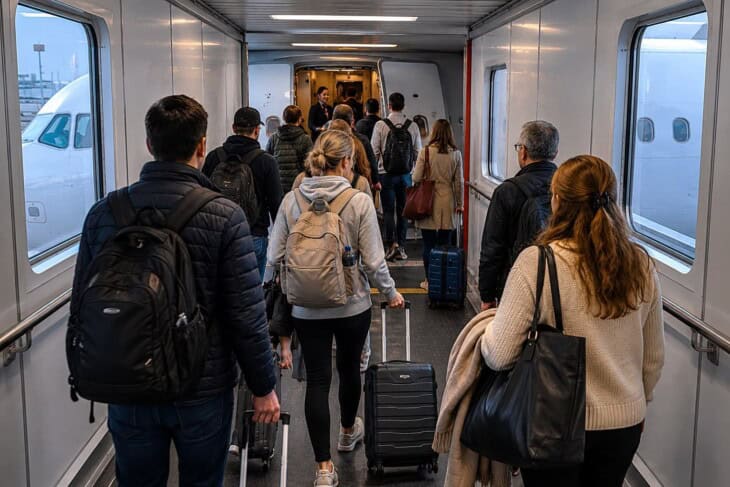
The next time you are standing in a gate crowd watching Group 7 be called and wondering why none of this has been fixed, the honest answer is that the people running the airline know what you know. The research is not a secret. The physics are not disputed. Boarding is slow because the faster alternatives would require giving up something more valuable to the airline than the minutes saved. Boarding is also, from an operational standpoint, only one piece of a much larger clock: to see how it fits into the full sequence of tasks an aircraft completes at the gate, the article on the 45-minute aircraft turnaround lays that out in detail. For the broader picture of how delays propagate when any one piece of that clock runs late, why flights get delayed explains the cascade. Both are part of the How Airlines Actually Work series.
FAQ
Sources and references used for research and fact-checking.
- Optimal boarding method for airline passengers (preprint) - arXiv
- Experimental test of airplane boarding methods - ScienceDirect / Journal of Air Transport Management
- There Are Quicker Ways to Board a Plane — So Why Don't Airlines Use Them? - Scientific American
- Airlines Know How To Speed Up Boarding — But They're Choosing Not To - View from the Wing
- Here's Why the Airlines Won't Adopt the Best Way to Board Passengers - Medium / WhereFlight
- Airlines Do Priority Boarding All Wrong - View from the Wing
- In Reality: How Different Are Narrowbodies' Actual Turnaround Times? - Simple Flying
Get the Newsletter
The latest aviation news and stories sent to your inbox.
About the Author

Tim is the owner and lead editor of AeroCorner since 2019, overseeing aviation content covering aircraft, airlines, airports, and the broader aviation industry. Through years of researching, writing, editing, and publishing aviation-focused content, he has developed extensive practical knowledge of commercial aviation and air travel. Based in Asia and a frequent traveler himself, Tim also brings firsthand passenger experience to AeroCorner’s coverage. Outside of publishing, he has also explored aviation firsthand through hands-on flight training in New Zealand.