


Table of Contents
You arrive at the gate, find your seat, and a few hours later you land somewhere else. The whole experience is so routine for frequent flyers that it can feel almost automatic. But the flight you just took was the product of hundreds of coordinated decisions made by people you never saw, governed by regulations most passengers have never heard of, running on systems that were adjusting in real time from the moment the aircraft landed on its previous sector. The visible part of commercial aviation, the check-in desk, the boarding call, the seat-back screen, is a thin layer over something considerably more complex.
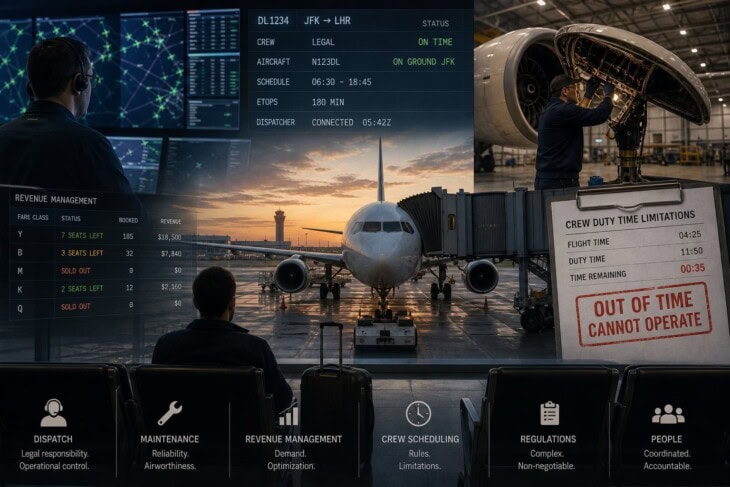
This series is about what lies beneath that layer. Not how aircraft fly, but how airlines run. The dispatcher who legally shares responsibility for your flight with the captain. The maintenance team working through the night to clear a fault before the 6am departure. The revenue management system that sold the seat next to you at a different price than yours. The rest rules that can cancel a flight in the final hour because a clock ran out. These are the systems, the people, and the decisions that determine whether your flight departs on time, diverts to an unplanned airport, or does not go at all.
The series covers ten aspects of airline operations, each one anchored in a question passengers actually ask and written for curious travellers rather than aviation professionals. Every article starts from something you have experienced as a passenger and explains the operational reality behind it.
What this series covers
10 articles on the decisions, systems, and people that keep commercial flights running — written for curious passengers, not aviation professionals.
The moving parts behind a single flight
Take any scheduled commercial flight and trace back what had to happen before it departed. The aircraft itself was inspected overnight by a line maintenance team working through a required daily check, clearing any deferred faults from the previous day’s flying against a regulated list of what is and is not allowed to be unresolved. A dispatcher on the ground built the flight plan, filed it with air traffic control, calculated the fuel load in consultation with the captain, and named at least one alternate airport in case the destination became unavailable. A crew scheduling team verified that every pilot and cabin crew member on the flight had received the legally required rest since their last duty period ended, and that their cumulative hours for the week and month sat within federal limits. The aircraft was cleaned, catered, refuelled, loaded with bags, and repositioned to the gate on a turnaround timeline that accounted for every task in sequence.
All of that happened before the first passenger scanned their boarding pass. And once boarding began, the gate agents, the ground crew, the operations centre, and the air traffic system were all tracking a departure time that, if missed, could cascade delays across the rest of that aircraft’s flying day. Commercial aviation is one of the most time-sensitive and operationally dense industries in existence. It is also remarkably reliable, operating tens of thousands of flights a day with a safety record that is genuinely extraordinary by any historical standard. The reason it works is that nearly every scenario has a procedure, every rule has a regulator, and every person in the system knows exactly where their responsibility begins and ends.
What this series covers
The series begins with the aircraft itself. What Happens to Your Aircraft the Night Before You Fly follows the maintenance team through a night-stop check, explaining what a line maintenance crew actually looks for, what gets deferred, and what has to be resolved before the aircraft flies again. The connection between overnight maintenance and what crews are legally permitted to defer is covered in The MEL: How Airlines Legally Fly Aircraft with Broken Equipment, which explains the Master Equipment List, how a technical fault gets placarded and deferred rather than immediately fixed, and why this is a designed safety feature rather than a shortcut. The choreography of getting an aircraft back in the air once it lands, from deplaning through refuelling to boarding a new set of passengers, is the subject of The 45-Minute Miracle: How Airlines Turn an Aircraft Around.
The planning and decision-making that sits behind every departure is covered in three articles. The Person Who Actually Plans Your Flight: Meet the Airline Dispatcher introduces a role most passengers have never heard of: the dispatcher who legally shares operational control of your flight with the captain, files the flight plan, monitors the aircraft throughout the trip, and coordinates any in-flight changes from the ground. Why Planes Carry More Fuel Than They Need explains how the fuel load is calculated, what the different categories of reserve fuel are for, and what a “minimum fuel” declaration to air traffic control actually means. Why a Crew Issue Can Cancel Your Flight: Rest Rules Explained covers FAR Part 117, the 2014 federal regulations that govern exactly how long pilots and cabin crew can work before they must rest, why those limits are built around the science of fatigue rather than the convenience of the schedule, and how a clock that started ticking at check-in can run out before the last flight of the day ever departs.
Three articles cover what happens when the system is under pressure. Why Flights Get Delayed — and Why One Delay Creates More explains the mechanics of the delay cascade: how a single late inbound aircraft can disrupt an afternoon’s worth of departures across an entire hub, and why the schedule is structurally more fragile than it appears. What Actually Happens When a Flight Diverts walks through the decision to land at an unplanned airport, who makes it, how alternate airports are selected before departure, and what the hours after landing at a small regional airport at midnight actually look like for 180 passengers and a crew approaching the end of their duty day. And for the specific species of disruption that results in no flight at all, the crew rest article above explains how timing out works in practice.
The final two articles look at the passenger experience from the inside. Why Does Boarding Take So Long explains the geometry of the aircraft aisle, what research has shown about faster boarding methods, and why airlines have largely chosen not to adopt them. Why the Seat Next to You Cost Twice What You Paid is the closest thing the series has to an economics lesson: how fare buckets work, why the same seat on the same flight can sell at a dozen different prices, and why buying a ticket at the last minute almost always costs more rather than less.
Where to start
If you have just come off a delayed or disrupted flight and want to understand what actually happened, start with the delay cascade article or the diversion piece. If you are curious about the people running the operation before the aircraft ever leaves the gate, the dispatcher article is the best entry point. If you want to understand the aircraft itself, begin with the overnight maintenance article and follow the thread through to the turnaround. Any article stands on its own, but they are written to connect, and most of them end by pointing toward the next natural question.
The goal of the series is the same across all ten articles: to take something you have experienced as a passenger and show you the operational reality behind it. Commercial aviation is full of moments that seem arbitrary, frustrating, or opaque from the cabin. Almost none of them are. Start with the dispatcher, and see what you never knew was happening.
Get the Newsletter
The latest aviation news and stories sent to your inbox.
About the Author

Tim is the owner and lead editor of AeroCorner since 2019, overseeing aviation content covering aircraft, airlines, airports, and the broader aviation industry. Through years of researching, writing, editing, and publishing aviation-focused content, he has developed extensive practical knowledge of commercial aviation and air travel. Based in Asia and a frequent traveler himself, Tim also brings firsthand passenger experience to AeroCorner’s coverage. Outside of publishing, he has also explored aviation firsthand through hands-on flight training in New Zealand.