

Table of Contents
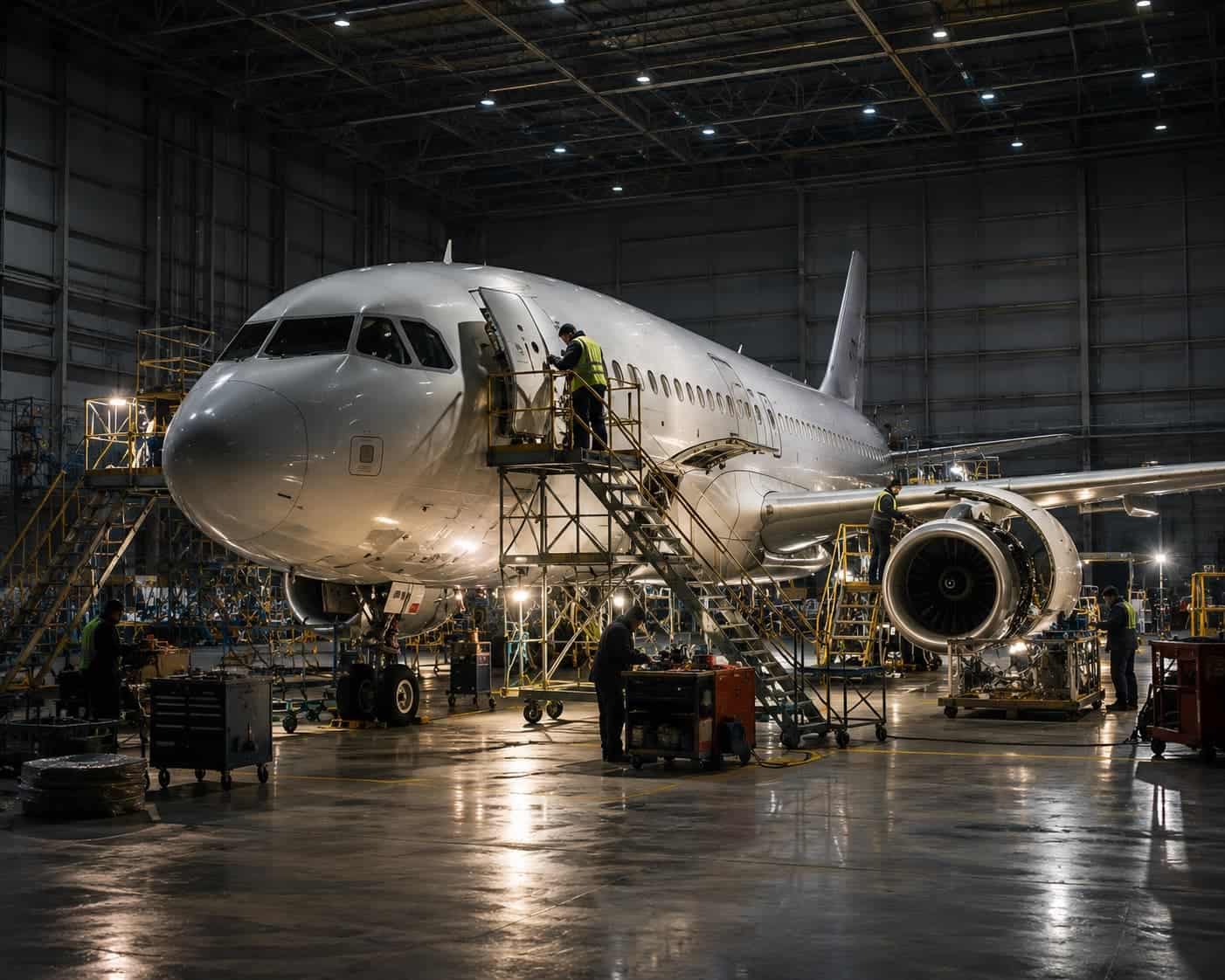
Your 6am flight boards at 5:40. The aircraft has been sitting at the gate since just after 11pm, when the inbound crew shut down the engines and handed over the paperwork. Seven hours have passed. In that time, the cabin lights have been off, the jet bridge has been retracted, and the ramp outside has been mostly quiet. It would be easy to assume that nothing happened: the aircraft sat, waited, and is now ready to fly again.
That assumption is wrong. Before that aircraft is legally permitted to carry passengers, a licensed maintenance engineer must sign their name to a document certifying it as airworthy. That signature cannot come from a walk-past. It follows a structured inspection that the airline is required by law to perform, a review of every defect the previous crew logged, and a check of the aircraft’s systems, fluids, and structure. On some nights, it also follows several hours of unscheduled repair work, a phone call to a maintenance controller, and a decision about whether the morning departure is going to happen at all.
This article explains what airlines actually do to their aircraft overnight: the inspection types, the people who perform them, the records that govern every finding, and what happens when something goes wrong in the middle of the night with a full load of passengers booked for the morning.
A commercial aircraft does not rest much
To understand what happens overnight, it helps to understand what happens during the day. A narrow-body aircraft on a short-haul network — the kind of Boeing 737 or Airbus A320 doing domestic routes — typically flies between eight and fourteen hours each day, spread across four to eight individual flights. It leaves its base in the morning, cycles through a sequence of airports and back, and eventually stops somewhere for the night. That final stop is called the RON station — the Remain Overnight location.
Where an aircraft RONs is not random. Airlines plan their overnight positions carefully, because not every airport on their network has maintenance engineers, spare parts, or the facilities to deal with a problem. Large hubs — the airline’s main operating bases — typically have full line maintenance teams working through the night. Outstations, the smaller spoke airports at the edges of the network, may have a contract engineer on call or a limited maintenance presence capable only of clearing logged defects. Some very small stations have no maintenance coverage at all overnight, and an aircraft that develops a problem there faces a tow or a ferry flight to somewhere equipped to fix it.
Airlines factor this into scheduling. An aircraft that is approaching a significant maintenance interval will be routed to a hub where the work can be done. An aircraft with known deferred items that need attention will be directed to a station where a mechanic is available. Maintenance planning and flight scheduling are intertwined — the schedule is not just about connecting passengers to destinations, it is also about connecting aircraft to the facilities they need.
The overnight check: what gets inspected and who signs for it
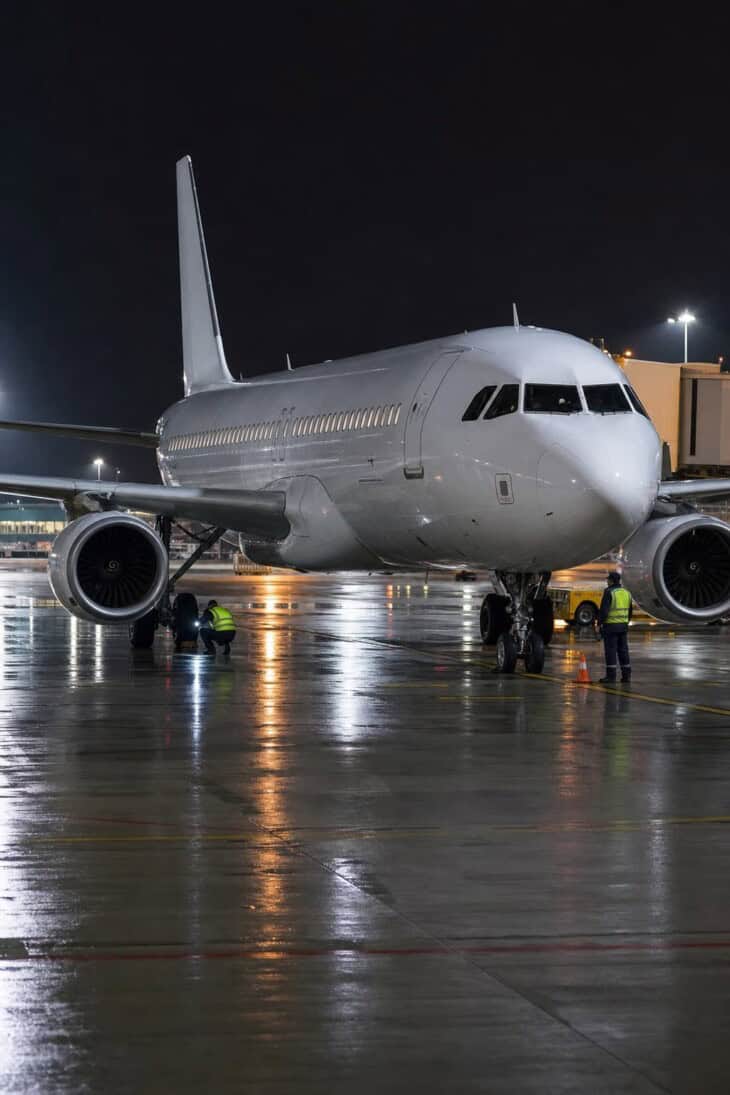
Every commercial aircraft operating under an airline’s approved maintenance programme is subject to a periodic check that must be completed within a certain number of flight hours or calendar days. The most frequent of these — known variously as a daily check, transit check, or overnight check depending on the airline — is typically required every 24 to 60 flight hours. For an aircraft flying eight hours a day, this means it receives this check every three to eight days at minimum. In practice, most airlines schedule it to coincide with the overnight RON, performing it during the window when the aircraft is not needed rather than taking it out of service during the day.
The overnight check is a line maintenance task: it is performed at the gate or on the ramp, not in a hangar, and it is designed to be completed in under an hour by a small team. It covers the items most likely to need attention after a day of flying: a walk-around of the exterior looking for obvious damage, fluid levels including engine oil and hydraulic fluid, brake wear indicators, tyre pressures and condition, lights, door seals, and a review of any entries in the aircraft technical log from that day’s flights. Nothing is taken apart. No deep inspection of structure or systems is performed at this stage. The purpose is to confirm that the aircraft is in a serviceable condition and that nothing has deteriorated since it last flew.
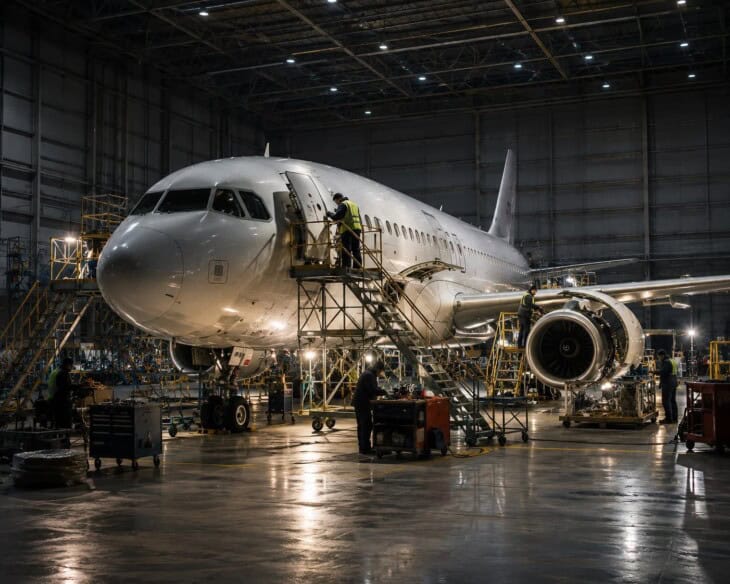
Every few hundred flight hours — typically 400 to 600 — the aircraft reaches an A-check interval, a more substantial overnight inspection that requires the aircraft to be in a hangar and takes a team of engineers somewhere between 10 and 70 man-hours to complete. An A-check goes further than the daily inspection: it includes lubrication of specified components such as landing gear actuators and flight control linkages, replacement of consumables like cabin air filters, a more thorough inspection of the airframe and engine exterior for corrosion or damage, and hydraulic fluid replenishment. For a narrow-body flying six sectors a day, the A-check interval arrives roughly every six to eight weeks. Airlines schedule it to happen overnight at a hub where hangar space and engineering support are available, aiming to return the aircraft to service in time for the first departure the following morning.
The maintenance check ladder
Daily / overnight check: Every 24 to 60 flight hours. Gate or ramp, under one hour. Covers walk-around, fluids, brakes, tyres, lights, log review. A-check: Every 400 to 600 flight hours. Overnight in a hangar, 10 to 70 man-hours. Covers lubrication, consumables replacement, more thorough structural and system inspection. C-check: Every 18 to 24 months, several thousand man-hours, typically contracted to a maintenance, repair, and overhaul (MRO) facility. The aircraft is out of service for one to two weeks. D-check / heavy maintenance visit: Every 6 to 12 years. The aircraft is stripped to the structure. Takes months.
Whatever the check type, the same regulatory requirement applies before the aircraft can fly again: a licenced maintenance engineer must sign an airworthiness release. Under US regulations, 14 CFR 121.709 requires an authorised person to certify — in writing, in the aircraft’s maintenance records — that the maintenance has been performed and the aircraft is in an airworthy condition. That signature is not a formality. It is a legal declaration that the person making it stands behind. Without it, the aircraft cannot depart.
The technical log: the aircraft’s running record
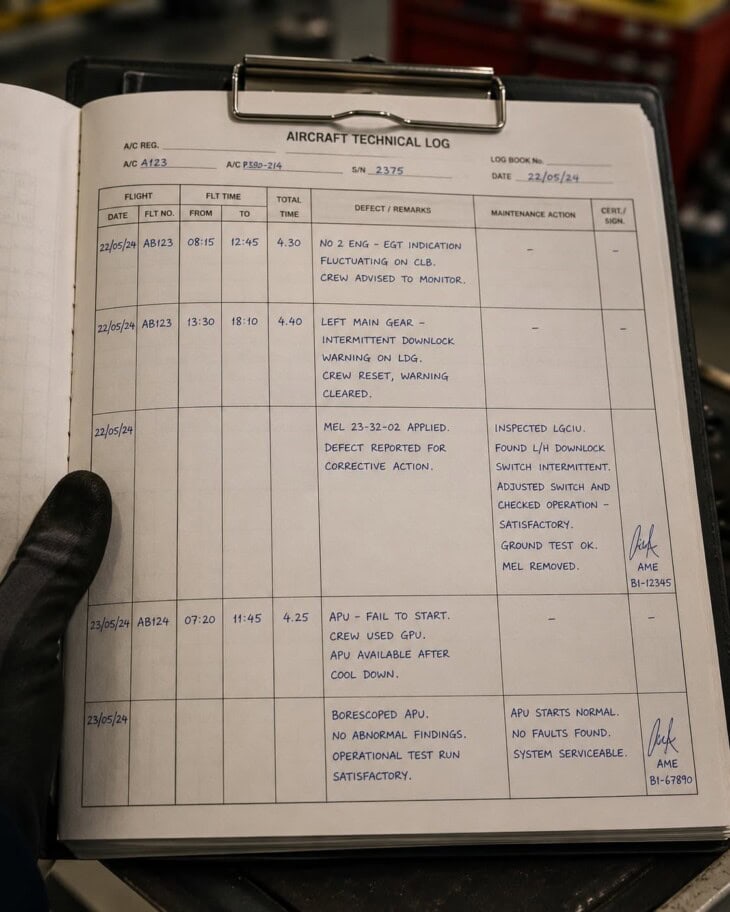
Every commercial aircraft carries an Aircraft Technical Log — a document that travels with the aircraft from flight to flight and records its condition in real time. At the end of every sector, the crew makes an entry: flight time, cycles, fuel, and any defects or irregularities observed during the flight. A defect entry — known in maintenance circles as a snag — is a formal notification that something on the aircraft is not functioning as it should. Once a snag is entered, the aircraft’s airworthiness is conditionally suspended: it cannot depart again until a licenced engineer has reviewed the entry and either fixed the problem or formally deferred it under the Minimum Equipment List.
The technical log is the primary document the overnight maintenance team works from. Before they begin the inspection, they review every open entry: what was reported, when, and whether any similar entry appears in the recent history of that aircraft. A one-off report of a minor cabin light failure gets different attention than the third consecutive entry reporting an intermittent hydraulic pressure fluctuation. Patterns in the log matter, and an experienced engineer reads them as much as the individual entries.
When a defect can be fixed overnight — a faulty component replaced, a system reset and tested, a fluid leak traced and repaired — the engineer performs the work, makes a detailed entry in the log describing what was done and which approved maintenance data was used, and signs the airworthiness release. When the defect cannot be fixed in the available time, or when the necessary part is not in stock at that station, the engineer consults the MEL to determine whether the item can be deferred. If it can, a placard is placed in the cockpit noting the inoperative item and any operational limitations that apply, and the aircraft can depart. The MEL and how its deferral categories work in detail is covered in The MEL: How Airlines Legally Fly Aircraft with Broken Equipment.
When the night does not go to plan
Most overnight maintenance windows are uneventful. The check is completed, the log is clear, the release is signed, and the aircraft is ready for the first departure without incident. But not always. A defect that cannot be deferred and requires a part not stocked at that station means the part has to be sourced and flown in — sometimes from the airline’s main maintenance base, sometimes from the manufacturer’s regional support centre. A fault that presents clearly during the inspection but cannot be reproduced during testing is one of the most difficult situations a maintenance engineer faces: they cannot sign an airworthiness release for a problem they cannot confirm has been fixed, but they also cannot indefinitely hold an aircraft for a fault they cannot find. These decisions are escalated to a maintenance control centre — typically a 24-hour facility at the airline’s hub — where more experienced engineers, access to deeper technical documentation, and visibility of the whole fleet’s status allow a more informed call to be made.
When the morning departure cannot happen — when the defect is serious enough, or the fix has run out of time — operations control is notified and the process of dealing with the consequences begins. The passengers booked on that flight may be rebooked, or a spare aircraft may be repositioned if one is available. Airlines at major hubs typically maintain a small number of spare aircraft precisely for this situation. At outstations, the options are more limited, and a technical cancellation is more likely to result in a delay rather than a seamless substitution.
Alaska Airlines Flight 261, 31 January 2000
Alaska Airlines Flight 261, an MD-83 operating from Puerto Vallarta to Seattle, crashed into the Pacific Ocean off the California coast, killing all 88 people on board. The NTSB determined the probable cause was a loss of pitch control due to the catastrophic failure of the horizontal stabiliser jackscrew assembly — the result of severe wear caused by inadequate lubrication and, critically, by Alaska Airlines extending the approved lubrication inspection interval from 300 to 2,550 flight hours without adequate engineering justification. The jackscrew was one of the specific components required to be lubricated during routine scheduled maintenance. The accident remains one of the clearest examples in commercial aviation of what happens when scheduled maintenance intervals are treated as targets to optimise rather than limits to respect.
For passengers, the overnight maintenance cycle is almost entirely invisible. The aircraft at the gate in the morning looks the same as it did the night before. What is different is the technical log entry, the signed airworthiness release, and the fact that someone who is professionally and legally accountable for the aircraft’s condition has reviewed it, checked it, and put their name to it. That is what the overnight is for.
To understand the maintenance deferral system in more detail — how the MEL defines what can be deferred and for how long — see The MEL: How Airlines Legally Fly Aircraft with Broken Equipment. For what happens to an aircraft during the turnaround between flights — the much shorter window when the crew changes and the next load of passengers boards — see The 45-Minute Miracle: How Airlines Turn an Aircraft Around. Both are part of How Airlines Actually Work.
FAQ
Sources and references used for research and fact-checking.
- Aircraft Maintenance Checks - Wikipedia
- 14 CFR Part 121 Subpart L — Maintenance, Preventive Maintenance, and Alterations - Electronic Code of Federal Regulations (eCFR)
- 14 CFR § 121.709 — Airworthiness Release or Aircraft Log Entry - Legal Information Institute / Cornell Law
- AC 120-16F — Air Carrier Maintenance Programs - Federal Aviation Administration
- The Different Types of Aviation Maintenance Checks - National Aviation Academy
- Careful Process: How Often Aircraft Are Maintained - Simple Flying
- Acceptable Deferred Defect - SKYbrary
- The Ultimate Guide to the Aircraft Technical Logbook (ATL) - AviationHunt
- How Do Airlines Manage Maintenance Inspections at the Spokes? - Airliners.net forum
- Alaska Airlines Flight 261 — NTSB Accident Report AAR-02/01 - National Transportation Safety Board
Get the Newsletter
The latest aviation news and stories sent to your inbox.
About the Author

Tim is the owner and lead editor of AeroCorner since 2019, overseeing aviation content covering aircraft, airlines, airports, and the broader aviation industry. Through years of researching, writing, editing, and publishing aviation-focused content, he has developed extensive practical knowledge of commercial aviation and air travel. Based in Asia and a frequent traveler himself, Tim also brings firsthand passenger experience to AeroCorner’s coverage. Outside of publishing, he has also explored aviation firsthand through hands-on flight training in New Zealand.