


Table of Contents
You are at the gate when the ground agent makes an announcement: there is a “minor maintenance item” being addressed, and departure will be slightly delayed. Twenty minutes later you board, and a small printed notice in the seat pocket mentions that the in-seat entertainment screen in your row is inoperative. The aircraft takes off anyway. A few weeks later, on a different flight, the captain comes on the PA to let you know that one of the aircraft’s weather radar systems is showing as inoperative, but that this is permitted under the aircraft’s maintenance documentation and does not affect the safety of the flight.
Both of these situations are governed by the same document: the Minimum Equipment List, known universally in the airline industry as the MEL. The MEL is a legally approved catalogue of every item of equipment on a specific aircraft type that may be inoperative at the time of departure while still meeting the airworthiness requirements for flight. It tells the airline which items can be broken, for how long, and under what conditions — and by extension, it defines the boundary between an aircraft that can legally depart and one that must stay on the ground until a repair is made.
Understanding the MEL is understanding one of the fundamental tensions in commercial aviation operations: the pressure to keep aircraft flying against the regulatory requirement to keep them safe. The MEL is the mechanism that manages that tension. This article explains where it comes from, how it works in practice, and where its limits are.
Where the MEL comes from
Every commercial aircraft type has a Master Minimum Equipment List — the MMEL — developed jointly by the aircraft manufacturer and the FAA. The MMEL is the foundational document: it covers all possible equipment configurations for that aircraft type across all operators globally, and it sets the outer boundary of what is permissible. No individual airline can deviate from it to be less restrictive. The MMEL for a Boeing 737 is not the same document as the MEL for United Airlines’ 737 fleet, or American’s, or Southwest’s. It is the template from which each airline builds its own.
Each airline takes the MMEL for the aircraft types it operates and derives its own MEL: a document tailored to its specific fleet configuration, its operational environment, and the routes it flies. An airline operating only domestic routes may have different MEL provisions from one flying transoceanic ETOPS (Extended-range Twin-engine Operational Performance Standards) routes, because the consequences of an equipment failure are different when the nearest airport is six hours away. Once an airline’s MEL is complete, it must be submitted to the FAA for approval before it can be used operationally. The approved MEL is then part of the airline’s operations specifications — the legal framework under which it is permitted to fly.
The MEL covers only items for which relief has been granted through the MMEL process. If an item is not listed in the MEL, it is not deferrable: it must be repaired before the aircraft can depart. The absence of an item from the MEL is itself a decision — it means that the manufacturer, the FAA, and the airline have determined that this piece of equipment is sufficiently critical to the safety of the flight that no provision for operating without it can be approved. There is no list of things that definitely cannot be deferred; there is only the list of things that can be, and everything else falls outside it.
Categories, clocks, and procedures
Every item in the MEL is assigned to one of four categories — A, B, C, or D — each with a defined maximum repair interval. The category reflects the assessed impact of the item being inoperative: how much safety margin it erodes, how urgently it needs to be restored, and whether operating without it requires the crew to do anything differently. Understanding these categories is the key to understanding how airlines manage their deferred defect lists in practice.
MEL deferral categories
Category A: No standard interval — the MEL specifies the exact condition under which the item may be deferred and for how long. Used for items requiring bespoke operational handling. Category B: Must be repaired within 3 consecutive calendar days, excluding the day the defect was discovered. Category C: Must be repaired within 10 consecutive calendar days, excluding the day of discovery. The most common category for significant aircraft system deferrals. Category D: Must be repaired within 120 consecutive calendar days, excluding the day of discovery. Reserved for items judged to have minimal impact on safety or that are considered optional equipment. An inoperative in-seat entertainment screen, for example, is typically a Category D item.
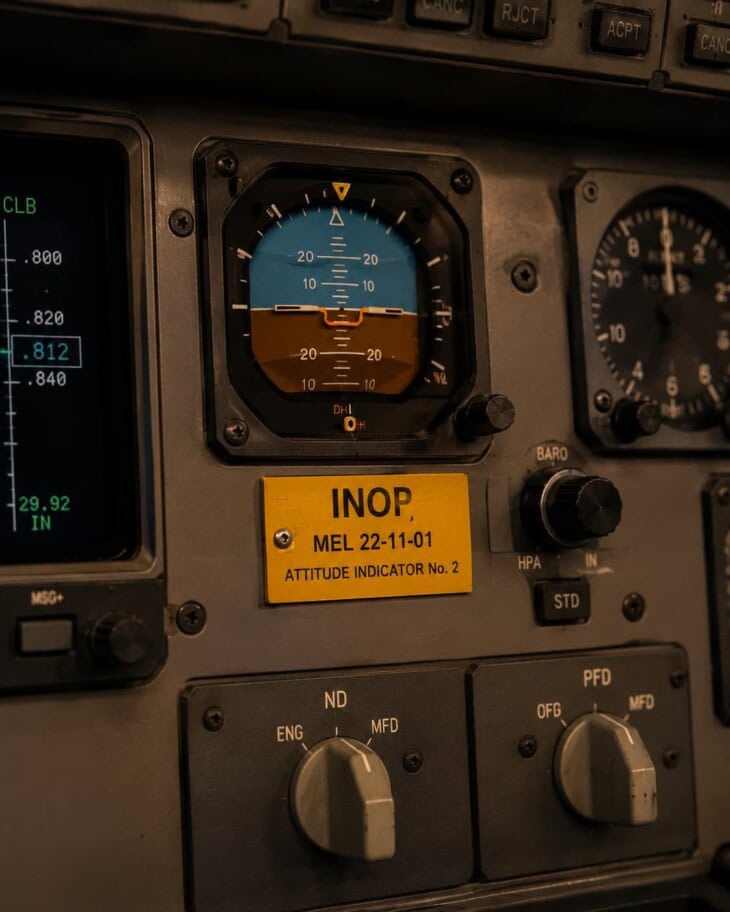
When a defect is found and the maintenance engineer determines it can be deferred under the MEL, a specific procedure must be followed before the aircraft can depart. The defect is entered in the Aircraft Technical Log with a reference to the relevant MEL provision. An “INOP” placard — a small label indicating the item is inoperative — is placed on the affected control, indicator, or system in the cockpit or cabin. The deferral clock starts from the day of discovery, not the day of the repair attempt: an airline cannot reset the clock by removing a component, noting it was checked, and reinstating it without fixing the underlying fault.
Many MEL items come with required procedures that must be carried out alongside the deferral. These are listed alongside the MEL item itself and fall into two types: maintenance procedures that must be performed to make the deferral valid (such as deactivating a system and confirming it is in a known safe state), and operational procedures that change how the crew must fly the aircraft with that item inoperative.
A deferred autopilot, for example, may require the crew to limit the flight to conditions where hand-flying is practical throughout. A deferred ice detection system may require crew to assume icing conditions exist whenever certain temperature and moisture conditions are met, rather than waiting for the system to alert them. The MEL is not merely permission to ignore a broken item — it is a framework for managing the reduced capability safely.
What the MEL cannot do
The MEL looks, from the outside, like a mechanism that makes it easier to fly aircraft with problems. In one sense it is — it provides an approved, structured path for operating with certain items inoperative rather than grounding the aircraft. But the MEL also defines a hard floor: below the level of equipment it specifies, flight is not permitted. There is no provision for judgement calls about items outside the MEL. If the item is not on the list, the aircraft does not go.
The MEL also does not allow indefinite deferral. Category C items must be fixed within ten days. Category D items within 120. An airline cannot roll a deferred item forward by re-logging it after its interval expires — the defect must be repaired, or the aircraft must be grounded. In practice, maintenance control systems at major airlines track every open MEL item across the entire fleet, showing which aircraft have what deferred, when the clock expires, and which maintenance station is best positioned to perform the repair. An aircraft with a Category C item approaching its tenth day will be routed to a maintenance station with the right parts and skills to clear it, even if that requires adjusting the aircraft’s rotation.
A further constraint that the MEL cannot override is the cumulative effect of multiple deferrals. Individual items may each be permitted in isolation, but the MEL explicitly prohibits operating with multiple unrelated deferred items that together create a hazard that no single deferral would produce on its own. An aircraft with one navigation system deferred may be fine. The same aircraft with an autopilot deferred, a weather radar deferred, and an alternate static port inoperative is a different proposition — each individual deferral may technically be permitted, but the combined degradation of capability must be assessed before the aircraft departs. This is a judgement that requires the dispatcher and the captain to review the full deferred defect list together as part of the pre-departure process.

When the system is tested
The tension the MEL is designed to manage — between keeping aircraft flying and keeping them safe — does not always resolve neatly. Airlines operate under enormous commercial pressure to maximise the time their aircraft are in service. Every aircraft on the ground is costing money and disrupting schedules.
The MEL provides a legitimate path for continuing to operate with certain items inoperative, and that path can, under pressure, be walked further than it should be. An item deferred to its Category C limit might not be repaired on day ten if the part is difficult to source.
An aircraft with a growing deferred defect list may continue to fly while the underlying reliability problem is managed through deferrals rather than resolved through maintenance. The FAA and equivalent regulators in other countries monitor this through surveillance of airline maintenance programmes and through audits that examine not just individual aircraft records but systemic compliance trends across the fleet.
American Airlines MD-80 grounding, April 2008
In early April 2008, the FAA ordered American Airlines to ground its entire fleet of approximately 300 MD-80 aircraft after a safety audit found that the airline had not correctly complied with an airworthiness directive requiring inspection and remediation of wheel-well wiring bundles by a specified deadline. The AD, issued in 2006, required a general visual inspection for chafing or arcing of auxiliary hydraulic pump wiring that could constitute a fire or explosion risk. American’s work was found by the FAA to be non-compliant in the specifics of how the wiring had been secured. The grounding caused more than 3,200 flight cancellations in a single week, stranding hundreds of thousands of passengers. American was later fined $24.2 million. The episode illustrated what happens when regulators conclude that an airline’s maintenance compliance programme is operating below the required standard: the consequences are immediate, large-scale, and very public.
The MEL is, in the end, a carefully engineered safety system. It is not, as it is sometimes characterised from the outside, a list of excuses for flying broken aircraft. It exists because the alternative — grounding an aircraft for any inoperative item regardless of its significance — is not actually safer.
Stranding passengers at remote airports, forcing crews to fly with unfamiliar replacement aircraft, and disrupting schedules to the point where fatigue and pressure increase all carry their own risks.
The MEL reflects decades of engineering analysis and operational experience about which failures genuinely threaten safe flight and which do not. The in-seat entertainment screen that is not working in your row has been through that analysis. The conclusion was that you can fly without it.

For more on the overnight maintenance window in which MEL decisions are most often made, see What Happens to Your Aircraft the Night Before You Fly. For the person on the ground who reviews the open MEL items as part of every flight release, see The Person Who Actually Plans Your Flight: Meet the Airline Dispatcher. Both are part of How Airlines Actually Work.
FAQ
Sources and references used for research and fact-checking.
- What is the Minimum Equipment List (MEL)? - Pilot Institute
- MEL Restrictions and Deferment Process - Sofema Online
- AC 120-MEL — Minimum Equipment List Authorization - Federal Aviation Administration
- 14 CFR § 91.213 — Inoperative Instruments and Equipment - Electronic Code of Federal Regulations (eCFR)
- Acceptable Deferred Defect - SKYbrary
- Managing Aircraft Minimum Equipment List (MEL) Defects - Sofema Online
- How Airlines Safely Dispatch Aircraft With Failed Equipment (the MEL) - James Harding
- NATA Best Practices — Minimum Equipment List - National Air Transportation Association
- American Airlines Inspection Failures Draw $24.2 Million FAA Fine - NPR
- Aircraft Grounded for Wiring Inspections - Aviation Safety Journal
Get the Newsletter
The latest aviation news and stories sent to your inbox.
About the Author

Tim is the owner and lead editor of AeroCorner since 2019, overseeing aviation content covering aircraft, airlines, airports, and the broader aviation industry. Through years of researching, writing, editing, and publishing aviation-focused content, he has developed extensive practical knowledge of commercial aviation and air travel. Based in Asia and a frequent traveler himself, Tim also brings firsthand passenger experience to AeroCorner’s coverage. Outside of publishing, he has also explored aviation firsthand through hands-on flight training in New Zealand.