

Table of Contents
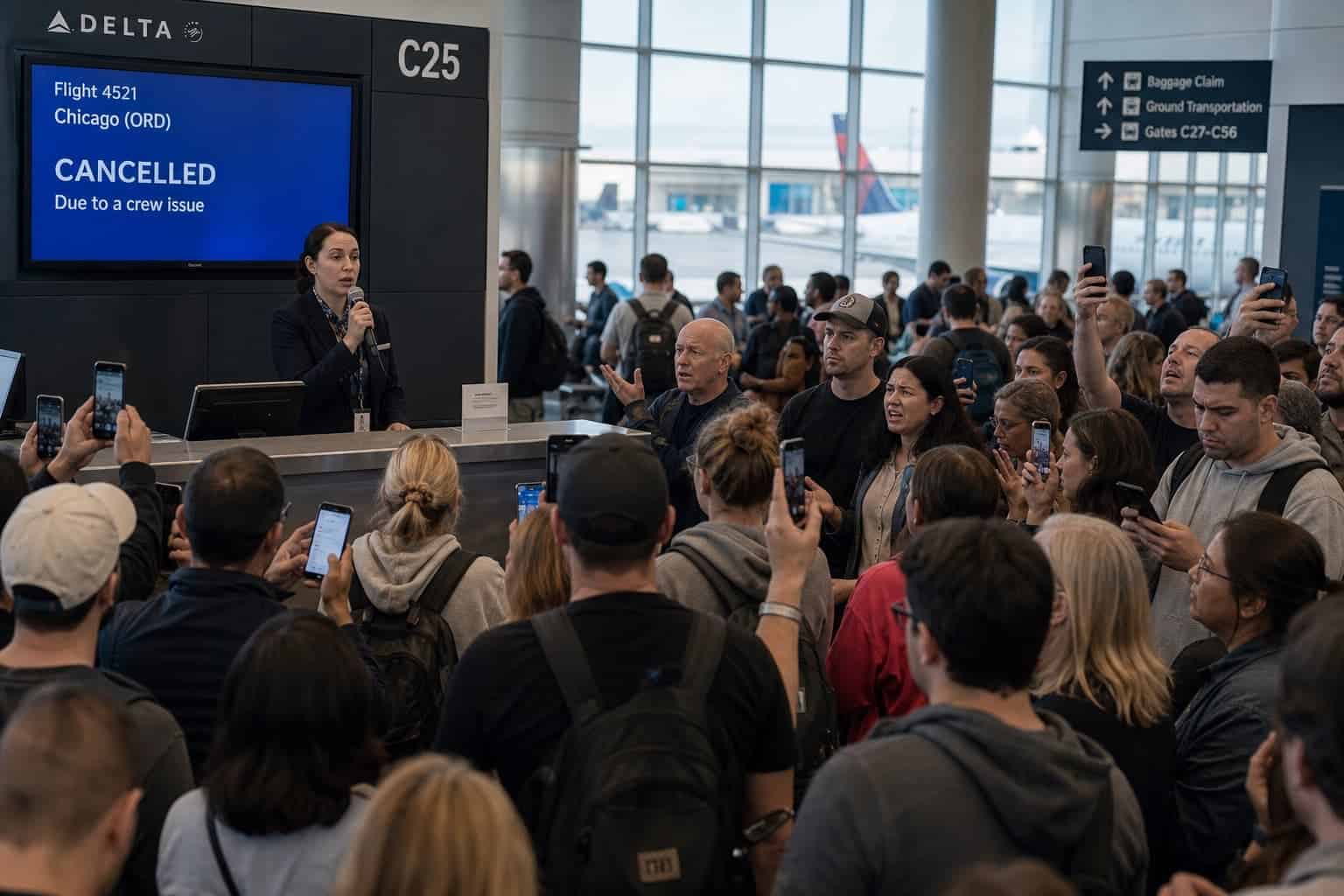
The gate agent picks up the microphone and delivers the phrase every passenger dreads: “Ladies and gentlemen, we’re sorry to inform you that this flight has been cancelled due to a crew issue.” No further explanation. A hundred people reach for their phones simultaneously. Some are confused. Some are furious. Most are wondering the same thing: what does “crew issue” actually mean, and why couldn’t it have been resolved before everyone dragged themselves to the airport?
The answer almost always involves a clock. Flight crews operate under strict legal limits on how many hours they can fly and how long they must rest between duties. These limits are not internal airline policies that can be waived by a manager. They are federal regulations, and violating them is not an option. When a crew runs out of hours, the flight does not go. When a replacement crew is not available in the right city at the right time, the flight does not go. The “crew issue” announcement is the passenger-facing result of a set of rules that exist specifically because of what happens when tired pilots fly aircraft.
The current rules, known as FAR Part 117, came into effect on January 4, 2014. They were the first major overhaul of US flight crew duty regulations in roughly 60 years, and they were written in direct response to a series of fatigue-related accidents and a growing body of scientific research on what sleep deprivation actually does to human performance. Understanding them is the key to understanding both why they exist and why, on occasion, they strand you at a gate.
The clock that starts when they check in
The central concept in Part 117 is the Flight Duty Period, or FDP. This is the total time from when a crew member checks in for duty, typically an hour before departure, to the moment the engines shut down at the end of the last flight of the day. Everything counts: the pre-flight briefing, the taxi, the flight itself, any ground time during a layover between legs, and the taxi in at the destination. The clock does not stop because the aircraft is sitting at a gate waiting for a late inbound connection. It does not pause because there is weather holding at the departure airport. It runs continuously from check-in to shutdown.
The maximum FDP a two-pilot crew can work is limited by several factors, including the time of day the FDP starts, the number of flight segments scheduled, and how many consecutive nights of reduced sleep the crew has accumulated. A crew starting their FDP at 6am and flying two segments might have a maximum allowable FDP of around 9 to 10 hours.
The same crew starting at midnight might have a shorter maximum, because the FAA’s rules are calibrated to circadian rhythms: the body’s performance degrades more steeply in the hours around 3 to 4am than at midday, and the regulations reflect this. Airlines must plan their rosters around these limits before the day even begins, but when operations go off-plan, crews can approach or reach their limits faster than expected.
Before the FDP starts, the crew must have received a minimum of 10 consecutive hours off duty, within which there must be at least 8 uninterrupted hours available for sleep. Not 8 hours of sleep necessarily, but 8 hours during which nothing should interrupt the opportunity to sleep. The airline cannot schedule a crew member for a duty period unless this rest window has been given.
And here is the part that catches passengers off guard: that 10-hour rest requirement applies to what was scheduled. If a crew member spent the previous evening dealing with a delayed inbound, a reassignment, or a commute from another city, the rest the airline planned for them may not match what they actually got. The rules address this through a fitness-for-duty provision, but only up to a point.

Why 2014 changed the rules
The regulations that Part 117 replaced were based on calendar time rather than physiology. The old rules, contained in Part 121 Subparts Q, R, and S, set limits on total flight hours per calendar month and required a minimum rest period defined by calendar day rather than by elapsed time.
They did not account for when in the day the duty occurred, how many consecutive days a crew had been working, or what the science of fatigue and circadian disruption had established about human cognitive performance. They were, in the words of the FAA’s own rulemaking documents, more than half a century out of date.
Part 117 replaced that calendar-day framework with one grounded in fatigue science. The new rules introduced the concept of the Flight Duty Period as the primary limit, with its maximum value varying by time of day to reflect circadian vulnerability. They added cumulative limits: no more than 100 flight hours in any 28 consecutive days, no more than 1,000 flight hours in any 365 consecutive days, no more than 60 flight duty hours in any 7 consecutive days.
They required 30 consecutive hours free from all duty in every rolling 168-hour window, ensuring every crew member gets the equivalent of at least one full day off per week. And they introduced the fitness-for-duty provision: the understanding that a crew member who is fatigued, regardless of whether they are technically within their legal limits, has both the right and the obligation to declare themselves unfit to fly.
That last provision is significant and uncomfortable in equal measure. Legal limits are measurable. Fatigue is not, at least not without medical monitoring. A pilot who slept poorly, commuted overnight, or is dealing with personal stress may be within every legal limit and still be cognitively impaired in ways that are difficult to quantify. The fitness-for-duty standard asks crew members to make an honest self-assessment and to report it to their employer. The regulations support them in doing this. The culture of the industry, historically, has not always made it easy.
Key Part 117 limits at a glance
Minimum rest before duty: 10 consecutive hours off, including 8 hours sleep opportunity. Maximum Flight Duty Period (unaugmented): Varies by report time and number of segments; typically 9 to 10 hours for a standard day-start, less for overnight starts. Weekly limit: 60 flight duty hours in any 7 consecutive days; 30 consecutive hours free from duty in any 168 consecutive hours. Monthly and annual limits: 100 flight hours in any 28 consecutive days; 1,000 flight hours in any 365 consecutive days. Augmented operations: Flights with a rest-qualified third or fourth pilot can extend the FDP to 13 hours (single lie-flat rest seat) or up to 17 hours (multiple isolated rest bunks).
When the rules meet the real world
The most common way a crew issue disrupts a passenger’s travel is not through a scheduling error made weeks in advance. It is through the cascade of small delays that accumulate over the course of an operating day. A crew arrives late because their inbound flight was delayed. The ground stop clears, the aircraft is ready, but the crew is now 90 minutes deeper into their FDP than the schedule assumed.
Add a lengthy taxi queue, and suddenly the legal hours available for the return flight shrink to the point where there is not enough runway. The airline can ask a reserve crew to cover, but reserve crew must also meet the rest requirements before they work. If the right crew is not already rested and positioned at the right airport, the flight cancels. The “crew issue” that passengers hear about is usually the final link in a chain that started many hours earlier.
Long-haul flights manage this problem differently, through what the regulations call augmented operations. On a route that cannot be flown within a single FDP by a standard two-pilot crew, the airline adds a third or fourth pilot. The aircraft carries a dedicated crew rest facility, typically a locked compartment above or below the main cabin with flat beds and noise and light isolation, classified by the FAA as a Class 1 rest facility.
While one pair of pilots flies, the other pair sleeps in the bunk. They rotate through the flight, each resting during the other’s watch. The maximum FDP for this type of operation can extend to 17 hours. The hidden bedroom above the ceiling panels of a Boeing 777 on a 14-hour trans-Pacific flight is not a curiosity. It is the regulatory mechanism that makes the route possible.
Colgan Air Flight 3407, February 12, 2009
Operating as Continental Connection from Newark to Buffalo, u003ca href=u0022https://aerocorner.com/blog/colgan-air-flight-3407/u0022 data-type=u0022postu0022 data-id=u0022561095u0022u003eColgan Air Flight 3407u003c/au003e crashed on approach and killed all 49 people on board plus one on the ground. The NTSB’s investigation found that both pilots had commuted through the night before the flight: the captain had travelled from Florida and slept in the crew lounge at Newark, while the first officer had flown from Seattle on FedEx jumpseats, arriving at the airport only hours before their duty began. u003cbru003eu003cbru003eThe NTSB cited fatigue as a contributing factor. The accident prompted Congress to pass the Airline Safety and Federal Aviation Administration Extension Act of 2010, which directly mandated the FAA to reform crew rest regulations. Part 117, effective 2014, was the result. It is the clearest example in US aviation history of a regulatory standard being rewritten around what happened when the previous one was not enough.

The next time a gate agent delivers the crew issue announcement, the rules described here are almost certainly what created it. A crew hit their legal limit, a replacement was not positioned or rested in time, and the mathematics of the regulations produced the only outcome they allow: the flight does not depart. The rules are frustrating to be on the wrong end of as a passenger.
They exist because the alternative, a fatigued crew operating an aircraft because the schedule demands it, carries consequences that no number of missed connections can justify. Crew rest requirements also appear in the article on why flights get delayed, where they are listed among the most common causes of late aircraft. The full picture of how airlines manage all the moving parts that keep flights running is in the How Airlines Actually Work series.
FAQ
Sources and references used for research and fact-checking.
- 14 CFR Part 117 — Flight and Duty Limitations and Rest Requirements: Flightcrew Members - Electronic Code of Federal Regulations (eCFR)
- Federal Register: Flightcrew Member Duty and Rest Requirements (Final Rule) - Federal Register
- NTSB Accident Report AAR-10-01: Colgan Air Flight 3407 - National Transportation Safety Board
- FAR Part 117 Rest Requirements - TrainingBoom / Understanding FAR 117
- Crew Schedules, Sleep Deprivation, and Aviation Performance - Psychological Science / ScienceDaily
- Crew rest compartment - Wikipedia
- Aviation Safety: Pilot Fatigue - US Department of Transportation
Get the Newsletter
The latest aviation news and stories sent to your inbox.
About the Author

Tim is the owner and lead editor of AeroCorner since 2019, overseeing aviation content covering aircraft, airlines, airports, and the broader aviation industry. Through years of researching, writing, editing, and publishing aviation-focused content, he has developed extensive practical knowledge of commercial aviation and air travel. Based in Asia and a frequent traveler himself, Tim also brings firsthand passenger experience to AeroCorner’s coverage. Outside of publishing, he has also explored aviation firsthand through hands-on flight training in New Zealand.