

Table of Contents
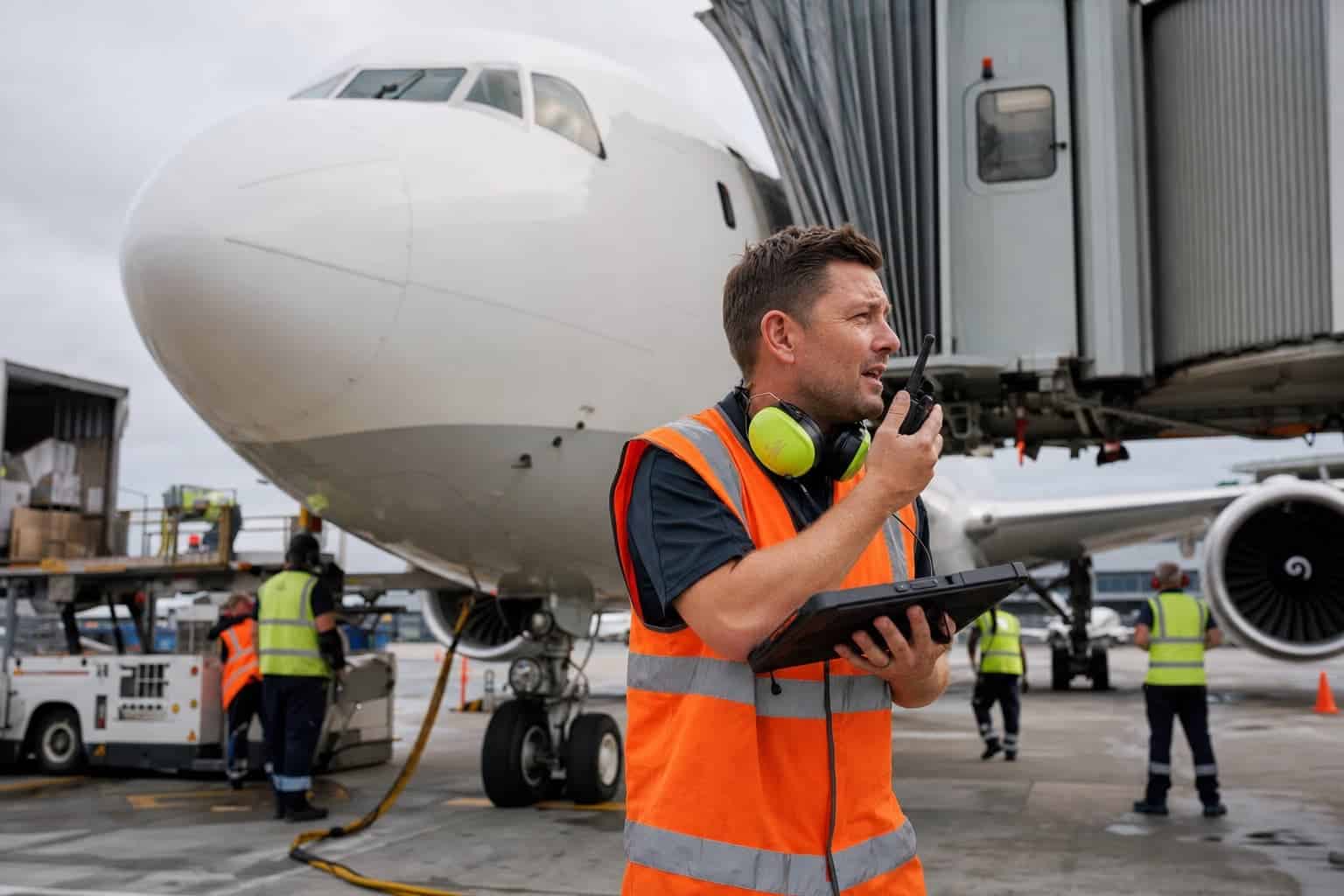
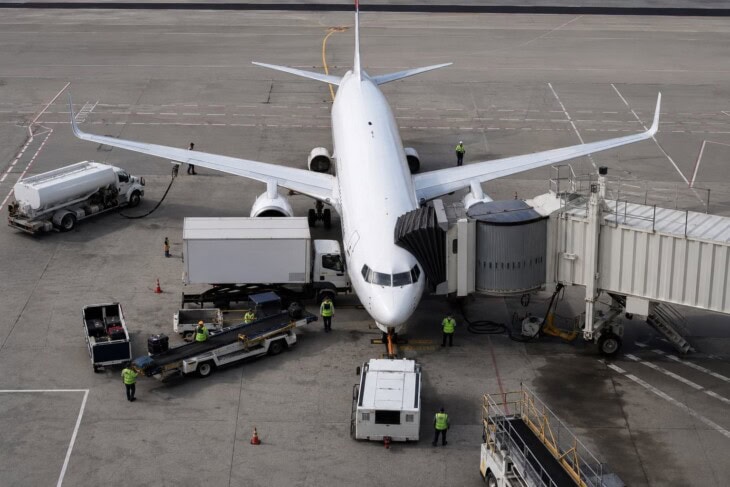
The aircraft pulls onto the stand, the jet bridge swings out, and the seatbelt sign clicks off. Within a few seconds, half a dozen vehicles converge on the gate from different directions. A baggage tug curves in under the cargo hold. A catering truck reverses up to the forward galley door. A fuel truck rolls in from the apron edge. A water truck and a lavatory truck pull around to the rear. Somewhere a small van drops off the cleaning crew, and the next flight’s crew walks up the jet bridge from the terminal. From a seat in row 14, this looks like organised chaos. From an airline operations centre, it is a tightly choreographed sequence with a target time that everyone on the ramp can recite from memory.
The turnaround, the time between an aircraft’s arrival at the gate and its next departure, is one of the most cost-sensitive intervals in the entire airline operation. Every minute the aircraft sits at the gate is a minute it is not flying paying passengers somewhere. For a short-haul jet that might fly five or six segments in a day, the difference between a 30-minute turn and a 50-minute turn translates directly into how many flights the airline can sell, how many crews it has to roster, and how robust the schedule is when something goes wrong.
Here is what is actually happening on the ramp while you wait at the gate, how the sequence is built, and why a delay to one specific task can hold up everything else.
The choreography on the ramp
A turnaround is not a single process. It is around a dozen separate processes happening at the same time, each handled by a different team, each with its own equipment and its own clock. The IATA Ground Operations Manual, the industry’s reference document for how airline ground handling is meant to work, breaks a typical narrow-body turnaround into roughly twelve linked activities.
Inside those twelve activities sit something in the region of 150 individual sub-tasks, performed by as many as 30 different people across half a dozen organisations. The airline itself usually performs only some of them. The rest are run by ground handling companies under contract.
Some tasks have to happen one after another. Passengers cannot board until the inbound passengers have deplaned and the cabin has been cleaned. Catering cannot finish loading the forward galley until the cleaning team has cleared the aisle. Pushback cannot happen until the doors are armed, the jet bridge is retracted, and the fuel truck has disconnected. Other tasks happen in parallel.
While passengers are still deplaning at the front, baggage is already being unloaded from the rear cargo hold. While the cabin is being cleaned, fuel is being pumped into the wing tanks. While the fresh catering trolleys are being swapped in, the lavatory truck is servicing the toilets and the water truck is refilling the potable water tanks. The art of turnaround design is figuring out which tasks must wait for others and which can be done at the same time, then sequencing the start times so nothing has to wait that does not have to.
The actual target time varies sharply by aircraft type and airline business model. A short-haul narrow-body operating between European cities for a legacy carrier is typically scheduled for around 45 to 60 minutes on the ground. A low-cost carrier flying the same kind of aircraft on the same kind of route will routinely target 25 to 30 minutes, sometimes less.
A wide-body long-haul aircraft arriving from a transatlantic or transpacific flight is usually scheduled for two to three hours, partly because the operation is bigger, partly because the schedule has time to spare, and partly because the deep cleaning and catering needed for a long-haul flight is substantially more involved. The size of the aircraft matters, but the bigger driver is what the airline is trying to do with it.
The critical path and the person who manages it
Most of the parallel activities on the ramp finish well before the aircraft is ready to leave. The fuel truck typically disconnects long before boarding ends. The lavatory and water service are done within fifteen minutes. The baggage from the inbound flight is usually unloaded before the outbound bags need to start going on. The total turnaround time is not the sum of all these tasks. It is determined by a much shorter list of tasks that have to happen in sequence and which cannot easily be sped up. This sequence is called the critical path.
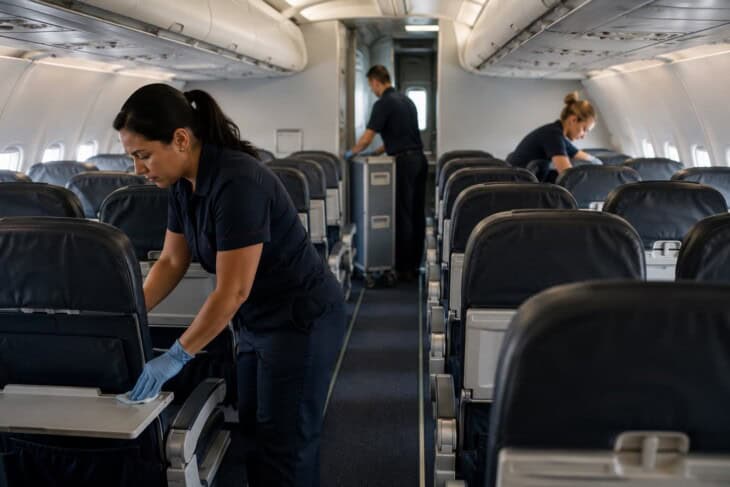
For a typical narrow-body turn, the critical path runs through deplaning, cabin cleaning, boarding, and door closure. Passengers leave the aircraft. The cleaners come on and clear the cabin. Catering finishes whatever is left. Boarding starts, the new passengers fill the aircraft, the gate agent does the final paperwork, the door is closed, the jet bridge retracts, and the aircraft pushes back. Almost everything else, fuel, baggage, water, lavatories, exterior checks, can be done inside this window without extending it. If the critical path takes 30 minutes, the turn takes 30 minutes, regardless of how many other things are happening in parallel.
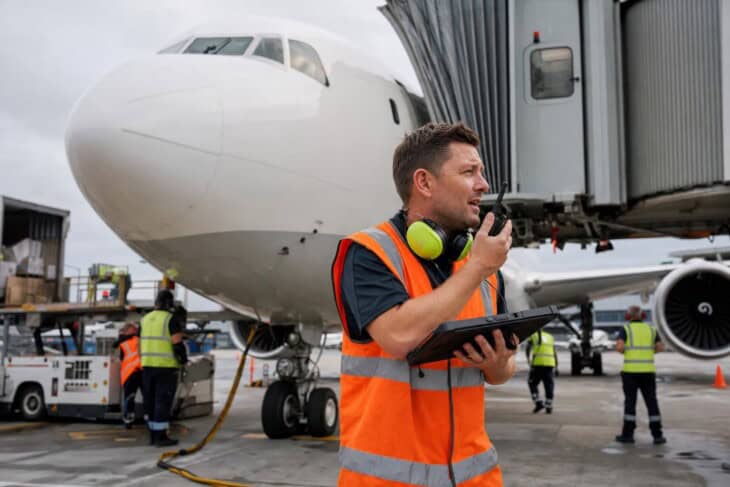
The person who keeps this sequence on schedule is the turnaround coordinator, sometimes called the ramp coordinator or turnaround manager depending on the airline. This is a position at the gate, on the ramp, in a high-visibility vest with a radio and often a tablet. Their job is to know where every team is in their part of the turn, to spot the moment when one team is about to slip, and to escalate quickly enough that the slip does not break the rest of the schedule.
They are also the person who decides, in real time, whether something out of sequence is acceptable: whether boarding can begin while the catering truck is still attached, whether the cleaning crew has done enough for the captain to release the aircraft, whether the fuel can keep flowing while passengers are walking up the aisle. Most of these are airline-specific judgments governed by published procedures, and a good coordinator will know them without having to look them up.
Typical turnaround times by aircraft and operator
Low-cost narrow-body short-haul (e.g. Ryanair, easyJet, Southwest): 25 to 30 minutes scheduled.
Legacy narrow-body short-haul (e.g. major European or US carriers): 45 to 60 minutes scheduled.
Regional jet: 30 to 45 minutes.
Wide-body long-haul: 2 to 3 hours, occasionally longer for premium-heavy configurations.
Critical-path tasks: deplaning, cabin cleaning, catering completion, boarding, door close. Everything else runs in parallel.
When the turn slips, and why one slip becomes many
The reason airlines obsess over turnaround time is that a single slip can travel through the rest of the day. An aircraft is rarely scheduled to fly just one segment. A narrow-body in a short-haul network might be assigned to four or five segments over the course of a day, each one with a turnaround between them. If the morning’s first turn runs 20 minutes long, the aircraft pushes back 20 minutes late. It arrives 20 minutes late. The next turn either runs short, eating into whatever buffer was built in, or it falls behind too.
By the late afternoon, what started as a single 20-minute delay can be a 90-minute one. The Bureau of Transportation Statistics records this category of delay as “late arriving aircraft,” and it has historically been one of the largest single causes of US domestic flight delays, accounting for several percent of all delayed flights in any given month. The underlying reason for that late arrival is rarely the airline’s fault in any clean sense. It is the compounding effect of an earlier disruption further up the aircraft’s chain of flights.
The cascade is worst at hub airports, where dozens of aircraft from across the network are scheduled to arrive and depart inside narrow connecting windows. When inbound flights are late, the airline has to choose between holding the connecting flight (which then becomes a late aircraft itself) or letting it go without its full load of passengers (who then need rebooking, hotel rooms, and meals).
Hub schedules are deliberately built with some buffer between flights, but that buffer is finite, and on a busy day it gets used up quickly. This is also why airlines pay close attention to which aircraft are assigned to which routes: rotating an aircraft through a long enough turnaround at the end of the day, or designating a fresh aircraft as a “spare” at a hub, can break a cascade before it starts.
Southwest Airlines and the birth of the 10-minute turn, 1972
In spring 1972, Southwest Airlines was losing money and had only $143 in its bank account. Management sold the fourth aircraft in its fleet, a Boeing 737, to raise cash, leaving the airline with three aircraft to fly its hourly Dallas to Houston service. To make the schedule work with one fewer aircraft, the airline needed to turn each plane in ten minutes. Vice president of operations Bill Franklin redesigned the ramp choreography, training ground crews to run cleaning, refuelling, baggage and boarding in tightly overlapped sequences. The 10-minute turn worked, the schedule held, and Southwest became profitable the following year. Fast turnarounds and high aircraft utilisation remained central to the airline’s economics for decades, and the operating model directly influenced the low-cost carriers that came later, including Ryanair and easyJet.
Not every slip is the airline’s fault. Air traffic control can hold an inbound aircraft in a stack at the destination, putting it on the ground 30 minutes after the schedule expected it. Weather can close a runway and back everything up. A medical incident on the inbound flight can mean paramedics meet the aircraft and the cabin cannot be cleaned until the patient is off.
A technical issue found during the walk-around can force a deferral decision under the Minimum Equipment List, sometimes resolved in minutes, sometimes hours. The turnaround team’s job is to absorb as much of this as possible without breaking the next departure, and when that becomes impossible, to flag it to operations control early enough that the rest of the day’s schedule can be reshuffled around it.
The next time you watch through the window as fuel trucks, catering trucks and baggage tugs swarm the aircraft at the gate, what looks like noise and motion is actually a critical path being protected. Almost everything you see is happening in parallel with something else, and almost none of it is what is holding up the next departure.
What is holding it up is usually a much smaller set of tasks inside the cabin and at the gate counter: how quickly the inbound passengers leave, how fast the cleaners reset the seats, how long boarding takes, and when the gate agent can finally close the door.
Turnaround is one of the points in the operation where everything else in the airline’s day either holds together or starts to come apart. The aircraft that just landed is the same one that has to push back on time, and what happens to it at the gate determines whether the next flight, and often the rest of that aircraft’s day, runs to schedule. For the longer view of how a single early-morning delay can spread across an entire hub by afternoon, the why flights get delayed article walks through the cascade in detail. The cabin cleaning, catering and crew handover that sit inside the turn often start the night before the flight, during the work covered in what happens to your aircraft the night before you fly. And the most visible part of any turnaround, the one passengers actually experience, has its own set of operational constraints that are explored in why does boarding take so long. The full picture of how these pieces fit together lives in the How Airlines Actually Work series.
FAQ
Sources and references used for research and fact-checking.
- IATA Ground Operations Manual (IGOM): overview - International Air Transport Association
- Aircraft total turnaround time estimation using fuzzy critical path method - Growing Science / Journal of Project Management
- What is aircraft turnaround time in aviation and why does it matter for on-time performance? - Aileron Air
- A Turning Point: The Birth of the 10-Minute Turn - Southwest Airlines
- The Man Who Saved Southwest Airlines With A '10-Minute' Idea - NPR
- Understanding the Reporting of Causes of Flight Delays and Cancellations - US Bureau of Transportation Statistics
- Airline On-Time Performance and Causes of Flight Delays - US Bureau of Transportation Statistics
- Future aircraft turnaround operations considering post-pandemic requirements - PMC / NCBI
Get the Newsletter
The latest aviation news and stories sent to your inbox.
About the Author

Tim is the owner and lead editor of AeroCorner since 2019, overseeing aviation content covering aircraft, airlines, airports, and the broader aviation industry. Through years of researching, writing, editing, and publishing aviation-focused content, he has developed extensive practical knowledge of commercial aviation and air travel. Based in Asia and a frequent traveler himself, Tim also brings firsthand passenger experience to AeroCorner’s coverage. Outside of publishing, he has also explored aviation firsthand through hands-on flight training in New Zealand.