

Table of Contents
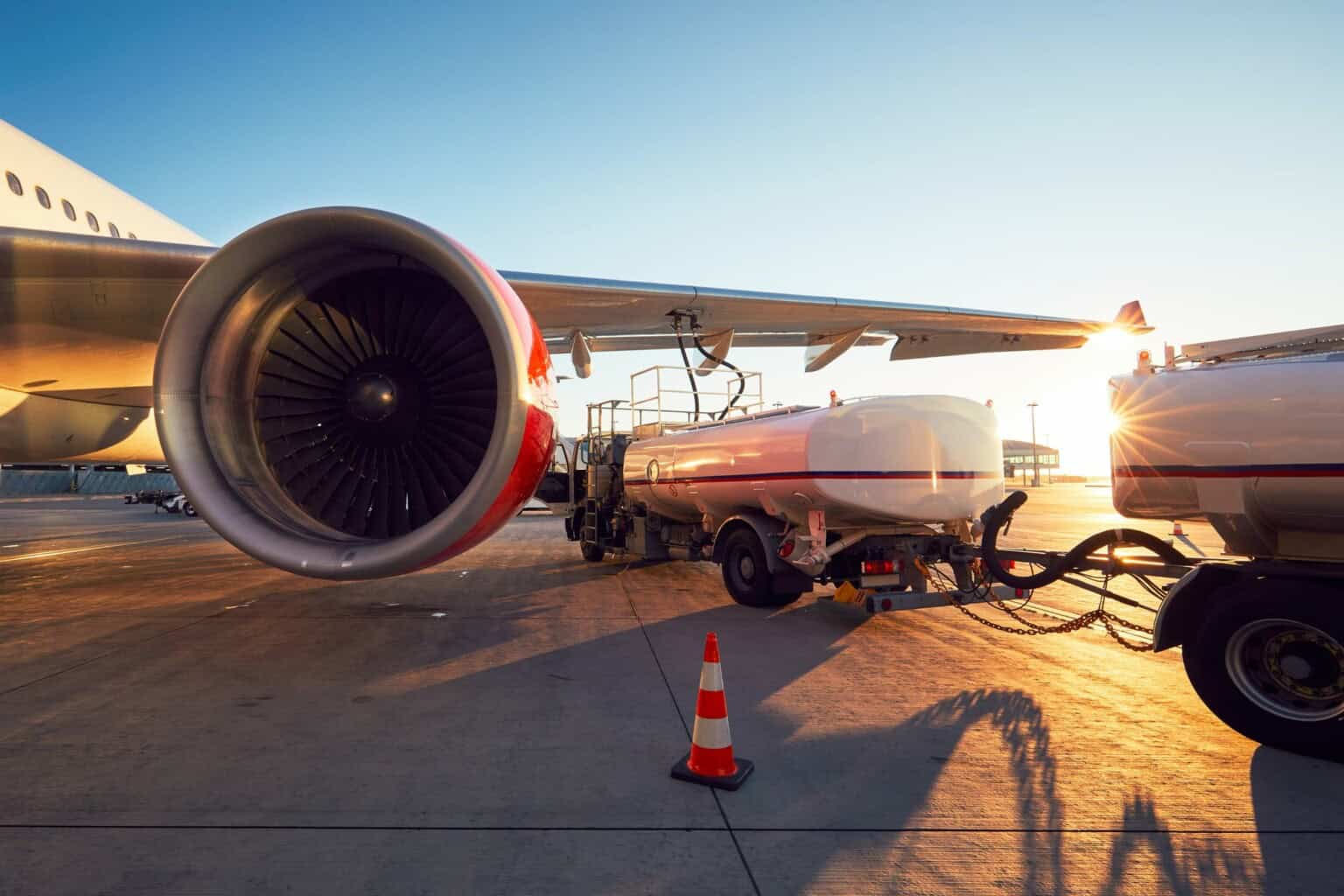
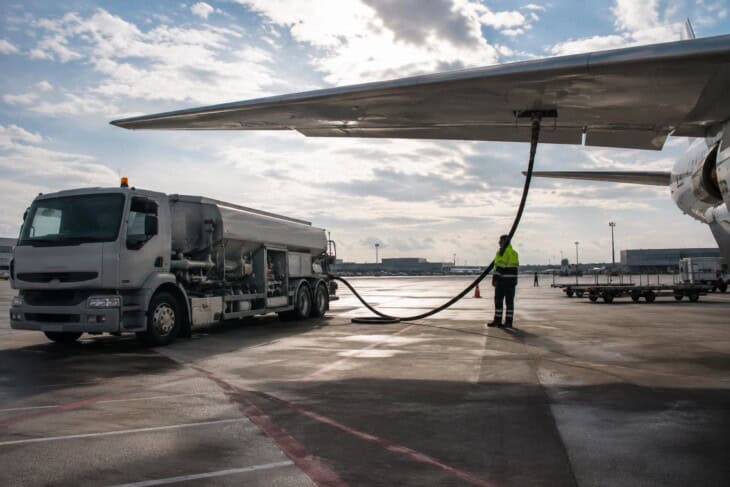
At some point before every flight, a fuel truck pulls up to the aircraft, connects a hose to the wing, and pumps in tens of thousands of pounds of jet fuel. The process takes anywhere from fifteen minutes to over an hour. Passengers barely notice. But the quantity of fuel going into that aircraft is not an arbitrary number, and getting it right involves regulations, weather forecasts, cost calculations, and a formal agreement between two people who share legal responsibility for the decision.
Airlines do not simply fill the tanks to the brim before every flight. Carrying fuel costs money: jet fuel is heavy, and a heavier aircraft burns more fuel to stay airborne. Every extra pound of fuel on board requires a small amount of additional fuel just to carry it. At the same time, running short of fuel in the air is one of the most serious situations a flight crew can face. The fuel load for any given flight is a carefully calculated balance between safety, regulation, and economics.
Here is how that calculation actually works, what the regulations require, and why an airline might deliberately load more fuel than the regulations demand.
The six layers of a fuel load
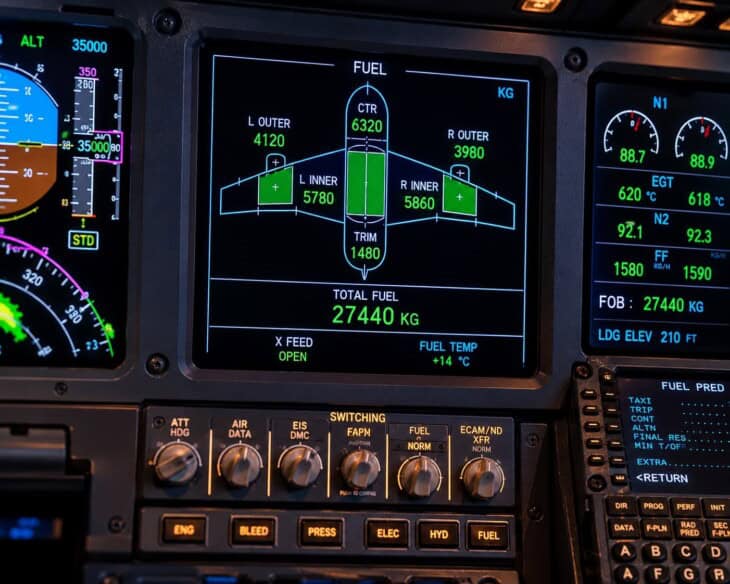
Every airline flight departs with fuel calculated in distinct categories, each serving a specific purpose. Together they form what is called the block fuel: the total amount of fuel loaded onto the aircraft before departure.
The largest portion is the trip fuel: the amount needed to fly from departure to destination under the forecast conditions for that specific flight. This is not a round number pulled from a table. It is calculated based on the planned route, the altitude, the expected winds, the weight of the aircraft, and the performance characteristics of the specific airframe. A westbound transatlantic flight in winter carries considerably more trip fuel than the same route going east, because the headwinds are stronger.
On top of the trip fuel sits a layer of contingency fuel, designed to cover unexpected events during the flight: a routing change from air traffic control, stronger headwinds than forecast, or a holding delay near the destination. Under ICAO Annex 6, the international standard, contingency fuel must be at least 5% of the trip fuel, or enough to hold for five minutes above the destination at 1,500 feet, whichever is greater.
Then there is alternate fuel: the fuel needed to fly from the destination airport, execute a missed approach, and divert to a designated alternate airport if landing at the original destination turns out to be impossible. Above that is final reserve fuel, a protected minimum that must remain untouched until the aircraft is on the ground: 30 minutes of holding at 1,500 feet above the alternate airport.
Finally, dispatchers and captains can add extra fuel for specific circumstances, including forecast conditions worse than usual, known delays at the destination, or passenger loads that make the aircraft heavier than typical.
What goes into a fuel load
Trip fuel — fuel to fly the planned route to the destination.
Contingency fuel — at least 5% of trip fuel, for unexpected routing or weather changes.
Alternate fuel — fuel to fly from the destination to the designated alternate airport after a missed approach.
Final reserve fuel — 30 minutes holding at 1,500 ft above the alternate. This is never intended to be used.
Extra fuel — discretionary fuel added by the dispatcher or captain for specific conditions.
Taxi fuel — fuel for engine start and ground movement before takeoff.
Who decides, and why it is a shared decision
In the United States, the fuel load for every commercial flight must be agreed upon by two people: the dispatcher and the captain. Under FAA regulations in 14 CFR Part 121, these two share what is called operational control, which means neither can override the other on matters of flight safety.
The dispatcher calculates the planned fuel load based on weather data, route analysis, airport conditions at the destination and alternate, and any known delays or restrictions. The captain reviews it and must sign off. Either can request more fuel than the regulations require, and either can flag a concern that requires further discussion before departure.
The FAA’s domestic fuel rules in Part 121.639 require airlines to dispatch with enough fuel to reach the destination airport plus 45 minutes at normal cruising consumption. For international flag operations under Part 121.645, the standard changes: if no alternate airport is designated, the aircraft must carry enough fuel to fly to the destination and then continue for two hours at normal cruising. These are minimums. In practice, actual fuel loads are almost always higher than the regulatory floor, because the regulatory minimum is a safety backstop, not an operational target.
One of the more counterintuitive fuel practices in commercial aviation is tankering: deliberately loading more fuel than the flight requires so that less needs to be purchased at the destination airport. Jet fuel prices vary significantly between airports. A flight departing from an airport where fuel is cheap may load enough extra fuel to cover not just the return leg but the full round trip, avoiding refuelling at a more expensive airport entirely.
Eurocontrol estimates that around 15% of flights in European airspace use full tankering and another 15% use partial tankering. The economics are straightforward, but there is a catch: carrying extra weight requires burning more fuel to carry it, so the savings diminish as the tankering distance increases. There is also an environmental cost, which has led European aviation regulators to begin limiting the practice.
When fuel becomes a problem in the air
Pilots and air traffic controllers have a shared language for fuel emergencies, and the distinction between the two phrases matters. If a crew reaches a point where any additional delay will result in landing with less than the final reserve fuel intact, the pilot declares “minimum fuel” on the radio. This is not an emergency declaration. It is an information call: it tells ATC that the aircraft is committed to landing at its current destination without delay, and that no holding or further vectoring can be accepted. Air traffic controllers note it and factor it into their sequencing, but minimum fuel does not automatically grant priority handling.
The emergency declaration comes one step further down: “MAYDAY FUEL.” A crew issues this when the calculated fuel remaining upon landing at the nearest suitable airport is expected to be less than the final reserve. This is a genuine emergency, requiring immediate priority handling from ATC. The aircraft will be cleared ahead of other traffic, approach procedures shortened, and emergency services may be placed on standby. The gap between minimum fuel and MAYDAY fuel can sometimes be measured in minutes of flying time.
United Airlines Flight 173, Portland, December 28, 1978
While troubleshooting a landing gear malfunction during approach to Portland, Oregon, the crew of a United Airlines DC-8 held the aircraft in a circling pattern for over an hour. The captain became absorbed in diagnosing the gear problem and managing preparations for a potential emergency landing. No one was specifically monitoring the fuel state. The aircraft ran out of fuel and crashed in a suburban neighborhood, killing 10 people on board. The NTSB cited the captain’s failure to monitor fuel and the crew’s failure to communicate the deteriorating fuel state as central causes. The accident became the founding case study for Crew Resource Management training, now mandatory at airlines worldwide, which teaches crews to speak up and share situational awareness regardless of seniority.
Fuel exhaustion in a commercial aircraft is rare precisely because the layered fuel planning system and shared decision-making structure are designed to make it nearly impossible. But the historical record shows that when it does happen, the cause is rarely a single miscalculation. It is usually a combination of an unexpected event, a crew distracted or under pressure, and a series of small decisions that each seemed reasonable in isolation.
Air Transat Flight 236, Atlantic Ocean, August 24, 2001
An Airbus A330 en route from Toronto to Lisbon developed a fuel leak caused by an incorrectly installed hydraulic part that had worn through an adjacent fuel line. Fuel was escaping at around 13 tonnes per hour. Despite multiple indications that a significant fuel loss was occurring, the crew did not identify the leak in time. Both engines flamed out over the Atlantic with around 100 kilometres to the nearest airport. The crew declared an emergency and glided the aircraft to Lajes Air Base in the Azores, completing what became the longest powerless glide ever recorded for a commercial aircraft. All 306 people on board survived, though 18 were injured during the hard landing and evacuation. The incident led to new fuel leak detection procedures for the A330 and A340 fleets and reinforced the importance of crews acting on abnormal fuel quantity indications early.

The next time you watch through the aircraft window as a fuel truck connects to the wing, you are watching the end result of a process that started hours earlier: weather data pulled from forecast models, winds computed along a specific route, alternate airports checked, and a fuel figure agreed upon by two people who both carry legal responsibility for the flight. The truck is the visible part. The calculation behind it, and the regulations that govern it, are what make the system as safe as it is.
Fuel planning sits at the centre of several other decisions that shape a flight. The dispatcher who agrees the fuel load is the same person coordinating the flight from the ground throughout its journey: the airline dispatcher article explains that role in full. And when a fuel situation does become serious in the air, one of the most likely outcomes is a diversion, which sets off its own chain of events for the crew, the airline, and the passengers: that is covered in what actually happens when a flight diverts. For the full picture of how these decisions fit together, the How Airlines Actually Work series covers each part of the operation.
FAQ
Sources and references used for research and fact-checking.
- 14 CFR § 121.639 – Fuel supply: All domestic operations - Legal Information Institute / Cornell Law School
- 14 CFR § 121.645 – Fuel supply: Turbine-engine powered airplanes, Flag and supplemental operations - Legal Information Institute / Cornell Law School
- Fuel – Flight Planning Definitions - SKYbrary Aviation Safety
- Fuel Emergencies: Guidance for Controllers - SKYbrary Aviation Safety
- United Airlines Flight 173 - Wikipedia
- Air Transat Flight 236 - Wikipedia
- What Is Fuel Tankering And Why Should You Care? - Simple Flying
- Tankering in aviation - Transport & Environment
- ICAO Fuel Calculations vs. FAA - International Flight Resources
Get the Newsletter
The latest aviation news and stories sent to your inbox.
About the Author

Tim is the owner and lead editor of AeroCorner since 2019, overseeing aviation content covering aircraft, airlines, airports, and the broader aviation industry. Through years of researching, writing, editing, and publishing aviation-focused content, he has developed extensive practical knowledge of commercial aviation and air travel. Based in Asia and a frequent traveler himself, Tim also brings firsthand passenger experience to AeroCorner’s coverage. Outside of publishing, he has also explored aviation firsthand through hands-on flight training in New Zealand.