

Table of Contents
Stand at a terminal window at a big hub and the business model looks obvious. Widebodies at every gate, tugs pushing them back, a landing every ninety seconds. All of that metal has to be where the money is.
It mostly is not. At the average airport, the aircraft side of the operation is run close to break even on purpose, and a huge share of what keeps the lights on comes from the parking garage, the duty free counter and the land around the runways.
Once you know that, a lot of what travelers find irritating about airports starts to make sense, including the price of the sandwich. Here is where the money actually comes from.
The short answer
Airport income splits into two buckets. Aeronautical revenue is everything charged for operating an aircraft: landing fees, terminal and gate rents, per-passenger charges, aircraft parking. Non-aeronautical revenue is everything else: parking, shops, restaurants, rental cars, advertising, hotels, cargo warehouses, leased land.
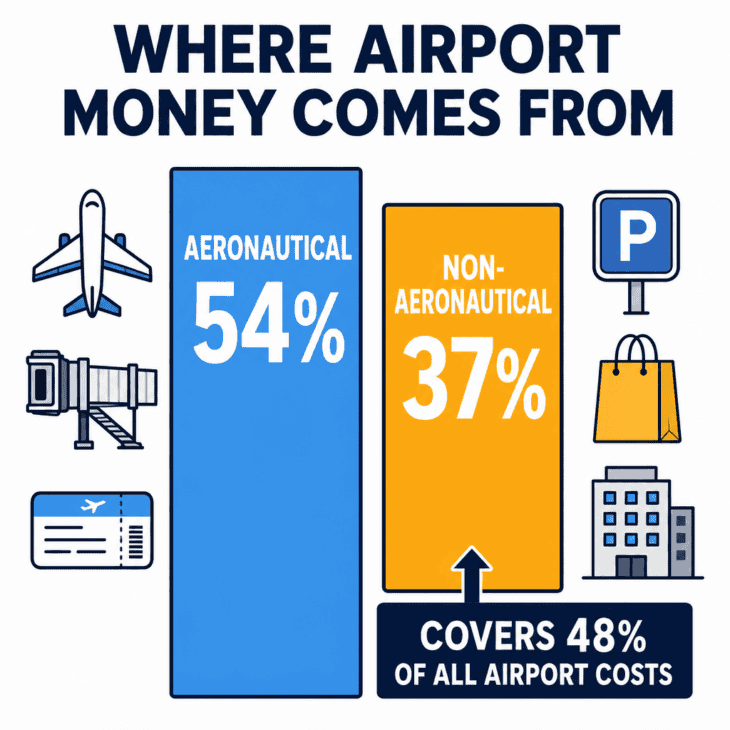
Aeronautical charges are the bigger line, at roughly 54 percent of global airport revenue in 2024 according to Airports Council International. But they are cost-recovery charges by design, negotiated or regulated to cover what the airfield costs to run.
The commercial side is where the margin lives. Non-aeronautical revenue was about 37 percent of global airport income in 2024, roughly 73 billion dollars, and ACI calculates that it covered 48 percent of the entire industry’s costs that year.
The business model in one line
Airports charge airlines roughly what the airfield costs them, then earn the difference between survival and solvency from passengers on the ground: parking, shopping, eating, renting cars and leasing land. Roughly half of all airport costs worldwide are covered by things that have nothing to do with flying.
The planes pay cost, not profit
What an airline pays an airport is not a market price. It comes out of a use agreement built on one of two accounting methods, and both of them are designed to recover cost rather than maximize profit.
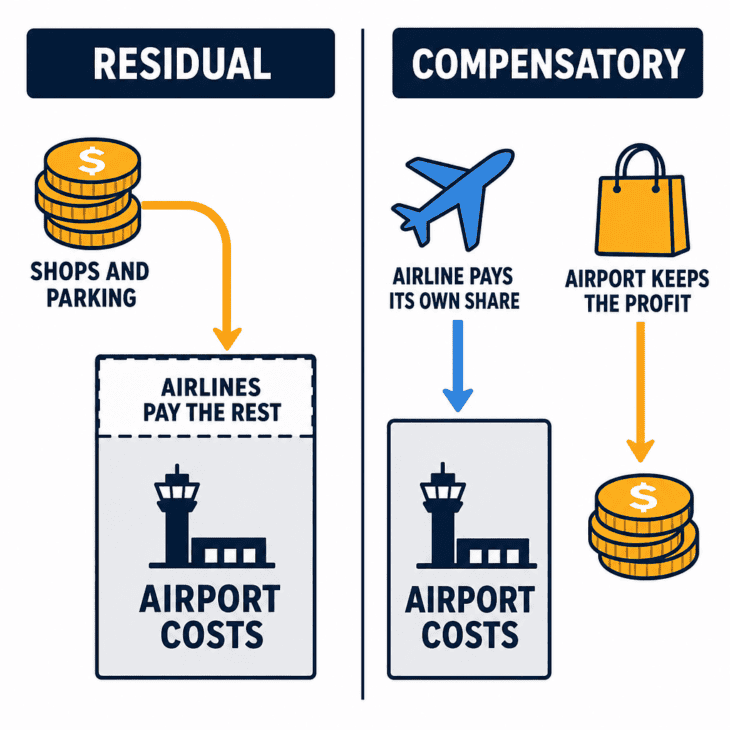
Under a residual agreement, the airport first applies all its commercial income against its costs, then divides whatever is left over among the airlines as landing fees and rents. The airlines guarantee the shortfall, so the airport cannot lose money. It also cannot really make any.
The consequence is neat and slightly perverse: the better the shops do, the less the airlines pay. Every dollar spent on a coffee at a residual-rate airport shaves a fraction off somebody’s landing fee.
Under a compensatory agreement, the airport charges each airline its allocated share of the facilities it actually uses, and keeps the commercial upside for itself. That is the model most large US airports have moved toward, and it is why terminal investment and retail strategy now matter so much to airport management.
In the United States there is a further constraint that surprises people. Under federal law, revenue generated by a public airport has to be spent on that airport or its local airport system. A city cannot run its airport as a cash machine and move the surplus into the general fund, and the FAA polices this as “revenue diversion.”
The per-passenger fee buried in your ticket is capped too. The Passenger Facility Charge started at 3 dollars in the early 1990s and has been frozen at a maximum of 4.50 dollars per flight segment since 2000, so inflation has quietly halved what it buys. It is one of the smaller pieces of what you actually pay for in an airline ticket, and airports have been lobbying to raise it for two decades.
Where the commercial money comes from
The split is not what most people guess. Duty free perfume gets the attention, but the single biggest line item is a slab of concrete you drive onto before you ever see a terminal.
| Source | Share of global non-aeronautical revenue |
|---|---|
| Car parking | 24.1% |
| Retail concessions | 23.1% |
| Property and real estate | 15.8% |
| Food and beverage | 6.3% |
Property is the line most travelers never think about. Airports sit on enormous tracts of land, and leasing it to cargo operators, hotels, maintenance hangars, offices and logistics parks produced almost 16 percent of global commercial income in 2024.
The parking garage is the quiet profit center
In North America, parking is not just the biggest commercial line, it is the dominant one, at roughly 43 percent of non-aeronautical revenue. Add rental car concession fees and per-trip charges on ride-hailing pickups and the ground transportation complex becomes the closest thing an airport has to a money printer.
The reason is margin. A parking deck is built once with bond money and then costs very little to operate, so most of what a garage takes in drops through. A gate, by contrast, comes with fire crews, de-icing, snow removal, security and a runway that has to be repaved.
This also explains a quirk of hub airports. A passenger who connects never parks a car, never rents one and never uses the garage, so a fortress hub can be enormous in flight terms and still earn less commercial revenue per head than a smaller origin-and-destination airport.
Atlanta handles around 1,285 flights a day as of late July 2026, and a large share of those passengers never leave the secure side of the building. That is exactly why Atlanta became the world’s busiest airport, and it is also why connecting traffic is worth less per passenger at the till than it looks on a movements chart.
Why the sandwich costs eighteen dollars
Here is the part that connects the business model to your wallet. The airport does not set the price of your sandwich. It sets the rent, and the rent is structured in a way that makes cheap food nearly impossible.
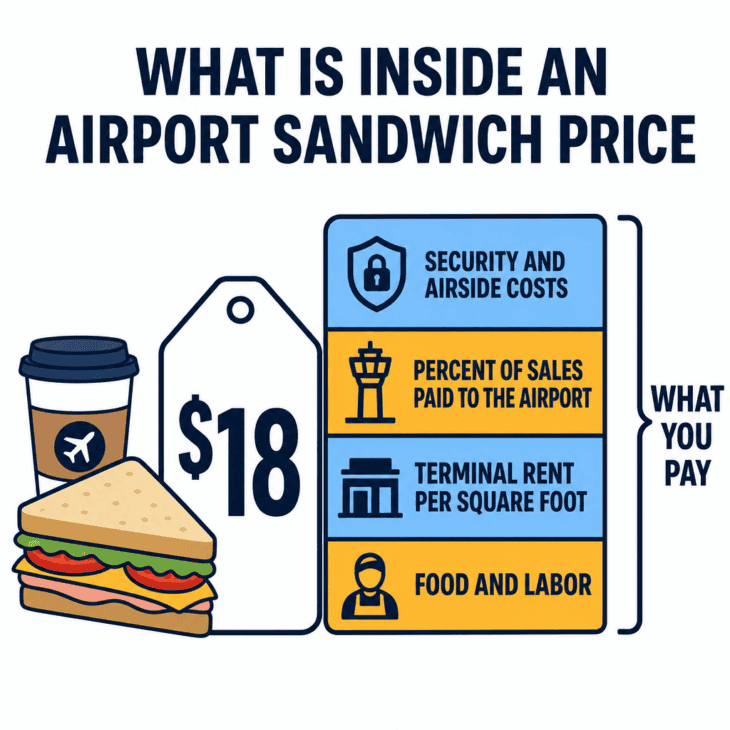
A terminal restaurant does not sign a normal lease. It signs a concession agreement that requires it to pay the airport the greater of a Minimum Annual Guarantee or a percentage of gross sales, commonly in the 10 to 18 percent range depending on the category.
That “greater of” clause is the killer. In a slow year the operator still owes the guaranteed floor, so it prices every good year to cover the risk of a bad one. On top of that, terminal space at large hubs rents for anywhere from about 60 dollars to well over 500 dollars per square foot per year.
Then come the operating costs unique to being behind a checkpoint. Every delivery is screened. Every employee needs a background check and a badge, and has to park and clear security before a shift that may start at 4 a.m. Restocking happens through service corridors on the airport’s schedule, not a truck at the back door.
Finally there is the customer. You are past the point of no return, you have limited time, and there are four options instead of forty. That is not a market that punishes high prices, which is a different problem from the one that makes the food on board taste the way it does.
What shopping is worth to one airport
Heathrow took 791 million pounds in retail revenue in 2025, about 9.36 pounds (roughly 12.65 dollars) from every one of its 84.5 million passengers, on total revenue of 3.6 billion pounds. Retail income grew faster that year than passenger numbers did, which is the whole strategy in a sentence.
The myth: the airport is gouging you
The common assumption
People assume some faceless airport authority marks up the coffee because it can. The markup is real, but it is a policy choice written into a lease, and a couple of American airports have chosen the other way.
Portland International and Salt Lake City both run a “street pricing” rule: a concession has to charge what it charges at its off-airport locations, and the airport audits prices and investigates complaints to enforce it. A Big Mac costs the same at the gate as it does downtown.
Portland runs about 331 flights a day, so this is not a rounding-error airport with nothing to lose. It is a mid-size operation that decided passenger goodwill was worth more than the extra percentage points, and reported passengers spending more per head than at several comparable airports.
Most airports instead run “street pricing plus,” allowing something like 10 to 15 percent above the outside price to reflect the cost of operating airside. Enforcement varies, and where there is no cap at all, the ceiling is whatever a hungry captive traveler will pay.
The second myth is that your taxes built the terminal. Most large airport projects are financed with revenue bonds repaid out of exactly the streams above, which is why an airport that cannot grow its commercial income cannot easily build anything either.
It also explains the strategy of the low-cost secondary airfield. Cut aeronautical charges to almost nothing, attract carriers that would otherwise never come, and make it back on parking and concessions once passengers arrive. That trade is a big part of why so many “city” airports are nowhere near the city.
So the next time you are handed a receipt that makes you blink, the chain behind it is short. The airline is paying close to cost for the runway, the airport needs to cover roughly half its expenses from the ground floor, and you are standing on the ground floor.
The terminal is not a building with shops in it. It is a shopping and parking business that happens to own a runway, and the runway is closer to a loss leader than anyone standing at that window would guess.
Sources and references used for research and fact-checking.
- ACI World Insights, Airport Non-Aeronautical Revenues: From Traffic Recovery to Value Reinvention
- Airports Council International, Airports face financial challenges despite air traffic rebound, ACI World economics report reveals
- US Department of Transportation / Federal Aviation Administration, Policy and Procedures Concerning the Use of Airport Revenue
- US Government Accountability Office, Commercial Aviation: Raising Passenger Facility Charges Would Increase Airport Funding, but Other Effects Less Certain
- DFW International Airport, Dallas Fort Worth International Airport Concessions Lease
- Heathrow Airport Holdings, Heathrow (SP) Limited Full Year 2025 Results
Get the Newsletter
The latest aviation news and stories sent to your inbox.
About the Author

Tim is the owner and lead editor of AeroCorner since 2019, overseeing aviation content covering aircraft, airlines, airports, and the broader aviation industry. Through years of researching, writing, editing, and publishing aviation-focused content, he has developed extensive practical knowledge of commercial aviation and air travel. Based in Asia and a frequent traveler himself, Tim also brings firsthand passenger experience to AeroCorner’s coverage. Outside of publishing, he has also explored aviation firsthand through hands-on flight training in New Zealand.