

Table of Contents
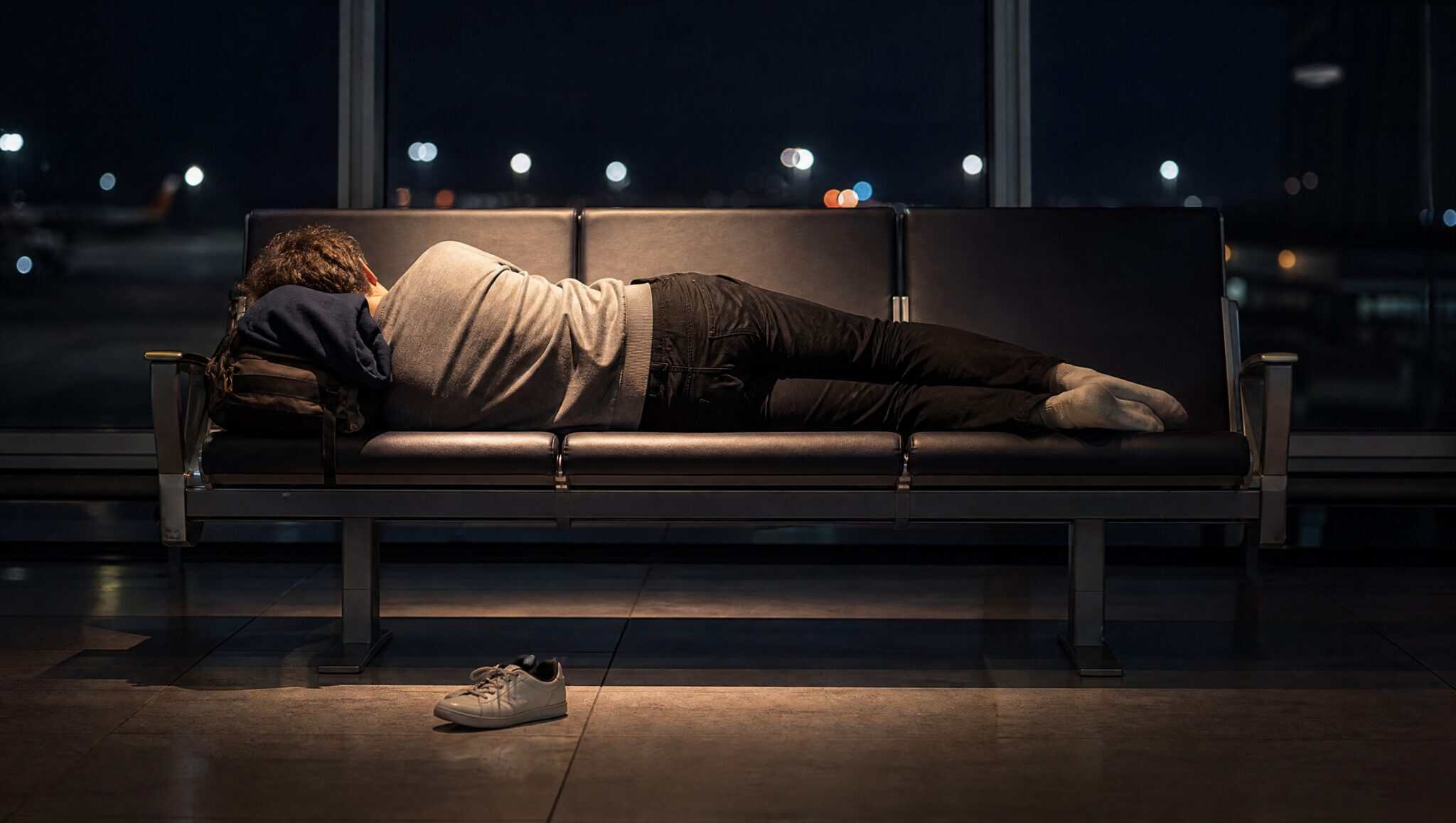
Jon Dee reached Sydney Airport after midnight for a 6 a.m. flight, planning to doze in the terminal until check-in opened. Security told him to leave. Other travellers told the ABC of waiting outside in the dark, among them a mother with a six-month-old baby who spent two and a half hours there.
“I travel around the world, all the major international airports,” Dee said, “the terminals themselves are open 24 hours a day even if they’re not allowed to fly 24 hours.” That is the assumption most of us carry: airports never close, so you can always sleep in one. It is only half right.
Whether you can spend the night depends on three things most travellers never check: whether the building locks its doors, which side of security you are on, and whether you are holding a boarding pass. Here is how each one works, and where each one catches people out.
Can You Sleep in an Airport Overnight?
Usually, yes, if you are a ticketed passenger and the building stays open. Sleeping itself is almost never the offence. What airports control is who may be inside, where, and at what hours.
That control has tightened. Since 2016, a run of airports from New York to Madrid has barred people without a boarding pass or a business reason, mostly in response to people living in terminals. Others close entire floors at night, or move connecting passengers out of the transit area.
The answer at a glance
Yes at most large airports, if you hold a boarding pass. But some terminals lock their doors overnight (Sydney’s international terminal shuts from 11 p.m. to 2:30 a.m.), security checkpoints often close and leave you in the public hall until morning, and a growing list of airports, including Atlanta, Charlotte and Madrid, now bars anyone without a ticket or a business reason.
Some Airports Simply Lock the Doors
The most absolute rule is a locked door. Sydney Airport runs under a legal curfew: from 11 p.m. to 6 a.m., the Sydney Airport Curfew Act 1995 bars most takeoffs and landings, and a breach can cost more than A$1.1 million.
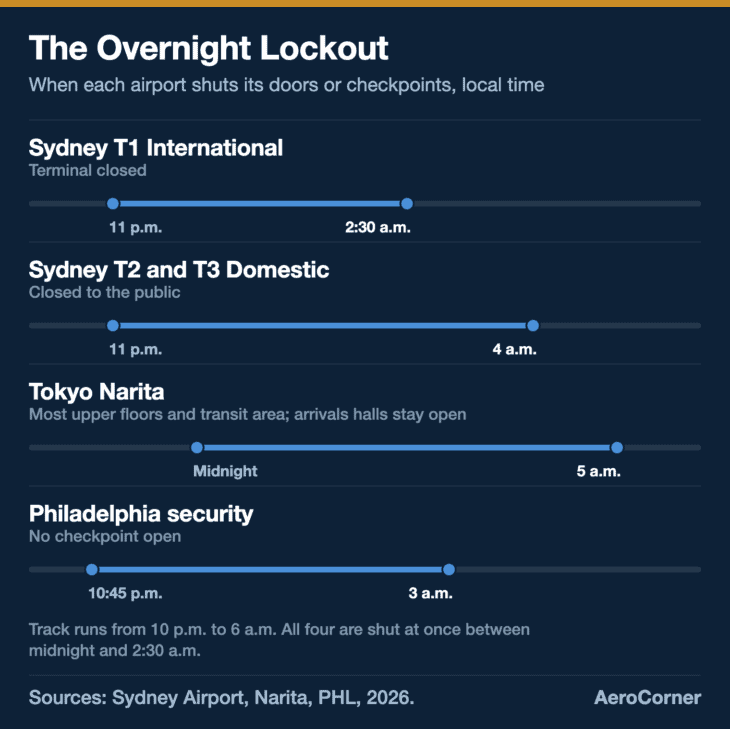
The terminals follow the flights. Sydney Airport says its T1 International terminal is closed from 11 p.m. to 2:30 a.m. and its T2 and T3 domestic terminals close to the public from 11 p.m. to 4 a.m., in both cases “for security reasons.”
After the ABC reported the lockouts in March 2024, the airport said it takes “a common sense approach” with its security contractor, particularly around vulnerable people. The closure hours reported then are the same ones the airport publishes today.
Tokyo’s Narita International Airport, the more distant of Tokyo’s two main airports, runs a softer version. It has no passenger flights at night, and most of its upper floors, including the check-in areas, close from midnight to 5 a.m.
The ground-floor arrivals halls stay open around the clock, and Narita publishes its own guide to waiting there overnight, down to which terminals have a 24-hour convenience store. For an actual bed, there is a capsule hotel in the parking garage connected to Terminal 2.
The Line That Matters Is Security
Every airport divides into two worlds. Landside is everything before security: check-in, the arrivals hall, the public concourse. Airside is everything after it: the gates, the duty-free shops, the transit area.
The two follow different rules at night, and the gate between them often shuts. At Philadelphia International, no security checkpoint is open around the clock. As posted in September 2026, the last one closes at 10:45 p.m. and the first reopens at 3 a.m.
So a traveller who turns up late in the evening for a dawn flight usually cannot reach the quiet gate area. They spend the night landside, in exactly the public space where the stricter rules below apply. It is also why the usual advice on how early to arrive at the airport assumes the checkpoint is open.
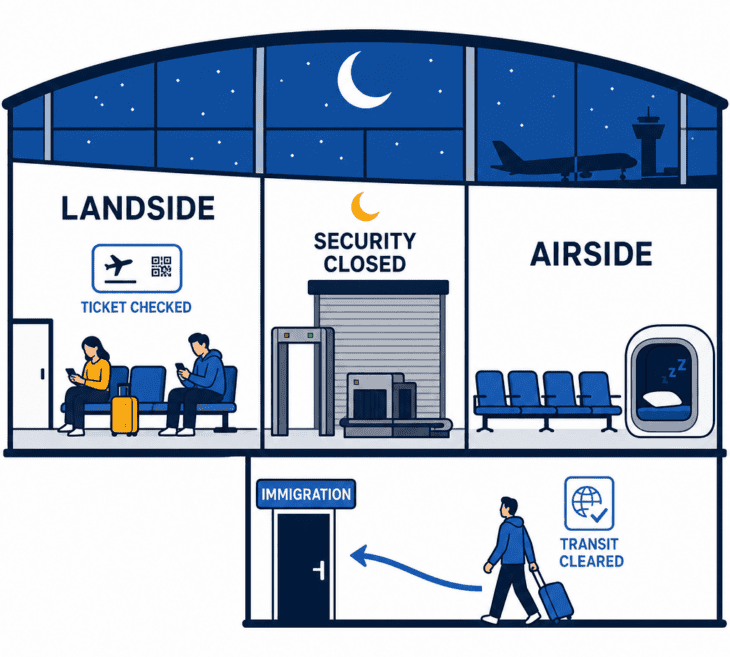
Connecting passengers have the opposite problem. If you land airside and fly out airside, you never enter the country, which matters if you have no visa. But some airports empty the transit area overnight.
Narita clears and closes its transit zone from midnight to 5 a.m., so an overnight connection means clearing immigration and leaving, according to a 2024 analysis by LoyaltyLobby. The site notes that Japanese authorities will usually grant an emergency entry permit to a stranded passenger without a visa.
At Heathrow, the site Sleeping in Airports reported in July 2026 that customer service was telling overnight passengers to leave the secure area, pass through UK Border Control where applicable, and book a hotel. For anyone who needs a UK visa or travel authorisation to cross that border, it is not a small detail.
The airports that welcome sleepers do it airside. Singapore Changi runs free snooze lounges in the departure transit halls of all four terminals, open 24 hours and, in the airport’s words, accessible to all passengers regardless of airline or ticket class.
Istanbul Airport has a YOTELAIR cabin hotel inside its duty-free area that sells overnight stays, but only to guests with a valid boarding pass for an international flight. Even the best bed in an airport comes with a ticket check.
Your Boarding Pass Is Your Permission Slip
The biggest change in airport sleeping has little to do with travellers. It is about people with nowhere else to go, and the rules written to move them on.
In January 2016, the Port Authority of New York and New Jersey began closing LaGuardia’s terminal to all but ticketed passengers from 11 p.m. to 4 a.m. “To meet our public safety mandate,” it said, “we will close the LaGuardia terminal to all but ticketed passengers during late night hours.”
Atlanta went further. Hartsfield-Jackson began limiting access to ticketed passengers, the people helping them and authorised staff in 2018, but only from 11 p.m. to 4:30 a.m. After a city ordinance passed in February 2024, the restriction has applied around the clock since that April.
It now covers the terminals, the SkyTrain, the rental car center and the parking decks. Anyone without legitimate business there, from a flight to a pickup, can be arrested and prosecuted.
Charlotte Douglas followed on July 1, 2024, admitting only people with a business purpose: ticketed passengers, those assisting them, staff, contractors, vendors and invited guests. Days later, Boston Logan stopped homeless families sleeping overnight in Terminal E, while promising that passengers facing delays and cancellations would still be accommodated.
Europe is moving the same way. In May 2025, Spain’s airport operator Aena said Madrid-Barajas would admit only boarding pass holders, staff and people accompanying travellers during its quietest hours, after homeless encampments had grown inside some terminals.
“Airports are not places designed for living in,” Aena said, “but rather are infrastructure solely for transit, which in no case offers adequate conditions for overnight stays.”
British airports work through byelaws rather than ordinances. Heathrow’s 2014 byelaws state that “no person shall loiter, frequent or remain on the Airport without reasonable cause.” A boarding pass for the first flight out is about as reasonable a cause as exists.
The Overnight Rules at 10 Airports
Here is how the rules above line up, airport by airport. At the four places with published closing times, the doors or checkpoints are all shut at once between midnight and 2:30 a.m.
| Airport | What happens overnight | Source, date |
|---|---|---|
| Sydney (T1 International) | Terminal closed 11 p.m. to 2:30 a.m. | Sydney Airport, 2026 |
| Sydney (T2 and T3 Domestic) | Closed to the public 11 p.m. to 4 a.m. | Sydney Airport, 2026 |
| Tokyo Narita | Most upper floors and the transit area close midnight to 5 a.m.; ground-floor arrivals halls stay open | Narita Airport, 2026 |
| Philadelphia | No security checkpoint open from 10:45 p.m. to 3 a.m. | PHL, September 2026 |
| London Heathrow | Overnight passengers told to leave the secure area and use a hotel | Reported July 2026 |
| Atlanta Hartsfield-Jackson | Legitimate business only, around the clock | Since April 2024 |
| Charlotte Douglas | Business purpose only | Since July 2024 |
| Boston Logan | No overnight sleeping for homeless families in Terminal E; stranded passengers accommodated | Since July 2024 |
| Madrid-Barajas | Boarding pass holders, staff and companions only in the quietest hours | Announced May 2025 |
| Singapore Changi | Free 24-hour snooze lounges in the transit halls of all four terminals | Changi Airport, 2026 |
| Istanbul | Airside YOTELAIR cabins for international boarding pass holders | YOTEL, 2026 |
The Myth of the Airport You Can Live In
The myth
Thanks to the film The Terminal, plenty of people believe an airport cannot throw you out once you are inside. The film was loosely inspired by a real man, but his case was a legal oddity, and the rules written since have made it rarer still.
Mehran Karimi Nasseri lived in Terminal 1 at Paris Charles de Gaulle from August 1988 until 2006. He was first stuck in legal limbo without residency papers, then stayed by apparent choice, reportedly refusing to sign the refugee papers he eventually received.
He left only when he was taken to hospital in 2006, and his story loosely inspired the 2004 Tom Hanks film. He died of a heart attack in the airport’s Terminal 2F in November 2022.
The other famous case ended in an arrest.
Three months inside O'Hare
Aditya Singh flew into Chicago O’Hare from Los Angeles on October 19, 2020, and prosecutors said he lived undetected in the airport’s security zone until January 16, 2021. He was caught when two United employees asked for ID and he showed a badge that an operations manager had reported missing. He was charged with impersonation in a restricted area of the airport and theft.
Both stories blur the line airports actually care about. A stranded passenger dozing across three seats is tolerated almost everywhere, and Boston wrote an exemption for them into its ban. Living in the building is what the rules are built to stop.
How to Know Before You Plan a Night in the Terminal
The rule that applies to you is set airport by airport, so check the airport’s own website before you count on it. Several publish exactly what you need: Sydney lists its closure hours, Narita maps its overnight waiting areas, and Philadelphia posts every checkpoint’s hours.
Then answer three questions: does the terminal close, will the checkpoint be open when you arrive, and, if you are connecting overnight, does the transit area stay open? If it does not, make sure you can legally enter the country before you rely on the arrivals hall.
Keep your boarding pass where you can reach it. At 3 a.m., in a growing number of airports, it is the document that separates a passenger from a trespasser.
Jon Dee was right that the world’s big airports rarely switch off. What he ran into is that an open runway, an open terminal and an open checkpoint are three different things, and at night you need all three.
If you do end up sleeping upright in a row of terminal chairs, the tricks that help you sleep on a plane work on the ground too. Just keep that boarding pass in your pocket rather than your checked bag.
Sources and references used for research and fact-checking.
- Sydney Airport, Sydney Airport opening hours
- ABC News, Passengers complain about Sydney Airport closure due to flight curfew
- Australian Department of Infrastructure, Transport, Regional Development, Communications, Sport and the Arts, Curfew at Sydney Kingsford Smith Airport
- Narita International Airport, Terminal Use at Night and Early Mornings
- LoyaltyLobby, Deciphering the Mystery of the Narita Airport Overnight Closure and Baggage-Check Limitations
- Sleeping in Airports, FAQ: Sleeping in Airports
- Sleeping in Airports, Sleeping in London Heathrow Airport
- Philadelphia International Airport, Security Checkpoint Hours
- Changi Airport Group, Free Snooze Lounges: Changi Airport Rest Areas
- YOTEL, YOTELAIR Istanbul Airport (Airside)
- CBS New York, Port Authority: Homeless Will No Longer Be Allowed At LaGuardia Overnight
- The Atlanta Journal-Constitution, Airport wants law restricting access overnight to limit number of homeless
- Atlanta News First, New access restrictions at Hartsfield-Jackson Atlanta International Airport now in effect
- WBTV, New policy bans homeless from sleeping inside Charlotte airport
- WBUR, What to know about the new rule against sleeping overnight at Logan Airport
- Spain in English, Madrid airport to restrict access for non-travellers due to homeless encampment problem
- Heathrow Airport Limited, Heathrow Airport Byelaws 2014
- NPR, The man who inspired 'The Terminal' dies at the airport he long called home
- CNN, Man 'lived undetected in Chicago airport for three months'
Get the Newsletter
The latest aviation news and stories sent to your inbox.
About the Author

Tim is the owner and lead editor of AeroCorner since 2019, overseeing aviation content covering aircraft, airlines, airports, and the broader aviation industry. Through years of researching, writing, editing, and publishing aviation-focused content, he has developed extensive practical knowledge of commercial aviation and air travel. Based in Asia and a frequent traveler himself, Tim also brings firsthand passenger experience to AeroCorner’s coverage. Outside of publishing, he has also explored aviation firsthand through hands-on flight training in New Zealand.