

Table of Contents
The biggest airplane graveyard in the world is the boneyard at Davis-Monthan Air Force Base in Tucson, Arizona. Run by the Air Force’s 309th Aerospace Maintenance and Regeneration Group (AMARG), it holds roughly 3,500 to 4,000 military aircraft on 2,600 acres (1,050 hectares) of desert.
Nothing else comes close. The largest commercial aircraft boneyards, in California and Arizona, are sized for roughly 450 to 500-plus aircraft each, so Davis-Monthan is several times bigger than any of them.
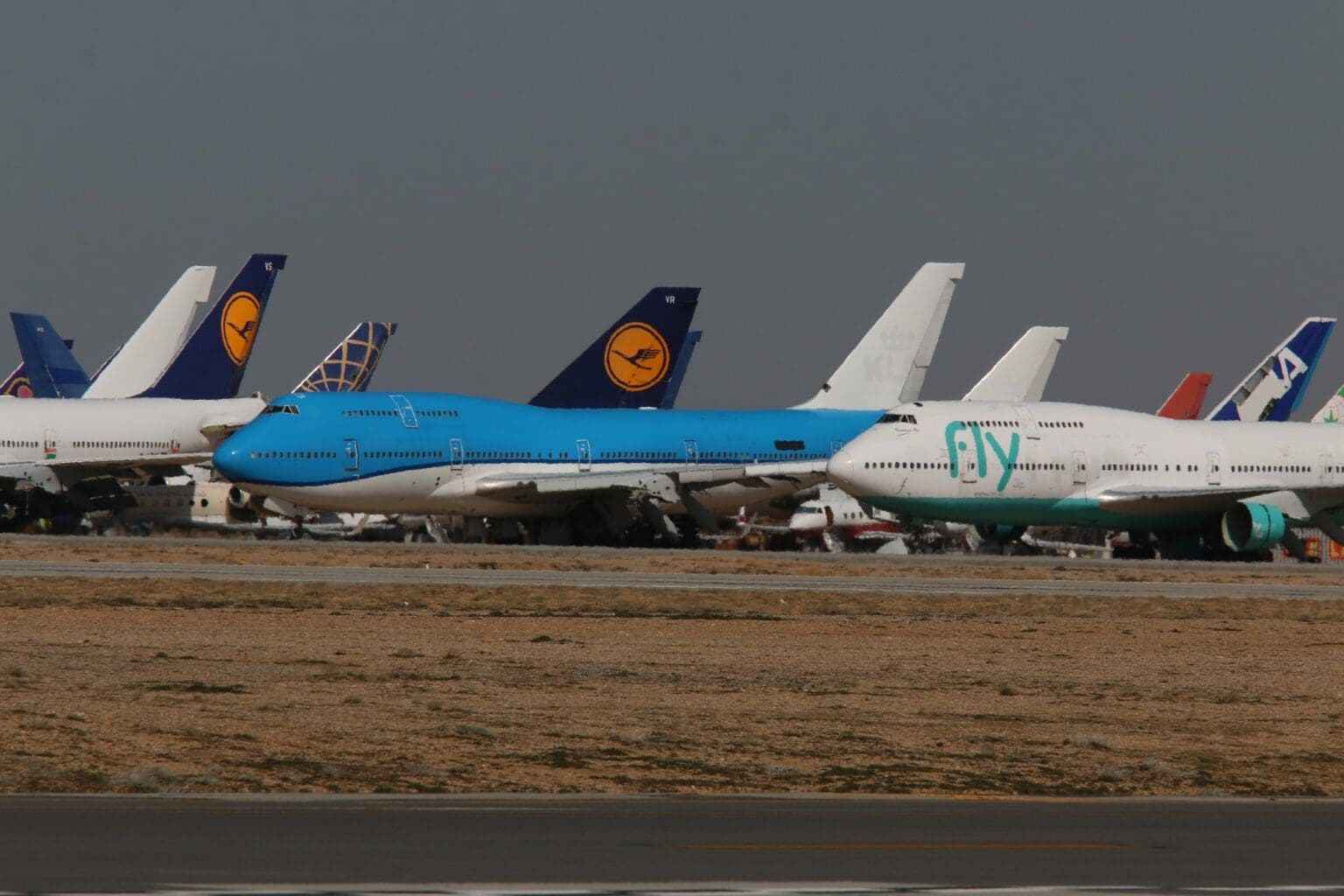
This list ranks the ten biggest airplane graveyards by the number of aircraft each one holds, as of September 2026. It covers military and commercial sites on three continents, explains why nearly all of them sit in deserts, and answers the question most people actually have: what happens to a plane once it gets there.
| Rank | Airplane graveyard | Location | Aircraft held | Type |
|---|---|---|---|---|
| 1 | Davis-Monthan AFB (309th AMARG) | Tucson, Arizona | ~3,500 to 4,000 stored | Military |
| 2 | Southern California Logistics Airport | Victorville, California | 500+ capacity | Commercial |
| 3 | Pinal Airpark | Marana, Arizona | Up to 450 capacity | Commercial |
| 4 | Teruel Airport | Aragón, Spain | Up to 400 capacity | Commercial |
| 5 | Roswell Air Center | Roswell, New Mexico | 300+ at the 2020 peak | Commercial |
| 6 | Alice Springs (APAS) | Northern Territory, Australia | 250 to 300 capacity | Commercial |
| 7 | Kingman Airport | Kingman, Arizona | ~250 stored | Commercial |
| 8 | Tarbes-Lourdes-Pyrénées | Tarbes, France | 100+ capacity | Commercial |
| 9 | Mojave Air and Space Port | Mojave, California | Not published | Commercial |
| 10 | Cotswold Airport | Gloucestershire, England | Not published | Commercial |
How this ranking works
Graveyards are ranked by how many aircraft they hold, because that is what makes one bigger than another. Total airport acreage is a poor measure: Roswell’s airport covers 5,029 acres, but that figure counts runways, taxiways and everything else on the field, not just parked aircraft. Where the storage operator publishes a capacity, that figure is used. Where it does not, the largest verified count on the ground is used instead. Mojave and Cotswold publish neither, so they close the list on reputation and scale of operations rather than a number. Places 2 and 3 are close enough that the order could flip in any given year.
1. Davis-Monthan Air Force Base (309th AMARG), Arizona
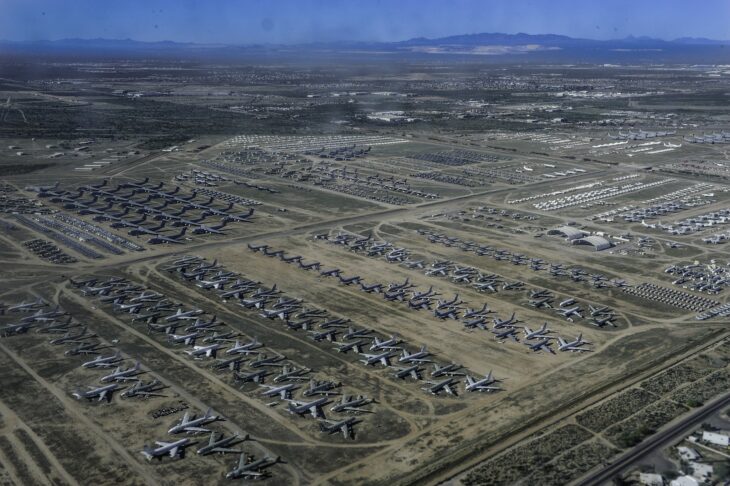

The Davis-Monthan boneyard is the largest aircraft storage and preservation facility in the world, according to the US Department of Defense. Its 2025 count put nearly 3,500 retired or stored aircraft on the base, and other recent tallies run closer to 4,000.
The site covers 2,600 acres (1,050 hectares) in Tucson. It has stored military aircraft since just after World War II, and today holds jets and helicopters from every branch of the US military, plus aircraft for more than 80 other customers including NASA, the Smithsonian Institution and the US Forest Service.
Tucson was chosen for its climate and its dirt. The base sits at 2,550 feet (780 m) with low humidity, infrequent rain and alkaline soil, a combination that slows rust and corrosion.
It is also far more than a scrapyard. Nearly 1,100 aircraft, including the F-102, F-100, F-106, F-4 Phantom II and F-16, have been pulled out and converted into unmanned target drones. In a single recent year the boneyard returned about 10,000 parts worth around $500 million to the services.
The boneyard has sent aircraft back to war
In 1948, about a quarter of the C-47 cargo planes stored in Tucson were pulled out and flown in the Berlin Airlift. In the early 1950s, nearly 150 B-29 bombers were regenerated for the Korean War. More recently, two B-1B Lancers in storage were returned to the Air Force and are flying again.
The boneyard also carried out arms control. In 1991 it oversaw the elimination of 314 B-52 Stratofortress bombers under the Strategic Arms Reduction Treaty, along with the last 443 ground-launched cruise missiles under the INF Treaty.
2. Southern California Logistics Airport, California
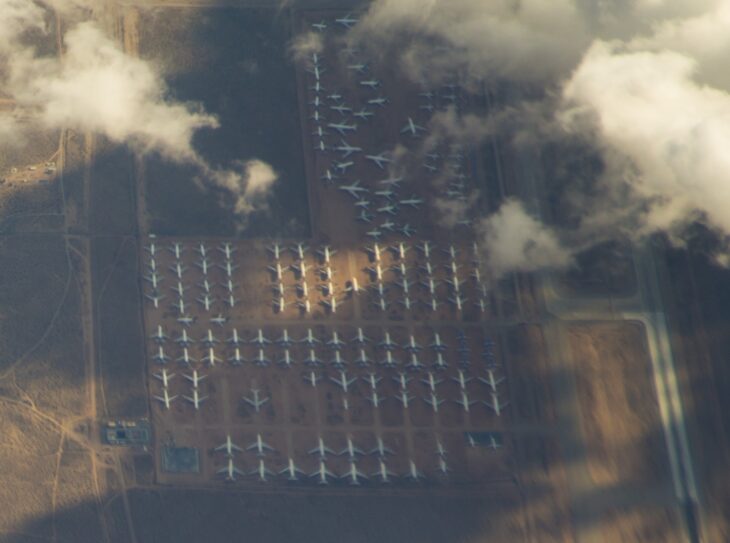

Southern California Logistics Airport in Victorville is the biggest commercial airplane graveyard on this list by published capacity. Its main storage operator, ComAv, runs a 240-acre (97 hectare) open storage yard with room for more than 500 aircraft.
The airport was George Air Force Base, a flight training base from 1941 until it closed in 1992. Today it covers about 2,300 acres (930 hectares) and has a 13,051-foot main runway, long enough to take the Airbus A380.
Victorville fills up whenever the airline industry stalls. Southwest parked grounded 737 MAX jets here in 2019, about 275 airliners had arrived by late March 2020, and Qantas moved its Airbus A380 fleet here in July 2020.
Air Force One's next jets waited here
Not every aircraft at Victorville is old. Boeing 747-8i airframes destined to become future presidential transports were stored here before their conversion, parked in the same desert as the retired jets around them.
3. Pinal Airpark, Arizona
.jpg)
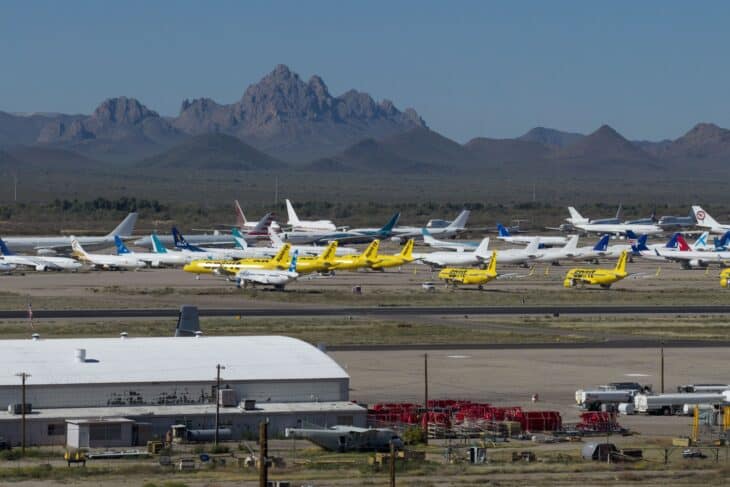
Pinal Airpark, about 30 miles (48 km) northwest of Tucson, can hold up to 450 widebody and narrowbody aircraft on the 500 acres (202 hectares) operated by its main tenant, Ascent Aviation Services. In 2020 a second operator, Jet Yard, was also storing and salvaging aircraft on the same airfield.
It has the strangest history on this list. During the Vietnam War years the airpark, then the old Marana Army Air Field, was the headquarters of CIA air operations and the main US maintenance base for the agency’s Southeast Asia operations, including Air America.
In April 2020 it held 268 aircraft, one of the highest totals in its history, after JetBlue alone sent more than 80 airliners in two weeks. Before the pandemic, 29 of its 93 parked aircraft were grounded Boeing 737 MAX 8s.
Pinal is growing, not shrinking. In March 2024 Ascent broke ground on two widebody hangars, a $55 million project to convert Boeing 777-300ER passenger jets into freighters for Israel Aerospace Industries.
4. Teruel Airport, Spain
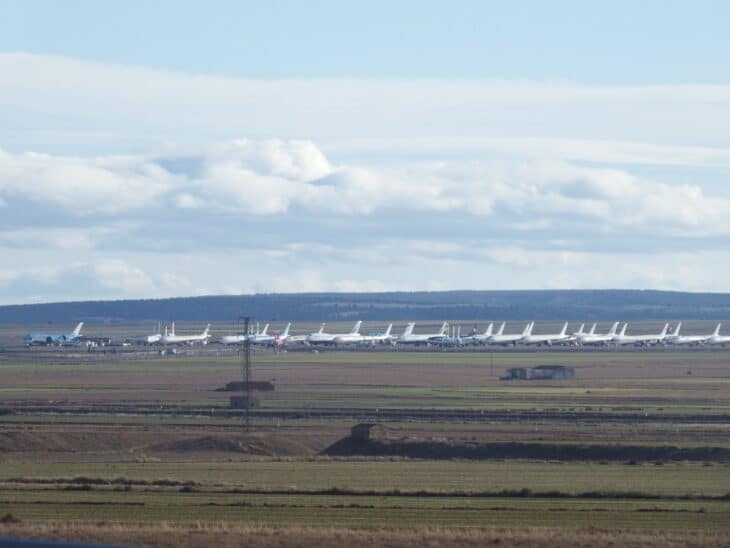

Teruel Airport in eastern Spain is an airport with no passengers. Certified in 2013, it operates as an aircraft storage, maintenance and recycling base and is not equipped to handle passenger traffic at all.
The airport says it can park up to 400 aircraft long-term, the biggest figure published by any European site on this list. The French firm Tarmac Aerosave, which runs the storage operation, rates its own Teruel yard at more than 120 aircraft plus 20 engines.
Teruel’s dry climate is what makes it suitable for long-term storage. About 100 grounded airliners were parked there during the COVID-19 pandemic, and its 9,268-foot runway and Boeing 747-sized hangar handle widebody jets.
5. Roswell Air Center, New Mexico
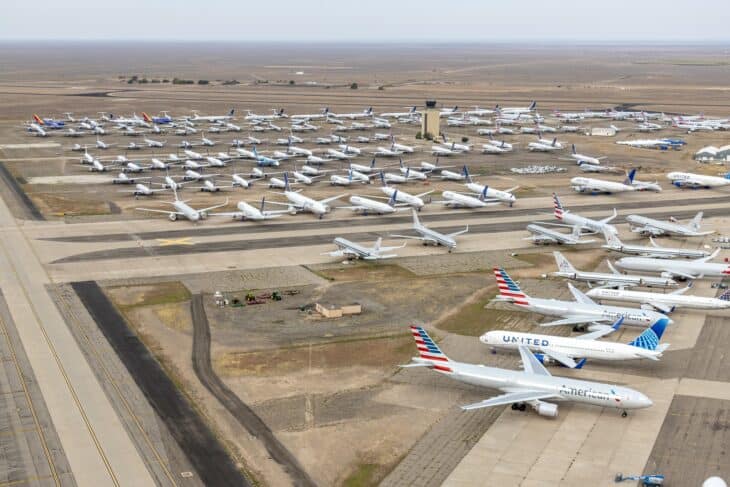

Roswell Air Center took in more than 300 aircraft during the COVID-19 pandemic in 2020, most of them from American Airlines and United. That is the largest verified count at the site, and the city’s own airport page gives no capacity figure.
The airfield was Walker Air Force Base, which was the largest base in Strategic Air Command when it closed on June 30, 1967. Today the airport covers 5,029 acres (2,035 hectares) and has a 13,000-foot main runway.
Roswell is where American Airlines retired about 20 MD-80s in a single day in 2016. It also kept Elvis Presley’s Lockheed JetStar parked for more than 40 years before the jet was sold at auction in 2023.
6. Alice Springs (Asia Pacific Aircraft Storage), Australia
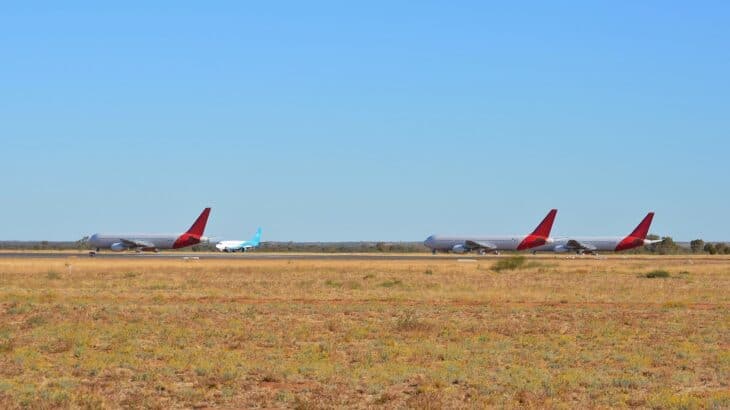

Asia Pacific Aircraft Storage (APAS) at Alice Springs Airport has hardstand space for 250 to 300 aircraft, depending on the mix of widebodies and narrowbodies. The operator says the site could be developed to hold more than 500.
Opened in 2014, it was the first commercial aircraft storage and recycling site in the Asia-Pacific region. APAS says it has stored, maintained and returned to service more than 350 commercial aircraft since then.
Central Australia gives it the same advantages as Arizona: average humidity of about 25%, little rain and a location outside Australia’s cyclone zone. It also sits on the Darwin to Adelaide railway, which the operator uses to move aircraft parts and recycled materials.
7. Kingman Airport, Arizona
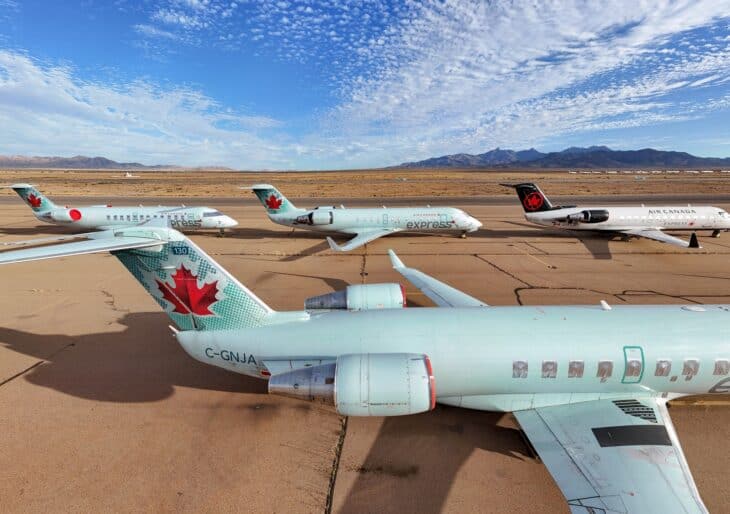

Kingman Airport in northwest Arizona has about 250 aircraft in storage, according to the city, most of them kept in airworthy condition until the market wants them back. The airport covers 4,000 acres (1,619 hectares).
Kingman ranks seventh today, but its past dwarfs its present. After World War II it became Sales and Storage Depot No. 41, and official records show close to 5,500 military aircraft were flown there between 1945 and 1947.
A field of bombers melted into ingots
More than 4,400 of the aircraft sent to Kingman after the war were heavy bombers, mostly B-17 Flying Fortresses and B-24 Liberators. A contractor stripped them, cut the airframes into pieces and fed them into a smelter, recovering around 46 million pounds of aluminum before the depot closed in 1948.
8. Tarbes-Lourdes-Pyrénées Airport, France
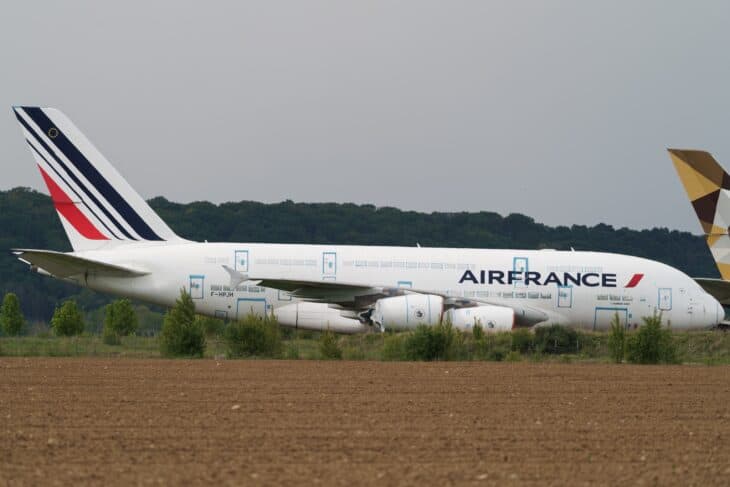

Tarbes, in the foothills of the Pyrenees, is Tarmac Aerosave’s home base and can hold more than 100 aircraft and 100 engines. The company was founded in 2007 by Airbus, Safran Aircraft Engines, Suez and Equip’Aéro, and its first aircraft, an Airbus A319, arrived at Tarbes in 2009.
Tarbes is best known for taking apart the world’s largest passenger airliner. Tarmac recycled its first A380 in 2019, and Tarbes has become a major European hub for dismantling the double-decker as airlines retire their A380s.
Across Tarbes, Teruel and Toulouse-Francazal, Tarmac passed its 1,000th aircraft handled in 2020. Its three sites together are rated for more than 280 aircraft.
9. Mojave Air and Space Port, California
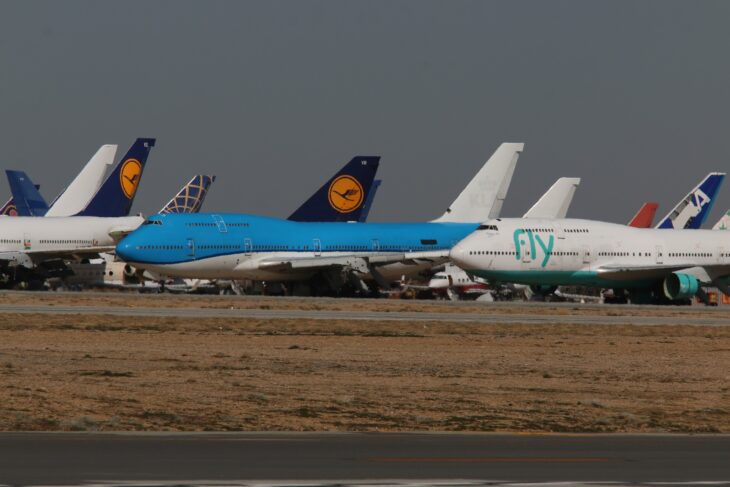
Mojave publishes no aircraft count, so it ranks here on the scale of its operation rather than a number. The airport covers 2,998 acres (1,213 hectares) at 2,801 feet (854 m), and its storage rows hold Boeing, Airbus, McDonnell Douglas and Lockheed airliners, widebodies included.
Unlike the storage yards above it, Mojave is mainly where airliners are cut up. The airport says most of its airframes are destined for scrap, and only a few, isolated on the west side of the field, are kept in flyable storage.
One arrival was already famous. C-GAUN, the Air Canada Boeing 767 known as the Gimli Glider, ran out of fuel on July 23, 1983 after a fuel calculation error and glided to a landing at a former air force base in Manitoba with no serious injuries.
It flew for Air Canada for nearly 25 more years, left for retirement at Mojave on January 24, 2008, and was scrapped there in early 2014.
10. Cotswold Airport, England
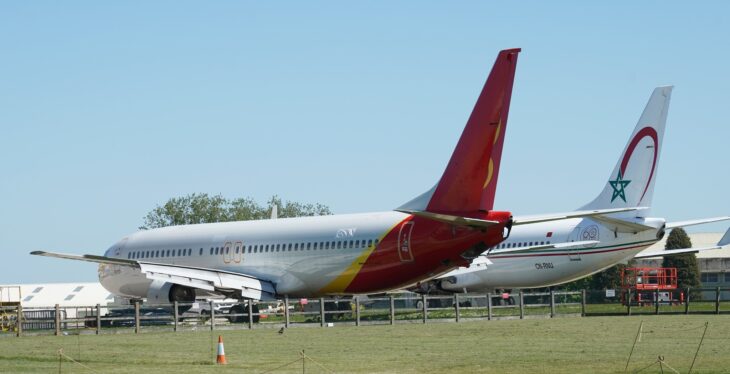
Cotswold Airport, the former RAF Kemble in Gloucestershire, is the UK’s airplane graveyard. The aircraft recycler Air Salvage International moved there in late 2009, and by 2017 the airport was being described as Europe’s leading airliner recycling location.
It has a long military past. The RAF began building the airfield in 1936, the Red Arrows display team was based there from 1966 to 1983, and a retired British Airways Boeing 747-400, G-CIVB, was preserved on site as of 2020.
Why are airplane graveyards in the desert?
Airplane graveyards sit in deserts because dry conditions reduce corrosion and the hard ground does not need to be paved. That combination lets an aircraft sit for years and still be worth returning to service.
The other reasons are practical. Desert airfields tend to be remote from big cities, and many are former military bases with long runways already built. Six of the ten sites on this list began as military airfields: Davis-Monthan, Victorville, Pinal, Roswell and Kingman in the US, and Cotswold in England.
What happens to planes in a boneyard?
A plane in a boneyard faces one of four fates: storage, return to service, parts harvesting, or scrapping. Many aircraft go through several of them in order.
At Davis-Monthan, every stored aircraft is taped and sprayed with a removable sealant that keeps out animals, reduces corrosion and keeps the aircraft about 10 degrees cooler than the air outside. Stored engines are sealed in cans filled with nitrogen to prevent corrosion caused by oxygen.
On commercial jets, the engines often go their own way. The airframe and the engines of a large airliner are typically owned by different companies, which is why many of the parked jets at Mojave have had their engines removed.
When a military aircraft has nothing left to give, contractors shred it and sort the pieces for aluminum, copper and exotic metals. The metal pays for the shredding, and if it is worth more than the job cost, the contractor sends a check to the US Treasury.
Is an airplane graveyard where planes go to die?
Often not, despite the name. Many aircraft arriving at a boneyard are being stored, not scrapped, and plenty fly out again. APAS says it has stored, maintained and returned to service more than 350 airliners at Alice Springs, and the military boneyard has regenerated everything from Berlin Airlift cargo planes to B-1B bombers. Graveyard is the nickname, storage yard is the job.
How many planes are in storage right now?
About 5,250 commercial aircraft were in storage worldwide as of June 2025, according to IATA’s analysis of Cirium fleet data. That is 15% of the global fleet of 35,550, well above the 2010 to 2018 average of 11.8%.
That looks odd during a shortage of new aircraft. IATA points to two causes: engine problems, particularly on the Pratt & Whitney PW1000G series, and aging regional aircraft that may never fly again.
The share of aircraft parked for more than five years has reached a level IATA calls unprecedented. Short-term storage is the opposite story: in IATA’s words, virtually everything that can fly is flying.
It was far worse in 2020. By mid-April that year, Cirium counted more than 16,000 passenger jets grounded, 62% of the world’s fleet, and yards from Victorville to Alice Springs scrambled for space.
Can you visit an airplane graveyard?
You can no longer tour the biggest one. The Pima Air and Space Museum’s bus tours of the Davis-Monthan boneyard have permanently ended because of changes in Air Force security considerations, and the museum says they will not be coming back.
The museum itself, in Tucson, is the best substitute. Its tram tour loops through 80 acres holding more than 200 aircraft, and it is the anchor of any trip through the aviation museums in Arizona.
The commercial yards are working maintenance and storage businesses on airport property, and the aircraft on them are privately owned by airlines and leasing companies. For most people, satellite imagery is the practical way to see them.
FAQ
Sources and references used for research and fact-checking.
- US Department of Defense, The Aircraft Boneyard
- Wikipedia, 309th Aerospace Maintenance and Regeneration Group
- Wikipedia, Aircraft graveyard
- Pima Air & Space Museum, Available Tours
- ComAv, Facilities
- Wikipedia, Southern California Logistics Airport
- Ascent Aviation Services, Aircraft Storage
- Arizona Daily Star, As airlines suffer, jet arrivals increase at airpark storage yard north of Tucson
- Wikipedia, Pinal Airpark
- Arizona Commerce Authority, Ascent Aviation Services Breaks Ground at Pinal Airpark for Two New Wide-Body Aircraft Hangars
- Aeropuerto de Teruel, Tarmac Aragón
- Wikipedia, Teruel Airport
- Tarmac Aerosave, Storage
- Tarmac Aerosave, History
- Wikipedia, Roswell International Air Center
- City of Roswell, Roswell Air Center
- Asia Pacific Aircraft Storage, Our Facility
- City of Kingman, About KMA
- Wikipedia, Kingman Airport (Arizona)
- AirplaneBoneyards.com, Kingman Army Air Field aircraft boneyard in post-WWII Arizona
- Wikipedia, Air Canada Flight 143
- City of Victorville, Airport
- Wikipedia, Mojave Air and Space Port
- Mojave Air and Space Port, Interest Point 4: The Boneyard
- Wikipedia, Cotswold Airport
- IATA, The global commercial aircraft fleet: Shortages cap growth (August 2025)
- TIME, Two-Thirds of the World's Passenger Jets Are Grounded Amid COVID-19
Get the Newsletter
The latest aviation news and stories sent to your inbox.
About the Author

Tim is the owner and lead editor of AeroCorner since 2019, overseeing aviation content covering aircraft, airlines, airports, and the broader aviation industry. Through years of researching, writing, editing, and publishing aviation-focused content, he has developed extensive practical knowledge of commercial aviation and air travel. Based in Asia and a frequent traveler himself, Tim also brings firsthand passenger experience to AeroCorner’s coverage. Outside of publishing, he has also explored aviation firsthand through hands-on flight training in New Zealand.