


Table of Contents
Every time a Cirrus goes down, the same question comes back. On November 3, 2026, it came back again, after an SR22 crashed near Lee C. Fine Memorial Airport at Lake of the Ozarks, Missouri, killing both people on board.
Why that airplane came down is a question only the NTSB can answer, and its investigation has just begun. The broader question has a long, documented answer, and it is not the one most people expect.
The SR22 is the airplane with the parachute, the glass cockpit and the modern composite airframe. For most of its first decade, it still killed its pilots at a higher rate than the older airplanes it was built to replace. This is how that happened, and how it was turned around.
Is the Cirrus SR22 Safe?
By the figures Cirrus, its owners’ association and Aviation Consumer published from 2013 to 2018, yes: the fleet’s fatal accident rate ran below the general aviation average of the time. It was not always so. In 2004, by Cirrus’s own figure, the rate was about twice the industry average.
The airplane did not change much between those two numbers. The training did. Cirrus and the Cirrus Owners and Pilots Association (COPA) rebuilt how pilots are taught to fly it, and above all when they are taught to pull its parachute.
The SR22 safety record at a glance
2004: about 2.6 fatal accidents per 100,000 flight hours, roughly twice the industry average (Cirrus). 2011: 16 fatal Cirrus accidents worldwide, the peak year. 2013: 1.01, below the 1.2 industry average of the time. 2014: three fatal accidents in more than 1 million fleet hours. 2018: about 0.6 (Aviation Consumer). The change came from training and parachute culture, not a redesign.
The Bad Years: A Modern Airplane With an Old-Fashioned Fatal Rate
The Cirrus SR22 was certified in November 2000 and went into production in 2001. In February 2003, Cirrus began fitting the Avidyne Entegra display, which made it one of the first light aircraft with a full glass cockpit.
On paper it had everything. AOPA described the puzzle plainly in 2016: how could a modern design with an airframe parachute and the most advanced safety equipment in its class have an accident record “that wasn’t as good as the legacy fleet”?
The figures bore that out. Cirrus executive Travis Klumb told a 2014 audience that the fleet’s fatal rate in 2004 was “about twice the industry average at 2.6/100,000 hours.” In 2007, AVweb reported a fleet fatal rate of 1.4 per 100,000 hours, against a general aviation average of 1.2.
The gap between those two figures, published three years apart, is an early lesson in how much a Cirrus safety number depends on the period and the counting behind it.
Fewer accidents, more deaths
In 2007, AVweb reported that the Cirrus fleet had 4.1 accidents of all kinds per 100,000 hours, against 6.2 for general aviation as a whole. Its fatal rate was still higher, at 1.4 against 1.2. The SR22 was crashing less often than average, but its crashes were more often deadly.
Things got worse before they got better. Aviation Consumer’s review in 2012 put the Cirrus fatal rate at 1.6 per 100,000 hours, still above the 1.2 general aviation average, and 2011 was the worst year on record with 16 fatal Cirrus accidents worldwide.
The same review found that the Piper Saratoga, the Mooney M20 series and the Cessna 206 had the same or higher fatal rates. So the SR22 was not uniquely dangerous. It was simply no safer than the airplanes it was supposed to beat.
For how it stacks up against one of those rivals on performance and cost, see our Cirrus vs Mooney comparison.
What Kept Killing Cirrus Pilots
The explanations that held up had more to do with how the airplane was flown than with how it was built. Klumb gave two of them in 2014: pilots were new to an unfamiliar airplane, and owners bought it for transportation rather than recreation.
A transportation airplane flies long trips, in real weather, over varied terrain. Klumb’s point was that the pilot is often the same kind who would otherwise fly around the traffic pattern, now taking on a much harder mission.
Richard Collins, writing in Air Facts in 2012, pointed to two patterns in particular. One was cloudy-day instrument (IFR) flights by newly rated pilots without much experience. The other was low-speed loss of control, in an airplane whose only approved spin recovery is the parachute.
Aviation Consumer’s 2019 review added landing accidents, which it said play an outsized role in the Cirrus accident picture, along with loss of control in turbulence or from distraction and stall-spin events, some in the turn from base to final.
The glass cockpit was not the cure it looked like either. A 2010 NTSB safety study of light single-engine airplanes from 2002 to 2008 found that those with glass displays had lower total accident rates but higher fatal accident rates than the same types with conventional instruments.
The NTSB concluded that glass cockpits had “not resulted in a measurable improvement in safety,” and noted that the FAA had no specific training requirements for pilots flying them. That is the same pattern the Cirrus fleet showed: fewer accidents, but deadlier ones. Our glass cockpit explainer covers what those screens actually do.
The biggest factor, though, was the handle in the ceiling that nobody pulled. Cirrus estimated in 2014 that two of every three fatal accidents could have been prevented with a timely parachute deployment, and COPA’s Rick Beach put the toll at more than 125 lives lost in situations where the parachute would likely have worked.
The Turnaround: Deciding to Pull Before Takeoff
Cirrus answered with a type-specific training program, Cirrus Approach, built around deciding in advance when to use the Cirrus Airframe Parachute System. Pilots now add the parachute to their takeoff briefing and make a “flaps and CAPS” callout as the flaps come up in the climb.
The company also brought CAPS decision-making into the standard factory course for new owners, and later launched a free program, Embark, for pilots who buy a used Cirrus. By 2019, Aviation Consumer counted about 400 factory-trained instructors and 90 Cirrus pilot centers worldwide.
Just as important was the culture. Cirrus and COPA set out to make sure a pilot who pulled the parachute was applauded rather than second-guessed, under Beach’s slogan “pull early, pull often.” How the parachute itself works, from rocket to touchdown, is covered in our guide to how the Cirrus parachute works.
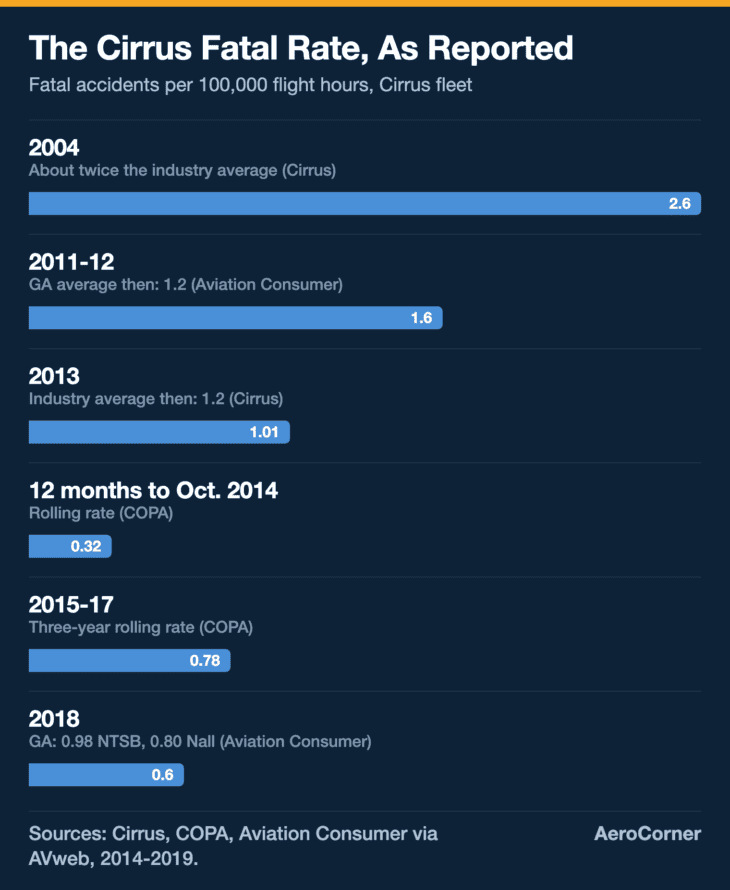
The numbers moved fast. By the end of 2013 the fatal rate had fallen to 1.01 per 100,000 hours, below the industry average of 1.2. In 2014, as Klumb later told AOPA, there was “a four-fold increase in the number of CAPS pulls,” and for the first time Cirrus pilots pulled the parachute more often than they had fatal accidents.
That year the fleet had three fatal accidents while almost 6,000 Cirrus aircraft logged more than 1 million hours. In October 2014, AVweb reported COPA’s 12-month rolling fatal rate at 0.32 per 100,000 hours, barely a quarter of the 1.2 industry average it cited.
The gains held. According to AOPA, 2015 had fewer fatal Cirrus accidents than any year since 2001, when fewer than 300 Cirrus airplanes existed, and in 2016 its Air Safety Institute gave Cirrus the first Joseph T. Nall Safety Award.
Later figures settled lower than the bad years, if not as low as 2014. COPA reported a three-year rolling fatal rate of 0.78 through 2017, and Aviation Consumer calculated about 0.6 for 2018, against general aviation figures of 0.98 from the NTSB and 0.80 from AOPA’s Nall Report.
Why the Numbers Never Quite Agree
Myth: the SR22 is in the news so often because it crashes so often
Cirrus delivered its 11,000th SR Series airplane in December 2025, and it calls the line the best-selling high-performance piston single for more than two decades. The most common airplane of its kind in the sky will also be the most common in the accident reports. A crash count says how many are flying; only a rate per flight hour says how safe they are.
A rate needs two numbers, and only one of them is easy to count. Fatal accidents are on the record, but flight hours have to be estimated, and Aviation Consumer noted in 2019 that Cirrus declined to release its yearly hours data.
COPA, which tracks the fleet with Cirrus, says it counts “all known fatal accidents” worldwide, more than the NTSB investigates. Its current page shows 0.84 fatal accidents per 100,000 hours over 12 months and 0.78 over 36 months, but it carries no date, so it is unclear which years those cover.
A tougher reading comes from PlanePhD, a third-party research site, which puts the SR22 family at 1.92 fatal accidents per 100,000 hours from 2005 to 2024, against 1.30 for all certified piston airplanes.
Its hours estimate, roughly 6.5 million over 20 years, is far lower than the roughly 1 million hours a year Cirrus claimed in 2019 for its whole fleet, SR20s included.
Even that harsher study comes out in the SR22’s favor where it counts. It compares the airplane with its real peers, single-engine pistons of 300 horsepower and up, which it puts at about 2.3, and finds the SR22 at roughly 0.83 times their rate.
That is the fair comparison. General aviation as a whole includes slow trainers flying the pattern on clear days, and AOPA’s latest McSpadden Report put its overall fatal rate at 0.65 per 100,000 hours in 2023.
A fast airplane flown on long trips in weather is doing a harder job, and it should be measured against airplanes doing the same one.
The last argument has never been settled. Critics once claimed the parachute gave pilots a false sense of security and encouraged risky flying, and AOPA’s verdict in 2016 was that “there’s no way to definitely prove or disprove that theory.”
What is documented is that the death rate fell when pilots started using the parachute, not when they stopped relying on it.
None of this explains any single crash, including the one at Lake of the Ozarks. Who was flying, what prompted the mayday call and whether the parachute was used have not been reported, and those are questions for the NTSB, whose preliminary report will be the first official account.
More on how that process works is in our guide to the NTSB.
What the record does show is that the SR22’s safety was never really about the airplane. The same airframe went from about twice the industry’s fatal rate to below it once its pilots were trained to fly the trips it was bought for, and to pull the handle in time.
For more on the airplanes and owners that make up this side of flying, see our general aviation guide and the full Cirrus Aircraft lineup.
Sources and references used for research and fact-checking.
- AOPA, How Cirrus radically reduced fatal accidents
- AVweb, Cirrus Reports Dramatic Accident Reduction
- AVweb, Debunking The Cirrus Accidents Myth
- AVweb, What The Frederick Crash Reveals About Cirrus Accident Trends
- AVweb / Aviation Consumer, Cirrus At 25: A Safer Airplane?
- Air Facts Journal, What's wrong with Cirrus pilots?
- National Transportation Safety Board, Introduction of Glass Cockpit Avionics into Light Aircraft (SS-10/01)
- Cirrus Owners and Pilots Association, Cirrus Accident Statistics
- PlanePhD, Cirrus SR22T research
- AOPA, McSpadden Report: GA accident rate down in 2023
- Cirrus Aircraft, Cirrus Delivers 11,000th SR Series Aircraft
- Wikipedia, Cirrus SR22
Get the Newsletter
The latest aviation news and stories sent to your inbox.
About the Author

Tim is the owner and lead editor of AeroCorner since 2019, overseeing aviation content covering aircraft, airlines, airports, and the broader aviation industry. Through years of researching, writing, editing, and publishing aviation-focused content, he has developed extensive practical knowledge of commercial aviation and air travel. Based in Asia and a frequent traveler himself, Tim also brings firsthand passenger experience to AeroCorner’s coverage. Outside of publishing, he has also explored aviation firsthand through hands-on flight training in New Zealand.