

Table of Contents
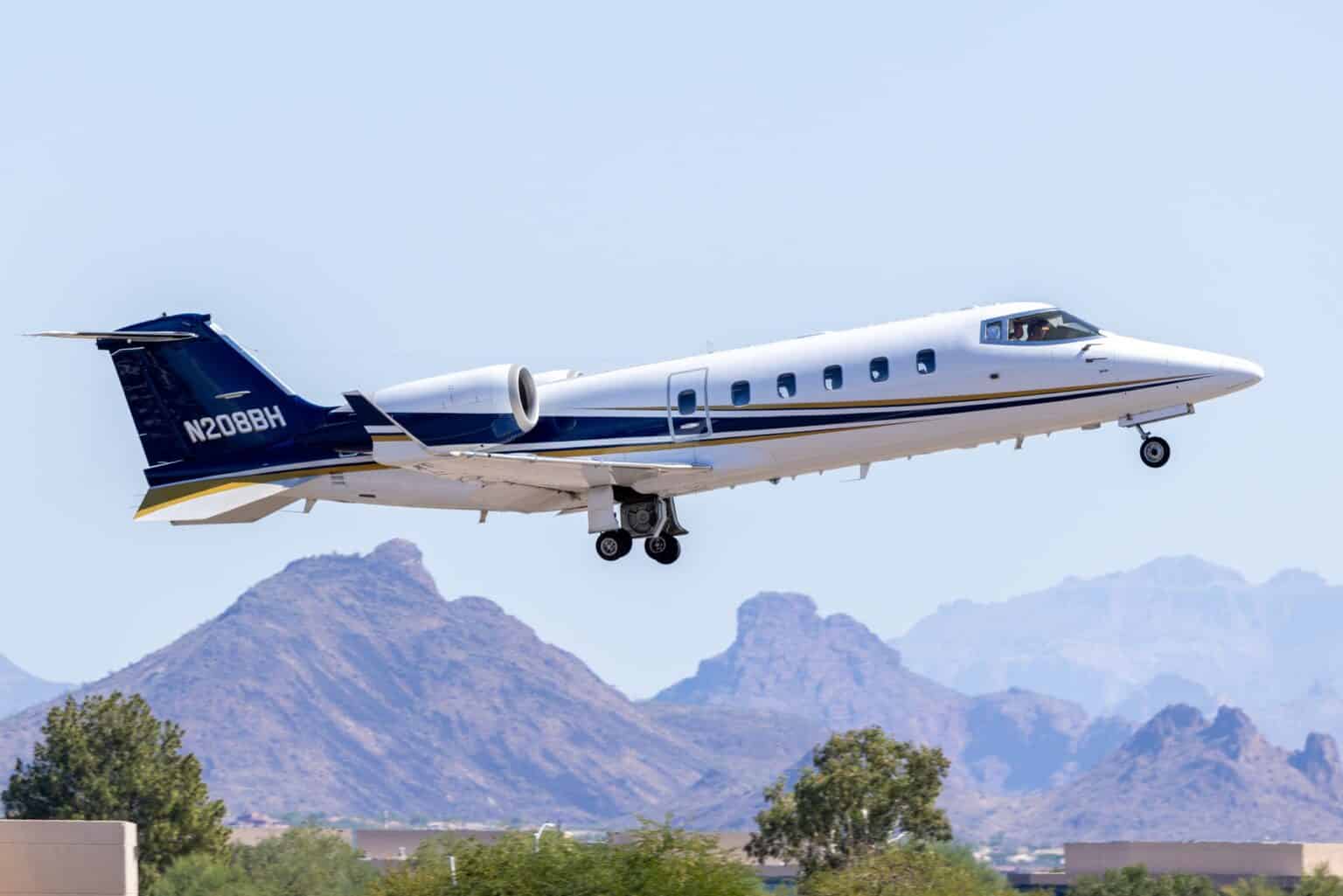
“Mayday, mayday,” the pilot of a Learjet 60 told Miami Center on November 1, 2026, according to CNN’s account of a LiveATC recording. Moments later came the call that prompted this article: “We are in an overspeed condition descending 20,000 feet per minute.”
The FAA puts the jet’s fall at 35,250 feet (10,740 m) to 8,750 feet (2,670 m) in a little over a minute, ABC News reported. All nine people aboard died near Greenacres, Florida. The NTSB has not determined a cause, and nothing here explains the N722BD crash, which we are covering separately.
The radio call does raise two questions any listener might ask. What exactly is an “overspeed” in a jet that cruises at hundreds of miles per hour anyway, and why can a crew not simply pull the nose up and stop a dive?
The answers sit in the certification rules, in the physics of air near the speed of sound, and in a recovery procedure that runs against instinct.
What Does Overspeed Mean in a Jet?
An overspeed means the jet is flying faster than its maximum operating limit speed. US certification rules for transport-category jets, at 14 CFR 25.1505, define that limit as “a speed that may not be deliberately exceeded in any regime of flight,” whether climbing, cruising or descending.
The limit comes in two forms. VMO is the maximum operating speed in knots of indicated airspeed, and MMO is the same limit expressed as a Mach number, the jet’s true airspeed as a fraction of the local speed of sound. Whichever one the jet reaches first is the one that applies.
Pilots see the limit as a “barber pole” on the airspeed tape that moves automatically to show the speed that applies at the current altitude, the FAA’s Airplane Flying Handbook explains.
Cross it by a small amount and a dedicated warning sounds: the rule at 14 CFR 25.1303 requires an aural alert at no more than VMO plus 6 knots or MMO plus 0.01, about 6 knots at 35,000 feet.
The answer at a glance
Overspeed means flying past VMO or MMO, the certified maximum operating speed, and a warning must sound within 6 knots or Mach 0.01 of it. It describes what the jet is doing, not why. A dive is hard to stop because a clean jet sheds speed slowly, gravity keeps adding it, high Mach pushes the nose down, and the safe recovery means rolling level before pulling up, with a limited number of g’s to spend.
Why a Jet Has Two Speed Limits
The speed of sound falls as the air gets colder, so the same true airspeed is a higher Mach number at altitude. At low, warm altitudes a jet runs into its indicated-airspeed limit first. High up, where the air is cold, it runs into the Mach limit first, the FAA handbook says.
That matters in a descent. A jet diving from cruise starts out against its Mach limit, but as it drops into thicker air its indicated airspeed climbs, and the limiting number hands over to VMO. A dive can therefore be an overspeed all the way down, against one limit and then the other.
At the top of the envelope the two ends of the speed range squeeze together.
That narrow band between the Mach limit and low-speed buffet is the subject of our explainer on coffin corner, and it is why a jet near its ceiling has little room to absorb a gust. This article is about what happens once the high-speed end has been crossed.
The Margin Above the Limit Is Thin by Design
VMO and MMO are not the speeds at which a jet breaks. Above them sits the design dive speed, VD and MD, the fastest speed the structure is designed and demonstrated for. Rule 25.1505 requires the operating limit to sit far enough below it that the dive speed is unlikely to be exceeded by accident.
The size of that buffer is written down. Under 14 CFR 25.335, where the Mach number limits the jet, the margin between the cruise design Mach and the dive Mach is set at Mach 0.07 unless analysis justifies less. It can never shrink below Mach 0.05.
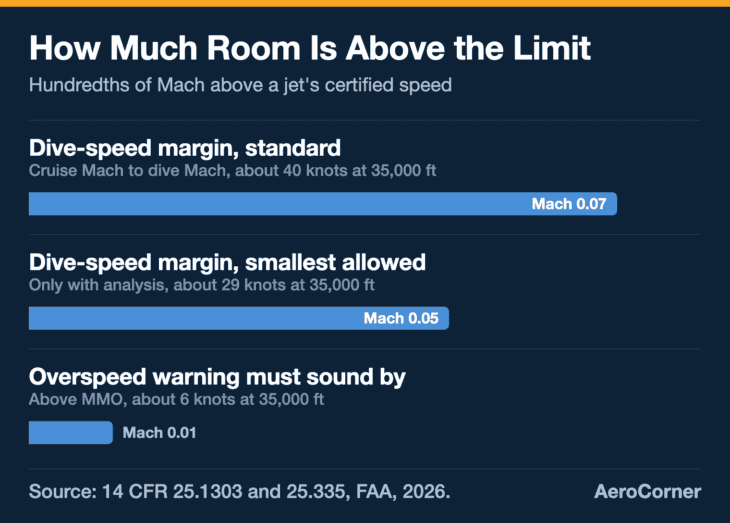
At 35,000 feet in a standard atmosphere, where sound travels at about 576 knots, Mach 0.07 works out to roughly 40 knots of true airspeed, and the Mach 0.05 floor to about 29. That is the cushion between the speed a crew must never deliberately pass and the edge of what the airframe was built and tested for.
Beyond the dive speed, the risk is no longer just discomfort. Rule 25.629 requires the airplane to be free of flutter, a self-feeding vibration of a wing or tail surface, only within an envelope 15 percent beyond VD in equivalent airspeed. Past that, nothing in certification promises the structure will hold.
The rules even describe the upset they have in mind. One way 25.335(b)(1) sizes the dive-speed margin is an upset from cruise in which the jet flies 20 seconds along a path 7.5 degrees below its original one, then pulls up at 1.5 g. A dive measured in tens of thousands of feet per minute is a very different event.
What 20,000 feet per minute really is
20,000 feet per minute is 333 feet per second, about 227 mph (366 km/h) of vertical speed alone. For a jet moving at or below the speed of sound at cruise altitude, that means a flight path roughly 20 degrees or more below the horizon, well over twice the 7.5-degree upset the dive-speed rule is sized around. From 35,000 feet, the ground is less than two minutes away at that rate.
Why the Dive Feeds Itself
The first problem is that jets are slippery. A jet engine at idle still produces forward thrust, and a clean jet airframe has none of the drag a propeller makes when the throttles close. In level flight at idle, the FAA’s Airplane Flying Handbook says, it takes about 1 mile (1.6 km) to lose 10 knots.
Point that same airframe downhill and gravity starts adding speed instead. A jet that needs a mile to lose 10 knots in level flight is now being pulled along its flight path by a component of its own weight, and in a steep dive speed builds far faster than idle thrust and drag can take it away.
The second problem appears near the speed of sound. Air speeding over the top of a jet’s wing goes supersonic before the jet does, and a shock wave forms there. As speed rises, the handbook explains, that shock moves aft, the wing’s center of pressure moves with it, and the nose starts to drop, a tendency pilots call Mach tuck.
Mach tuck turns more speed into a steeper dive, which makes more speed. The FAA warns that it must not progress to the point where there is no longer enough elevator authority to stop the airplane entering “a steep, sometimes unrecoverable, dive.” Behind the shock the airflow can also separate, bringing heavy buffeting.
Because of this, most jets that fly in this Mach range carry some form of automatic Mach tuck compensation to counter that nose-down pitch. If it fails, the handbook notes, the airplane is typically limited to a lower maximum Mach number. For the cruise speeds of each model, see our look at how fast a Learjet goes.
Why Pulling Back Is Not the Answer
The natural reaction to a dive is to haul back on the controls. The FAA’s upset recovery guidance, Advisory Circular 120-111, lays out a different order, built with input from Airbus, ATR, Boeing, Bombardier and Embraer. A manufacturer’s own procedure takes precedence, but the shared template for a nose-low upset runs like this.
- Recognize it and call it out: “Nose low.” The FAA counts an unintended pitch of more than 10 degrees nose down as an upset.
- Disconnect the autopilot and autothrottle, and expect the airplane to be badly out of trim when you do.
- Recover from a stall first if the wing is stalled, even though that may mean pushing the nose down.
- Roll in the shortest direction to wings level, easing off back pressure if needed so the ailerons work.
- If airspeed is high, reduce thrust and, if necessary, extend the speedbrakes.
- Only then recover to level flight, without excessive g.
The roll comes before the pull for a reason the circular spells out. Until the wings are level, the crew should not add positive g or nose-up trim, because pulling while steeply banked points “a large lift vector toward the ground.” In a bank, pulling back mostly tightens a descending spiral rather than raising the nose.
The pull itself has a budget. Under 14 CFR 25.337, a transport jet’s structure is designed for a positive limit maneuvering load of at least 2.5 g, and up to 3.8 g for lighter types depending on weight. Pull harder at a speed well beyond the limit and the recovery can damage the airplane it is trying to save.
The circular also warns that excessive pitch trim or rudder can make an upset worse or cause high structural loads. Add the startle of a sudden dive at night or in cloud, and the problem is less about strength than about doing six things in the right order with seconds to spare.
A Jet That Fell 31,500 Feet and Landed
Overspeed dives can be survived, and the best-documented case shows what the recovery costs. On February 19, 1985, China Airlines Flight 006, a Boeing 747SP flying from Taipei to Los Angeles, lost power on its No. 4 engine at 41,000 feet (12,500 m) with the autopilot engaged.
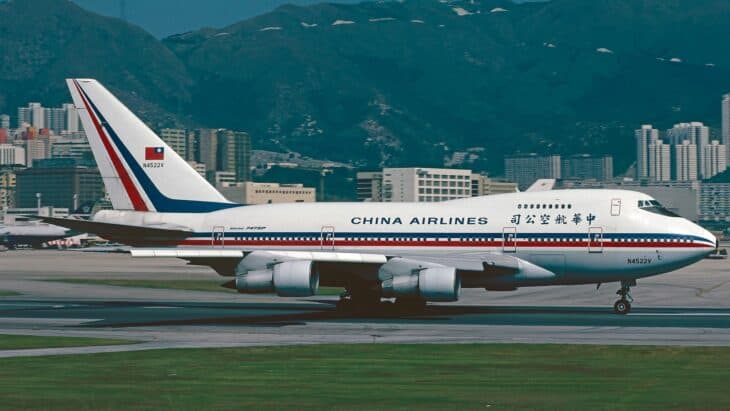

The jet went into a steep dive, losing 31,500 feet (9,600 m) in under two and a half minutes. The crew broke out of cloud at 11,000 feet (3,400 m) and leveled off at 9,500 feet (2,900 m), and occupants experienced up to 5 g, according to accounts of the NTSB investigation (report AAR-86/03).
The pull-out bent the wings permanently upward by 2 inches (5 cm), tore large outer sections off the horizontal stabilizer and ripped away the entire left outboard elevator. The 747 diverted to San Francisco, and no one died. The NTSB found the captain had over-relied on the autopilot, which masked the onset of the loss of control.
The Myth: “Overspeed” Explains What Happened
Myth: an overspeed call tells you why a jet went down
Overspeed is a state, not a cause. It is the name for flying past a certified number, and a crew reporting it is describing what the airplane is doing at that moment. Engine trouble, weather, an autopilot problem, an instrument failure or a control problem can all end in the same high-speed dive.
A related misconception is that an overspeed means the engines were at full power or the jet was going supersonic. Neither is required. A descending jet can pass VMO at idle thrust, and subsonic jets carry a Mach limit below Mach 1 precisely because shock waves form over the wing first.
That is why investigators do not stop at the word. They rebuild the minutes before the dive from radar and ADS-B tracks, the radio recordings, the wreckage and, where a jet carries them, the flight recorders. The NTSB says it tries to finish an investigation within 12 to 24 months.
So the next time you hear “overspeed” in a mayday, you will know what it does and does not say.
The jet is past a number written into its certification, its structural margin is a few dozen knots, and the way out is roll first, thrust back, speedbrakes out, and a careful pull. How it got there is a separate question, and only the investigation can answer it.
Sources and references used for research and fact-checking.
- Cornell Law School Legal Information Institute, 14 CFR 25.1505, Maximum operating limit speed
- Cornell Law School Legal Information Institute, 14 CFR 25.1303, Flight and navigation instruments
- Cornell Law School Legal Information Institute, 14 CFR 25.335, Design airspeeds
- Cornell Law School Legal Information Institute, 14 CFR 25.337, Limit maneuvering load factors
- Cornell Law School Legal Information Institute, 14 CFR 25.629, Aeroelastic stability requirements
- Federal Aviation Administration, Airplane Flying Handbook (FAA-H-8083-3C), Chapter 16: Transition to Jet-Powered Airplanes
- Federal Aviation Administration, Advisory Circular 120-111, Upset Prevention and Recovery Training
- CNN, South Florida plane crash
- ABC News, Learjet with 9 aboard crashes in Palm Beach, Florida, FAA says
- Wikipedia, China Airlines Flight 006
- National Transportation Safety Board, The Investigative Process
Get the Newsletter
The latest aviation news and stories sent to your inbox.
About the Author

Tim is the owner and lead editor of AeroCorner since 2019, overseeing aviation content covering aircraft, airlines, airports, and the broader aviation industry. Through years of researching, writing, editing, and publishing aviation-focused content, he has developed extensive practical knowledge of commercial aviation and air travel. Based in Asia and a frequent traveler himself, Tim also brings firsthand passenger experience to AeroCorner’s coverage. Outside of publishing, he has also explored aviation firsthand through hands-on flight training in New Zealand.