

Table of Contents
A fighter jet’s spec sheet says Mach 1.6. You look up what Mach 1 is, get 767 mph, multiply, and write down about 1,230 mph. Every step of that is reasonable, and the answer is wrong by more than 170 mph.
The problem is that Mach 1 is not a speed at all. It is a ratio, and the thing being measured against changes constantly with the air the aircraft happens to be flying through.
This article covers what Mach 1 actually equals, why it drops by about 100 mph between the runway and cruise altitude, and why a fighter goes supersonic at a lower true speed the higher it climbs.
How Fast Is Mach 1?
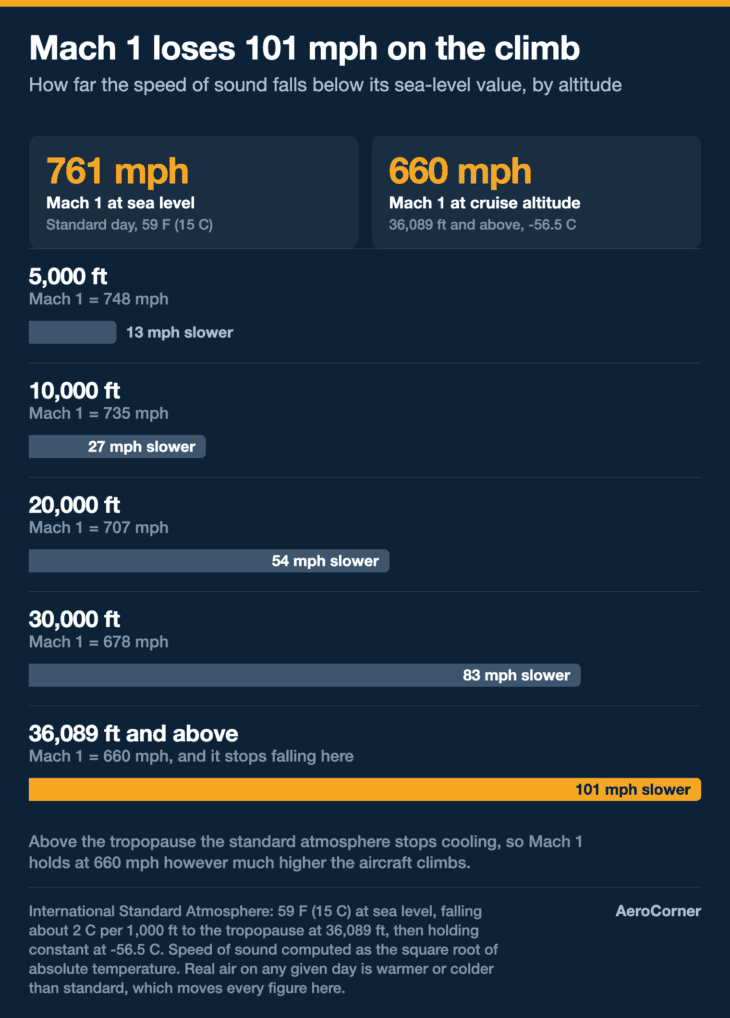
At sea level on a standard day of 59 degrees Fahrenheit (15 C), Mach 1 is 761 mph (1,225 km/h). That is 661 knots, which the FAA rounds to “approximately 660 knots” in its high-altitude operations guidance.
At the altitude where airliners and fighters actually spend their time, Mach 1 is 660 mph (1,062 km/h), or 574 knots. Same aircraft, same physics, roughly 100 mph less.
Watch the units in that pair, because they trap people. Mach 1 is about 660 knots at sea level and about 660 mph at 36,000 feet. The matching number is a coincidence, not a rule.
The short version
Mach 1 is whatever the local speed of sound happens to be, and the local speed of sound is set by air temperature alone. Warm air near the ground: 761 mph. Cold air at cruise altitude: 660 mph. Any single figure quoted without a temperature attached is only true somewhere.
Mach 1 Is a Temperature Reading, Not a Speed
Sound travels as a chain of collisions. A pressure disturbance moves through air only as fast as the molecules can bump into their neighbours and pass it along.
Temperature is a direct measure of how fast those molecules are already moving. Warm them up and they carry the disturbance along faster, which is the entire mechanism. The speed of sound rises with the square root of absolute temperature and depends on nothing else in ordinary air.
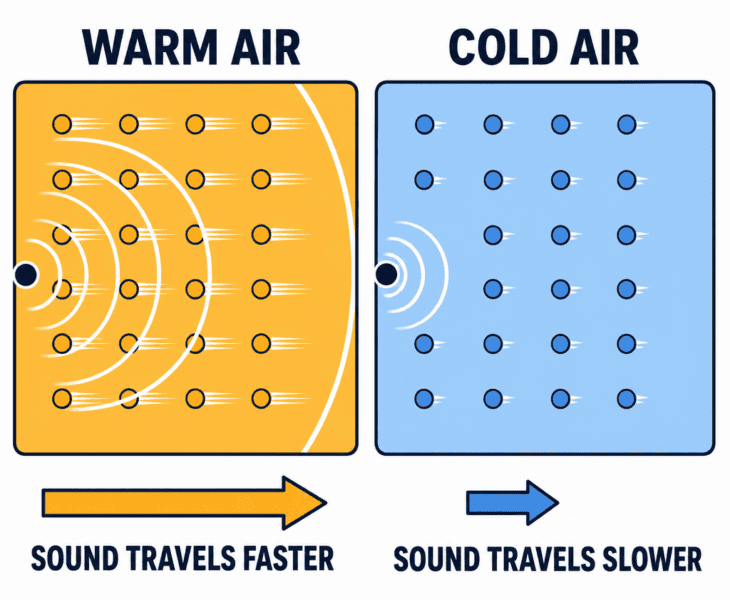
The FAA states it flatly in Advisory Circular 61-107B: “The speed of sound is directly related only to temperature.”
That single sentence does most of the work here. Air pressure and air density both fall steeply with altitude, but they fall together, and their effects cancel out.
So the standard atmosphere becomes a lookup table for Mach 1. Temperature drops roughly 2 C per 1,000 feet of climb, and the speed of sound drops with it.
Then it stops. At the tropopause, 36,089 feet, the standard atmosphere holds steady at minus 56.5 C all the way up through the lower stratosphere, so Mach 1 flatlines at 660 mph and stays there.
You do not need altitude to move the number, either. Weather alone does it on the ground.
On a 129 F day in Death Valley, Mach 1 at ground level is about 811 mph. On the Antarctic plateau at minus 128 F, it is about 609 mph. That is a spread of roughly 200 mph in the same sea-level-equivalent air, purely from temperature.
Why 700 mph Is Supersonic Up High and Subsonic Down Low
On 14 October 1947, Chuck Yeager flew the Bell X-1 at Mach 1.06 and became the first person to fly faster than sound. His true speed was 700 mph, at an altitude of 43,000 feet.
Fly that identical 700 mph at sea level and you are doing Mach 0.92. Comfortably subsonic, no shock wave, no sonic boom, no record.
Nothing about the aircraft changed. The air did, and the air is what defines the finish line.
This is why every published top speed given as a Mach number needs an altitude attached before it means anything. The F-35 Lightning II‘s Mach 1.6 works out to about 1,056 mph in the cold air where it would actually be flown, not the 1,218 mph the same Mach number would represent at sea level.
Fighters do not reach their headline Mach numbers near the ground anyway. Drag rises with air density and with the square of true speed, so a low-level supersonic dash costs enormously more thrust and dumps far more heat into the airframe than the same Mach number does at 40,000 feet.
The record that has stood for 50 years
On 28 July 1976 an SR-71 Blackbird flown by Captain Eldon Joersz set the absolute speed record for a manned air-breathing aircraft at 2,193.167 mph. In the thin, slightly warmer air of the lower stratosphere that is roughly Mach 3.3. The record has never been broken.
The Speed Bands That Actually Matter
Pilots and engineers rarely care about Mach 1 as a milestone. They care about the bands either side of it, because that is where the handling of the aircraft changes.
| Regime | Mach range | What is happening |
|---|---|---|
| Subsonic | Below Mach 0.75 | Airflow stays below the speed of sound everywhere on the airframe |
| Transonic | Mach 0.75 to 1.20 | Air accelerating over the wing goes supersonic while the aircraft itself has not |
| Supersonic | Mach 1.20 to 5.0 | The aircraft outruns its own pressure waves and drags a shock cone behind it |
| Hypersonic | Above Mach 5.0 | Aerodynamic heating becomes the dominant design problem |
The transonic band is the awkward one, and it starts well below Mach 1. Long before the aircraft is supersonic, air speeding up over the curve of the wing gets there first, and the shock wave that forms can pull the nose down or strip lift off a wing asymmetrically.
That is why airliners are limited by a Mach number rather than a speed in mph. Typical airliner cruise is Mach 0.78 to 0.85, which at 36,000 feet is only about 515 to 560 mph.
Higher up, an airliner’s speed limit stops being a fixed airspeed and becomes a maximum operating Mach number. The aircraft is not managing how fast it is going through the ground, it is managing how close the airflow over its wing is to the speed of sound.
That swap has a name and a moment. On the climb an airliner holds a fixed indicated airspeed, but because Mach 1 keeps falling as the air gets colder, the same indicated airspeed creeps closer to the Mach limit with every thousand feet.
At some point in the high twenties or low thirties of thousands of feet, the two limits cross and the Mach number takes over as the binding one. From there upward, the aircraft is flown to a Mach target.
Climb far enough and the squeeze gets serious. The speed at which the wing stalls keeps rising in true airspeed terms while the Mach limit keeps falling, and the gap between too slow and too fast narrows toward nothing.
The FAA calls the place where those boundaries meet the Q-corner, better known as coffin corner. It is the aerodynamic ceiling of the aircraft, and it exists only because Mach 1 refuses to hold still.
Concorde cruised at Mach 2.04, about 1,354 mph, above 50,000 feet. Designing an airliner to live permanently on the far side of that transonic band is most of the reason it cost what it did.
The Myth: Mach 1 Is 767 mph
Where 767 mph comes from
767 mph is the speed of sound at 68 F (20 C), the room temperature used in physics classrooms. It is a laboratory figure, not an aviation one. Aviation’s standard day is 59 F (15 C), which gives 761 mph, and no aircraft flying at altitude meets either number.
The 767 mph figure is not wrong, exactly. It is just an answer to a question about a warm room rather than a question about the sky.
The second myth is older and more romantic: the idea that the sound barrier was a physical wall aircraft had to punch through. Pilots in the 1940s had good reason to believe it, because aircraft approaching it shook violently, lost control response, and sometimes came apart.
None of that was a barrier. It was the transonic band: shock waves forming on the wings of aircraft that had never been designed for them, wrecking lift and control authority. Give an airframe a thin wing and a moving tailplane, as the X-1 had, and the wall turns out to be nothing at all.
There is a nice irony in the name, too. Ernst Mach, the Austrian physicist who photographed the shock wave off a supersonic bullet in 1887, never flew in an aircraft and died in 1916, thirty-one years before anyone flew faster than sound.
He never used the number named after him, either. The Swiss engineer Jakob Ackeret coined the term “Mach number” in 1929, thirteen years after Mach’s death.
So Mach 1 is not 767 mph, and it is not 761 mph either, at least not where aircraft fly. It is a number that has to be recalculated for the air the aircraft is sitting in at that moment.
Next time a spec sheet quotes a Mach number, the useful question is not how fast that is. It is how cold the air was when they measured it.
Sources and references used for research and fact-checking.
- Federal Aviation Administration, AC 61-107B: Aircraft Operations at Altitudes Above 25,000 Feet MSL and/or Mach Numbers Greater Than .75
- NASA Glenn Research Center, Beginner's Guide to Aeronautics, Speed of Sound
- NASA Glenn Research Center, Earth Atmosphere Model
- Smithsonian National Air and Space Museum, Bell X-1
- Federation Aeronautique Internationale, 50 years of Lockheed Blackbird records
- Aerospaceweb.org, Ernst Mach and Mach Number
- Heritage Concorde, Concorde Airframe and Performance
Get the Newsletter
The latest aviation news and stories sent to your inbox.
About the Author

Tim is the owner and lead editor of AeroCorner since 2019, overseeing aviation content covering aircraft, airlines, airports, and the broader aviation industry. Through years of researching, writing, editing, and publishing aviation-focused content, he has developed extensive practical knowledge of commercial aviation and air travel. Based in Asia and a frequent traveler himself, Tim also brings firsthand passenger experience to AeroCorner’s coverage. Outside of publishing, he has also explored aviation firsthand through hands-on flight training in New Zealand.