

Table of Contents
The Soviet Union won the race into the air and lost the race that mattered. Concorde flew paying passengers for 27 years; the jet the West nicknamed “Concordski” managed seven months.
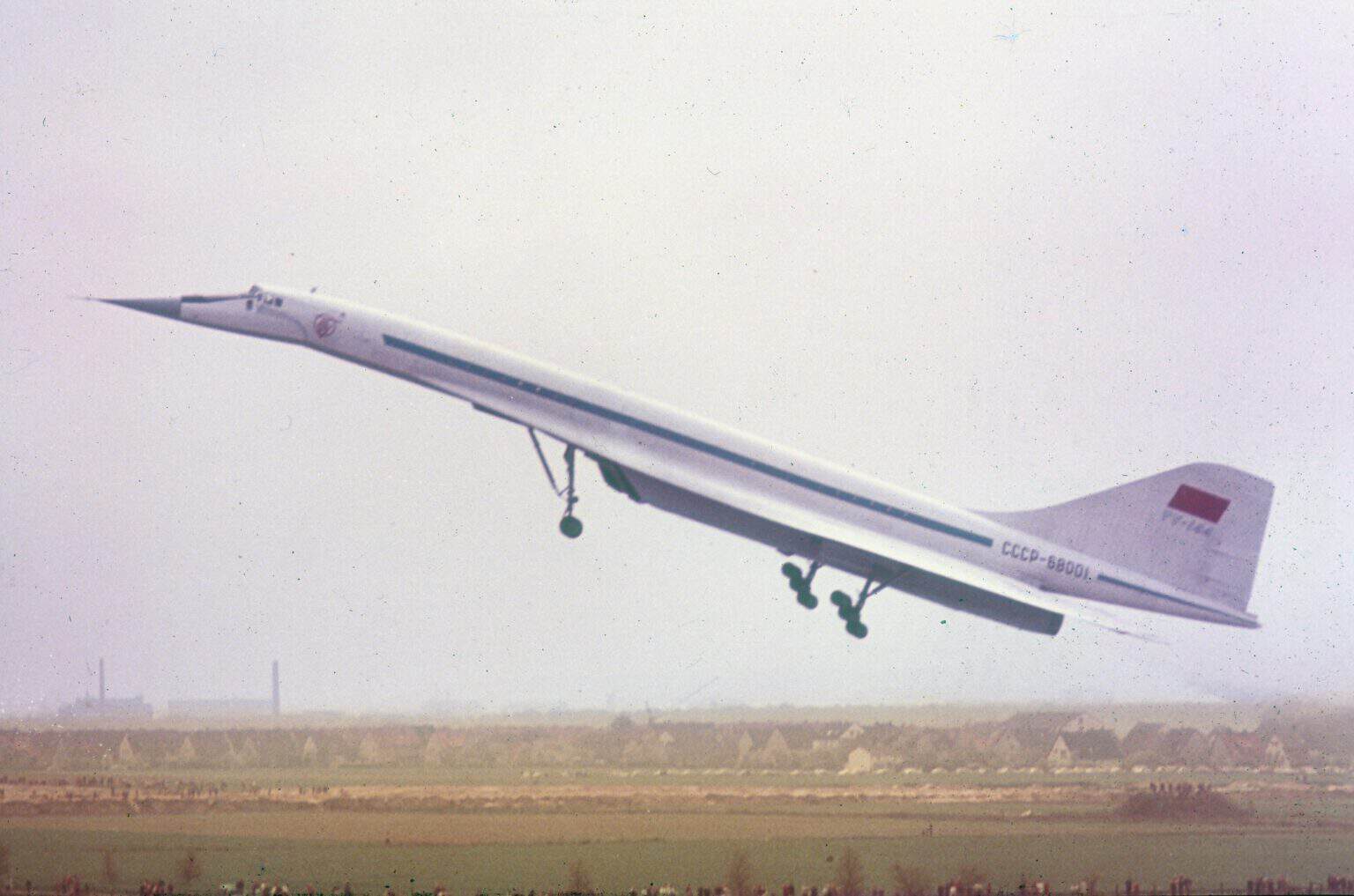
The Tupolev Tu-144 first flew from Zhukovsky, outside Moscow, on Dec. 31, 1968. That was about two months before the Anglo-French Concorde left the ground at Toulouse on March 2, 1969.
Aeroflot opened Tu-144 passenger service on Nov. 1, 1977, between Moscow and Alma-Ata, now Almaty. The 55th and last scheduled passenger flight flew on June 1, 1978.
That is the whole passenger career of the world’s first supersonic airliner to fly: one route, roughly one flight a week, and 55 trips.
A deadline set in 1963 decided the first flight
The Tu-144 did not beat Concorde because it was ready. The Soviet government decree that launched the program in 1963 said the aircraft should fly in 1968, and it took off on the last day of that year.
Concorde’s first flight had been scheduled for February 1968. It slipped to March 1969 while engineers worked through problems and tested components. Brian Calvert, Concorde’s technical flight manager, later said the rush to get the Tu-144 airborne “exacted a heavy penalty later”.
The engine was the clearest penalty. The Kuznetsov NK-144 turbofans had to run their afterburners continuously to hold supersonic speed, where Concorde could cruise without them. That cost fuel and range, and it filled the cabin with noise.
Then came Paris. On June 3, 1973, a production Tu-144S, registered 77102, crashed during its display at the Paris Air Show at Le Bourget. All six crew members and eight people on the ground in the town of Goussainville were killed.
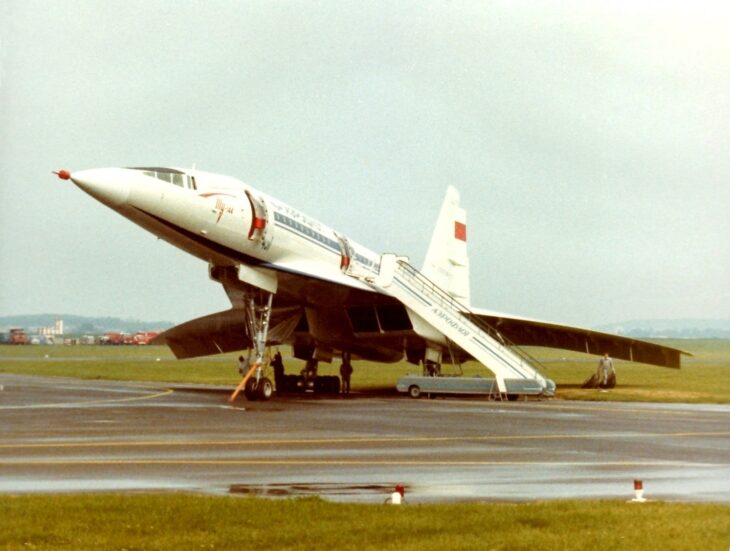

The cause has never been fully settled. One account holds that the crew left the approved display profile, and the leading theory involves a French Mirage chase plane the Soviet crew had not been told about. The official inquiry found no real risk of collision but said the pilot was likely to have been surprised.
The crash, rising fuel prices and the jet’s projected operating costs drained what foreign airline interest there had been. It is one of the events covered in our look at the worst air show disasters.
55 passenger flights, one route, hundreds of failures
The Tu-144 actually entered Aeroflot service two years before it carried a passenger. From Dec. 26, 1975, it flew mail and freight between Moscow and Alma-Ata, a route of about 1,930 miles (3,100 km).
Passengers arrived on Nov. 1, 1977, and Aeroflot never added a second route. It kept flights to one a week even though eight certified Tu-144S aircraft were available, which suggests the airline itself had little faith in the jet.
Over 102 commercial flights and 181 hours of freight and passenger flying, the Tu-144S logged more than 226 failures, 80 of them in flight. Flight instruments, navigation gear, radios and the autopilot caused the most trouble.
102 flights is not the passenger count
NASA’s Tu-144LL fact sheet says passenger service ended after 102 passenger flights, and the figure is still widely repeated. Other accounts put 102 as the total of commercial flights, mail and freight included, and only 55 of those carried passengers.
The cabin was the other problem. Noise averaged at least 90 to 95 decibels, and accounts describe passengers two seats apart passing handwritten notes because they could not hear each other.
The end came from a test flight, not a passenger flight. On May 23, 1978, the first Tu-144D caught fire on a pre-delivery test flight and crash-landed near Yegoryevsk, killing two crew members. Nine days later, on June 1, the last passenger service flew.
In all, 16 airworthy Tu-144s were built: a prototype, a pre-production aircraft, nine Tu-144S and five longer-range Tu-144D. A 17th airframe, Tu-144D 77116, was never finished, which is why NASA counts 17 and some histories give 16 or 17.
Why the Tu-144 outlived its passenger career by two decades
Seven months was the passenger story, not the aircraft’s. Aeroflot restarted freight-only flights with the re-engined Tu-144D on June 23, 1979, including longer routes from Moscow to Khabarovsk.
A government decree cancelled the program on July 1, 1983, and turned the remaining jets into flying laboratories. In 1985 Tu-144Ds were used to train pilots for the Buran space shuttle.
The strangest chapter came after the Cold War. Tu-144D 77114, built in 1981 with only about 82 hours in its logbook, was rebuilt as the Tu-144LL for a NASA supersonic research program alongside U.S. and Russian industry.
NASA says research flights ran from June 1996 to April 1999, gathering data for a proposed second-generation supersonic airliner. That airliner was never built, and Concorde, which had entered service in January 1976, retired in 2003 after 27 years.
The gap between the two careers is the real lesson of the first supersonic race. Being first to fly decided nothing; reliability and economics decided everything, as our piece on how Concorde was beaten on paper rather than in the air explains.
Volunteers are restoring a Tu-144 at Zhukovsky
Volunteers are now working on Tu-144D CCCP-77115 at Zhukovsky, the airfield where the prototype first flew, The Aviationist reported on Oct. 18, 2026. They have fitted a TA-6A auxiliary power unit and restored the drooping nose, the canards and the cabin lighting.
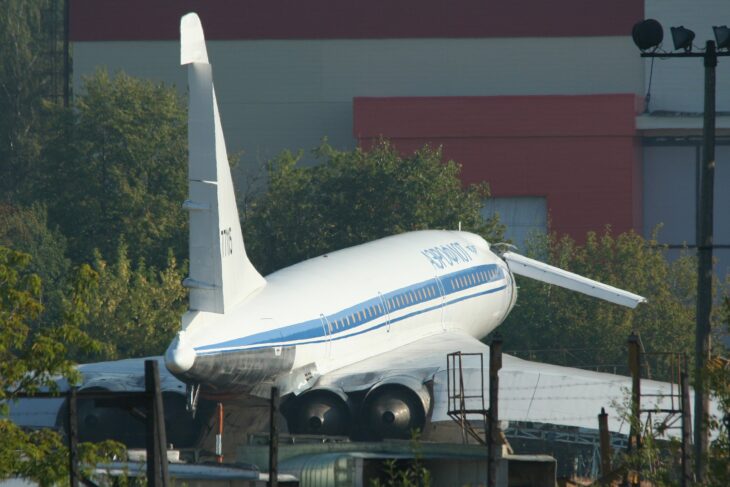

It will not fly again. Pavel Efter, the volunteer leading the work, told the outlet it is for static display only, and that there is no official decision behind it.
The timing points at the MAKS airshow, where 77115 was long shown and which has not been held since 2021. A 2027 return is expected but not confirmed.
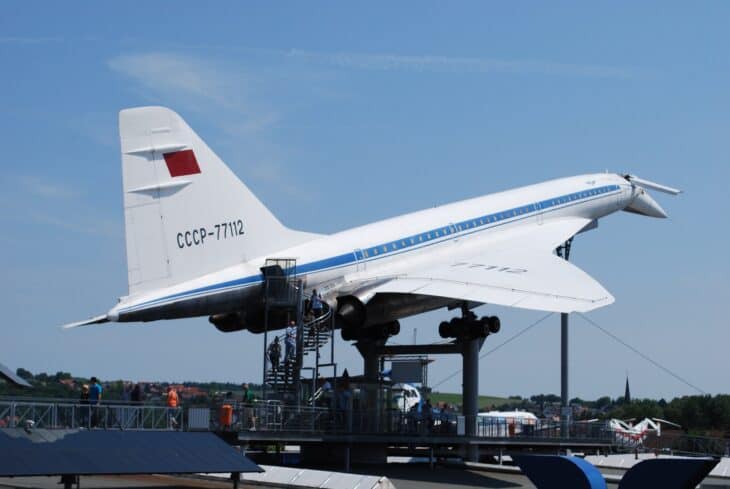
The jet’s sister, 77114, the former NASA laboratory, has stood on a pedestal outside Zhukovsky airport since 2019. Other Tu-144s are preserved at Monino, Ulyanovsk and Samara, and one, 77112, stands at Germany’s Technik Museum Sinsheim next to an Air France Concorde.
Concorde’s survivors are easier to find, as our count of how many Concordes are left shows. As of 2017, Sinsheim was the only museum in the world showing the two rivals together.
Russia’s United Aircraft Corporation said in June 2026 that it is building a prototype of a new supersonic passenger aircraft at Zhukovsky. Whether it fares better than the Tu-144 depends on the lesson the first one taught: flying first is not the same as being ready.
Sources and references used for research and fact-checking.
- The Aviationist, A Tu-144 'Russian Concorde' is Being Restored for Display Ahead of Expected MAKS Return
- NASA Dryden Flight Research Center, The Tu-144LL: A Supersonic Flying Laboratory (FS-062-DFRC)
- Wikipedia, Tupolev Tu-144
- Wikipedia, 1973 Paris Air Show Tupolev Tu-144 crash
- CNN, Concordski: What ever happened to Soviets' spectacular rival to Concorde?
- Wikipedia, Concorde
Get the Newsletter
The latest aviation news and stories sent to your inbox.
About the Author

Tim is the owner and lead editor of AeroCorner since 2019, overseeing aviation content covering aircraft, airlines, airports, and the broader aviation industry. Through years of researching, writing, editing, and publishing aviation-focused content, he has developed extensive practical knowledge of commercial aviation and air travel. Based in Asia and a frequent traveler himself, Tim also brings firsthand passenger experience to AeroCorner’s coverage. Outside of publishing, he has also explored aviation firsthand through hands-on flight training in New Zealand.