

Table of Contents
Every surviving Concorde sits in a museum or at an airport in five countries. Two are missing, and one of them was scrapped by its own airline after barely five years of flying.
Britain and France built 20 Aérospatiale-BAC Concordes: two prototypes, two pre-production aircraft and 16 production airframes. As of October 2026, 18 of them still exist.
Two are gone. F-BTSC crashed outside Paris on July 25, 2000, as Air France Flight 4590. F-BVFD, an Air France jet that had not flown since 1982, was broken up for scrap at Charles de Gaulle Airport in 1994.
Of the 18 survivors, 16 are on public display. By our count of what each museum and the Heritage Concorde survey publish, you can still walk inside 13 of them.
Why Britain and France stopped at 20
Twenty was never the plan. When the first prototype flew from Toulouse on March 2, 1969, the order book held 74 options from 16 airlines, and the consortium had at one point counted more than 100.
Then the options evaporated. Pan Am and TWA both cancelled on Jan. 31, 1973, and many other airlines followed that February.
The reasons stacked up fast. The 1973 oil crisis made a thirsty supersonic jet hard to justify, the Boeing 747 offered a low-risk way to carry far more people, and sonic boom and noise worries turned public opinion.
That left two customers. British Airways and Air France took seven airframes each, so only 14 Concordes ever flew in airline service.
The other six were test aircraft: the two prototypes, the two pre-production jets, and the first two production airframes, F-WTSB and G-BBDG, which never joined an airline. The bill for the whole program reached £1.5 billion to £2.1 billion in 1976 money, against a 1962 estimate of £70 million.
That gap between engineering and economics is the real Concorde story, and it is the one we tell in how Concorde was beaten on paper, not in the air.
The two Concordes that no longer exist
F-BTSC is the one everyone knows. On July 25, 2000, it crashed shortly after takeoff from Charles de Gaulle, killing all 109 people aboard and four on the ground, the only fatal accident in Concorde’s history.
Its wreckage is kept in a hangar at Le Bourget. The crash is often blamed for ending Concorde, but the record is more complicated, as we explain in why Concorde really stopped flying.
F-BVFD is the one almost nobody remembers. It was an Air France aircraft, first flown on Feb. 10, 1977, and from January 1979 to June 1980 it even carried the U.S. registration N94FD, registered to Air France and Braniff Airways.
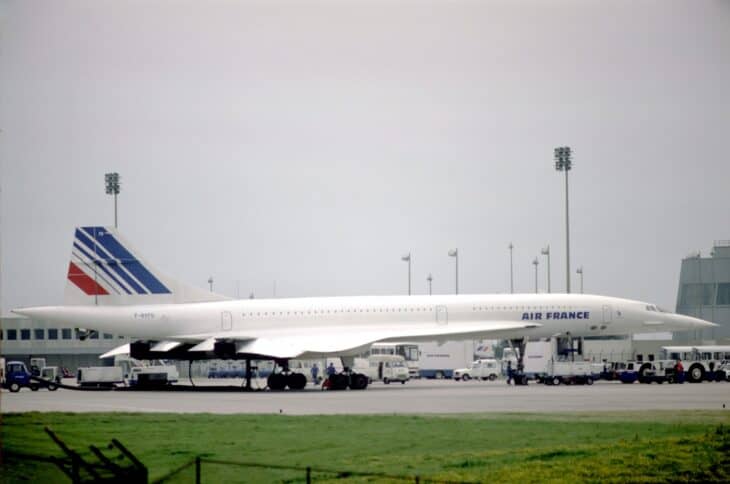

In November 1977 it made a heavy landing at Dakar, Senegal. It kept flying, but when Air France closed its Paris-Dakar-Rio route, the jet was surplus and made its last flight on May 27, 1982.
It had logged just 5,814 hours, the fewest of any Concorde that flew for an airline. Every other airline Concorde logged more than twice that.
For 12 years it sat outside at Charles de Gaulle while Air France stripped it for spares, some of them sold to British Airways. By 1994 the structure was too corroded to save, and the airframe was broken up.
Pieces survive. The nose was sold to an American collector in March 1995 for 300,000 French francs, its exhaust cowlings are at the Farnborough Air Sciences Museum, and a section of fuselage went to the Musée de l’Air et de l’Espace at Le Bourget.
Where all 18 surviving Concordes are, and which you can board
France holds six, the UK seven, the United States three, and Germany and Barbados one each. Here is every one, with whether the public can get inside.
| Registration | Built as | Where it is | Can you go inside? |
|---|---|---|---|
| F-WTSS | Prototype 001 | Musée de l’Air et de l’Espace, Le Bourget, France | Yes, with the aircraft ticket |
| G-BSST | Prototype 002 | Fleet Air Arm Museum, Yeovilton, UK | Yes, walk-through |
| G-AXDN | Pre-production 101 | IWM Duxford, UK | Yes, at selected times |
| F-WTSA | Pre-production 102 | Musée Delta, Athis-Mons, France | Yes, guided tours only |
| F-WTSB | Production 201 (test) | Aeroscopia, Toulouse, France | Yes, forward cabin |
| G-BBDG | Production 202 (test) | Brooklands Museum, Weybridge, UK | Yes, guided tour |
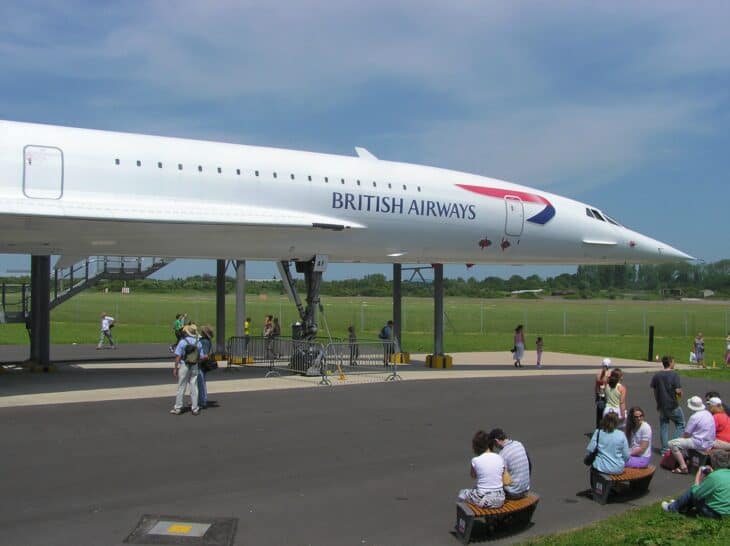
| G-BOAC | British Airways | Manchester Airport, UK | Yes, on tours |
| F-BVFA | Air France | Smithsonian Udvar-Hazy Center, Virginia, US | No, closed since delivery |
| G-BOAA | British Airways | National Museum of Flight, East Fortune, UK | Yes, front cabin |
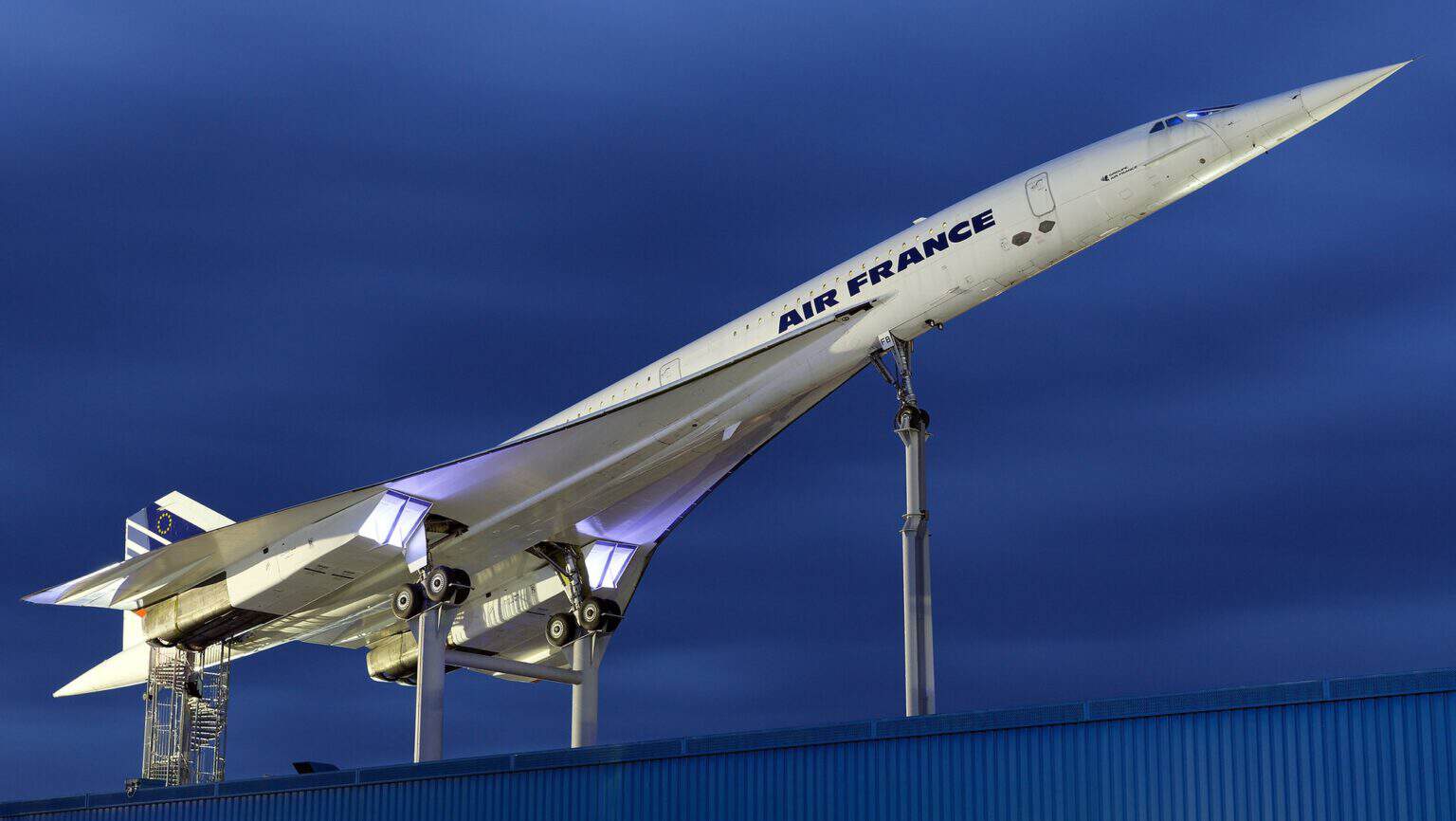
| F-BVFB | Air France | Technik Museum Sinsheim, Germany | Yes, from the roof |
| G-BOAB | British Airways | Heathrow Airport, UK (stored) | No |
| F-BVFC | Air France | Aeroscopia, Toulouse, France (outdoors) | No |
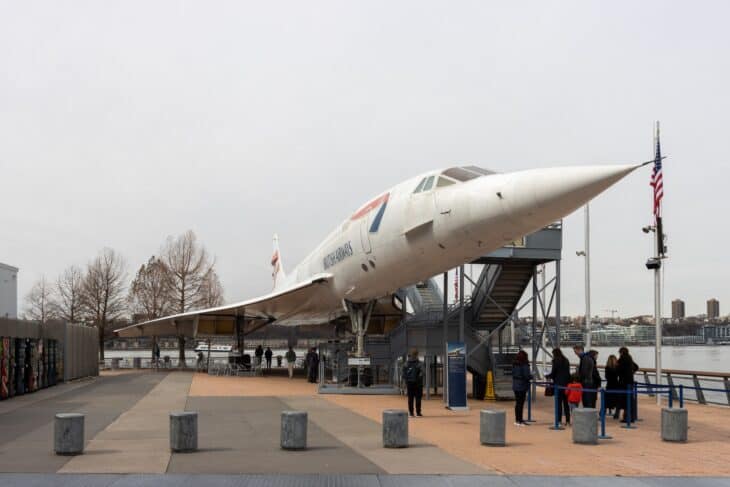
| G-BOAD | British Airways | Intrepid Museum, New York, US | Yes, 20-minute guided tour |
| G-BOAE | British Airways | Grantley Adams Airport, Barbados (stored) | No, museum closed |
| F-BTSD | Air France | Musée de l’Air et de l’Espace, Le Bourget, France | Yes, with the aircraft ticket |
| G-BOAG | British Airways | Museum of Flight, Seattle, US | Yes, cabin aisle |
| F-BVFF | Air France | Charles de Gaulle Airport, Paris (outdoors) | No |
| G-BOAF | British Airways | Aerospace Bristol, Filton, UK | Yes |
Three of the 16 on display are look-only. The Smithsonian has kept F-BVFA’s cabin and cockpit closed since the jet arrived at Washington Dulles in June 2003, and F-BVFC in Toulouse and F-BVFF at Charles de Gaulle are seen from the outside.
Why some counts say 16, 17 or 18
Search for how many Concordes are left and you will find all three numbers. They are all defensible, because each one answers a different question.
Our test is simple: a complete airframe that still exists counts. By that test the answer is 18, the same figure Heritage Concorde uses. The wreckage of F-BTSC and the scattered pieces of F-BVFD do not count.
Sixteen is the number on public display, the figure in The Telegraph’s 2025 tally. It leaves out the two Concordes in storage.
One is G-BOAB at Heathrow. It sits on British Airways engineering land, closed to the public, with its seats, carpets and most cockpit instruments removed, though passengers can spot it from some departing flights.
The other is G-BOAE in Barbados, and it is why 17 also turns up. Its hangar museum, the Barbados Concorde Experience, is listed as closed on the official Visit Barbados site, and in November 2023 airport management said the building would become a departure area for cruise passengers.
So G-BOAE is on display in a sense, but only to travelers transferring between ship and plane. Count it and you get 17 on show; leave it out and you get 16.
The last Concordes left to sit in
The fleet stopped growing in 1979 and stopped flying in 2003. The last commercial flights landed on Oct. 24, 2003, and the final flight of all came on Nov. 26, 2003, when G-BOAF flew to Filton, where it now sits at Aerospace Bristol.

The survivors carry their records with them. G-BOAD at the Intrepid holds the fastest Concorde transatlantic crossing, 2 hours, 52 minutes and 59 seconds on Feb. 7, 1996, the kind of time we break down in how fast Concorde actually flew.

F-BTSD at Le Bourget set a round-the-world record of 31 hours, 27 minutes and 49 seconds in August 1995. Seattle’s G-BOAG set an east-to-west record across North America on Nov. 5, 2003, cleared to fly supersonic over land on its delivery flight to the museum.
The museums keep them alive in small ways. At Le Bourget, ground power is restored to F-BTSD once a week so visitors can watch its nose and visor move.
Whether any of the 18 could ever leave the ground again is a separate question, one we take on in will Concorde ever fly again. For now, 13 open cabins are the only way left to take a seat in the airliner that carried passengers faster than sound for 27 years.
Sources and references used for research and fact-checking.
- Wikipedia, List of Concorde aircraft
- Wikipedia, Concorde
- Heritage Concorde, F-BVFD (211)
- Airdata News, The only Concorde that ended up becoming scrap
- The Telegraph (via Yahoo News), All but one of the 20 Concordes are accounted for. Here's what happened to the missing plane
- Heritage Concorde, Visit Concorde
- Heritage Concorde, G-BOAB (208)
- Heritage Concorde, Visit Concorde in Barbados
- Visit Barbados, Barbados Concorde Experience
- Barbados Today, Concorde museum to handle sea to cruise traffic
- Heritage Concorde, Visit Concorde in Toulouse
- Heritage Concorde, Visit Concorde in Seattle
- Heritage Concorde, G-BOAG (214)
- Heritage Concorde, Visit Concorde in Scotland
- Heritage Concorde, Visit Concorde in Bristol
- Heritage Concorde, Visit Concorde at Duxford
- Heritage Concorde, Visit Concorde at Yeovilton
- Heritage Concorde, Visit Concorde at Brooklands
- Heritage Concorde, G-BOAC (204)
- Heritage Concorde, F-WTSA (102)
- Visit Paris Region, Delta Museum
- Visit Paris Region, Musée de l'Air et de l'Espace
- Heritage Concorde, F-BTSD (213)
- Heritage Concorde, Visit Concorde at Charles de Gaulle
- Heritage Concorde, F-BVFA (205)
- European Route of Industrial Heritage, Technik Museum Sinsheim
- Intrepid Museum, First Flight Museum Marvel: Inside the Legendary Concorde
Get the Newsletter
The latest aviation news and stories sent to your inbox.
About the Author

Tim is the owner and lead editor of AeroCorner since 2019, overseeing aviation content covering aircraft, airlines, airports, and the broader aviation industry. Through years of researching, writing, editing, and publishing aviation-focused content, he has developed extensive practical knowledge of commercial aviation and air travel. Based in Asia and a frequent traveler himself, Tim also brings firsthand passenger experience to AeroCorner’s coverage. Outside of publishing, he has also explored aviation firsthand through hands-on flight training in New Zealand.