

Table of Contents
On the morning of April 1, 2025, a British Airways Concorde registered G-BOAG left London Heathrow for New York. An Air France Concorde, F-BTSD, had already departed Paris. At the peak, 106,000 people were watching the two aircraft cross the Atlantic on Flightradar24.
Neither aircraft moved an inch. Flightradar24 had recreated both flights as an April Fools’ joke, and the British Airways one became the most-tracked flight on the site faster than any real flight in its history.
A year later, a YouTuber went further. Posting on April 1, 2026, he documented what looked like a one-off revival service across the Atlantic, cut together over six months from footage of seven separate flights and filmed inside museum Concordes, wearing the same clothes throughout so the continuity held. Plenty of aviation people did not spot it until the reveal in the closing seconds.
These hoaxes keep working because the answer feels like it should be yes. Eighteen Concordes still exist, most of them intact and indoors. So what is actually stopping one of them?
Will Concorde Ever Fly Again?
Almost certainly not, and the obstacle is not the one most people assume. It is not money, not fatigue in the airframes, and not a rule that forbids it. Britain’s Civil Aviation Authority has never said no.
The obstacle is that a certified aircraft needs a company willing to take legal responsibility for its design, and the only company realistically able to do that for Concorde gave the job up in 2003 and has shown no interest in taking it back.
The answer in one paragraph
Concorde is grounded by a paperwork chain, not a physical one. Airbus surrendered the aircraft’s type certificate when the fleet retired, and without a type certificate no individual aircraft can hold a Certificate of Airworthiness. The regulator would consider reissuing one, but only to an applicant backed by a credible design authority. That points straight back at Airbus, which declines. Everything else, the parts, the pilots, the money, sits behind that closed loop.
The certificate was handed back, not lost
Every airliner type flies under a type certificate: a regulator’s approval of the design itself. It is held by a company, and holding it is an active job rather than a filing-cabinet formality.
The holder issues service bulletins, answers airworthiness directives, supplies approved spares and provides the engineering judgment when something on the aircraft needs a decision. Concorde’s was held jointly by the British Aircraft Corporation and Aérospatiale, and passed in time to Airbus.
When a holder stops supporting a type, the certificate goes back to the regulator, and the fleet is permanently grounded. That is what happened to Concorde in 2003, which is a separate question from why the airlines stopped flying it in the first place.
The individual aircraft certificates went the same way. Each Concorde’s Certificate of Airworthiness is a document issued under that type certificate, so once the parent approval was surrendered there was nothing left for the individual certificates to hang from.
This is the part the hoaxes quietly skip. A preserved Concorde is not a licensed aircraft waiting for a pilot. In legal terms it is a very large, very fast object that used to be one.
The regulator’s door is open. Its first condition is the one nobody can meet.
The CAA has actually set out what it would want to see. It says it would consider an application for Concorde to requalify for a type certificate, which would in turn allow a Certificate of Airworthiness to be issued.
Note what that is not. The CAA is not offering the permit-to-fly route that keeps most vintage warbirds in the air. It wants Concorde back under full certification, the same standard it flew to commercially.
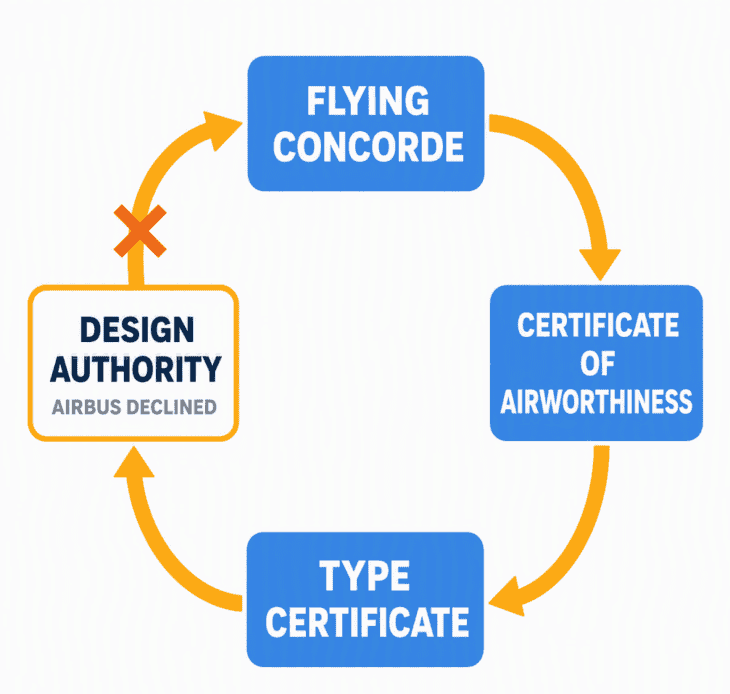
Then comes the condition that closes the loop. The applicant must have a suitable design authority in place, and the CAA’s own wording names the preferred one: Airbus. It also wants demonstrated support from whoever holds the type certificate for the engines.
A circle with no way in
To fly a Concorde you need a Certificate of Airworthiness. To get one you need a type certificate. To get that you need a design authority the regulator will accept, and the regulator says it would prefer that to be Airbus. Airbus is the company that gave the type certificate up.
There is one further wrinkle. The two British prototypes, G-BSST at Yeovilton and G-AXDN at Duxford, were never built to the production standard and are not covered by that type certificate at all, so they are outside even this theoretical route.
What a flying Concorde would actually need
Suppose the design-authority problem vanished tomorrow. The queue behind it is long, and most of it cannot be solved by writing a check.
| What is needed | Where it stands |
|---|---|
| Certified spare parts | No pool exists. Certification paper trails were lost when the fleet retired, and most original subcontractors are gone. |
| Ability to certify new parts | The test equipment used to approve Concorde components no longer exists. |
| Licensed engineers | The engineers who maintained Concorde no longer hold current licenses for the type. |
| Type-rated pilots | None current anywhere. Type ratings need recurrent checks, and the certified simulators were decommissioned. |
| Engineering support | Concorde needed roughly 65 hours of support and engineering for every hour it flew. |
| Hangarage | A very large secure hangar meeting CAA storage requirements. |
Some of the shortages are wonderfully specific. Concorde did not use Skydrol, the hydraulic fluid in ordinary airliners, because Skydrol is not chemically stable at the temperatures a Mach 2 airframe reaches.
It used a silicate ester fluid called Chevron M2V, rated from minus 76°F to 446°F (minus 60°C to 230°C). M2V is ruinously fussy: let water or any other fluid into it and the whole batch is scrap.
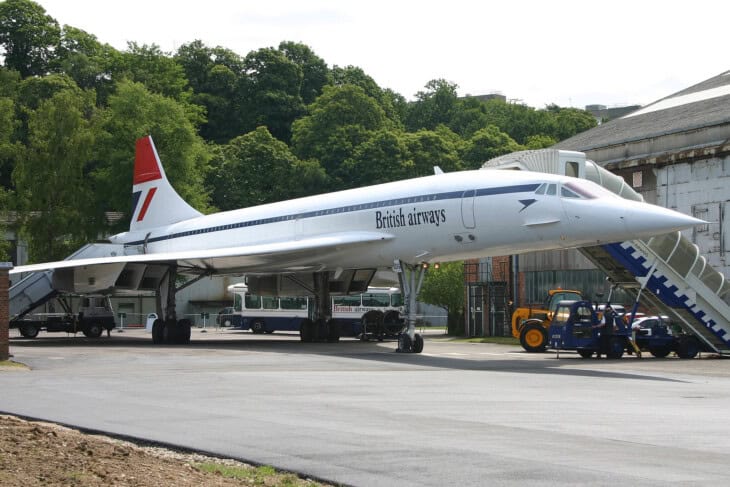
Nor is there a fleet to cannibalize. Only 20 Concordes were ever built, and British Airways already stripped one of them, G-BBDG, for spares while the fleet was flying. It sits at Brooklands today with parts of it distributed across other airframes.
One British delta did fly again. Watch how it ended.
The best argument that a Concorde revival could work, and the best argument that it would not last, are the same aircraft: Avro Vulcan XH558.
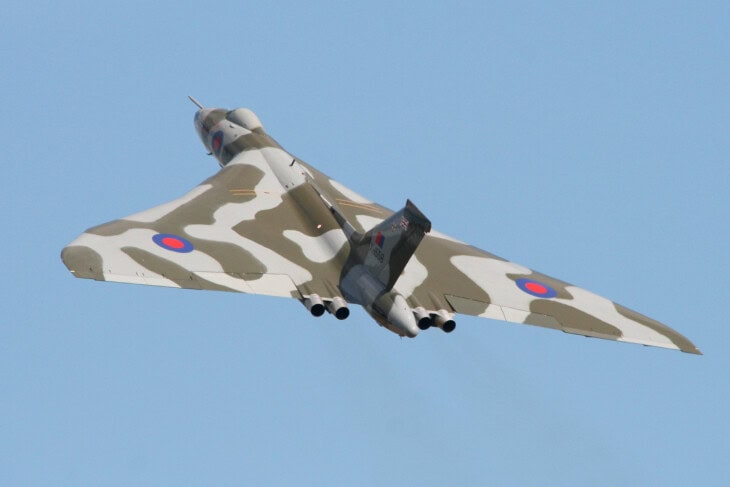
XH558 was pulled out of retirement and restored to flight by a charitable trust in a project widely described as the most complex return-to-flight ever attempted. It worked. The bomber flew again in October 2007 and displayed for eight seasons.
1993
XH558 retires. The last flying Vulcan leaves RAF service and is sold into private hands.
2005-2007
A £6.5 million restoration. Vulcan to the Sky Trust rebuilds the aircraft to certified standard with the support of its original manufacturers.
18 October 2007
It flies. XH558 returns to the air after 14 years on the ground.
2008-2015
Eight display seasons. Running costs settle at roughly £2 million a year, funded by donations.
Early 2015
The technical authorities step back. BAE Systems, Marshall Aerospace and Rolls-Royce announce they will no longer support the airframe, engines and systems.
28 October 2015
Grounded for good. Without third-party technical support the CAA permit cannot stand, and XH558 flies for the last time.
The ending is the instructive part. XH558 was not grounded by money or by a broken part. It was grounded because the companies legally underwriting its airworthiness decided their expertise had thinned too far to keep signing.
That happened to a subsonic 1950s bomber whose manufacturers were still supporting it, and it still only bought eight years. Concorde is a Mach 2 airliner whose manufacturer walked away two decades ago.
The myth: a rich enough backer could just buy the problem away
This is the assumption underneath every revival headline, and it has been tested. In 2015 a group called Club Concorde said it had raised £120 million (about $186 million) to put an aircraft back in the air by 2019, with two French Concordes in its sights.
What happened to the £120 million plan
Nothing flew. Airbus told CNN it had received no requests from the group about providing support, and British Airways has consistently refused to release an airframe. The target year of 2019 passed without a restoration beginning, and the group’s website went offline.
Aviation journalist David Kaminski-Morrow put the structural problem plainly at the time, noting that the refusal of the manufacturer to support a restoration was the greatest obstacle, and that the CAA would not entrust a supersonic airframe to enthusiasts without that technical backing however genuine their passion.
He also made the point that gets lost in the funding announcements: so few Concordes were built that there is no deep pool of spares and engines to raid, and money is arguably the easiest of the problems to solve.
British Airways looked at keeping one aircraft flying for heritage purposes when the fleet retired and could not justify the expense. It has not revisited that view.
What does happen: the noses are moving again
There is a real revival going on, and it is smaller and stranger than a transatlantic service. Volunteer engineers have been bringing individual Concorde systems back to life inside museums.
The droop nose is the prize, because it is the thing that made Concorde look alive. At Duxford, a team worked on G-AXDN’s nose using a 28-volt supply and a donated hydraulic power pack, waking a system that had been dormant since 1977.
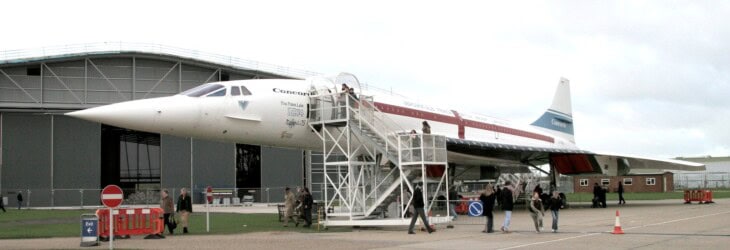
Aerospace Bristol did the same for G-BOAF, the aircraft that made the final Concorde flight of all on November 26, 2003, leaving Heathrow and landing at Filton after a farewell loop over the city. New cabling runs under the cabin floor to a transformer feeding the original circuits.
None of this is a step toward flight, and the people doing it do not claim it is. Moving a nose on ground power and certifying a supersonic airliner are separated by the entire apparatus of airworthiness law.
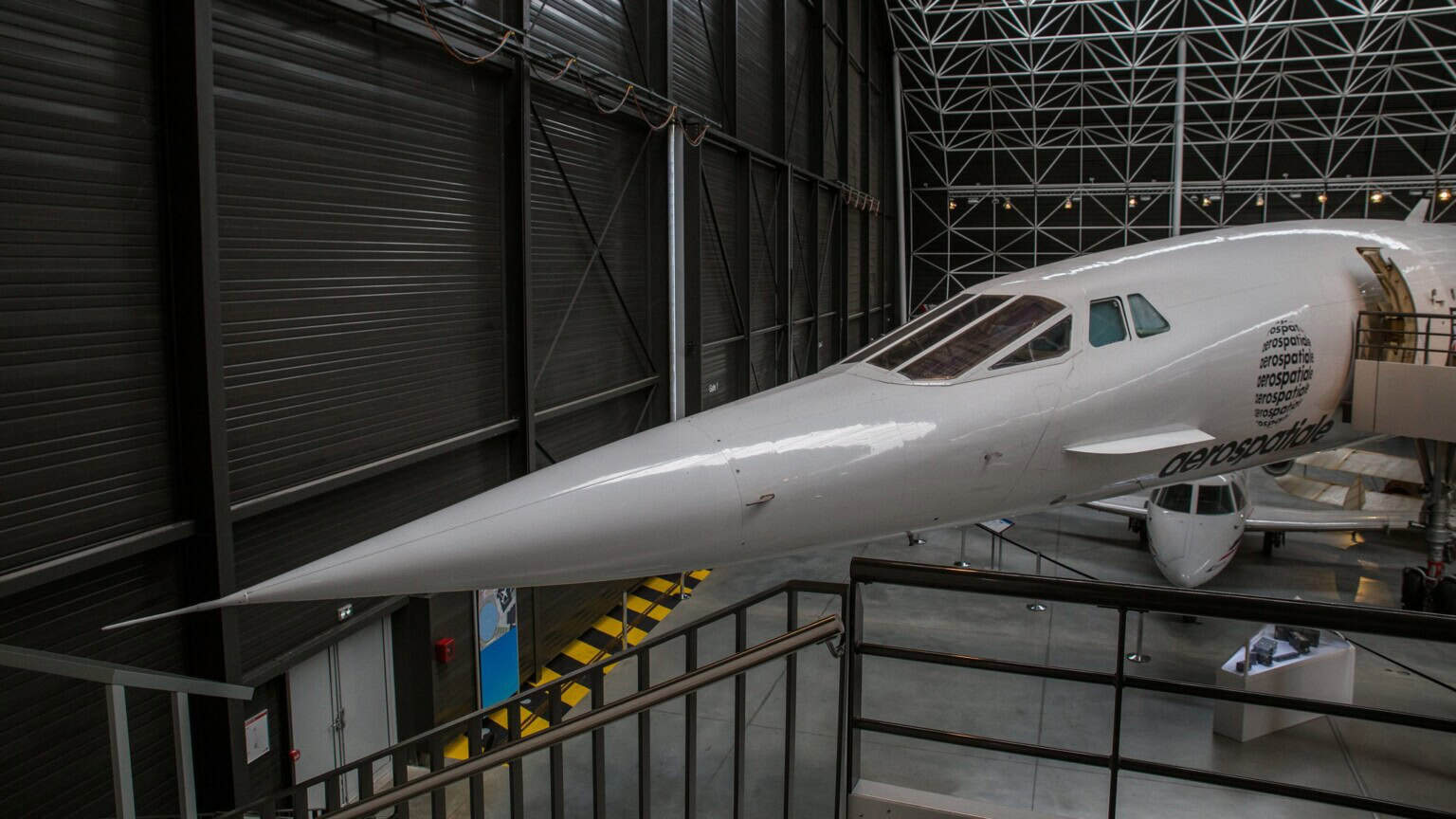
So the aircraft in the hoaxes are all real, and you can go and stand under them. G-BOAG, the one Flightradar24 flew to New York, is at the Museum of Flight in Seattle, and its genuine last flight was a good story in itself: JFK to Seattle across northern Canada, cleared to go supersonic over land, setting an east-to-west record for crossing North America.
F-BTSD, the Air France aircraft in the same prank, is at the Musée de l’Air et de l’Espace at Le Bourget. It flew its own last short hop, Charles de Gaulle to Le Bourget, in June 2003.
Next time one of them appears on a flight tracker, the giveaway is not the speed or the route. It is that a Certificate of Airworthiness is a piece of paper only one company can restart, and that company said no more than twenty years ago. Until Airbus changes its mind, every Concorde you see crossing the Atlantic is a memory of an aircraft that genuinely did it, parked indoors.
Sources and references used for research and fact-checking.
- Heritage Concorde, The Civil Aviation Authority & Concorde RTF (Return to Flight)
- Heritage Concorde, Concorde Type Certificate and Airworthiness
- Heritage Concorde, Barriers to Concorde Return to Flight
- Heritage Concorde, Concorde Hydraulic Oil (M2V)
- Flightradar24, Has Concorde really made a comeback?
- Supercar Blondie, Aviation fans fooled by a fake one-off 2026 Concorde flight to New York
- CNN Travel, Can plan to fly Concorde again get off the ground?
- Wikipedia, Avro Vulcan XH558
- Wikipedia, List of Concorde aircraft
- Sam Chui, Concorde to have droop-nose reactivated for 50th anniversary
- Hydraulics Online, Concorde Hydraulics: Restoring the Droop Nose Across the UK
Get the Newsletter
The latest aviation news and stories sent to your inbox.
About the Author

Tim is the owner and lead editor of AeroCorner since 2019, overseeing aviation content covering aircraft, airlines, airports, and the broader aviation industry. Through years of researching, writing, editing, and publishing aviation-focused content, he has developed extensive practical knowledge of commercial aviation and air travel. Based in Asia and a frequent traveler himself, Tim also brings firsthand passenger experience to AeroCorner’s coverage. Outside of publishing, he has also explored aviation firsthand through hands-on flight training in New Zealand.