


Table of Contents
COMAC’s CE-25A spent nine months flying itself before anyone climbed aboard. Now a crew has flown it, and the numbers it carried into the air are smaller than the ones China showed off three years ago.
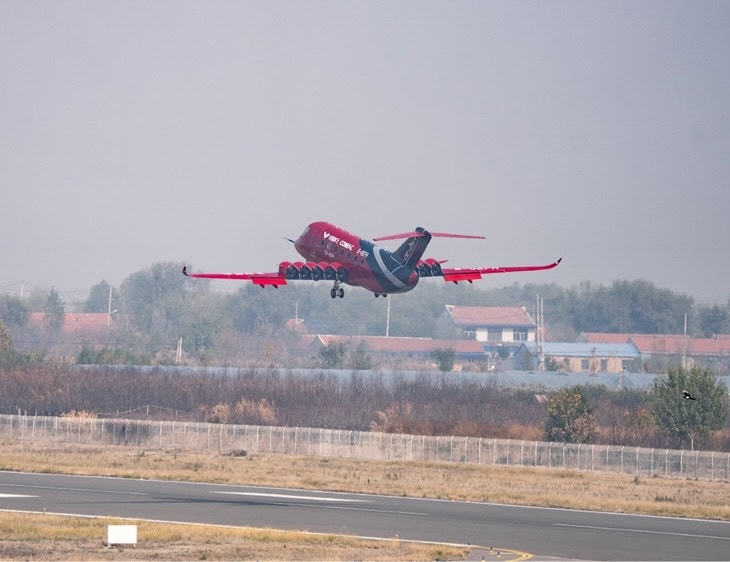
On Nov. 14, 2026, the COMAC CE-25A took off from Binzhou in China’s Shandong province with two pilots and a flight test engineer aboard, Xinhua reported. It was the first crewed flight of the battery-powered, 19-seat airliner.
The aircraft was airborne for 16 minutes and 38 seconds and covered 37.5 miles (60.4 km), AeroTime reported. COMAC said it “operated normally, and all performance indicators met expectations.”
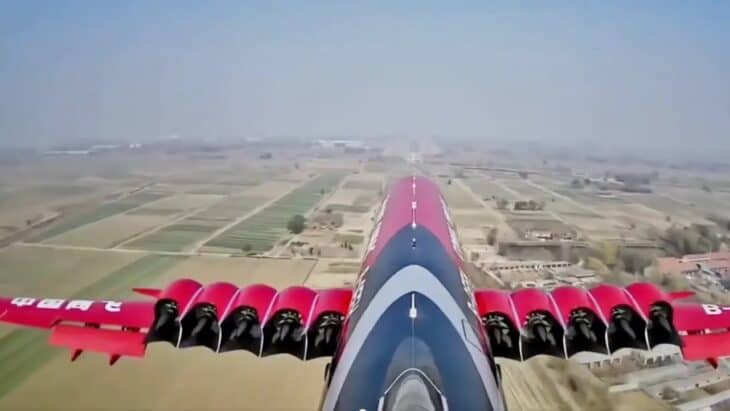
Where a conventional 19-seater hangs two propellers off its wings, the CE-25A has 10 electric ducted fans, five on top of each wing.
The CE-25A Flew Itself for Nine Months Before It Carried People
The crewed flight was not the aircraft’s first. COMAC says the CE-25A made its first uncrewed, autonomous flight on Feb. 2, 2026, and has completed 19 uncrewed autonomous flight validations.
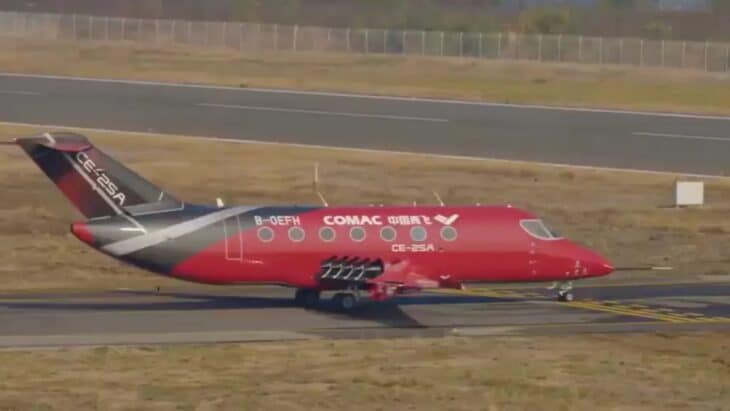
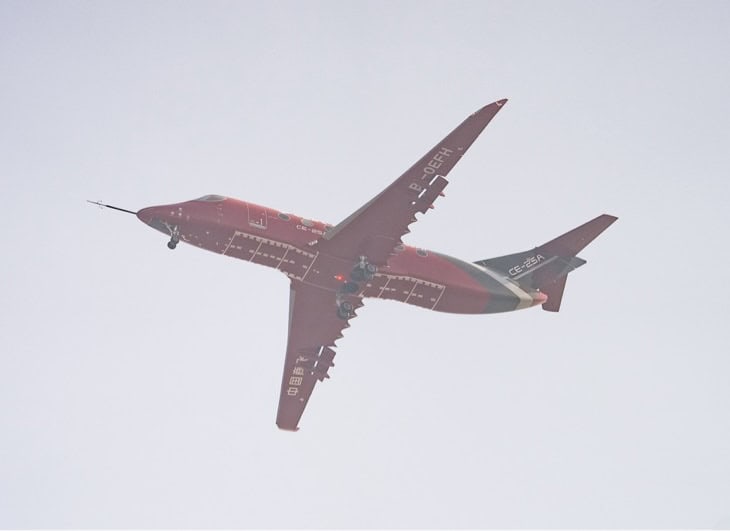
None of that was public at the time. The first photos of a full-size CE-25A only surfaced on Oct. 28, posted on Weibo by the Chinese automotive blogger Han Lu, Leeham News reported. They showed a red-and-black airframe with a T-tail and the registration B-0EFH.
COMAC did not confirm the aircraft at the time. TWZ wrote that it could not verify the images and that there was no clear sign the airplane had flown. Seventeen days later, state media announced the crewed flight and the 19 uncrewed ones before it.
COMAC calls the Nov. 14 sortie a crewed “intelligent flight.” It has not explained how control was split between the pilots and the automated systems, Air Data News noted.
Why 10 Small Fans Instead of Two Big Propellers
The layout is called distributed electric propulsion: instead of one or two large engines, many small electric motors are spread along the wing.
On the CE-25A, the 10 fans sit in a row above each wing, five per side, according to Leeham. TWZ described the system as replacing the small number of turboprop engines a commuter airliner would normally use.
The name spells out the ambition. “C” stands for China and COMAC, “E” for electric, “25” for CCAR-25, China’s rulebook for transport-category airliners, and “A” for the first aircraft in a planned family, Air Data News reported.
COMAC built it with battery maker CATL and Shanghai Jiao Tong University, among other partners. It has not said which battery the airplane uses. AeroTime notes that CATL unveiled a cell rated at up to 500 Wh/kg in 2023 and said it was qualifying it for aviation.
The Numbers Shrank Between the Reveal and the First Crew
COMAC first showed the CE-25A at the China International Import Expo in Shanghai in November 2023. The published targets then were a cruising speed of about 250 mph (400 km/h) and a range of 250 to 310 miles (400 to 500 km), TWZ reported.
The figures COMAC released with the crewed flight are lower. Xinhua lists a cruising speed of 186 mph (300 km/h), a range of about 250 miles (400 km) and a cruising altitude of about 7,900 feet (2,400 m).
The new range sits at the bottom of the old 250-to-310-mile band, and the cruising speed target is down by a quarter. The maximum takeoff weight is 10 metric tons, about 22,000 pounds.
For scale, the Beechcraft 1900, the archetypal 19-seat turboprop, has a maximum takeoff weight of 17,100 lb and a maximum cruise speed of 327 mph. The electric airplane is heavier, slower, and covers a fraction of the distance, because batteries hold far less energy per pound than jet fuel.


COMAC’s 2023 claim of a completed “verification flight” also turned out to involve a subscale model, according to Chinese media reports cited by Leeham. The Nov. 14 flight is the first confirmed one with people aboard a full-size CE-25A.
Where the CE-25A Sits Among the West’s Electric Airliners
By weight, the CE-25A is not the biggest battery airplane to fly. Heart Aerospace’s X1 demonstrator first flew on Aug. 12, 2026, at Plattsburgh, New York, for 27 minutes, at more than 25,000 pounds and with a 106-foot wingspan, Heart said.
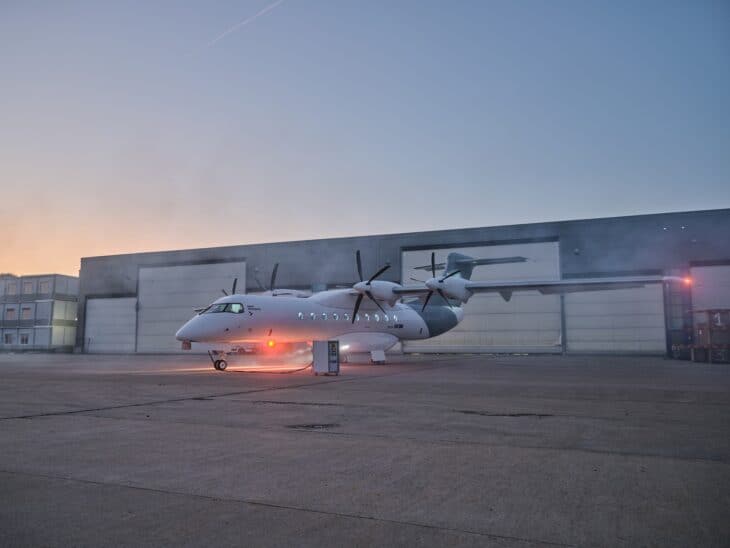

Heart’s production airliner, though, will not be all-electric. The X1 stands in for the 30-seat ES-30, which Heart is developing as a hybrid-electric aircraft and targets for service in 2031.
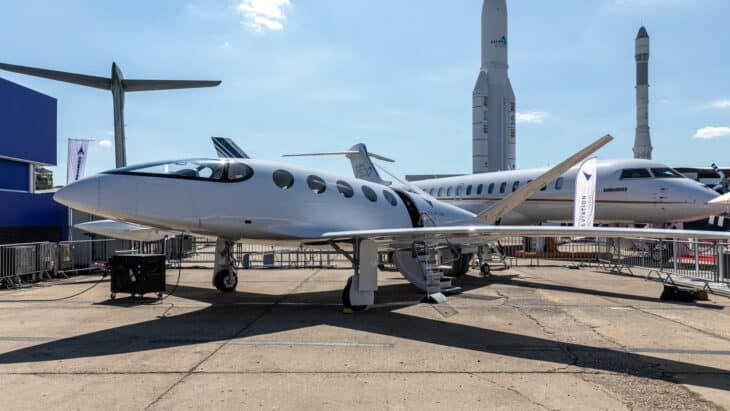
The best-known Western all-electric commuter fared worse. Eviation’s nine-passenger Alice flew for about eight minutes at Moses Lake, Washington, on Sept. 27, 2022. In February 2025 the company laid off most of its staff and paused the program indefinitely, according to its Wikipedia record.

Other Western bets have moved to hybrids as well. Electra’s EL2, which landed a fixed-wing plane on a Manhattan heliport in October, is a hybrid-electric demonstrator, not a battery airplane.
What Comes Next for China’s Electric Commuter
The Civil Aviation Administration of China has accepted COMAC’s application for a type certificate, Xinhua reported. Acceptance starts the certification process. It does not approve the aircraft to carry passengers, and COMAC has not published a date for certification or service entry.
The CE-25A is a new kind of product for COMAC, the state-owned maker of the C919 narrowbody and the smaller ARJ21 regional jet.
Global Times, quoted by migflug, reported that the target market is high-frequency short-haul routes of about 125 to 250 miles (200 to 400 km). Experts it quoted floated larger new-energy aircraft in the same CE family, plus business, rescue and uncrewed cargo variants, none of them a program yet.
The open question is the same one that stalled Alice and pushed Heart toward a hybrid: whether a battery can carry 19 people far enough, often enough, to pay for itself. China has now put a crew on the test. The rest of the world is waiting to see what the next set of numbers says.
Sources and references used for research and fact-checking.
- Xinhua, China's 10-tonne electric commercial aircraft completes maiden piloted flight
- AeroTime, China's COMAC completes first piloted flight of CE-25A electric aircraft
- Air Data News, COMAC CE-25A electric aircraft makes first crewed flight
- Leeham News, China's Comac May Have Built Electric Aircraft Demonstrator
- TWZ, China's CE-25A Electric Commuter Airliner Demonstrator Emerges In Photos
- Interesting Engineering, China's 22,000-pound electric aircraft completes flight test milestone
- migflug, COMAC CE-25A: First Piloted Electric Flight
- Heart Aerospace, Heart Aerospace completes first flight of world's largest electric aircraft
- Wikipedia, Eviation Alice
Get the Newsletter
The latest aviation news and stories sent to your inbox.
About the Author

Tim is the owner and lead editor of AeroCorner since 2019, overseeing aviation content covering aircraft, airlines, airports, and the broader aviation industry. Through years of researching, writing, editing, and publishing aviation-focused content, he has developed extensive practical knowledge of commercial aviation and air travel. Based in Asia and a frequent traveler himself, Tim also brings firsthand passenger experience to AeroCorner’s coverage. Outside of publishing, he has also explored aviation firsthand through hands-on flight training in New Zealand.