

Table of Contents
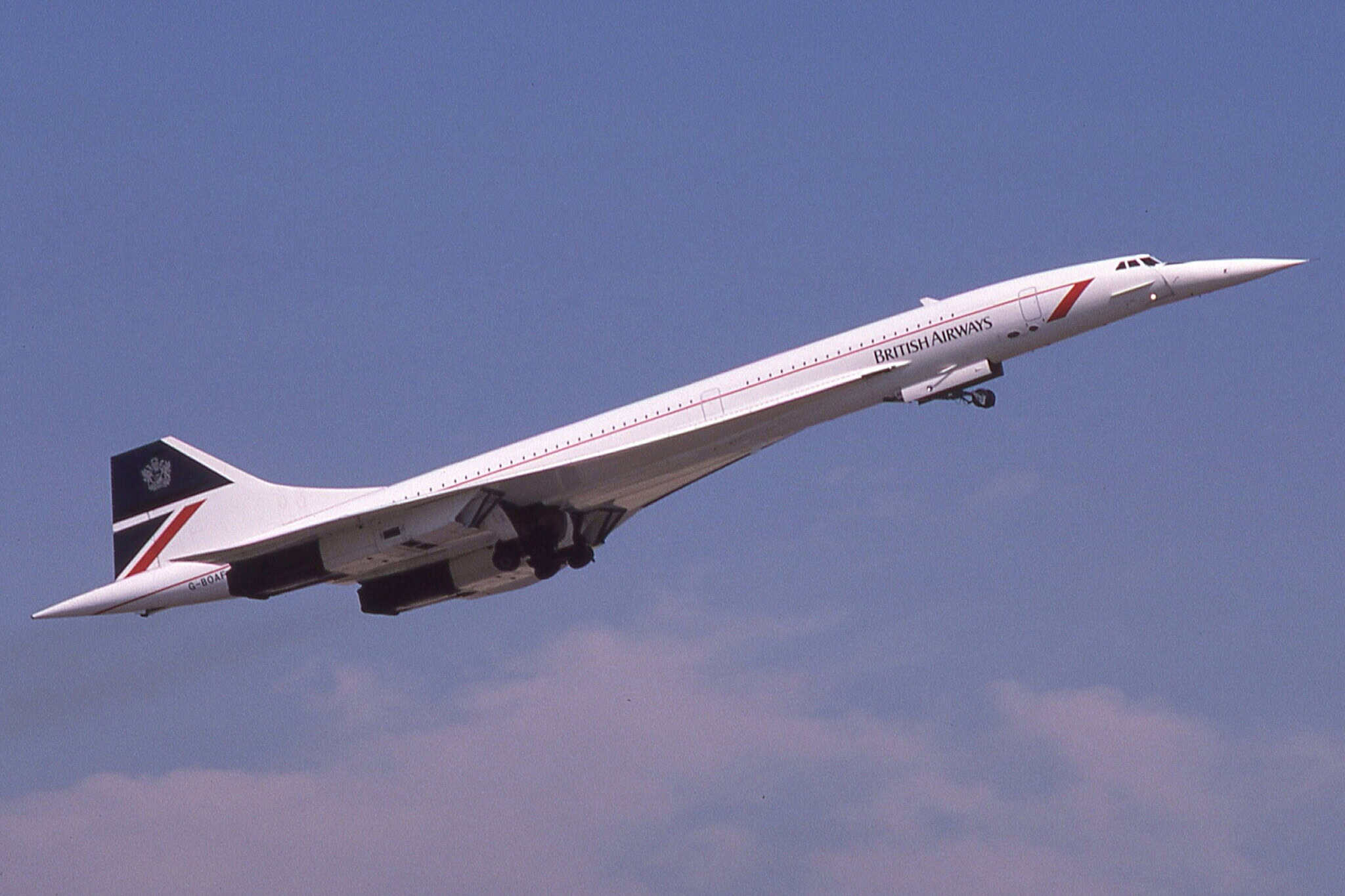
British Airways flight BA001 left London Heathrow at 10:30 in the morning and landed at New York JFK at 9:30 in the morning. Not the next day. The same morning, an hour before it took off.
That was the schedule, printed in a normal timetable, five days a week. Passengers landed in Manhattan with the working day still ahead of them and the clock apparently running backwards.
Concorde has now been out of service for longer than most people realize, and no airliner built since has come close to matching it. The speed is easy to look up. The interesting question is why an aircraft that fast was allowed to disappear, and why the replacement still has not arrived.
How Fast Did Concorde Fly? Mach 2.04, and about half the time
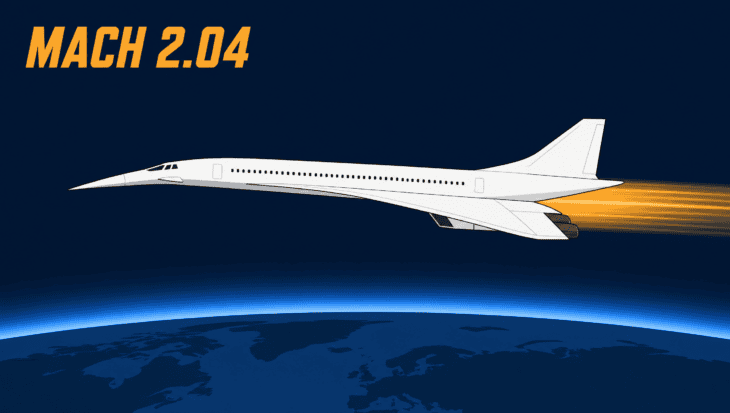
Concorde cruised at Mach 2.04, roughly 1,354 mph (2,179 km/h), at 60,000 feet (18,300 m). That is a little over twice the speed of sound and roughly twice the cruise speed of the jet you flew on last.
On paper the scheduled crossing between New York and London took about three and a half hours. The record run took considerably less.
The answer in one box
Concorde cruised at Mach 2.04, about 1,354 mph (2,179 km/h), at 60,000 feet. Scheduled New York to London crossings ran about 3 hours 30 minutes. The record, set on 7 February 1996, was 2 hours 52 minutes 59 seconds. The same trip is scheduled at 7 hours 30 minutes today.
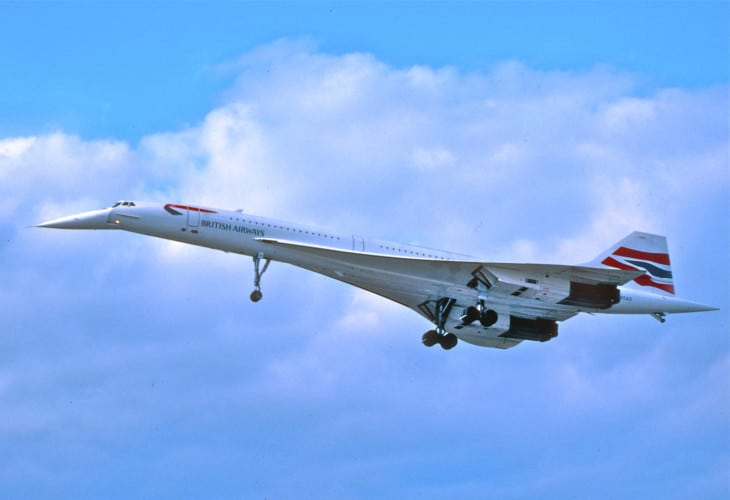
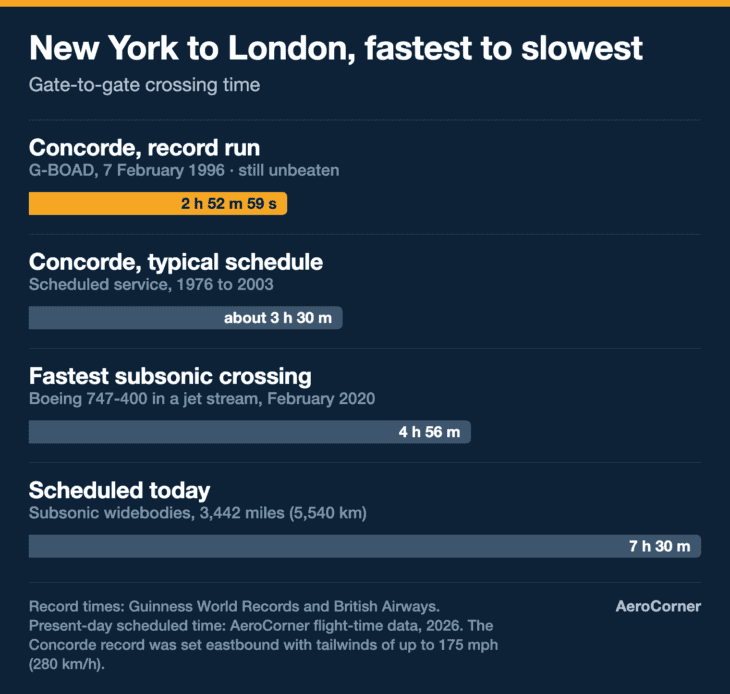
The record belongs to British Airways aircraft G-BOAD, which flew JFK to Heathrow on 7 February 1996 in 2 hours 52 minutes 59 seconds, averaging about 1,250 mph (2,010 km/h) gate to gate with tailwinds of up to 175 mph (280 km/h) behind it. Twenty-seven passengers were on board. It still stands.
For contrast, the fastest a subsonic airliner has ever managed on the same crossing is 4 hours 56 minutes, set by a British Airways Boeing 747-400 riding a violent jet stream in February 2020. Today AeroCorner’s own JFK to London Heathrow flight time data puts the scheduled trip across 3,442 miles (5,540 km) at 7 hours 30 minutes.
| New York to London | Time | Aircraft | When |
|---|---|---|---|
| Fastest ever crossing | 2 h 52 m 59 s | Concorde (G-BOAD) | 7 February 1996 |
| Typical Concorde schedule | about 3 h 30 m | Concorde | 1976 to 2003 |
| Fastest subsonic crossing | 4 h 56 m | Boeing 747-400 | February 2020 |
| Scheduled today | 7 h 30 m | Subsonic widebodies | 2026 |
Nothing in airline service has bettered that since. The fastest passenger planes flying today all sit just below the sound barrier, cruising in the Mach 0.78 to 0.85 band, because that is where a swept-wing jet is most efficient rather than where it is fastest.
What Mach 2 did to the aircraft itself
Going twice as fast is not a matter of adding thrust. Above roughly Mach 1.5, air compressing against the airframe heats it, and the aircraft has to be designed around that heat rather than against it.
At cruise, the skin at Concorde’s nose reached about 261°F (127°C). The cabin windows were genuinely warm to the touch, and there was a temperature gradient down the length of the cabin, with the front rows warmer than the back.
The aircraft grew in flight
Thermal expansion stretched Concorde’s 202-foot airframe by somewhere between 6 and 10 inches (15 to 25 cm) at Mach 2. The stretch was visible in the cockpit, where a seam beside the flight engineer’s panel opened up in cruise. Crews wedged their caps into the gap on the last flights, knowing it would close on descent and seal them in permanently.
The four Rolls-Royce/SNECMA Olympus 593 engines used afterburners, called reheat, to get through the transonic acceleration, which is a military technique almost never seen on a civil aircraft. Full specifications are on our Aérospatiale-BAC Concorde aircraft page.
Cruising at 60,000 feet put Concorde roughly two miles above ordinary traffic, high enough that passengers could see the curvature of the Earth and the sky went a deep indigo. That altitude is also close to the practical ceiling for a crewed airliner, which we cover in the invisible ceiling every airliner slams into.
The sonic boom took away the route map
Here is the constraint that shaped everything else. An aircraft flying supersonically drags a continuous pressure wave along the ground beneath it, a boom carpet tens of miles wide, and it does that for the whole cruise rather than once at the moment it breaks the sound barrier.
The United States settled the argument early. In 1973, before Concorde carried a single fare-paying passenger, the FAA banned civil supersonic flight over US land, a rule that still sits in the regulations as 14 CFR 91.817.
That single rule removed every profitable overland route from the aircraft’s business case. Concorde could go fast over water and nowhere else.
The rest of the network died the same way. A London to Singapore service via Bahrain was suspended after three flights when Malaysia objected to the boom over its airspace.
Braniff spent 17 months flying leased Concordes between Washington Dulles and Dallas at subsonic speed, which is to say it operated the fastest airliner ever built with its main feature switched off. It gave up in 1980 when fuel prices climbed.
What survived was a pair of ocean crossings to New York, from London and from Paris. An aircraft designed for a global network ended up serving essentially one market.
One hundred seats, and the fuel bill of four hundred
The second constraint is arithmetic. Concorde burned about 6,770 US gallons (25,600 liters) of fuel an hour at cruise while carrying around 100 passengers.
Per mile flown, that is roughly what a Boeing 747 used. The 747 was carrying four times as many people.
Expressed the way efficiency is usually measured, Concorde managed about 17 passenger-miles per gallon. The subsonic airliner fleet runs somewhere between 50 and 80.
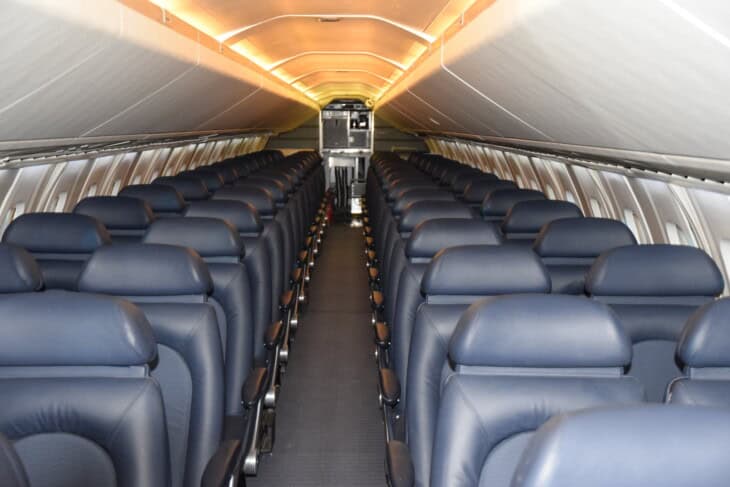
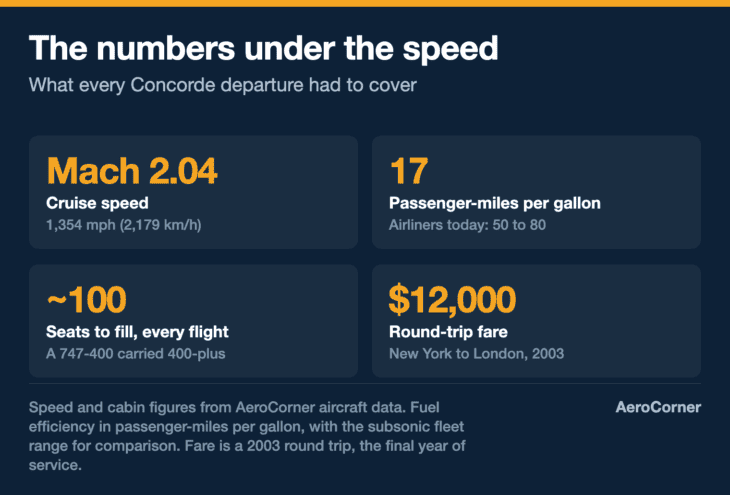
That math only closes if every seat sells at a fare no ordinary passenger would pay. By 2003 a London to New York round trip cost roughly $12,000, and the cabin was 100 seats of business travelers, bankers and entertainers buying back a working day.
Airlines saw this coming. Sixteen carriers held options on more than 70 Concordes in the late 1960s, and after the 1973 oil crisis and the overland ban, every single one of them walked away.
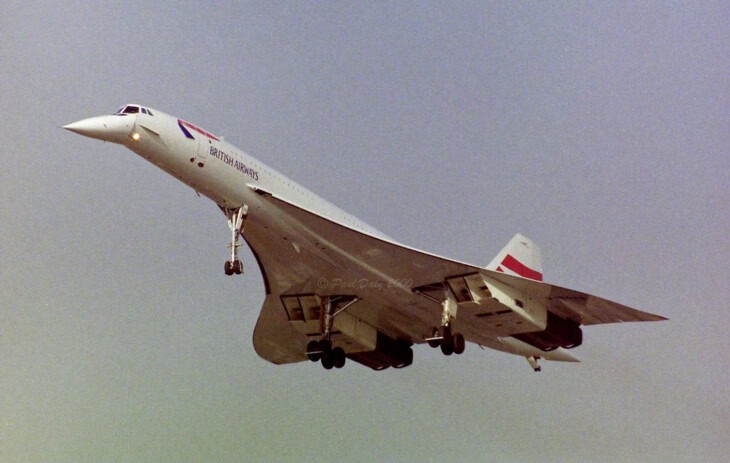
Twenty aircraft were built in total and only 14 ever entered airline service, split between British Airways and Air France. A production line that small can never recover its development cost, and Concorde never did.
The myth: that Concorde was a money pit that crashed and died
The popular version of the story is that Concorde lost money on every flight until a crash finished it off. Both halves of that are wrong, and the real version is stranger.
The fare was raised because passengers guessed high
British Airways discovered in the 1980s that its Concorde passengers had no idea what the ticket cost, and when asked, guessed a figure well above the actual fare. BA raised prices to match the guess. Bookings went up, and the operation went on to earn an average operating profit of £30 to £50 million a year.
Across its whole British Airways career, Concorde is reported to have brought in around £1.75 billion in revenue against roughly £1 billion in operating cost. The development program was a financial disaster for the two governments that funded it, but the flying operation itself, once the airlines owned the aircraft outright, made money.
The crash matters, but not as a single cause. Air France Flight 4590 went down shortly after takeoff from Paris on 25 July 2000, killing all 109 people on board and four on the ground, and the fleet was grounded for over a year while the fuel tanks were reinforced.
Concorde returned to service in November 2001, into a transatlantic premium market that had just collapsed after the September 11 attacks. Its core customers, the people who paid five figures to save four hours, had largely stopped flying.
The decisive blow was quieter. In 2003 Airbus, which had inherited responsibility for the type, said it would no longer support a bespoke 1960s airframe with a fleet of 12 flying examples. Without a manufacturer behind it, no airline can legally maintain an aircraft, and both operators announced retirement within weeks. That sequence is the reason Concorde stopped flying when it did, and why the crash was the trigger rather than the cause.
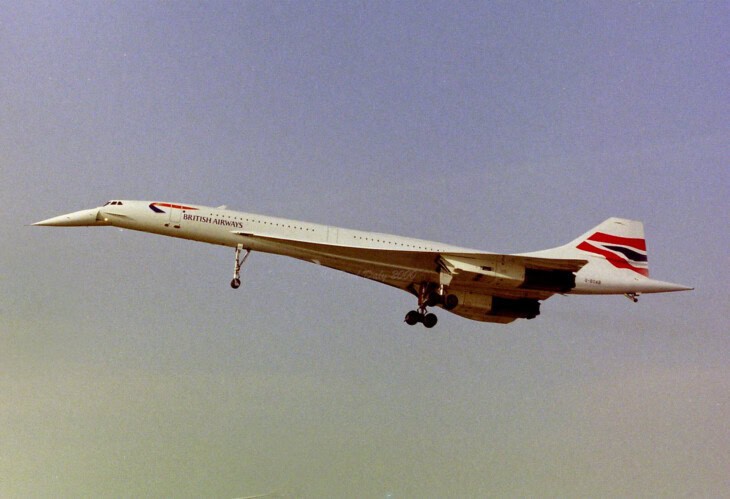
Air France flew its last commercial Concorde service on 30 May 2003. British Airways followed on 24 October 2003, and the supersonic era in airline service ended that afternoon.
Eighteen of the twenty airframes survive, most of them intact and on public display. None of them can fly again while the type certificate that covered the fleet sits with the regulator instead of with a manufacturer.
What has changed since, and what has not
For 23 years the answer to “what replaced Concorde” has been “nothing.” That is finally starting to shift, and the reason is that engineers stopped trying to beat the sonic boom and started trying to hide it.
The physics is called Mach cutoff. Break the sound barrier high enough and slowly enough, and the boom bends upward in the warmer, denser air below and never reaches the ground at all.
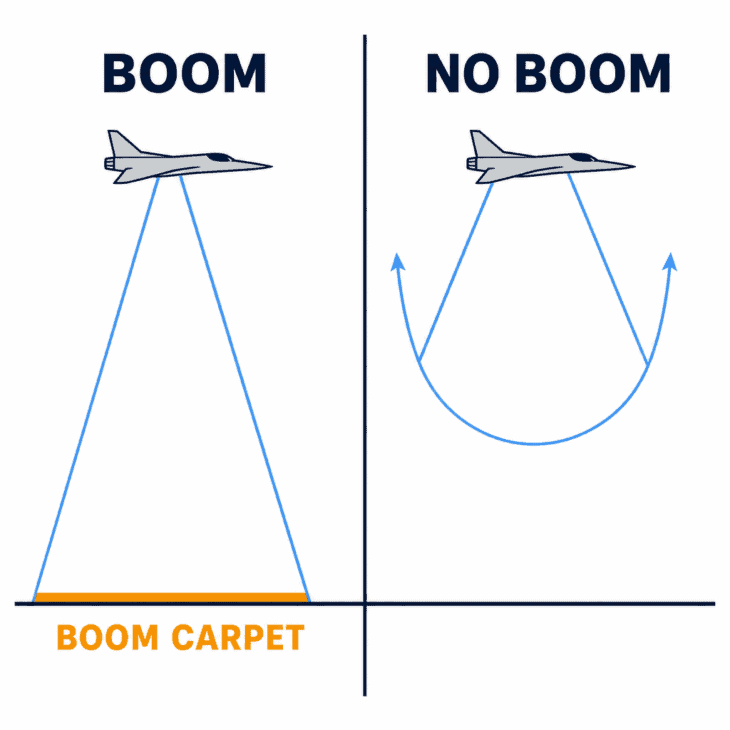
NASA’s X-59 exists to prove a related idea, that an airframe can be shaped so its shock waves never coalesce into a bang. It flew supersonic for the first time on 5 June 2026 and reached its survey condition of Mach 1.4 at 55,000 feet a week later.
The point of those flights is not speed. It is to fly over real American towns and measure what people underneath actually hear, so regulators have data instead of a 1973 assumption.
The rule itself is now moving. On 2 July 2026 the FAA proposed replacing the outright overland ban with a noise standard, allowing supersonic flight over the US where the boom reaching the surface stays at or below 0.11 pounds per square foot.
Boom Supersonic is building the aircraft that would use it. Overture is designed for Mach 1.7 with 60 to 80 seats, roughly twice Concorde’s cabin at a lower speed, with a “Boomless Cruise” mode up to Mach 1.3 over land using the refraction trick.
The honest status, in 2026, is that none of it has flown yet. Boom’s XB-1 demonstrator went supersonic in January 2025, its Symphony engine is in ground testing, and passenger service is targeted for around 2029 or 2030, a date most outside analysts expect to slip into the 2030s.
1969
Concorde flies. The Anglo-French prototype makes its first flight from Toulouse in March, with 16 airlines holding options on more than 70 aircraft.
1973
The overland ban. The FAA prohibits civil supersonic flight over US land. The oil crisis follows, and every airline option is cancelled.
1976
Service begins. British Airways and Air France launch on the same day, 21 January. Only 14 aircraft will ever fly for airlines.
1996
The record. G-BOAD crosses from New York to London in 2 hours 52 minutes 59 seconds on 7 February. It has never been beaten.
2000
Air France 4590. A Concorde crashes on departure from Paris on 25 July, killing 113 people. The fleet is grounded for more than a year.
2003
Retirement. Airbus withdraws type support. Air France stops in May, British Airways on 24 October, and airline supersonic flight ends.
2026
The rule moves. NASA’s X-59 goes supersonic in June, and in July the FAA proposes replacing the overland ban with a noise limit of 0.11 pounds per square foot.
So the fair answer to “why has nothing replaced Concorde” is that speed was never the hard part. The hard parts were a rule that deleted most of the map, and a fuel bill that only about 100 people per flight could ever cover.
One of those two problems now has a plausible engineering answer and a proposed regulation to match. The other, the arithmetic of burning several times the fuel per passenger, has not changed at all.
Next time your evening flight to London is scheduled at seven and a half hours, it is worth knowing that the same trip was once sold at three. The aircraft that did it was retired while it was still profitable and still unbeaten.
It was not out of speed. It was out of places it was allowed to fly, and out of a manufacturer willing to keep it airworthy.
Concorde prompts three questions in the same order, and speed is only the first. Our Concorde collection takes the retirement and the grounded survivors in turn.
Sources and references used for research and fact-checking.
- Guinness World Records, 1996: Fastest Flight Across the Atlantic in a Commercial Aircraft
- Federal Aviation Administration, Federal Register, Enabling Supersonic Overland Flight (Notice of Proposed Rulemaking)
- NASA, NASA's X-59 Aircraft Flies Supersonic for First Time
- Boom Supersonic, Boom Supersonic Announces Boomless Cruise
- Simple Flying, Did British Airways Make A Profit Flying Concorde?
- AeroCorner, Aérospatiale-BAC Concorde
Get the Newsletter
The latest aviation news and stories sent to your inbox.
About the Author

Tim is the owner and lead editor of AeroCorner since 2019, overseeing aviation content covering aircraft, airlines, airports, and the broader aviation industry. Through years of researching, writing, editing, and publishing aviation-focused content, he has developed extensive practical knowledge of commercial aviation and air travel. Based in Asia and a frequent traveler himself, Tim also brings firsthand passenger experience to AeroCorner’s coverage. Outside of publishing, he has also explored aviation firsthand through hands-on flight training in New Zealand.