

Table of Contents
Somewhere over Kansas the seatback map settles on a number and stops moving. Thirty eight thousand feet. It will sit there, unchanged, for the next four hours.
It is easy to read that as a preference, the altitude this particular crew happened to like. It is closer to a wall.
A few thousand feet higher, the aircraft runs out of usable flight envelope. A few thousand miles further, it runs out of fuel it can physically carry. Those two limits, the ceiling and the range wall, are what turn every fun hypothetical about aviation into a much shorter answer than people expect.
Can a plane fly to the moon?
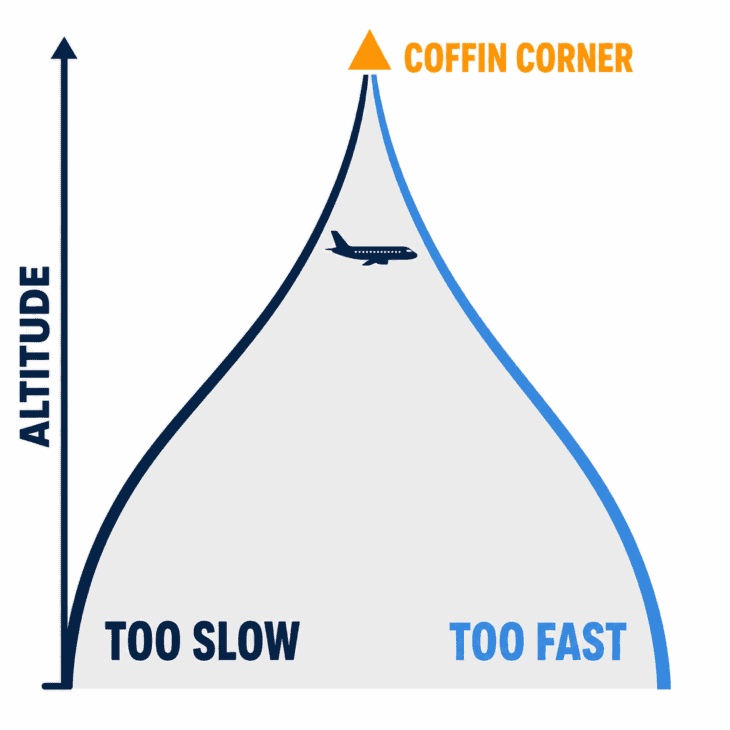
Airliners stop climbing near 41,000 feet because that is roughly where the gap between flying too slow and flying too fast closes to nothing. It is an aerodynamic squeeze, not a lack of engine power.
Range works the same way. Fuel is heavy, and carrying more of it burns more of it, so every aircraft hits a point where adding fuel stops adding useful distance. Even the longest scheduled flight on earth covers only about 38 percent of the planet’s circumference.
The limits, at a glance
Typical airliner ceiling: 41,000 to 43,100 feet. Ultra-long-range business jets: 51,000 feet. The highest sustained jet flight on record: 85,069 feet, still only about a quarter of the way to the edge of space. Longest scheduled flight: 9,530 miles (15,336 km). Earth’s circumference: 24,901 miles (40,075 km).
Why the ceiling sits just above 40,000 feet
As a jet climbs, the air thins. Thin air means the wing has to move faster through it to generate the same lift, so the speed at which the aircraft stalls creeps upward with every thousand feet.
At the same time, the aircraft’s maximum speed is coming down. Airflow over the wing accelerates past the aircraft’s own speed, and once parts of it go supersonic the aircraft starts to buffet, so the safe upper limit falls as the air gets thinner.
One limit rising, one limit falling. Keep climbing and they meet, leaving a crew just a handful of knots between a stall and an overspeed. Pilots call that squeeze the coffin corner, and it is the real reason airliners level off where they do.
Two other constraints arrive at about the same altitude. Engines make thrust by burning air, and there is progressively less of it to burn, so the climb rate decays toward zero at what engineers call the absolute ceiling. The published service ceiling sits a little below that, at the point where the aircraft can still manage a meaningful rate of climb.
The fuselage matters too. US certification rules cap the cabin at a pressure altitude of 8,000 feet in normal operations, so the higher the aircraft flies, the harder the outside air is trying to burst the tube. Building a fuselage for 45,000 feet instead of 40,000 means more structure, more weight, and worse economics on every flight it ever makes.
Then there is airspace itself. Reduced Vertical Separation Minimum airspace, where aircraft are stacked 1,000 feet apart, runs from FL290 to FL410 inclusive. Above FL410 the separation standard doubles to 2,000 feet, which makes the sky above that band both emptier and less useful to an airline.
| Aircraft | Ceiling | What it is |
|---|---|---|
| Boeing 737 MAX 8 | 41,000 ft | Typical short-haul airliner |
| Boeing 787-9 / Airbus A350-900 | 43,100 ft | Modern long-haul twin |
| Gulfstream G650ER | 51,000 ft | Ultra-long-range business jet |
| Concorde | 60,000 ft | Retired supersonic airliner |
| Lockheed U-2 | Above 70,000 ft | High-altitude reconnaissance |
| Lockheed SR-71 | 85,069 ft | Record for sustained horizontal flight, 1976 |
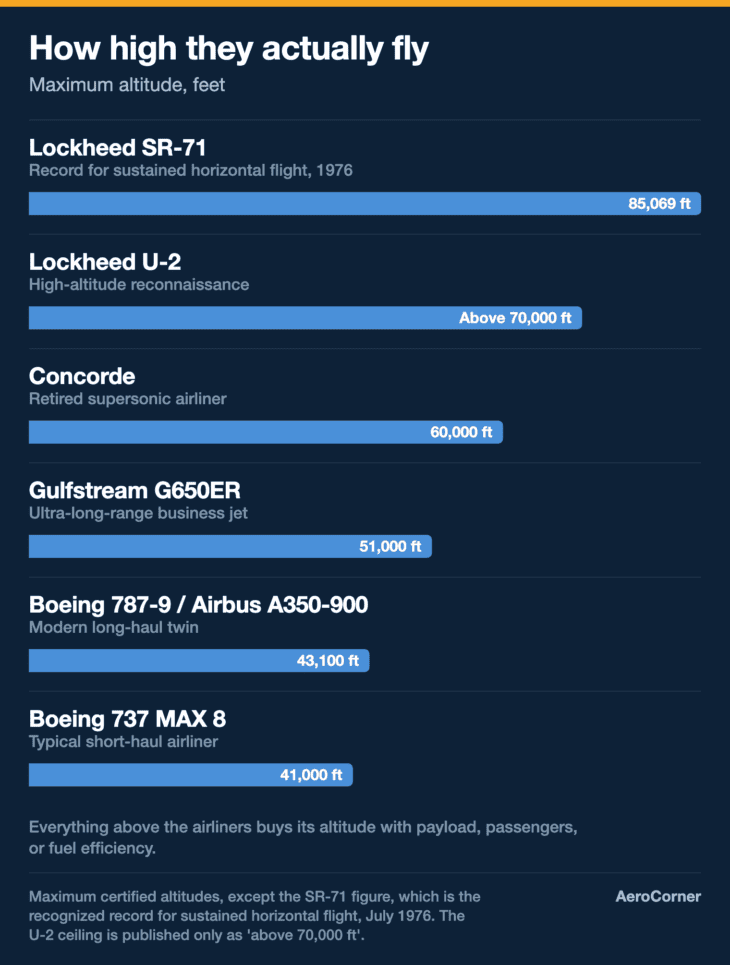
The pattern in that table is worth sitting with. Every jump up the list costs something: passengers, payload, fuel efficiency, or in the SR-71’s case, an airframe that leaked fuel on the ground because it was built to expand several inches when it got hot at speed.
Nobody is holding airliners back. The altitude they cruise at is the one where all of those competing costs come out best, which is a fuller answer than the usual explanation of how high airplanes fly.
The other wall: why range runs out before the world does
Range has its own trap, and it is the most counterintuitive thing in commercial aviation: fuel costs fuel.
Load an extra ton of it and the aircraft is now a ton heavier for the entire flight, so it burns more just carrying the reserve around. Each additional gallon buys slightly less distance than the one before it, until the curve flattens out entirely.
That is why ultra-long-haul aircraft give things up rather than simply adding tanks. AeroCorner’s own longest flight routes ranking puts Newark to Singapore at the top, 9,530 miles (15,336 km) in 18 hours 20 minutes, flown by an A350-900ULR whose cabin is deliberately kept small.
Qantas is pushing that further. Its Project Sunrise A350-1000ULRs, due to open Sydney to London nonstop in October 2027 on a flight of up to 22 hours, will carry 238 passengers where a standard A350-1000 seats around 410.
Nearly half the cabin is traded away for the fuel to make the distance. That is the same logic behind every entry on our list of the longest flights in the world.
Even that is not a lap of the planet. Sydney to London is roughly 10,560 miles (17,000 km) against a circumference of 24,901 miles (40,075 km), so the most ambitious airline route ever planned gets about 42 percent of the way around.
Aircraft have gone all the way around nonstop, but only by abandoning the idea of carrying anything. In December 1986 the Rutan Voyager flew 24,987 miles (40,212 km) without refueling, taking nine days to do it, with roughly three quarters of its takeoff weight made up of fuel.
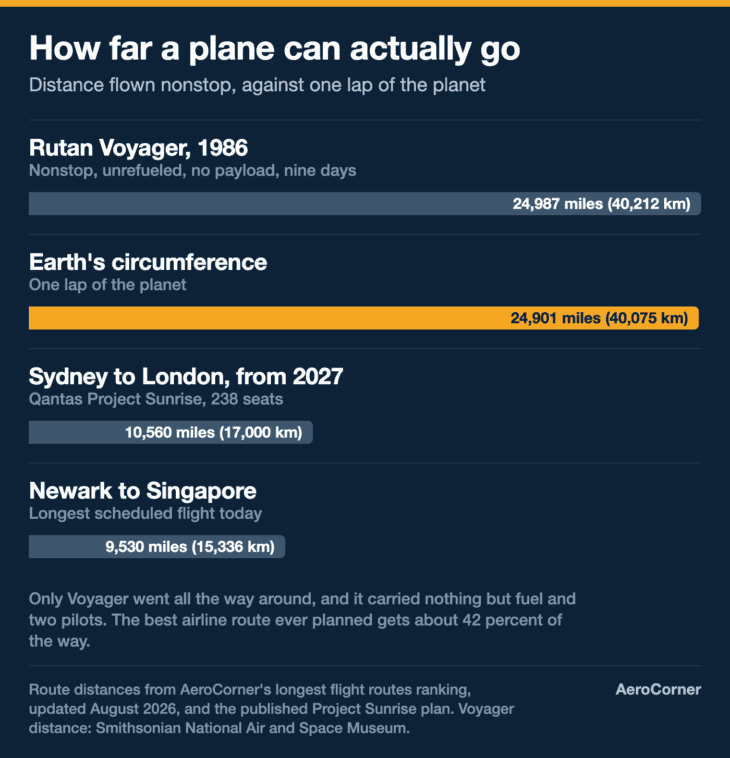
A circumnavigation is possible. It just is not an airliner.
Voyager needed nine days and a fuel fraction no passenger aircraft could ever accept. Steve Fossett did it solo in the Virgin Atlantic GlobalFlyer in 2005 in a little over 67 hours, averaging 342 mph. Both aircraft were essentially flying fuel tanks with a pilot bolted on, which is exactly why no airline operates anything like them.
So how long would it take to fly to the Moon?
This is the question the ceiling and the range wall were always leading to, and the arithmetic part of it is easy.
The Moon sits an average of 238,855 miles (384,400 km) away. At a typical airliner cruise of 550 mph (885 km/h), that is about 434 hours, or a little over 18 days of continuous flying.
The myth: a plane could get there with enough fuel
It could not, and the reason has nothing to do with fuel. A wing needs air to push against and a jet engine needs oxygen to burn. Both run out long before the atmosphere does, and the atmosphere itself ends a rounding error into the trip.
The edge of space is conventionally placed at the Karman line, 62 miles (100 km) up. An airliner at 40,000 feet is 7.6 miles up, already above roughly 80 percent of the atmosphere by mass, and still nowhere near it.
The SR-71’s record 85,069 feet is 16 miles, about a quarter of the way to that line. The absolute altitude record for any ground-launched aircraft, set by Alexandr Fedotov in a MiG-25 in August 1977, is 123,523 feet, or 23 miles.
Even that was a zoom climb. Fedotov threw the jet upward on momentum and it came back down, so nothing about it was sustained flight.
Put the whole trip in proportion and it collapses. The Karman line is 0.026 percent of the way to the Moon, and the Moon is around 31,000 times further from the ground than a cruising airliner. Which is another way of saying that planes cannot fly into space for the same reason boats cannot drive to Denver.
The 18-day figure is a fine piece of trivia. It just describes a journey no aircraft could begin, because the medium it flies in gives out in the first four hundredths of one percent.
So the next time the map freezes at 38,000 feet for four hours, that number is not a habit. It is the flat top of a curve where thin air, engine thrust, fuselage strength, and the price of a seat all arrive at the same answer.
Aviation spent a century learning to live inside a band of sky about eight miles thick and a fuel load that runs dry somewhere short of halfway around. Everything above and beyond that turned out to belong to rockets.
Sources and references used for research and fact-checking.
- Cornell Law School, Legal Information Institute, 14 CFR 25.841 - Pressurized cabins
- Federal Aviation Administration, Reduced Vertical Separation Minimum (RVSM), FAA Order JO 7110.65
- Smithsonian National Air and Space Museum, Rutan Voyager
- Smithsonian National Air and Space Museum, Setting Records: SR-71 Blackbird
- CNN, Qantas locks in launch date for Sydney-London nonstop flights
- AeroCorner, Longest Flight Routes in the World
Get the Newsletter
The latest aviation news and stories sent to your inbox.
About the Author

Tim is the owner and lead editor of AeroCorner since 2019, overseeing aviation content covering aircraft, airlines, airports, and the broader aviation industry. Through years of researching, writing, editing, and publishing aviation-focused content, he has developed extensive practical knowledge of commercial aviation and air travel. Based in Asia and a frequent traveler himself, Tim also brings firsthand passenger experience to AeroCorner’s coverage. Outside of publishing, he has also explored aviation firsthand through hands-on flight training in New Zealand.