

Table of Contents
Every time a business jet goes down, the same question follows within hours: have they found the black box? After a Learjet 60 crashed near Greenacres, Florida, on November 1, 2026, killing all nine people aboard, it came up again almost immediately.
The NTSB has not found a cause for the Greenacres Learjet 60 crash, and as of November 3, 2026 it had not said publicly what recording equipment, if any, investigators recovered. That uncertainty is normal for a private jet, and the reason is not what most people assume.
Airliners always carry recorders. Private jets carry them only when a specific set of US rules says so, and those rules care about three things: how many engines the jet has, how many passenger seats it has, and how many pilots it needs.
Do Private Jets Have Black Boxes?
Some do and some do not. Under US rules, a twin-engine jet with six or more passenger seats that needs two pilots must carry a cockpit voice recorder, and one with 10 or more passenger seats must also carry a flight data recorder.
Below those lines, the law requires nothing. A single-engine jet, or a twin certified to be flown by one pilot and kept small, can fly privately with no crash-protected recorder at all. An owner can fit one anyway, but that is a choice, not a requirement.
The answer at a glance
A “black box” is really two devices: a cockpit voice recorder (CVR) and a flight data recorder (FDR). For US private jets, the CVR is required on multi-engine turbine aircraft with 6 or more passenger seats that need two pilots. The FDR is required from 10 passenger seats up. Everything smaller is optional.
The Three Questions That Decide It
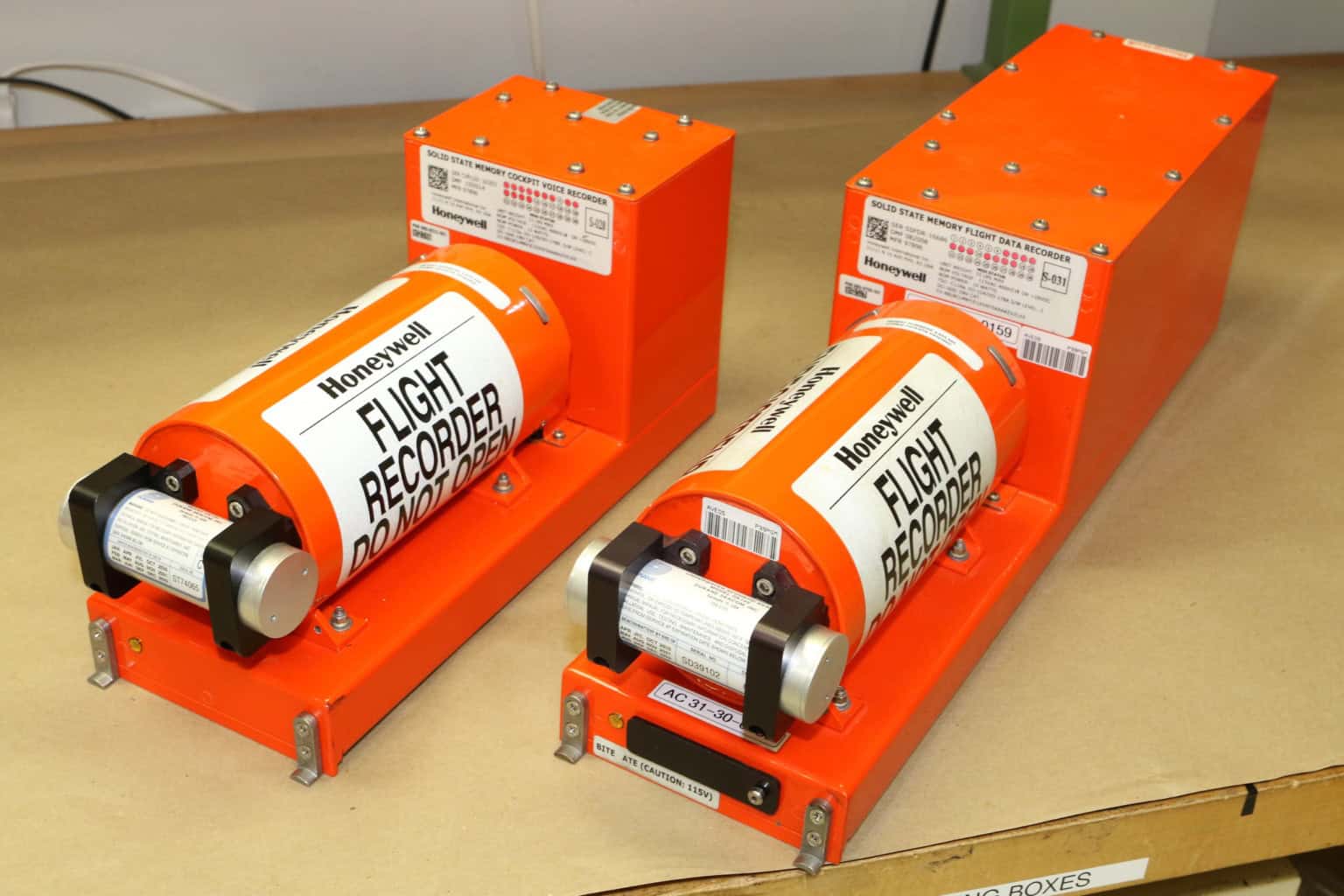
The term “black box” covers two separate recorders. The cockpit voice recorder captures sound on the flight deck: the pilots’ voices, radio calls, alarms and engine noise. The flight data recorder logs the aircraft’s numbers, such as altitude, airspeed, heading and control positions. If you want to know what black boxes are made of and how they survive a crash, that is a separate story.
For an owner flying their own jet, the rule is 14 CFR 91.609. Its voice recorder clause applies to a US-registered, multi-engine, turbine-powered airplane with a passenger seating configuration of six or more, “for which two pilots are required by type certification or operating rule.” All three conditions must be true at once.
Its flight data recorder clause sets a higher bar: a multi-engine turbine airplane with 10 or more passenger seats, not counting pilot seats, built after October 11, 1991. Those recorders must hold at least 8 hours of flying, and airplanes built on or after April 7, 2010, must keep the last 25 hours.
| Jet profile (private, Part 91) | Example | Voice recorder (CVR) | Flight data recorder (FDR) |
|---|---|---|---|
| Single-engine jet | Any single-engine personal jet | Not required | Not required |
| Twin jet certified for one pilot, under 10 passenger seats | Pilatus PC-24 (typically 8 seats) | Not required | Not required |
| Twin jet that needs two pilots, 6 to 9 passenger seats | Two-pilot light and midsize jets | Required | Not required |
| Twin jet with 10 or more passenger seats, built after Oct. 11, 1991 | Gulfstream G650 (up to 19 seats) | Required | Required |
Why the Pilot Count Matters So Much
The two-pilot condition is the one that catches people out. Under 14 CFR 91.531, a private operator needs a second-in-command for any airplane type certificated for two pilots, any large airplane (over 12,500 pounds, or 5,670 kg) and any commuter category airplane. But the same rule exempts “any airplane certificated for operation with one pilot.”
That exemption covers a growing class of jets. The Pilatus PC-24 earned FAA and EASA certification in December 2017 as a single-pilot jet, with a typical cabin of eight seats. Flown privately by one pilot, it meets none of the voice recorder conditions, so no recorder is required, even though it is a twin-engine jet carrying passengers.
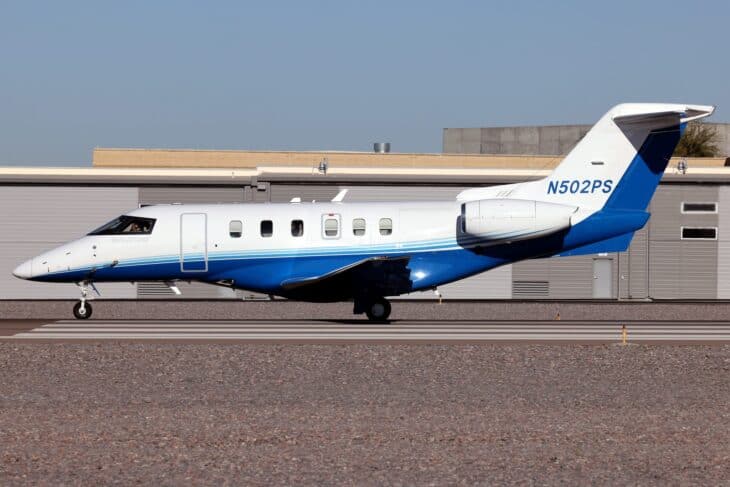

Big-cabin jets sit at the other end. The Gulfstream G650 seats up to 19, is a large airplane that needs two pilots, and has more than 10 passenger seats, so it must carry both recorders even when its owner flies nobody but family.

A single engine means no requirement at all
Both the private and the charter recorder rules apply only to multi-engine, turbine-powered aircraft. A single-engine jet falls outside every clause, whatever its seat count or however it is flown.
What Changes When the Jet Flies Charter
Charter flights fall under Part 135, and its recorder rules mirror the private ones with a few tighter edges. Section 135.151 uses the same voice recorder test (multi-engine turbine, six or more passenger seats, two pilots required) and adds a stricter version for aircraft with 20 or more seats.
Section 135.152 requires a flight data recorder on multi-engine turbine aircraft with 10 to 19 passenger seats that joined the US register, or an operator’s US operations specifications, after October 11, 1991. That recorder must retain no less than 25 hours of operation. The differences between Part 121 and Part 135 run well beyond recorders, but this is one of the clearest.
The bigger difference is crew. Part 135 requires a second-in-command on any aircraft with 10 or more passenger seats, and on any passenger flight under instrument flight rules unless the operator holds FAA approval to use an autopilot instead. A jet that needs no second pilot privately can need one on a charter, and once two pilots are required by an operating rule, the voice recorder rule follows.
Fractional ownership programs, flown under Part 91 subpart K, borrow the charter rules outright. Section 91.1045 sends program aircraft with 30 seats or fewer to the Part 135 recorder sections.
The Myth: Every Jet Has a Black Box
The myth
Every jet carries a black box, so investigators will always hear what happened in the cockpit. In reality, US rules leave many business jets with no required recorder, and even a required voice recorder may hold only the last two hours.
The NTSB has been blunt about the gap. On its page calling for crash-resistant recorders, it says 83% of the turbine-powered aircraft operating under Part 91 or 135 in which flight crew were killed, and which it investigated between 2005 and 2020, had no recording equipment installed.
Its recommendations A-13-12 and A-13-13 ask the FAA to require a crash-resistant recorder system, capturing cockpit audio, images and flight data, on new and existing turbine aircraft that lack both recorders. Both are still listed as open. Recommendation A-16-34 asks for flight data recording devices across all Part 135 operators.
The FAA has moved on recording time, not coverage. A final rule published February 2, 2026, raises the voice recorder standard from 2 hours to 25 hours, but only for newly built aircraft that already need a recorder. For Part 91 and 135 aircraft weighing 59,524 pounds or less at takeoff, it applies to those built on or after February 2, 2029, and the FAA did not require existing aircraft to be retrofitted.
How Investigators Work Without a Recorder
No recorder does not mean no data. Since January 1, 2020, 14 CFR 91.225 has required ADS-B Out equipment for flight in Class A airspace and much of the other controlled airspace, so a jet flying there broadcasts its position, altitude and speed to ground stations, and flight-tracking sites pick it up too.
Investigators also pull air traffic control radar and the recorded radio calls. They examine the wreckage itself, and they read the non-volatile memory inside modern avionics, the flash memory in solid-state cockpit equipment that can keep data after power is lost. The NTSB’s recorder engineers also run forensic examinations of electronic devices and synchronize every source onto one timeline.
What that cannot replace is the cockpit itself: what the crew said, what alarms sounded, and what they were trying to do. The NTSB can rebuild where a jet went far more easily than why.
A case that stayed partly open
On June 4, 2023, a privately flown Cessna Citation V (N611VG) stopped responding after departing Tennessee, flew over Washington, D.C., was intercepted by F-16s and crashed in Virginia. The NTSB said it had no flight data recorder and was not required to have one; maintenance records showed a voice recorder, but it was never found. The final report pointed to likely hypoxia but could not determine what caused the loss of pressurization.
Helicopters face the same patchwork, which is why the question of whether helicopters have black boxes gets a similar answer: it depends on size, seats and the kind of flying.
So the next time a business jet crash makes the news and someone asks when the black box will be read, the honest answer starts with three questions. How many engines, how many seats, and how many pilots did the rules require? For a large share of private jets, the answer means investigators will be working from radar tracks, radio calls and wreckage instead.
Sources and references used for research and fact-checking.
- eCFR, 14 CFR 91.609, Flight data recorders and cockpit voice recorders
- eCFR, 14 CFR 135.151, Cockpit voice recorders
- eCFR, 14 CFR 135.152, Flight data recorders
- eCFR, 14 CFR 91.531, Second in command requirements
- eCFR, 14 CFR 135.99, Composition of flight crew
- eCFR, 14 CFR 135.101, Second in command required under IFR
- eCFR, 14 CFR 91.1045, Additional equipment requirements
- eCFR, 14 CFR 91.225, ADS-B Out equipment and use
- Federal Register, 25-Hour Cockpit Voice Recorder (CVR) Requirement, New Aircraft Production
- NTSB, Install Crash Resistant Recorders
- NTSB, Office of Research and Engineering
- SKYbrary, Non Volatile Memory
- AOPA, Pilatus PC-24 certified
- Wikipedia, 2023 Virginia Cessna Citation crash
- Wikipedia, 2026 Greenacres Learjet 60 crash
- CBS12, NTSB set to share new details on fiery plane crash in Greenacres
Get the Newsletter
The latest aviation news and stories sent to your inbox.
About the Author

Tim is the owner and lead editor of AeroCorner since 2019, overseeing aviation content covering aircraft, airlines, airports, and the broader aviation industry. Through years of researching, writing, editing, and publishing aviation-focused content, he has developed extensive practical knowledge of commercial aviation and air travel. Based in Asia and a frequent traveler himself, Tim also brings firsthand passenger experience to AeroCorner’s coverage. Outside of publishing, he has also explored aviation firsthand through hands-on flight training in New Zealand.