Midsize Business Jets
Gulfstream G800
ICAO: GA8C
The Pilatus PC-24 is the Swiss "Super Versatile Jet", a single-pilot light jet with a cargo door that can land on gravel, grass and snow, and the first business jet Pilatus ever built.
Updated: by Tim de Vries

The latest aviation news and stories sent to your inbox.
The Pilatus PC-24 is a twin-engine light jet that first flew on 11 May 2015 and entered service with launch customer PlaneSense on 7 February 2018. Pilatus pitched it as a jet with the rough-field ability of its PC-12 turboprop, and it is certified for single-pilot operation. Air ambulance, government and corporate operators fly it from short, unpaved strips that most jets cannot use.
Live Fleet Activity (PC24)
Fetching live data…



The Pilatus PC-24 is a twin-engine light business jet built in Switzerland. Pilatus calls it the “Super Versatile Jet” because it pairs jet speed with the short-field, rough-runway ability of the company’s PC-12 turboprop.
It was the first jet Pilatus ever built. It first flew on 11 May 2015, received EASA and FAA certification on 7 December 2017, and went into service when PlaneSense took the first delivery on 7 February 2018.
The full specification table for the aircraft is on this page. The sections below explain the figures that need context.
Pilatus began work on the program in 2007, funded from company money. The jet was introduced at the EBACE show in Geneva on 21 May 2013.
Three prototypes flew. P01 made the first flight from Buochs on 11 May 2015, P02 followed on 16 November 2015, and P03 joined the test fleet in March 2017.
Series production started in 2017, and eight aircraft were on the assembly line that December.

The PC-24 has a straight wing with double-slotted flaps and long-stroke trailing-arm landing gear. The flaps are made of abradable material, so loose debris on a gravel strip does not wreck the engines.
Pilatus certified the jet for dry sand and gravel runways in the last quarter of 2018. Rough-field certification for grass, wet earth and snow followed in early 2020.
That ability is why air ambulance and government operators buy it. A jet that can reach a remote strip at 440 knots removes the choice between speed and access.
The cabin was styled by BMW Designworks. Its length, width and height are in the panel on this page, and Pilatus says the volume surpasses that of business jets costing up to twice as much.
A large rear cargo door is standard, which is rare in a business jet. It lets operators load bulky freight or a medical stretcher, and a divan can convert into a bed.

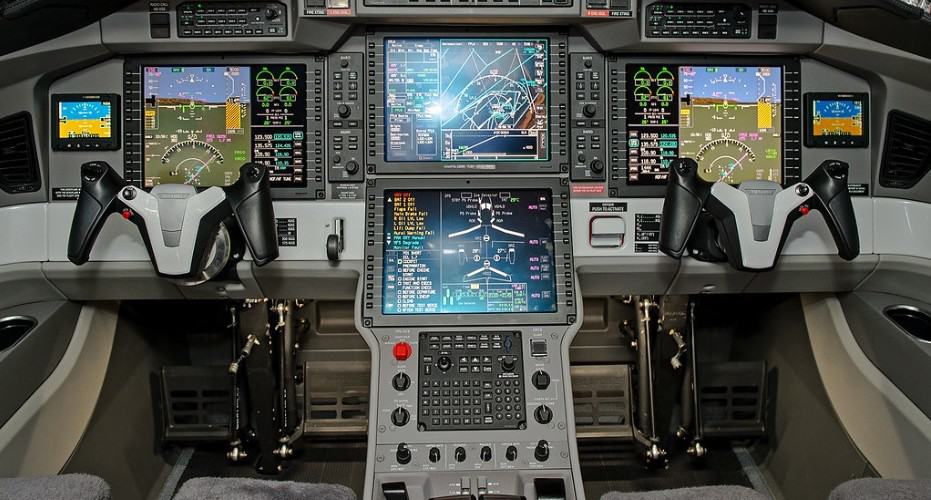
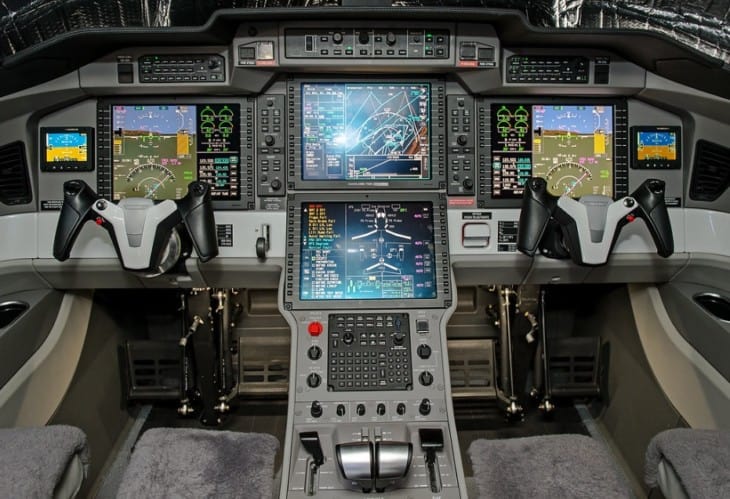
The cockpit uses the Advanced Cockpit Environment, a Honeywell Primus Epic 2 based avionics suite designed with Pilatus. It is certified for single-pilot operation, though many operators fly with two.
The panel’s range is the headline figure, but Pilatus quotes a maximum of 2,000 nautical miles, and the stored figure follows it. That is with a light load and NBAA IFR reserves, so fill every seat and the range drops.
Takeoff and landing distances are measured at maximum weight, at sea level on a dry paved runway. A hot, high or unpaved strip needs more.
The maximum takeoff weight was raised from the 31st aircraft in October 2018, so figures for early aircraft differ from later ones. Pilatus says top speed was raised during certification to 440 knots.
The two Williams FJ44-4A engines sit on the rear fuselage and give the jet a service ceiling of 45,000 ft. It can reach that altitude in about 27 minutes.
Pilatus quoted about $8.9 million at certification in December 2017. When orders reopened in May 2019 the price was $10.7 million (2019), the figure in the panel. Equipped and medical versions cost more.

Pilatus had built 212 PC-24s by the first quarter of 2024. The launch customer, PlaneSense, flies it in fractional service in the United States.
The Royal Flying Doctor Service of Australia uses it as an air ambulance with three beds and an electric stretcher loader. Sweden’s Svenskt Ambulansflyg, NSW Ambulance and Ontario’s Ornge also fly or have ordered medical versions.
Military and government users include Qatar’s Emiri Air Force, French Naval Aviation, Spain and Indonesia, which has orders on the books.
It is a twin-engine light jet with two Williams FJ44-4A turbofans of 3,400 lbf each. Maximum cruise speed is 440 knots, the service ceiling is 45,000 ft and Pilatus quotes a range of 2,000 nautical miles. See the specification table on this page for the full list.
Yes. The PC-24 is certified for single-pilot operation, and Pilatus says all of its aircraft are. Many operators still fly with two pilots.
The price was $10.7 million (2019) when orders reopened in May 2019, with equipped and air ambulance versions costing more.
Yes. It is certified for dry sand and gravel runways, and for grass, wet earth and snow after the 2020 certification.
Elon Musk is associated with Gulfstream jets, not the PC-24. See our Elon Musk private jet article for his aircraft.
Sources and references used for research and fact-checking.