

Table of Contents
Look up in the cabin of any Cirrus piston plane and you will find a handle tucked into the ceiling behind a cover. Pull it with both hands and a rocket fires out of the rear fuselage, dragging a parachute big enough to carry the whole airplane to the ground.
That system, the Cirrus Airframe Parachute System or CAPS, has been standard on every Cirrus since the SR20 was certified in 1998. It has now carried more than 300 people to the ground alive.
Yet for its first decade, Cirrus pilots kept dying in situations where the parachute would probably have saved them, because they never pulled it. This is how the system works, step by step, and how the training around it was rebuilt so that pilots would use it.
How Does the Cirrus Parachute Work?
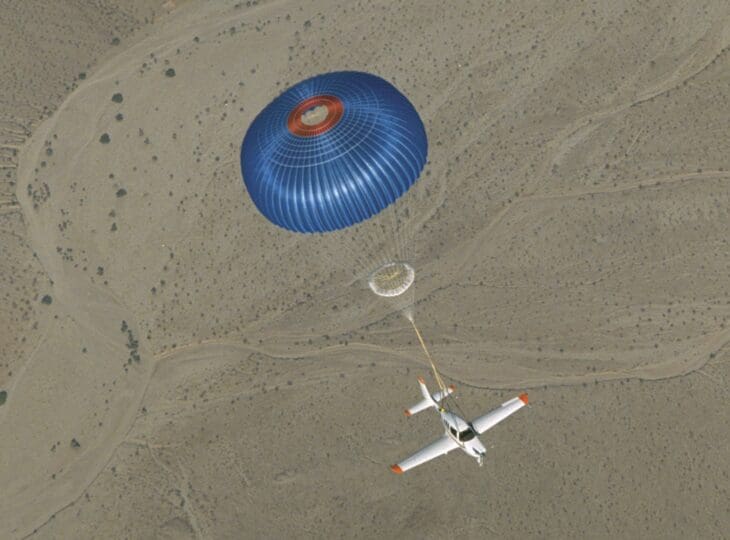
The pilot pulls an overhead handle, a cable fires a small solid-fuel rocket, and the rocket pulls the packed parachute clear of the airplane into free air. The canopy inflates in stages, the airplane slows to a stop in forward flight within about 8 seconds, and it then sinks at under 1,700 feet per minute until it hits the ground.
That touchdown is not gentle. The SR22 pilot’s handbook compares it to dropping the airplane from about 13 feet (4 m), and it relies on crushable seats and landing gear to protect the people inside.
CAPS at a glance
Activation: overhead handle, both hands, pulled straight down. Extraction: a solid-fuel rocket in the aft fuselage. Descent: under 1,700 feet per minute, about 19 mph, drifting with the wind. Touchdown: like a drop from about 13 feet. Minimum altitude: none set, but Cirrus advises pulling at or above 2,000 feet above the ground when possible. Fitted to: every SR20, SR22 and SR22T, and the SF50 Vision Jet.
From Handle to Touchdown
The handbook checklist starts with two steps: remove the handle cover, then pull the handle straight down with both hands. The pull is deliberately firm. A 2004 NTSB safety letter put the force needed at about 35 pounds (16 kg), so the rocket cannot be fired by a bumped elbow.
That pull drags a cable to an igniter that fires the rocket. It burns for about 1.2 seconds and is past 100 mph (160 km/h) in the first tenth of a second, and COPA notes it is there to get the parachute out even in a spin or with the airplane inverted.
A rocket the size of a thermos
According to the NTSB’s 2004 description, the CAPS rocket weighs 1 pound 6 ounces, carries 1 pound of solid propellant and produces a peak thrust of about 300 pounds. AOPA puts the whole parachute system at just 75 pounds (34 kg).
The canopy does not snap open all at once. The Cirrus Owners and Pilots Association (COPA) describes a slow inflation rate and reefed risers, which let the airplane settle quickly into a stable attitude under the canopy.
The parachute is tied into the airframe by cables built into the structure, and when the canopy takes the load they tear free of it. A UK accident report on an SR22 that came down under its parachute in 2018 found the only significant airframe damage near the lower left engine mount and where those cables had pulled out of the structure.
Under canopy, the Cirrus SR22 comes down at less than 1,700 feet per minute, about 19 mph (31 km/h), drifting sideways at the speed of the surface wind. Cirrus tested the system in every flap setting and from a spin, and found that once the rocket got the parachute into free air, it pulled the airplane into its level descent attitude.

The descent is when the pilot works the post-deployment checklist: mixture to cutoff, fuel selector off, fuel pump off, master switches off after any radio calls, ignition off, emergency locator transmitter on. Then everyone tightens their belts, secures loose items and sits upright with their back against the seat.
That posture matters because the seat cushions have an aluminum honeycomb core built to crush on impact and protect the spine. The handbook’s biggest worry on touchdown is back injury, especially for anyone twisting sideways to open a door at the wrong moment.
Every certified Cirrus carries the system, from the SR20 to the turbocharged SR22T. The SF50 Vision Jet is the odd one out: its parachute deploys from the nose rather than the aft cabin.
Why There Is No Minimum Altitude, and Why 2,000 Feet Matters
The figure most often quoted as the minimum altitude for a Cirrus parachute is 400 feet, and even AOPA has called it the official minimum. The handbook says something subtler: “No minimum altitude for deployment has been set,” because the height lost depends on the airplane’s speed, attitude and conditions at the moment of the pull.
The 400-foot figure is a test result, not a floor. Cirrus demonstrated an altitude loss of less than 400 feet from level flight, and an earlier edition of the SR22 handbook gave 920 feet from the entry into a one-turn spin to a stable descent under canopy.
Even a successful low pull leaves almost no time. The later handbook warns that a deployment that low “leaves little or no time for the aircraft to stabilize under the canopy or for the cabin to be secured,” and advises pulling at or above 2,000 feet above the ground when circumstances allow.
Waiting longer does not buy more safety. The handbook notes that a pull above 2,000 feet is not necessarily safer than one at 2,000 feet, while distraction, worsening weather, damage or injury can stop a pilot from pulling at all if the decision is put off.
Cirrus turns this into a plan that pilots brief before every takeoff. Its CAPS training syllabus splits a climb-out engine failure into three altitude bands, each with one answer decided in advance.
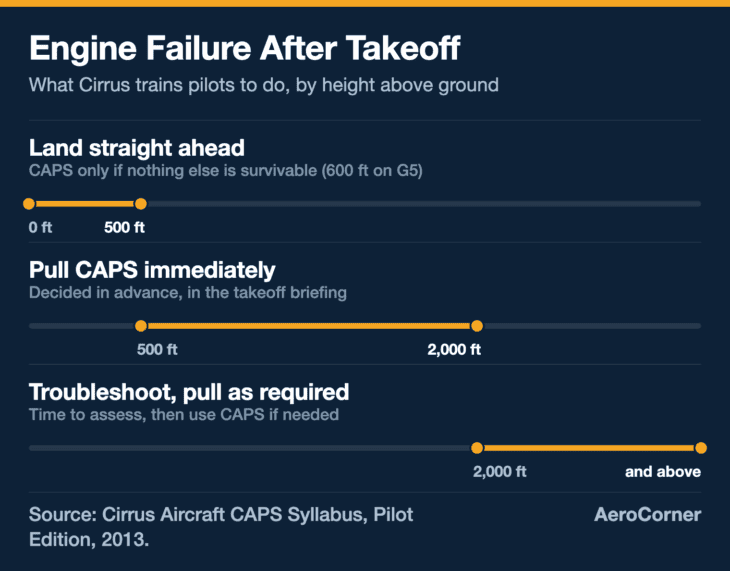
Below 500 feet (600 feet on the G5 generation), the pilot lands straight ahead unless no other survivable option exists. Between that height and 2,000 feet, the answer is to pull immediately. Above 2,000 feet there is time to troubleshoot, and the parachute is used as required.
The same syllabus has pilots call out “CAPS available” on the climb when they pass that lower boundary. For a spin there is no decision to make: the only approved and demonstrated spin recovery in a Cirrus is to pull the parachute.
The record shows why the height matters. COPA states that no one has died when CAPS was deployed more than 1,000 feet above the ground and below the airplane’s never-exceed speed, while its event history lists several fatal deployments marked “Too Low”, two of them at about 100 feet.
Why Early Cirrus Pilots Died Without Pulling It
The idea came from a crash that nearly happened. Cirrus co-founder Alan Klapmeier survived a 1985 midair collision, and that experience led him to start the parachute project.
The first emergency use came on October 3, 2002, near Lewisville, Texas, when a solo SR22 pilot lost aileron control after maintenance and came down unhurt. It looked like proof the concept worked, and in a sense it was.
The hardware was never the weak link. Cirrus told AOPA in 2016 that there had never been a fatality when a deployment was attempted within the normal envelope, yet the fatal accidents kept coming, peaking at 16 in 2011.
Rick Beach, the safety lead at COPA, estimated in 2016 that more than 125 people had died in situations where CAPS likely would have worked but no one tried to deploy it.
Even the handbook was hesitant at first. For a forced landing after an engine failure, an earlier edition said CAPS activation was “only warranted if a landing cannot be made that ensures little or no risk to the aircraft occupants”, and that over hostile terrain it “should be considered.”
The later edition reverses that default. CAPS is “recommended unless the pilot in command concludes there is a high likelihood that a safe landing can be accomplished”, and over rough terrain, water, fog or at night it is “strongly recommended.” The same section now says plainly that numerous Cirrus fatalities “likely could have been avoided” if pilots had pulled in time.
The training material names the human side too. Cirrus’s 2013 syllabus says pilots must be aware of the hazardous attitudes “that might interfere with the decision to pull CAPS”, and that the key is being mentally prepared on the ground, before the flight.
Pull Early, Pull Often
The fix was cultural as much as technical. Beach coined the line “pull early, pull often” to get pilots to commit to the handle before the airplane got too fast or too low for the parachute to do its job.
Cirrus built that into its type-specific training, which drills the decision in advance. Pilots add a CAPS plan to every takeoff briefing and make a “flaps and CAPS” callout as the flaps come up in the climb, and COPA runs its own recurrent courses, the COPA Pilot Proficiency Program.
The turning point came in 2014. That year, for the first time, Cirrus pilots pulled the parachute more often than they had fatal accidents, and fatal Cirrus accidents fell to three in a year when the fleet flew more than 1 million hours.
The pulls have kept coming. AOPA counted 65 saves in mid-2016, and the latest entry in COPA’s CAPS event history, an SR20 near Arden, North Carolina, on September 19, 2026, is save number 152, with 305 survivors in total.
The Myth vs the Reality
Myth: a parachute means a soft, safe landing at any height
The Cirrus handbook sets no minimum altitude, but it is blunt about the rest: a deployment is likely to damage or destroy the airframe, the touchdown is like a 13-foot drop, and a low pull may leave no time for the canopy to stabilize. The parachute widens the margin. It does not remove the need to pull early.
The other half of the myth runs the opposite way: that a parachute pull is a failure, or a waste of an airplane. Cirrus’s own handbook notes that CAPS has been pulled at more than 180 knots on several occasions with good outcomes, well above the 140-knot demonstrated speed in the later handbook.
The lesson Cirrus and COPA drew is that the speed and altitude limits are targets for a planned pull, not reasons to wait. The handbook’s line is simple: once the parachute is the only option left, “deploy the system without delay.”
Why airliners carry nothing similar is a different question, covered in our guide to whether airplanes have parachutes.
Every time a Cirrus goes down, the same question follows: did the pilot pull the handle? After the SR22 crash near Lee C. Fine Memorial Airport at Lake of the Ozarks on November 3, 2026, that is not yet known, and it is for the NTSB to establish.
What is known is how the system is meant to be used. The parachute is the easy part; the rocket fires and the canopy opens almost every time. The decision is the hard part, which is why Cirrus pilots now make it on the ground, before the wheels ever leave the runway.
Sources and references used for research and fact-checking.
- Cirrus Design, via NTSB docket, Cirrus SR22 Pilot's Operating Handbook, Section 10: Safety Information and Section 3: CAPS Deployment (P/N 13772-006, Reissue A, excerpts)
- Cirrus Design, via NTSB docket, Cirrus SR22 Pilot's Operating Handbook, Section 10: CAPS Deployment (P/N 13772-001, earlier edition, excerpts)
- Cirrus Aircraft, CAPS Syllabus, Pilot Edition (March 2013)
- National Transportation Safety Board, Safety Recommendation A-04-36 through -41 (April 29, 2004)
- Cirrus Owners and Pilots Association, CAPS Event History
- Cirrus Owners and Pilots Association, Cirrus Airframe Parachute System (CAPS)
- Cirrus Owners and Pilots Association, About CAPS
- AOPA, How Cirrus radically reduced fatal accidents
- AOPA, How It Works: Airframe parachute
- AOPA, What am I? CAPS
- UK Air Accidents Investigation Branch, AAIB Bulletin 3/2019: Cirrus SR22, G-SRTT
- Wikipedia, Cirrus Airframe Parachute System
Get the Newsletter
The latest aviation news and stories sent to your inbox.
About the Author

Tim is the owner and lead editor of AeroCorner since 2019, overseeing aviation content covering aircraft, airlines, airports, and the broader aviation industry. Through years of researching, writing, editing, and publishing aviation-focused content, he has developed extensive practical knowledge of commercial aviation and air travel. Based in Asia and a frequent traveler himself, Tim also brings firsthand passenger experience to AeroCorner’s coverage. Outside of publishing, he has also explored aviation firsthand through hands-on flight training in New Zealand.