

Table of Contents
For decades, learning to fly meant learning to read a panel full of round dials. Each instrument did exactly one thing: the airspeed indicator showed airspeed, the altimeter showed altitude, the attitude indicator showed attitude. The pilot built a complete picture of the flight by scanning all six, over and over, combining the individual readings into a mental model that was continuously updated. It worked. It still works. Tens of thousands of pilots fly with analogue instruments every day.
Then, starting in the 1980s in commercial aviation and accelerating dramatically into general aviation in the mid-2000s, the individual round dials began to disappear. In their place came screens — large, bright, high-resolution displays showing all of the same information, but integrated, cross-referenced, and surrounded by navigation maps, weather overlays, and traffic displays that no round dial could ever provide. The information a pilot needed had not changed. The way of presenting it had changed completely.
This article explains what a glass cockpit is, how each screen works, how the concept scales from a training aircraft to an airliner, and what the real differences are between flying behind screens and flying behind dials.
What is a glass cockpit?
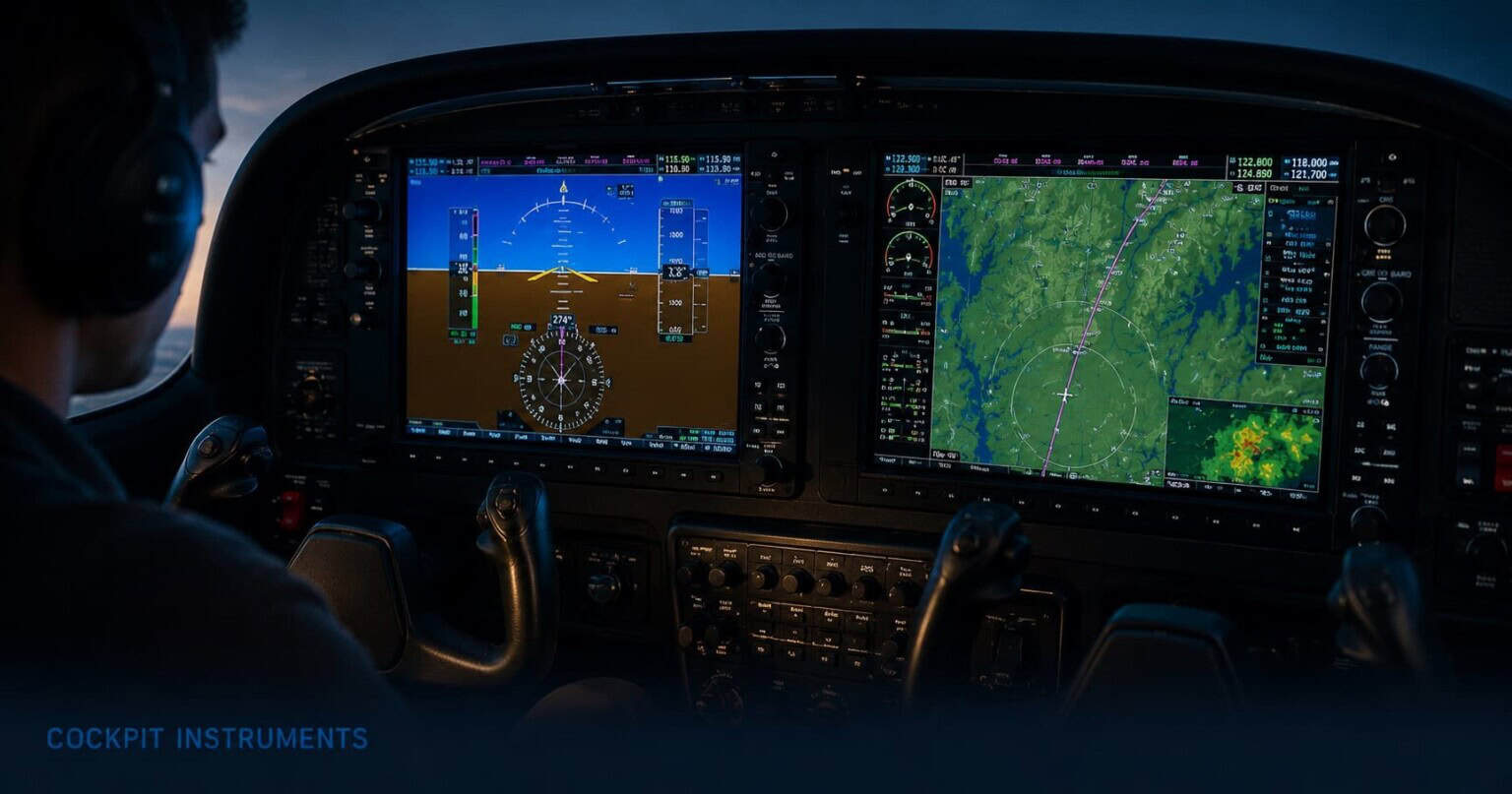
A glass cockpit replaces most or all of the individual analogue gauges in an aircraft with a small number of large electronic displays. In a typical light aircraft glass cockpit, two screens sit side by side in the centre of the panel: a Primary Flight Display on the left and a Multi-Function Display on the right. The Primary Flight Display shows the pilot all the information previously spread across six separate round instruments. The Multi-Function Display adds navigation, weather, traffic, terrain, and engine data in a single, configurable screen. Two displays replace what used to require a panel crowded with individual gauges and their associated wiring, vacuum lines, and pitot-static connections.
The dominant glass cockpit system in light aviation is the Garmin G1000, first shipped in a Diamond DA40 in June 2004. By the following year, Cessna was fitting it as standard equipment in new 172s, and five manufacturers had committed to adopting it across their piston aircraft lines. Within a decade, a glass cockpit had shifted from a high-end option to the expected standard for any new general aviation aircraft. A student learning to fly today is far more likely to train on a G1000 or its successor, the G1000 NXi, than on the six-pack of round gauges that defined cockpits for the previous seventy years.
The Primary Flight Display
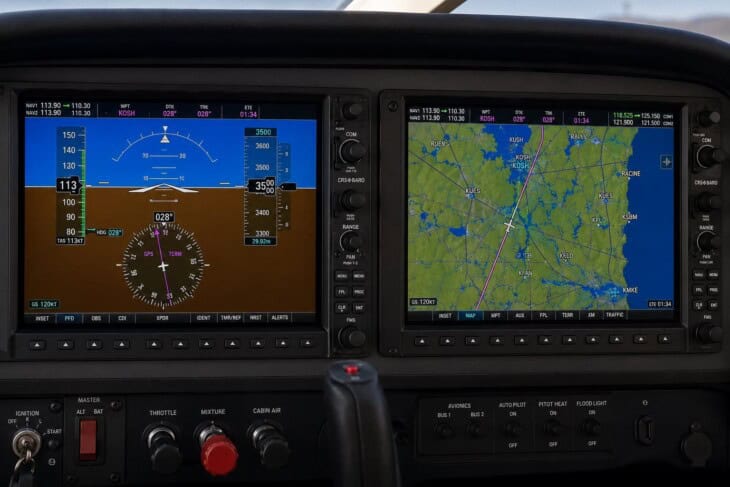
The Primary Flight Display is where the six-pack lives in a glass cockpit. Every instrument from the basic T arrangement is present on the PFD — not as a separate dial, but as a region of the screen, each in the same relative position that decades of cockpit design established for analogue instruments.
The attitude indicator occupies the centre of the screen and is now large — far larger than the three-inch round dial it replaced. The same blue-sky, brown-earth, white-horizon-line display fills the middle of the PFD, with the miniature aircraft symbol fixed at the centre and bank angle markings across the top arc. It is immediately familiar to any pilot who has flown analogue instruments. To the left of the attitude display, a vertical tape scrolls up and down to show airspeed — the airspeed indicator reimagined as a number in the centre of a moving scale, with the same white, green, and yellow colour zones from the analogue dial preserved as coloured bands on the tape. To the right, a second vertical tape does the same for altitude, with the current altitude shown in a large rolling counter at the centre of the tape. Below the attitude display, a compass rose and heading tape replace the heading indicator, showing current heading, selected course, and course deviation in a single integrated display. A small vertical scale on the right side of the altitude tape shows vertical speed. The slip/skid indicator — the ball — appears as a small bar beneath the miniature aircraft symbol.
The six-pack on the PFD: where to find each instrument
Airspeed indicator: vertical tape, left side. Attitude indicator: large artificial horizon, centre. Altimeter: vertical tape, right side. Vertical speed indicator: small scale alongside the altitude tape. Heading indicator / HSI: compass rose and tape, bottom. Turn coordinator ball: slip/skid bar beneath the miniature aircraft symbol.
The PFD also shows information that had no equivalent on the old panel. Flight director bars — magenta guidance cues — appear over the attitude display, showing the pilot the exact pitch and bank attitude required to follow a programmed route or approach. Autopilot status annunciations confirm which modes are active. Radio altitude (the actual height above the terrain directly below, measured by radar) appears in large numbers during the approach. Warning and caution messages appear in colour-coded text. The PFD is not just the six-pack; it is the six-pack plus a layer of contextual intelligence that was impossible to deliver through individual analogue gauges.
The Multi-Function Display
The Multi-Function Display is the screen that most clearly shows what a glass cockpit can do that a row of round dials never could. Its default view is a moving map: a top-down navigation chart that scrolls in real time as the aircraft moves, showing the aircraft’s position, its programmed route, nearby airports, airways, and airspace boundaries. A pilot looking at the MFD moving map can see at a glance exactly where they are, where they are going, how far it is, and what airspace they are about to enter — information that previously required a folded paper chart on the knee and a great deal of mental arithmetic.
Layered over the moving map are data overlays that add layers of situational awareness not previously available to light aircraft pilots at any price. Datalink weather shows the positions of precipitation cells updated every few minutes, allowing the pilot to navigate around storm systems with the same kind of weather awareness previously reserved for airliners. Traffic display shows other aircraft in the vicinity — those equipped with ADS-B transponders appear as symbols on the map with altitude and direction information, giving the pilot a picture of the traffic environment without needing to spot aircraft visually. Terrain awareness shading colours the map to show where ground rises above the aircraft’s altitude, providing an electronic safety net against controlled flight into terrain. The MFD can also switch to the engine indication page, showing all engine parameters digitally in a column on the right side of the screen. One display surface carries more navigational and situational awareness capability than an entire generation of cockpit designers could have imagined.
Glass cockpits across different aircraft
In light general aviation aircraft, the G1000 and its successor the G1000 NXi are now standard in most new Cessna, Piper, Diamond, and Beechcraft piston aircraft. The current G1000 NXi adds higher-resolution displays, faster processing, and more capable weather and traffic integration than the original, but the fundamental two-screen PFD-plus-MFD architecture remains identical. A pilot trained on the original G1000 in 2006 can sit in a new NXi-equipped aircraft and find everything in the same place.
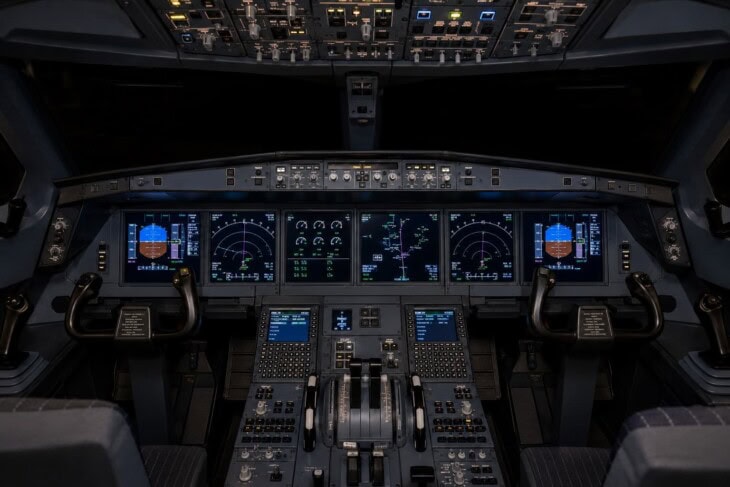
Business jets operate glass cockpits that follow the same PFD-and-MFD concept but at significantly greater scale and sophistication. The Garmin G5000, fitted in aircraft including the Cessna Citation Latitude and the Bombardier Learjet 70 and 75, uses three large touchscreen displays and integrates far more systems data than the G1000. The Collins Aerospace Pro Line Fusion, fitted in aircraft including the Bombardier Global 5000 and 6000 and the Embraer Legacy 450 and 500, offers four or five large displays with touchscreen interfaces, synthetic vision that renders a three-dimensional terrain image in all conditions, and enhanced vision that fuses infrared camera imagery with the synthetic display. The Honeywell Primus Epic underlies the Gulfstream PlaneView system and the Dassault EASy cockpit, each manufacturer customising it into a distinctive flight deck experience. In all cases the principle is the same: integrated screens, cross-checked data, and a level of situational awareness that individual dials could not provide.
In commercial aviation, the glass cockpit story began earlier. The Boeing 767, which entered service with United Airlines on 8 September 1982, was the first Boeing airliner to replace steam gauges with CRT-based electronic displays — six Rockwell Collins screens presenting EFIS flight information and EICAS engine data. The Airbus A320, which entered service in 1988, followed the same path with its own ECAM system. These aircraft eliminated the flight engineer’s position by centralising engine and systems monitoring into displays the two pilots could manage directly. Today, the Boeing 787 Dreamliner’s flight deck has five 15-inch LCD displays. The Airbus A350 has six. Both represent the logical end point of a process that began with those first CRTs in 1982: reduce the panel to the fewest, largest, most integrated screens possible.
The systems that monitor engines and aircraft health on commercial aircraft are worth understanding by name, because they appear in aviation news and incident reports. On Boeing aircraft, the Engine Indicating and Crew Alerting System — EICAS — monitors engine performance, hydraulic systems, fuel quantity, electrical systems, and pressurisation, presenting alerts to the crew in a prioritised format with associated procedures. On Airbus aircraft, the equivalent is the Electronic Centralised Aircraft Monitor — ECAM — which not only alerts crews to failures but displays the relevant checklist steps directly on the system display. Both go far beyond anything the round-dial engine instruments of an earlier generation could achieve.
What changed, and what did not
The advantages of glass over steam are real and significant. The most important is integration: the instruments on a PFD cross-check each other automatically in ways that analogue gauges cannot. The AHRS corrects attitude and heading data against GPS track and magnetometer input continuously, eliminating the vacuum pump failure mode and the gyroscopic precession drift that required manual correction every fifteen minutes. Map and weather data, previously carried on paper or simply unavailable, appear on the MFD without any additional equipment. Traffic appears on screen. Terrain warnings fire automatically. A glass cockpit pilot has more information, better organised, with fewer single-point failures than a steam gauge pilot.
What has not changed is what matters most in the air. The fundamental information — airspeed, altitude, attitude, heading, vertical speed — is identical. The instrument scan, the discipline of continuously updating a mental model of the flight from the instruments, is still necessary; the displays just arrange the information more efficiently. Spatial disorientation remains exactly as dangerous as it was with round dials: the attitude indicator is still a representation of the aircraft’s orientation relative to the horizon, and a pilot who ignores it and trusts their body will still find themselves in a spiral. The causes of most accidents — poor decision-making, loss of situational awareness, spatial disorientation, fuel mismanagement — are unchanged by the type of instruments on the panel.
When glass goes dark: the total failure tradeoff
Steam gauges fail individually and incrementally — one instrument stops working while the others continue. Glass cockpits can fail totally: if the PFD goes dark, the pilot loses all flight instrument information from that screen at once, replaced by a blank display or a red X. Most glass cockpit aircraft carry a small integrated standby instrument — a compact display showing attitude, airspeed, and altitude on an independent battery — as the backup. The transition from a richly integrated PFD to this minimal backup is abrupt and requires immediate recognition. Modern instrument training programmes include specific practice for glass cockpit partial-panel scenarios for exactly this reason: the failure mode is different, and the response must be practised.
There is also a genuine debate about training sequence. Many flight instructors prefer student pilots to learn on analogue instruments first, arguing that round dials force a deeper understanding of each instrument’s behaviour and failure modes before the integrated glass cockpit abstracts those details away. A student who has spent fifty hours scanning individual gauges and learning why the heading indicator drifts has a different mental model of what the cockpit is telling them than one who has only ever seen a compass rose on a PFD. Both can fly safely. The question is which understanding is more robust when something unexpected happens.
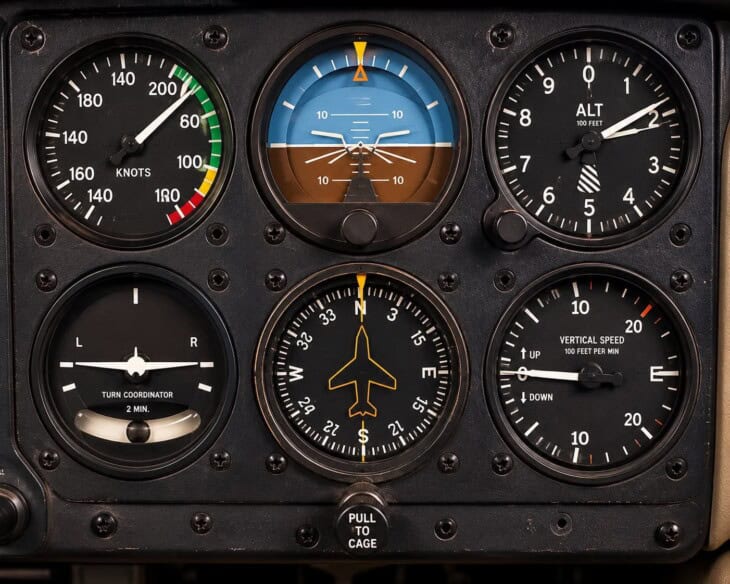
The glass cockpit is the present and future of flight instrumentation, and understanding it begins with understanding the instruments it replaced. Each element of the PFD — the airspeed tape, the artificial horizon, the altitude tape, the heading compass rose — has a direct lineage back to the individual round gauges of the six-pack. Readers who want to understand those instruments in depth will find them covered in the individual articles in this series, linked from the six-pack hub. For the full overview of how all cockpit instruments — analogue flight instruments, engine gauges, and glass cockpit displays — fit into a complete picture, see Airplane Cockpit Instruments Explained.
FAQ
Get the Newsletter
The latest aviation news and stories sent to your inbox.
About the Author

Tim is the owner and lead editor of AeroCorner since 2019, overseeing aviation content covering aircraft, airlines, airports, and the broader aviation industry. Through years of researching, writing, editing, and publishing aviation-focused content, he has developed extensive practical knowledge of commercial aviation and air travel. Based in Asia and a frequent traveler himself, Tim also brings firsthand passenger experience to AeroCorner’s coverage. Outside of publishing, he has also explored aviation firsthand through hands-on flight training in New Zealand.