

Table of Contents
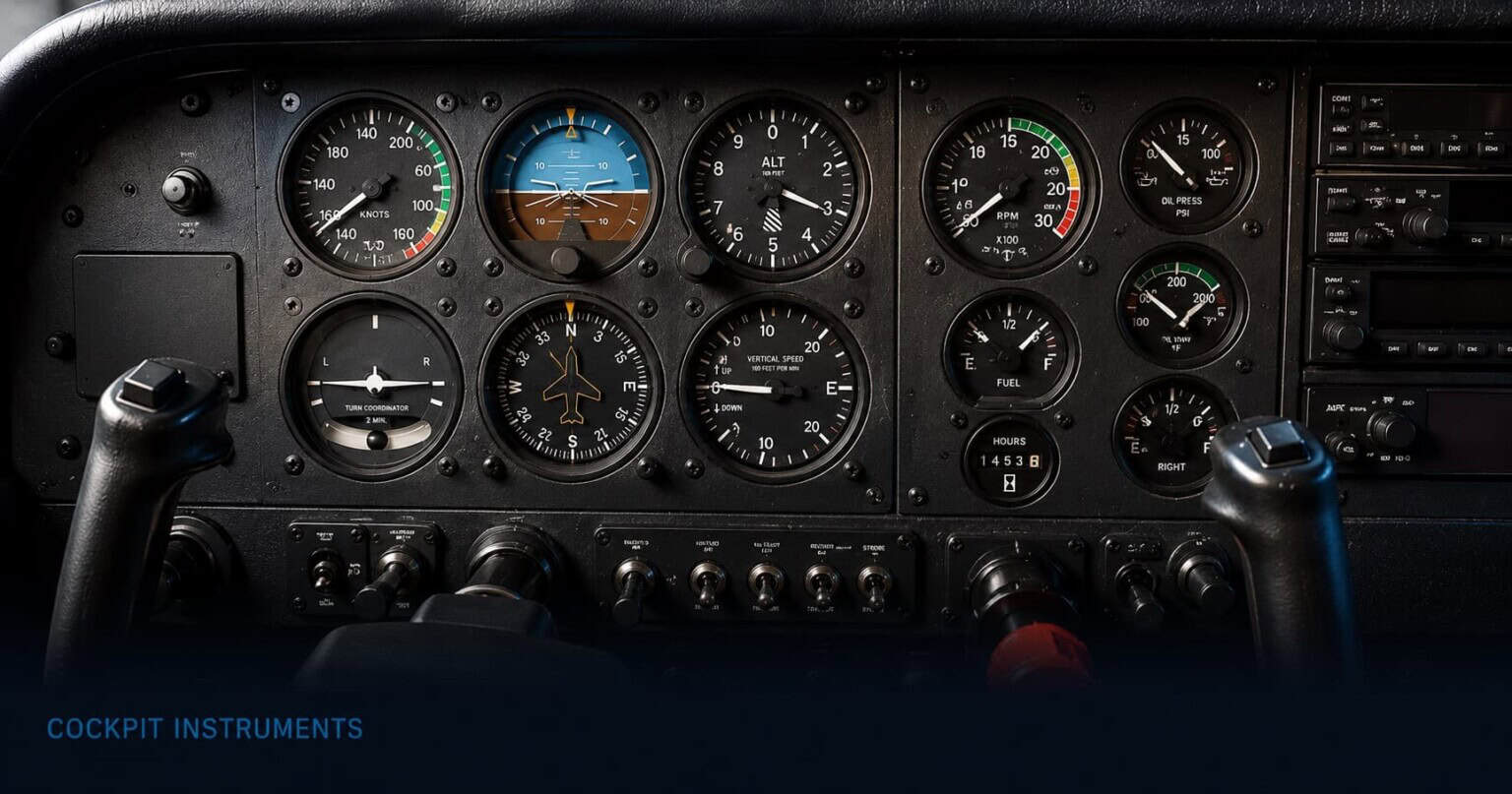
Sit down in the left seat of a small training aircraft and the first thing that hits you is the panel. Dozens of round dials, needle-and-scale gauges, digital readouts, switches, and knobs fill the space in front of you. From the outside, it looks like controlled chaos. From the pilot’s seat, it is something else entirely: a continuous flow of information about exactly what the aircraft is doing, where it is, and whether the engine is happy. Every single instrument has a job. Pilots learn to read them all at once, in a pattern, without thinking about it.
The instruments fall into three groups. The first group, known as the flight instruments, tells the pilot about the aircraft’s behaviour in the air: its speed, altitude, direction, attitude, and the rate at which it is climbing or descending. The second group, the engine instruments, monitors what is happening inside the powerplant: oil pressure, engine speed, temperature, and fuel. The third group is the avionics and navigation equipment, which tells the pilot where the aircraft is and where it is going. This article focuses on the first two groups, which together form the foundation of what every pilot learns to read.
There is also a divide between old and new. Older and smaller aircraft use individual analogue gauges for each instrument, a collection of round dials that has been largely unchanged since the 1940s. Modern aircraft, from new training planes to business jets to large airliners, replace most of those dials with large digital screens. The instruments are the same. The presentation is radically different. This guide explains both, starting with the analogue gauges that every pilot still learns first.
Analogue gauges and glass cockpits: the same information, two different eras
For most of aviation’s history, every instrument had its own dedicated gauge: one round dial for airspeed, another for altitude, another for engine RPM. These analogue gauges use mechanical systems to move a needle across a printed scale. Pilots learn to scan from one gauge to the next, building a mental picture of the aircraft’s state. Because each instrument is independent, a single gauge can fail without affecting the others.
Modern aircraft replace most of those individual gauges with a small number of large digital screens. Instead of moving your eyes across six separate dials to get six pieces of information, you read one integrated display that shows all of them at once, arranged intelligently around a central picture of the aircraft’s attitude. This is called a glass cockpit, and it became standard equipment in new general aviation aircraft from around 2004, when Garmin introduced the G1000 integrated flight deck. Before that, glass cockpits were found only in airliners and military aircraft.
The key point, and the one worth holding onto throughout this guide, is that a glass cockpit does not introduce new instruments. It is a new way of displaying the same information that the old round gauges provided. Understanding the analogue instruments first makes everything else easier to follow, which is why every pilot still learns on the classic panel before moving to glass.
The flight instruments: the six-pack
The core set of flight instruments is known among pilots as the six-pack, a nickname for the six gauges that sit together in a standardised arrangement at the centre of the instrument panel. The layout was first defined by the British Royal Air Force in 1937 and adopted as standard across all RAF aircraft from 1938. The arrangement has remained essentially unchanged ever since, for one very practical reason: a pilot trained on one aircraft can sit in any other and immediately find the instruments in exactly the same place.
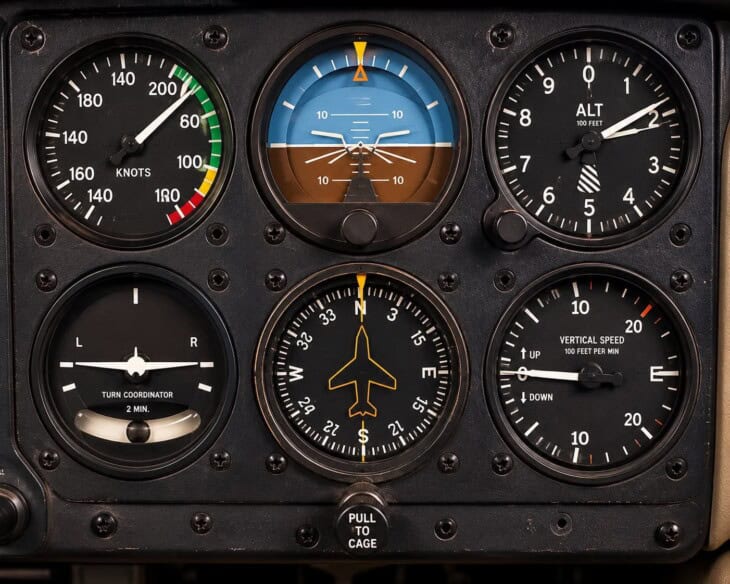
The six instruments are arranged in what pilots call the basic T. The attitude indicator sits at the centre top, with the airspeed indicator to its left and the altimeter to its right. Below the attitude indicator is the heading indicator. The vertical speed indicator and the turn coordinator fill the remaining two positions. Together, these six gauges give the pilot everything needed to fly the aircraft safely: how fast, how high, which direction, whether level, whether climbing or descending, and whether a turn is coordinated.
The six instruments in the six-pack
Airspeed indicator, attitude indicator, altimeter, vertical speed indicator, heading indicator, and turn coordinator. Each one is explained in detail in the dedicated articles linked from the six-pack overview.
The six-pack articles in this series cover each instrument individually, explaining what it shows and how a pilot reads it at each stage of a flight. The six-pack overview is the best place to start if you want to understand how the instruments work together as a group before going deeper on any single one.
The engine instruments
Separate from the flight instruments is a cluster of gauges devoted entirely to the engine. Where the flight instruments tell the pilot about the aircraft’s movement through the air, the engine instruments tell the pilot whether the powerplant is operating within safe limits. In a small piston-engine aircraft, the typical set includes a tachometer showing engine RPM, oil pressure and oil temperature gauges, fuel quantity gauges, and often exhaust gas temperature and cylinder head temperature readouts on more complex aircraft.
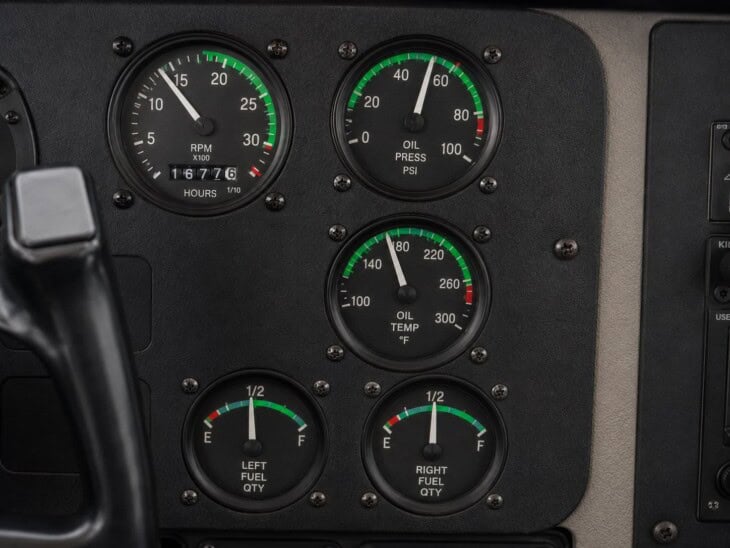
Pilots scan the engine instruments regularly throughout a flight, but they are especially important during run-up checks before takeoff and during the initial climb, when the engine is working hardest. An abnormal reading on any one of them, particularly oil pressure, demands immediate attention. The engine instruments article in this series covers each gauge, what normal looks like, and what a pilot does when a reading moves into the red.
Read the full guide: Engine Instruments Explained: What Pilots Monitor to Keep the Engine Running
The glass cockpit: the same instruments on a screen
A glass cockpit replaces the collection of individual round gauges with a small number of large screens. In a typical general aviation glass cockpit, there are two: the Primary Flight Display, or PFD, and the Multi-Function Display, or MFD. The PFD handles the flight instruments, showing airspeed, altitude, attitude, heading, and vertical speed all on one integrated screen. The MFD shows navigation data, including a moving map, traffic, weather, and terrain. In some smaller glass cockpit aircraft, both displays are combined into a single wide screen.
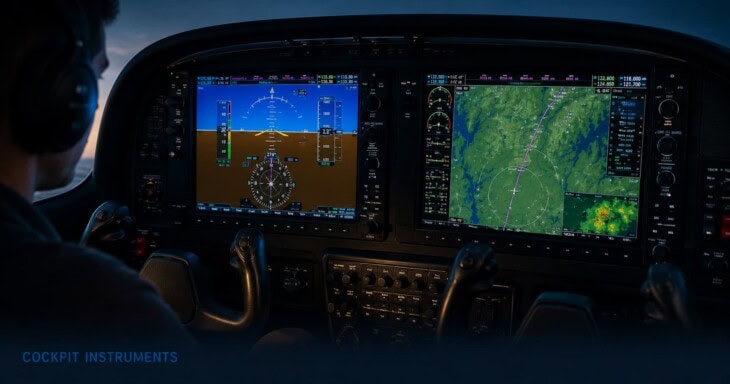
The Garmin G1000, which became standard in most new Cessna and Piper training aircraft from the mid-2000s onwards, is the best-known example for general aviation. Tens of thousands of G1000-equipped aircraft are now flying, and it is the system most student pilots and simulator pilots encounter first. Business jets use similar concepts with more advanced systems from Garmin, Honeywell, and Collins, featuring more screens, more data, and in newer aircraft, touch interfaces. Airliners have had glass cockpits since the 1980s, when the Boeing 767 and Airbus A310 introduced Electronic Flight Instrument Systems that replaced steam gauges with cathode-ray tube screens. Today, every commercial airliner uses a glass cockpit.
One important difference between glass and analogue is how failures behave. An analogue panel can lose one gauge while the others keep working. A glass cockpit screen, when it fails, goes completely dark, taking all of its information with it at once. For this reason, aircraft with glass cockpits always keep a small set of backup analogue instruments, and pilots train specifically for the scenario of losing a primary screen.
Read the full guide: Glass Cockpit Explained: How Modern Aircraft Replaced Dials with Screens
Where to go next
The articles in this series are designed to be read in any order, but the logical path starts with the six-pack. The six-pack overview explains how the six flight instruments work together, and from there each instrument has its own dedicated article covering exactly how a pilot reads and uses it in flight. The engine instruments article and the glass cockpit article stand on their own and can be read whenever you are ready. By the end of the series, the instrument panel that looked like controlled chaos on first glance will make complete, logical sense.
FAQ
Get the Newsletter
The latest aviation news and stories sent to your inbox.
About the Author

Tim is the owner and lead editor of AeroCorner since 2019, overseeing aviation content covering aircraft, airlines, airports, and the broader aviation industry. Through years of researching, writing, editing, and publishing aviation-focused content, he has developed extensive practical knowledge of commercial aviation and air travel. Based in Asia and a frequent traveler himself, Tim also brings firsthand passenger experience to AeroCorner’s coverage. Outside of publishing, he has also explored aviation firsthand through hands-on flight training in New Zealand.