

Table of Contents
Imagine flying at four thousand feet through a solid layer of cloud. There is nothing outside the windows but grey: no ground, no sky, no horizon line to anchor your sense of up and down. Within about twenty seconds of losing your visual reference, your inner ear begins to lie. A gradual bank feels exactly like straight and level flight. Your body is completely confident that the aircraft is fine. The attitude indicator is the only instrument standing between that false confidence and disaster.
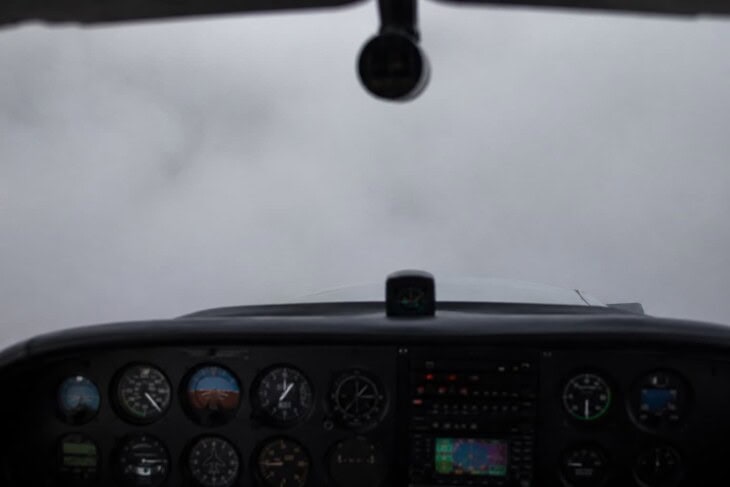
The attitude indicator sits at the dead centre of the six-pack, and that position is not an accident. It is the master reference. When a pilot in cloud wants to know whether the aircraft is climbing, banking, or pitching, the attitude indicator is the instrument they look at first. Every other instrument in the scan is checked against it and then the eyes return to it. In conditions where the pilot cannot see outside, the attitude indicator is the closest thing in the cockpit to looking at the real horizon.
This article explains what the attitude indicator shows, how a pilot reads it through every phase of flight, and why spatial disorientation — the phenomenon where the human body becomes an unreliable sensor — makes this the most safety-critical instrument in the six-pack.
What the attitude indicator shows
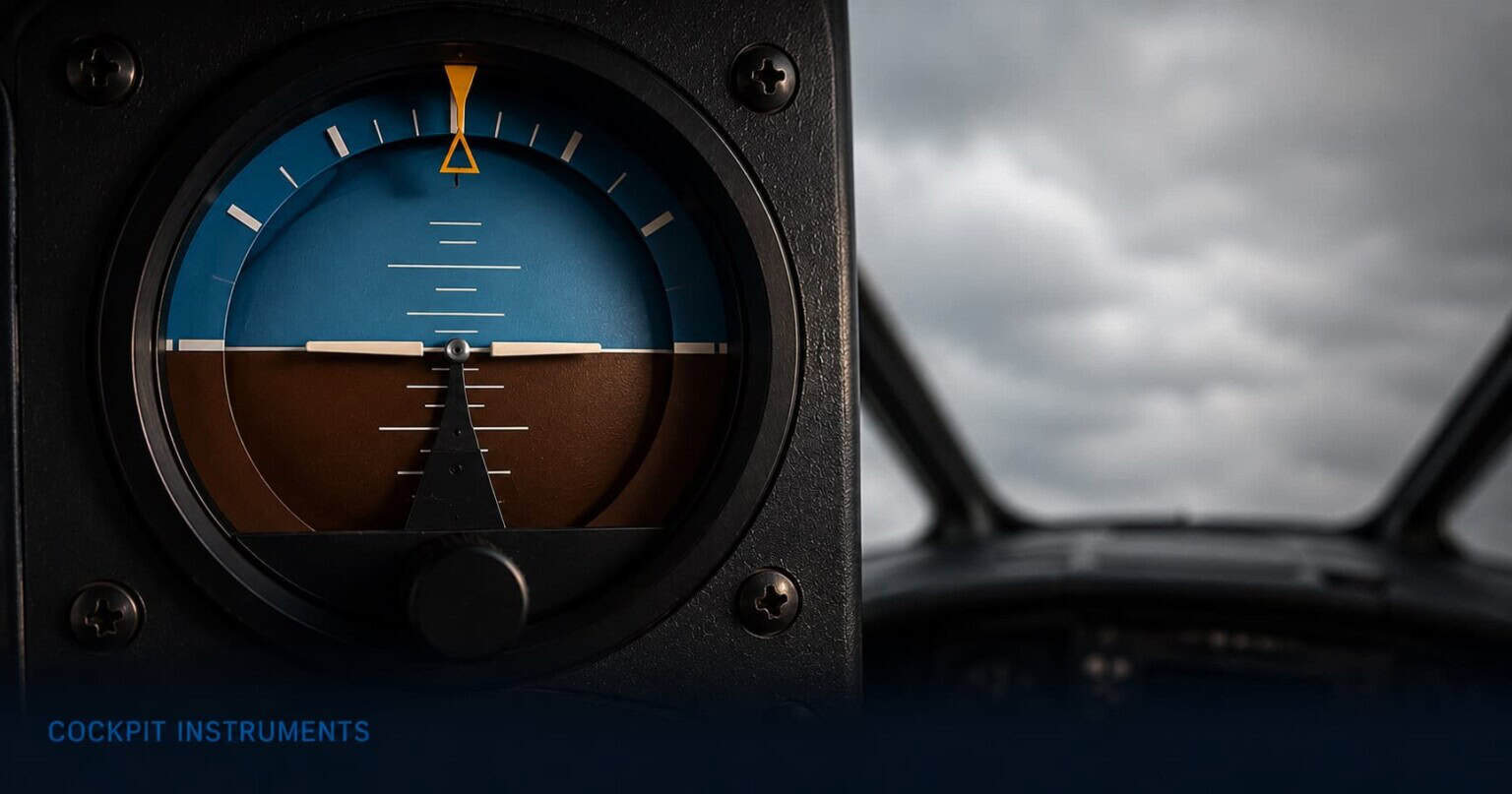
The face of the attitude indicator is split horizontally into two halves. The upper half represents sky and is coloured blue. The lower half represents earth and is coloured brown or tan. A white horizontal line running across the centre is the artificial horizon. Overlaid on this is a small fixed symbol called the miniature aircraft — a simple silhouette of a plane as seen from the pilot’s seat, with stubby wings extending left and right.
When the real aircraft is in straight and level flight, the wings of the miniature aircraft sit exactly on the white horizon line, blue sky above and brown earth below. When the pilot banks left, the miniature aircraft tilts left. When the nose pitches up, the miniature aircraft rises above the horizon line. The display mirrors the orientation of the real aircraft in real time, giving the pilot an immediate picture of their attitude — the position of the aircraft relative to the horizon.
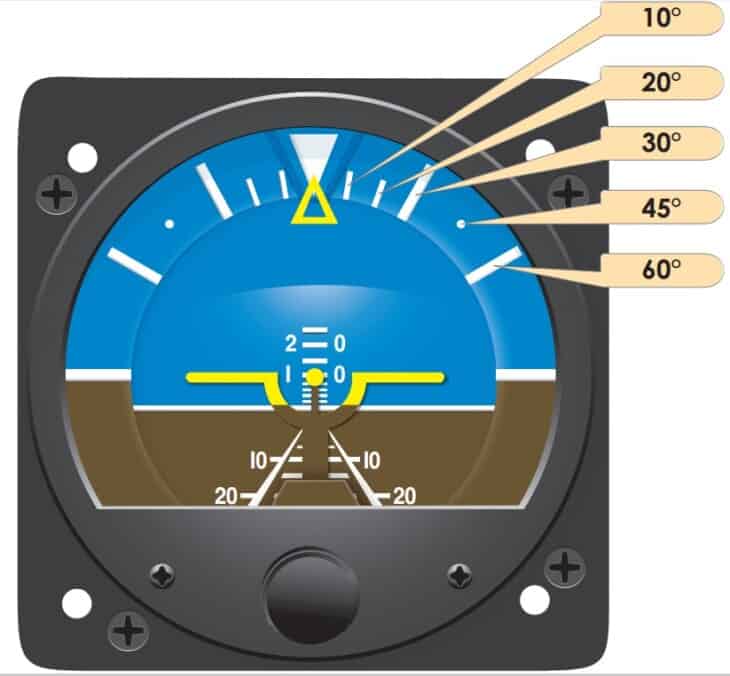
Around the top edge of the dial runs a bank angle scale with markings at 10, 20, 30, 60, and 90 degrees. A small triangular pointer at the top of the display tracks against this scale as the aircraft banks, showing exactly how many degrees of bank are applied. In normal cruise flight, the pointer sits at the top centre. In a standard rate turn — the turn rate used for precise instrument flying — the bank angle is typically around 15 to 20 degrees depending on airspeed.
Reading the attitude indicator at a glance
Miniature aircraft on the horizon line: level flight. Wings above the line: nose-up pitch. Wings below the line: nose-down pitch. Miniature aircraft tilted left or right: aircraft is banked. Degree markings on the top arc: exact bank angle in degrees.
How pilots read the attitude indicator in flight
Before every flight, the pilot checks the attitude indicator during the pre-flight cockpit check. With the aircraft stationary on the ground, the miniature aircraft should sit level on the horizon bar. On vacuum-driven instruments, the gyro takes around five minutes to fully erect after engine start. A pilot who taxis out immediately after starting may find the display still settling, and flying with an attitude indicator that has not fully erected means the reference is not yet reliable.
Once airborne, the attitude indicator becomes the centre of the instrument scan. The technique pilots learn for flying in cloud is a continuous, disciplined sweep of the eyes across the six-pack, always returning to the attitude indicator as the anchor point. It gets the most attention not because it holds the most detailed information, but because it is the fastest instrument to interpret. A single glance tells the pilot whether the aircraft is level, banked, climbing, or descending. The other instruments then fill in the numbers.
During the climb after takeoff, the pilot pitches the nose up to a specific angle above the horizon line on the attitude indicator and holds it there. A typical climb attitude in a light training aircraft is around 10 degrees nose-up. Rather than watching the airspeed indicator and waiting for the number to settle, an experienced pilot sets the pitch attitude on the AI and trusts that the correct climb speed will follow. Attitude first, then verify the result on the other instruments.
In cruise, the wings of the miniature aircraft should sit level on the horizon bar with a slight nose-high attitude of perhaps 2 to 4 degrees, depending on the aircraft and its loading. In turns, the pilot references the degree markings on the bank angle arc to enter and hold a specific bank angle. A standard rate turn requires a precise bank angle, and the attitude indicator is how the pilot sets and maintains it. On approach and landing, the pitch attitude shown on the AI helps the pilot hold the correct descent profile: a stable instrument approach typically calls for around 3 to 5 degrees nose-low, held consistently all the way to the threshold.
What pilots watch out for
The most serious hazard associated with the attitude indicator is not a failure of the instrument itself — it is a conflict between what the instrument shows and what the pilot’s body believes. The human vestibular system, which senses motion through fluid in the inner ear, is tuned for the low-acceleration environment of walking and running. In flight, particularly in smooth cloud where there is no turbulence to signal a gradual change in bank, it fails completely. A bank entered slowly enough that the semicircular canals do not register it feels indistinguishable from straight and level flight. The pilot is genuinely convinced the aircraft is not turning.
This conflict is called spatial disorientation, and it leads to one of the most dangerous scenarios in aviation: the graveyard spiral. The aircraft enters a gradual bank without the pilot noticing. The nose drops as lift decreases, and the pilot, feeling no bank, pulls back on the controls to stop the descent. Pulling back inside an undetected turn tightens the spiral rather than stopping it. The aircraft accelerates. Speed builds rapidly. The altimeter unwinds. By the time the instruments make clear what is happening, the pilot may have insufficient altitude to recover. The correct response — roll the wings level using the attitude indicator and only then pull back — is exactly what the body does not want to do, because levelling out from a prolonged bank creates the sensation of banking in the opposite direction.
When the body lies: the 1999 JFK Jr. accident
On 16 July 1999, John F. Kennedy Jr. was piloting a Piper Saratoga at night over open water toward Martha’s Vineyard, Massachusetts. Kennedy held a private pilot licence but was not instrument rated — he had no training in flying solely by reference to instruments. In haze and darkness over open ocean, with no visible horizon, he entered a descending spiral. The NTSB determined the probable cause was the pilot’s failure to maintain control as a result of spatial disorientation. The aircraft struck the Atlantic at high speed, killing Kennedy, his wife, and his sister-in-law. The accident is one of the most widely cited examples of what happens when a pilot without instrument training encounters conditions that demand it.
The other significant failure mode is loss of the vacuum pump. In many older general aviation aircraft, the attitude indicator is powered by suction from an engine-driven vacuum pump. If the pump fails in flight — and they fail without warning — the gyro gradually loses its rigidity. The display drifts or tumbles into an incorrect position. In clear conditions, the pilot can simply look outside and fly visually. In cloud, the pilot must immediately switch to electric standby instruments, declare an emergency, and prioritise getting out of the cloud and onto the ground. In 2016, the NTSB found that a Beechcraft Bonanza crashed near Syosset, New York, after the vacuum pump failed in IMC; the pilot lost control and the aircraft broke apart. The pump had been in service seventeen years beyond its mandatory replacement interval.
The attitude indicator in a glass cockpit
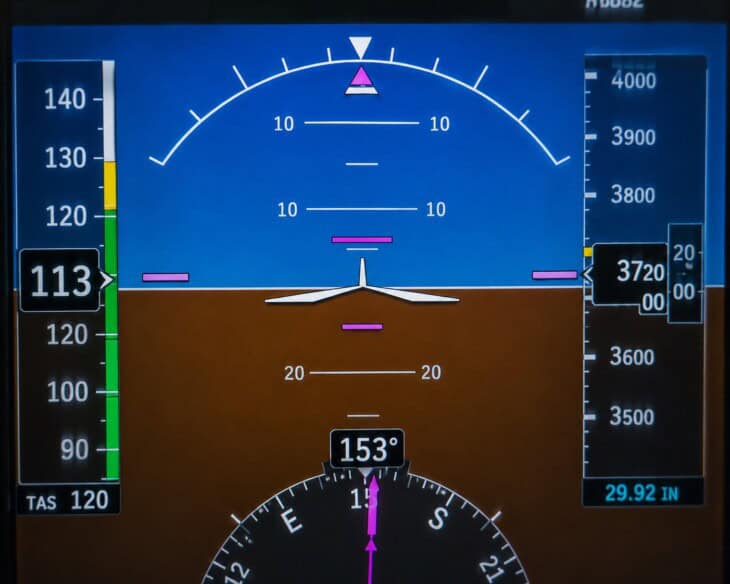
On a glass cockpit Primary Flight Display, the attitude indicator is no longer a small round gauge — it is the centrepiece of the entire screen. A large artificial horizon dominates the display: the same blue sky, brown earth, and white horizon line, now rendered digitally across most of the screen width. The miniature aircraft symbol sits fixed at the centre. Bank angle markings appear across the top arc. The result is a much larger, easier-to-read picture of the aircraft’s attitude than any analogue gauge can provide, visible in the pilot’s primary scan without requiring a focus shift to a small dial.
More importantly, glass cockpit aircraft replace the vacuum-driven gyroscope with an Attitude and Heading Reference System, or AHRS. This solid-state device uses microelectromechanical sensors to detect rotation and acceleration without any spinning parts. There is no vacuum pump to fail. AHRS is backed up by additional sensors including GPS and magnetometers, and its data is cross-checked continuously. The transition to solid-state attitude sensing is one of the most meaningful safety improvements that came with the glass cockpit era: the single most important instrument in the panel no longer depends on a mechanical pump that can stop without warning.
The attitude indicator is part of the six instruments that make up the six-pack. It sits at the centre of the basic T, flanked by the airspeed indicator on the left and the altimeter on the right. Below it sits the heading indicator, another gyroscopic instrument with its own unique failure mode. For the full picture of how all cockpit instruments fit together, see Airplane Cockpit Instruments Explained.
FAQ
Get the Newsletter
The latest aviation news and stories sent to your inbox.
About the Author

Tim is the owner and lead editor of AeroCorner since 2019, overseeing aviation content covering aircraft, airlines, airports, and the broader aviation industry. Through years of researching, writing, editing, and publishing aviation-focused content, he has developed extensive practical knowledge of commercial aviation and air travel. Based in Asia and a frequent traveler himself, Tim also brings firsthand passenger experience to AeroCorner’s coverage. Outside of publishing, he has also explored aviation firsthand through hands-on flight training in New Zealand.